Naga (नाग) – Guardian Serpent of Kerala Folklore | Lokkatha — LokKatha
नाग
Naga
Cautionserpent deityKerala16 Views
Among the most ancient and ambivalent of India's supernatural beings, the Nāga occupies a liminal sovereignty that resists simple classification. It is neither wholly chthonic nor entirely celestial, existing perpetually at thresholds — its consciousness rooted in the jeweled corridors of Pātāla even as its influence rises through the laterite-banked rivers of Malabar, the rain-struck temple tanks of Thrissur, and the sacred groves where the canopy closes so completely that noon arrives as a kind of dusk. The Periyar carries its presence downstream each monsoon. So does the Kabbani, dark with silt, pressing against the roots of the sacred ficus trees that no axe has touched in living memory.
Venerated across the breadth of Sanskrit tradition — from the Mahābhārata's Āstīka Parva, where serpent lineages such as Takṣaka and Vāsuki are granted dynastic stature, to Purāṇic cosmologies in which Śeṣa bears the weight of creation upon his thousand hoods — the Nāga emerges as a being both beautiful and terrible. Capable of appearing as a radiant human presence carrying the subtle scent of wet earth and crushed tulsi, it can with equal authority command the southwest monsoon, regulate the fertility of paddy fields from Palakkad to Kottayam, and deliver venomous retribution with a patience that exceeds human generations. Shape-shifting is not merely its capacity but its nature — the boundary between the serpent coiled beneath a termite mound and the composed stranger appearing at a household threshold has never been reliably fixed in the oral accounts collected across Travancore's village lineages.
In Kerala, where Nāga worship finds its most intricate ritual expression at the Mannarasala temple in Haripad — where the presiding deity is tended exclusively by a woman of the household lineage, her authority unbroken across centuries — and within the sarpakkāvu groves maintained inside ancestral compounds from Irinjalakuda to Thiruvananthapuram, the relationship between human family and serpentine guardian is understood as a binding covenant of mutual obligation. These groves are not symbolic gestures. They are living territories: their soil unturned, their trees unfelled, their anthills left undisturbed through generations of encroaching cultivation. When the covenant breaks — through the clearing of sacred vegetation, the construction of walls across consecrated ground, the neglect of the oil lamp that should burn through Karkidakam's rains — the Nāga's displeasure does not arrive as immediate violence. It settles instead as hereditary skin afflictions, reproductive failure, and a creeping ancestral grief that neither the physicians of Thiruvananthapuram's modern hospitals nor the vaidyas of the old Ayurvedic lineages can fully diagnose or cure. The prudent householder who encounters a shrine marked by pooled milk offerings and the hood-spread form of Śeṣa carved deep into monsoon-slicked laterite stone proceeds with unhurried reverence — for the Nāga's memory is geological in its depth, its grievances are inherited across bloodlines, and its forgiveness, when it comes at all, arrives only according to a rhythm entirely its own.
First Reference —Vedic period
Last Recorded —Present
Appearance
स्वरूप
Natural Form
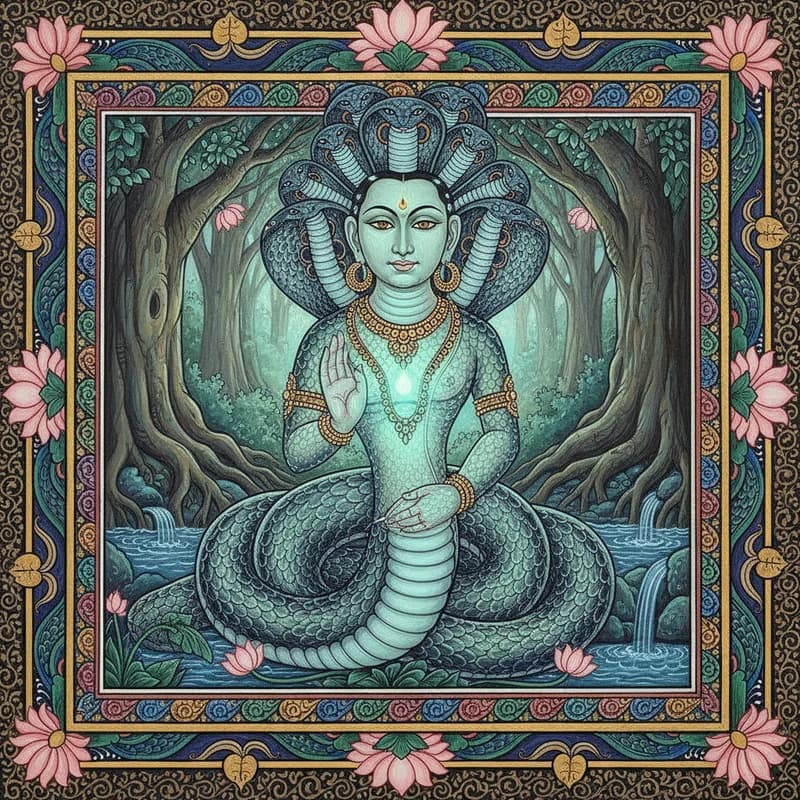
The Naga manifests as a being of sinuous duality — the upper body luminous and human in form, its skin carrying the cold iridescence of moonlit scales that shift between deep indigo and burnished gold as the light moves, transitioning seamlessly below the waist into the massive coiled body of a king cobra, its hood spread wide and etched with the ancient *sarpa* lineage markings that mirror the sacred kolam patterns drawn by Kerala's *pulluvan* priests in offering. The eyes hold the amber stillness of a serpent's gaze yet burn with the deep cognizance of a divine guardian — pupils vertical and absolute as the line between this world and the next — framed by a crown of living hoods that rise and sway in rhythms no earthly wind dictates, each one patterned like an opened palm bearing the *Om* of primordial sound.
From the body emanates a faint phosphorescent shimmer, the legendary *nāga-mani* — that serpent gem of ancient Puranic lore said to form over millennia within only the most venerable of their kind — pulsing with pale blue-green radiance that renders the roots of banyan and *pala* trees luminous and turns still water into mirrors of celestial fire. This cold light does not illuminate so much as *reveal*, casting across the moss-draped altars and whispering waterways of the *sarpa kāvu* groves a glow that makes the boundary between the terrestrial and the *pātāla* realms feel perilously, beautifully thin.
Alternate Forms
Nagas move between worlds with the fluid ease of water finding its level—most often coiling into the form of the great hooded cobra, its hood spread like a living crown, before dissolving that skin entirely to walk as mortals of impossible beauty, betrayed only by the cold iridescence beneath their flesh, the unblinking steadiness of eyes that have watched rivers change course, or the faint musk of rain-soaked earth that clings to them even in drought. In certain Purāṇic accounts and the living oral traditions of the Nāgavamśī communities of Chhattisgarh, this human form is further distinguished by an absence of shadow at noon and a refusal to cross thresholds of iron—small betrayals that the village-wise still watch for in strangers who arrive with the rains and depart before the water recedes.
In the liminal hours of dusk and monsoon, they are said to manifest at the *valmīka*—the sacred ant-hill mounds that serve as earthen doorways to the *nāgaloka* below—rising as coiling mist or an uncanny stillness upon the water's surface, that breathless pause before the first rains break, which village women in Kerala and coastal Odisha still recognize as the Naga's passing breath. Most treacherous and most testing is their wandering form as the dusty ochre-clad ascetic at the threshold, staff in hand and matted locks piled high to conceal the vestigial hood beneath, appearing at households near sacred groves to measure the righteousness of those within—for in the *Ādi Parva* and countless regional *sthala purāṇas* alike, it is precisely this disguise through which the Nagas dispense both curse and boon, their serpentine nature revealed only when dharma has been weighed and found wanting or worthy.
River confluences of Karnataka, nāga propitiation rites
Temple tanks of Tamil Nadu, fertility invocations
Coastal shrines of Goa, fishermen's protective offerings
Anthill sanctuaries of Andhra Pradesh, ancestral serpent veneration
Forest edges of Odisha, tribal nāga festivals
Paddy fields of Maharashtra, harvest blessing ceremonies
Sacred ponds of Assam, nāga water deity traditions
Historical Record
ऐतिहासिक अभिलेख
First Documented
Vedic period
Last Recorded
Present
Source Language
Malayalam
Origin
In the primordial age recounted in the Ādi Parva of the Mahābhārata, the great serpent beings were born of Kadrū, consort of the sage Kaśyapa, whose thousand progeny coiled forth from cosmic eggs laid upon the churned waters of a not-yet-ordered world. The Āstīka Parva sharpens this origin into something more contractual: the Nāgas emerge already entangled in obligation and betrayal, their mother's curse — that they would perish in Janamejaya's serpent sacrifice, the sarpasatra held on the banks of the Gaṅgā at Takṣaśilā — written into their lineage before the first hood had fully spread. This is not the origin of a defeated people. It is the origin of a sovereign one, acquainted from the beginning with the peculiar loneliness of those whose power exceeds the patience of the gods.
The Purāṇic literature elaborates this genesis into something more cosmological. The Nāgas emerged as lords of the antarloka, the intermediate space between the celestial and the chthonic, their hoods wide enough to canopy entire cosmological ages, their venom and their grace held in perpetual, terrible equipoise. The Viṣṇu Purāṇa places Śeṣa-Ananta beneath the weight of all created worlds, his thousand hoods each bearing a portion of the earth's mass, his concentration so absolute that even Brahmā regards him with cautious reverence. Coiled in the depths of the Kṣīrasāgara, the ocean of milk whose churning first separated order from chaos, the Nāgas predate the gods' current dispensation — and will, tradition holds, outlast it.
The Nāgas of Kerala's sacred groves — the sarppakkāvu — are understood within regional oral tradition to be emanations of Ananta-Śeṣa himself, who descended into the red laterite earth of the southwestern coast to guard the permeable threshold between the living world and the ancestral. The ritual corpus of sarpam paṭṭu, performed through the monsoon nights of Karkiḍakam when the Periyar runs brown and swollen, and the ecstatic tullal performances of the pulluvan priests who draw their serpentine kolam patterns in rice flour upon the courtyard earth, preserve the memory of an originary covenant struck at the edge of deep time. In that covenant, the serpent guardians bound themselves to the first Nāyar lineages — promising fertility of soil and womb in exchange for the unbroken maintenance of their groves and the faithful performance of āyilyam worship beneath the spreading roots of the jackfruit and the pala, trees whose root systems, village elders in Kottayam district will tell you, reach down to where the nāgaloka begins. To disturb the sarppakkāvu is, in the cosmological understanding of Kerala's Brahmin and non-Brahmin traditions alike, to sever a thread woven at the moment of creation itself — an act that draws down the wrath of Vāsuki and withdraws from the earth its most ancient generative consent.
Frequently Asked
Questions About Naga
A Naga is a serpentine deity of ancient Indian mythology — a being of dual nature, appearing as a great hooded cobra or as a luminous human figure, existing at the threshold between the living world and the subterranean nāgaloka. Born of Kadrū in the Ādi Parva of the Mahābhārata, Nagas are sovereign beings who predate the current dispensation of the gods, commanding sacred waters, ancestral fertility, and the deep generative forces of the earth. In Kerala, they are understood as emanations of Ananta-Śeṣa himself, bound to human lineages through covenants struck at the edge of deep time.
Nagas occupy a position of profound moral ambivalence — neither benevolent protectors nor malevolent destroyers, but beings whose response is entirely proportional to human conduct. Honour the covenant, maintain the sacred grove, keep the oil lamp burning through Karkidakam's rains, and the Naga grants fertility, wealth, and ancestral protection. Break that covenant — clear the sarpakkāvu, neglect the āyilyam worship — and its displeasure settles not as immediate violence but as hereditary skin afflictions and reproductive failure that persist across generations.
The most significant site of Naga worship in Kerala is the Mannarasala temple in Haripad, where the presiding serpent deity has been tended exclusively by a woman of the founding household lineage for centuries without interruption. Equally important are the sarpakkāvu — sacred serpent groves maintained within ancestral compounds from Irinjalakuda to Thiruvananthapuram — where the soil remains unturned, the trees unfelled, and the anthills undisturbed through generations of encroaching cultivation. The ritual of sarpam paṭṭu, performed by pulluvan priests through the monsoon nights along the Periyar, preserves the living memory of the original covenant between Naga and human lineage.
Nagas command the southwest monsoon and regulate the fertility of paddy fields, their influence felt from the rain-struck temple tanks of Thrissur to the laterite-banked rivers of Malabar. They can bestow or withdraw wealth from bloodlines across generations, grant fertility to barren lands and wombs, and paralyze trespassers with a venomous sacred gaze. The most ancient among them are said to carry the nāga-maṇi — a serpent gem formed over millennia — whose pale blue-green radiance makes the boundary between the terrestrial world and pātāla feel perilously thin.
Oral traditions collected across Travancore's village lineages and the Nāgavamśī communities of Chhattisgarh identify several signs: a Naga in human form casts no shadow at noon, refuses to cross thresholds of iron, and carries the faint musk of rain-soaked earth even in the driest months. The eyes are the most reliable betrayal — pupils vertical and absolutely still, holding the amber steadiness of a serpent's gaze behind an otherwise human face. Most treacherous is the wandering form of the ochre-clad ascetic, staff in hand, whose matted locks conceal a vestigial hood, appearing at households near sacred groves to measure the dharma of those within.
A Naga designates the male serpent deity, while a Nagini — or Nāginī — is the female counterpart, both sharing the same dual nature of cobra and luminous human form. Naginis appear with particular frequency in the Purāṇic literature and in the oral traditions of coastal Kerala and Odisha as beings of extraordinary beauty, their presence associated with sacred tanks, river confluences, and the deep roots of banyan trees. Where the Naga tends to be invoked as a territorial guardian of ancestral compounds and agricultural fertility, the Nagini is more often associated with the protection of water sources and with the granting of boons to devoted women seeking children.
The Naga's most authoritative textual origins lie in the Ādi Parva and Āstīka Parva of the Mahābhārata, where serpent lineages such as Takṣaka and Vāsuki are granted dynastic stature and the great sarpasatra of King Janamejaya — held on the banks of the Gaṅgā at Takṣaśilā — nearly destroys the entire Naga race. The Viṣṇu Purāṇa elaborates their cosmological role through Śeṣa-Ananta, whose thousand hoods bear the weight of all created worlds beneath the Kṣīrasāgara. Regional sthala purāṇas of Kerala, alongside the living ritual corpus of sarpam paṭṭu, preserve a parallel textual tradition that grounds these cosmic beings in the specific red laterite earth of the southwestern coast.
Turmeric paste applied to thresholds is the most widely documented repellent in Kerala's village practice, its purifying properties understood to be antithetical to serpentine energy. The shadow of Garuḍa — the great eagle vehicle of Viṣṇu and the Naga's ancient adversary, their enmity rooted in the Ādi Parva — causes immediate retreat, and the presence of a mongoose disrupts Naga manifestation entirely. Sacred panchagavya, the purifying compound of five cow-derived substances used in Vedic ritual, is said to dissolve serpentine enchantment, while the full strength of noon sunlight weakens the subterranean power that the Naga draws from the nāgaloka below.
A serpent being of immense power was reportedly encountered at an undisclosed location, its exact form shifting between a great hooded snake and a luminous human figure draped in jewels. The witness described a presence that felt neither hostile nor welcoming, but ancient beyond measure — as though the creature had watched rivers form and mountains rise from nothing. No offerings were made, and the being departed into water or earth without a word, leaving behind only a faint smell of rain and wet stone.
Source: Oral account collected by Supriya Chattopadhyay, field survey, Murshidabad District, West Bengal, 1963.
Tirunelveli regionLate 19th century to early 20th century
A traveler whose name has been lost to time reported an encounter with an unnamed presence at a place and hour no longer remembered, leaving behind only the bare fact of the meeting itself. The account survived through word of mouth alone, passed from one teller to the next until the surrounding details wore away like paint off an old wall. What remains is a fragment — a whisper of something seen or felt — preserved here so that even incomplete testimony is not forgotten.