प्रतीक्षा करें
Consulting the Shastra archives…
प्रतीक्षा करें
Consulting the Shastra archives…
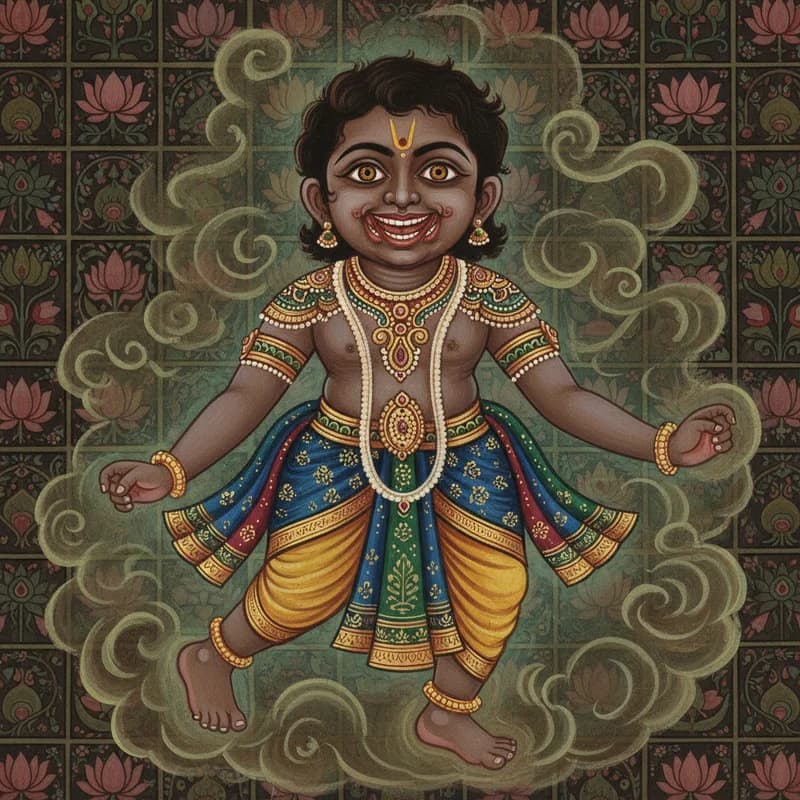

Kuttichathan
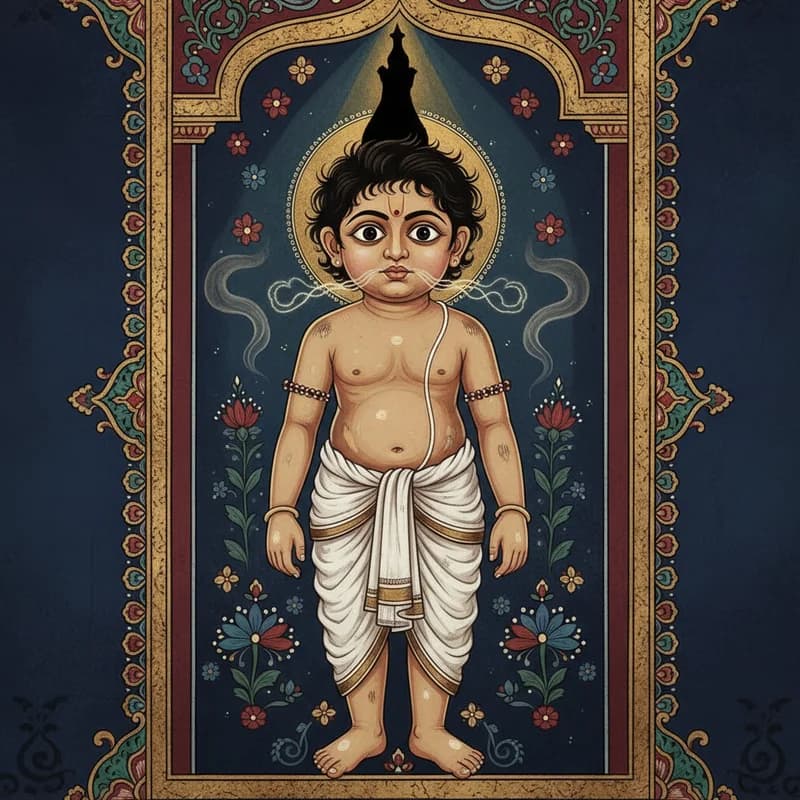
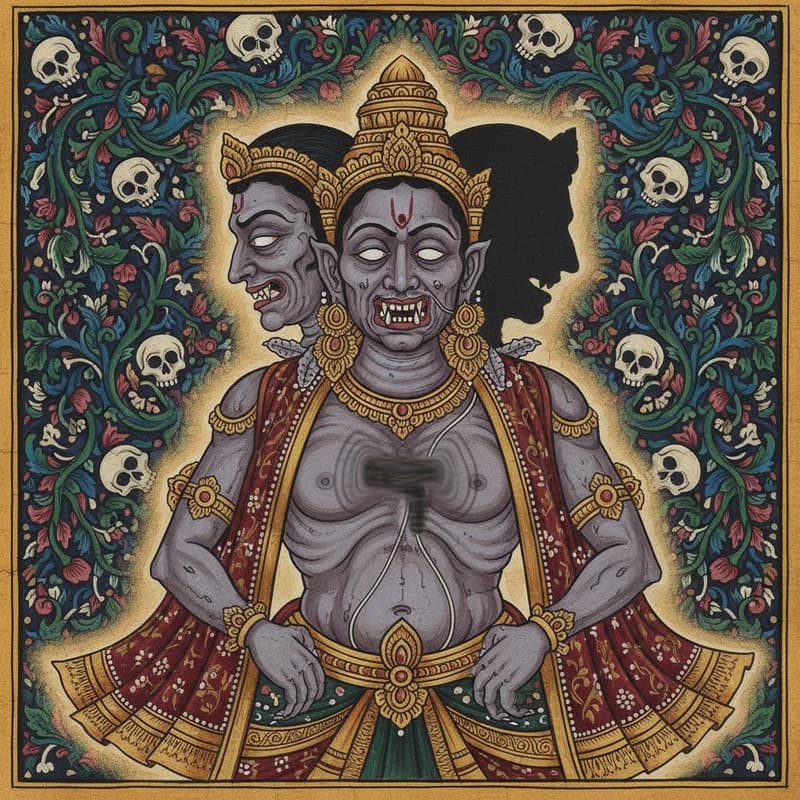
Small, dark, and perpetually hungry, Kuttichathan moves through the domestic spaces of Kerala like a fault-line running beneath a house — imperceptible until something cracks. The folk record from Malabar to Thiruvananthapuram is consistent on this point: he does not arrive uninvited. Someone summons him. A sorcerer working through specific rites tied to the tantric traditions of Kerala's Nambudiri households, or a practitioner operating from the margins of those traditions, binds him to a task — and the task is almost always the same. Ruin a neighbour. Sour a marriage. Make a prosperous man's cattle sicken and his children trip on flat ground. Accounts collected near the Periyar river and in the forested interiors of Wayanad describe his presence not as a visitation but as a condition: milk curdling before it can be heated, brass lamps toppling without wind, a persistent smell of burning that has no source. He is child-sized, some say, and sometimes glimpsed — a dark figure crouched at the edge of a courtyard at dusk — but the accounts rarely agree on what he looks like beyond that smallness, that darkness.
What makes Kuttichathan unusual in the Kerala spirit record is the question of loyalty. Bound through sorcery, he is not an autonomous predator but a contracted one, and the relationship carries obligations on both sides. Feed him, acknowledge him, maintain the terms of the binding — and he performs. Neglect those terms, and he turns. Several accounts from the Thrissur region describe households destroyed not by an enemy's commission but by the sorcerer's own failure to sustain the compact: the spirit, unpaid and unacknowledged, redirecting his appetite inward. The protective rites against him, documented in the oral traditions surrounding Kerala's Bhagavati temples, involve counter-binding rather than expulsion — you do not drive Kuttichathan out so much as you make him someone else's problem, or convince him, through ritual, that the commission has lapsed.
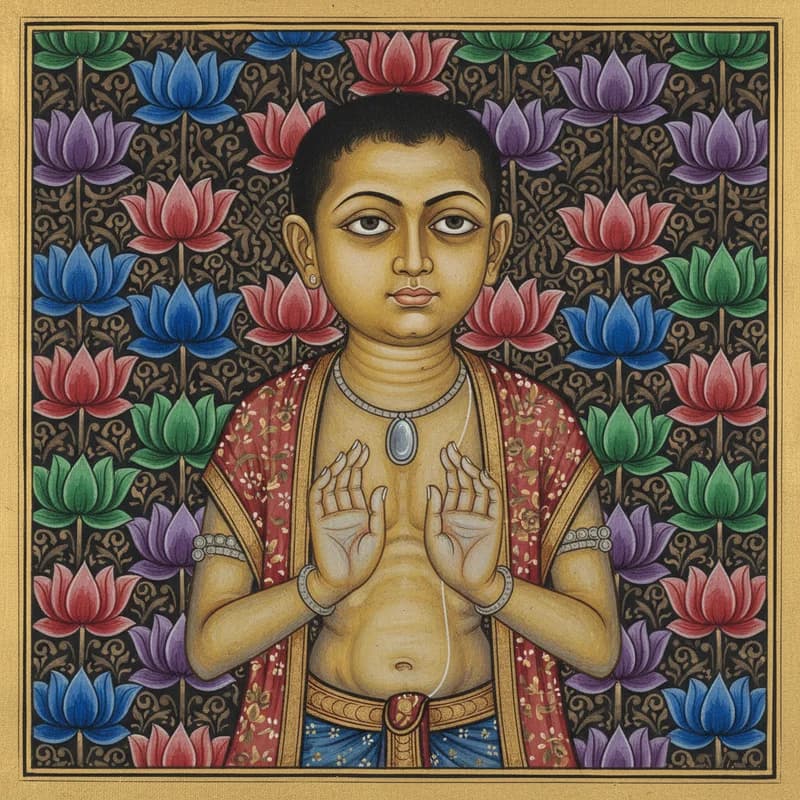
Kuttichathan appears as a small, dark-skinned boy, the height of a child no older than seven, though the proportions are slightly wrong — the arms a finger's length too long, the head carried forward of the shoulders as though permanently mid-run. Witnesses from the villages east of Thrissur and along the Periyar's flatter banks describe bare feet that leave no impression in mud or wet sand, even after monsoon when the ground holds everything. The smell arrives before the sighting: raw coconut husk left to rot in standing water, and beneath that, something sharper — struck flint, or the residue of a clay lamp just extinguished. He laughs. This is the detail that recurs most insistently in accounts collected from Palakkad to Kottayam — not a child's laugh but a sound with too many layers to it, as though several mouths are producing it from slightly different distances.
In the households of Malabar and around the Periyar basin, Kuttichathan most commonly appears as a small boy — seven or eight years old, barefoot, wearing a half-clean school uniform with the collar turned wrong — loitering near the compound wall at the hour when children are called in for the evening meal. The disguise is persuasive precisely because such children are unremarkable in any village lane. The first tell is the eyes: they do not move to track sound the way a child's eyes do, staying fixed a moment too long on whatever they last settled on, even when a dog barks or a vessel clangs in the kitchen. The second is that crows, which roost noisily through dusk in the jackfruit trees of central Kerala, go silent when he is near — not gradually, but all at once, as if a hand were placed over every beak simultaneously.
First Documented
Kuttichathan surfaces most clearly in the *Kuttichathan Katha*, a body of oral tradition preserved among the sorcerer-priests of Malabar, and gains textual footing in the *Keralolpathi* chronicles, which document the spirit's invocation alongside other malevolent entities tied to the region's tantric practices.
Last Recorded
Accounts of Kuttichathan persist into the present, with families in Thrissur and Palakkad districts still reporting unexplained domestic disturbances — shattered vessels, missing grain, sudden illness in children — attributed to a neighbor's sorcery as recently as the 2010s.
Source Language
Malayalam
Origin
Kuttichathan enters the documented record through the Tantric literature of Kerala's Tulu-Brahmin tradition, particularly in the *Prayogamanjari* and related manuals of *abhichara* sorcery, where he appears as a bound spirit — a child who died before initiation and was intercepted at the threshold of transmigration. The oral tradition of the Ezhavas and Thiyyas of Malabar carries a different account entirely: Kuttichathan was never a ghost but a category of being, one of thirty-six *chathan* spirits catalogued in the oral transmission of *kolam* practitioners around the Tirur and Perinthalmanna regions, each assigned distinct temperament and jurisdiction. Where the textual record frames him as a recruited instrument — summoned, fed with offerings of rice and fish near the Bharatapuzha's eastern tributaries, and set loose into an enemy's compound — the oral tradition insists he chooses his operator as much as he is chosen, abandoning sorcerers who fail to entertain him. That divergence matters: it shifts Kuttichathan from a
Frequently Asked
Kuttichathan is a child demon from Kerala's folk tradition — a small, mischievous spirit invoked through sorcery to bring misfortune, domestic chaos, and inexplicable accidents upon a targeted household. The name itself translates roughly to 'little Chathan,' linking it to the broader class of Chathan spirits worshipped and feared across the Malabar coast. Unlike benevolent household spirits, Kuttichathan is deliberately weaponized, sent by an enemy rather than arriving uninvited.
Kuttichathan sits at a precise threshold — its pranks begin as petty disruption, objects moved, food spoiled, animals agitated near the paddy fields of Palakkad or Thrissur — but sustained infestation can escalate into genuine harm. Practitioners of Kerala's tantric sorcery traditions, particularly those versed in the darker applications of Kōlam rituals, treat it as a caution-level threat rather than a benign trickster. Left unaddressed, the spirit's presence is said to hollow out a family's luck over months.
Kuttichathan is not encountered by accident — it is sent, summoned through specific sorcery rites by someone bearing a grievance against the target family. The invocation draws on traditions documented in Kerala's Mantravadam practices, often performed at crossroads or near cremation grounds in the hours before dawn. Certain oral accounts collected from villages along the Bharathapuzha river describe the use of effigies, lime, and iron nails to bind the spirit to its mission.
Witnesses across central Kerala describe a consistent pattern: objects vanishing and reappearing in wrong rooms, milk curdling without cause, children waking screaming from sleep, and an inexplicable smell of burning near the tulsi plant in the courtyard. Livestock grow restless, and the household's eldest member often reports a persistent sense of being watched from low angles — consistent with the spirit's child-like stature in oral descriptions. These signs are taken seriously enough that families in Thrissur district have historically consulted a Vaidyar or a Tantri before assuming mundane explanations.
Chathan is the broader, older spirit — a powerful entity with both protective and destructive aspects, propitiated in formal Theyyam performances along the northern Kerala coast near Kannur and Kasaragod. Kuttichathan is its diminutive, more specifically malicious counterpart, stripped of protective function and used almost exclusively as a weapon of sorcery. Think of the relationship as one between a general and a foot soldier — same lineage, very different deployment.
Removal requires a counter-ritual performed by a practitioner familiar with Kerala's Mantravadam tradition, often involving offerings of toddy, raw rice, and fish at the threshold of the afflicted home — materials that mirror the spirit's own earthy, low-caste associations. Some accounts from villages near the Periyar river describe the spirit being 'returned' to its sender through a reversal rite, which was considered the more dangerous but more satisfying resolution. Appeasement alone, without identifying the source of the sending, is generally regarded as temporary.
Kuttichathan does not appear in Sanskrit canonical texts like the Puranas or the Atharvaveda's demonological passages — its roots are firmly in Kerala's oral and regional tantric traditions rather than pan-Indian scripture. The spirit's clearest documentation exists in Malayalam folk narratives, local Granthavari manuscripts held in certain illam households, and the living memory of Theyyam performers in Malabar. This regional specificity is precisely what makes it a distinct entity rather than a local name for a pan-Indian demon type.
Formal temple worship of Kuttichathan is rare, but small shrines — often no more than a stone platform beneath a pala tree — exist in certain villages of Palakkad and Malappuram districts, maintained by families who have historically served as intermediaries between the spirit and those who seek to use it. These are not sites of public devotion but of transactional propitiation, visited quietly and without announcement. The distinction between a shrine to Kuttichathan and a sorcerer's working space is, in practice, often very thin.
संबंधित लोकगाथाएं
Related Lore
Algorithmic Inference
आपको यह भी पसंद आ सकता है
You May Also Like
Community Discussion
Comments are reviewed by AI before appearing publicly. Unsafe, unrelated, or uncertain comments go to human review.
Sign in to join the discussion.
0 comments
No public comments yet.