प्रतीक्षा करें
Awakening the Churel dossier…
प्रतीक्षा करें
Awakening the Churel dossier…
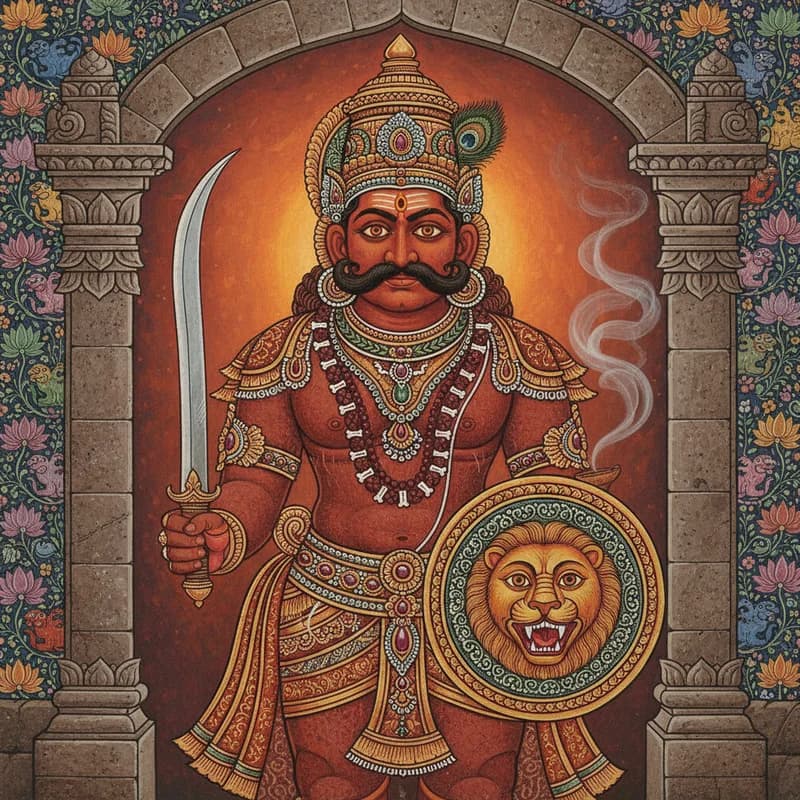

Muthuchami
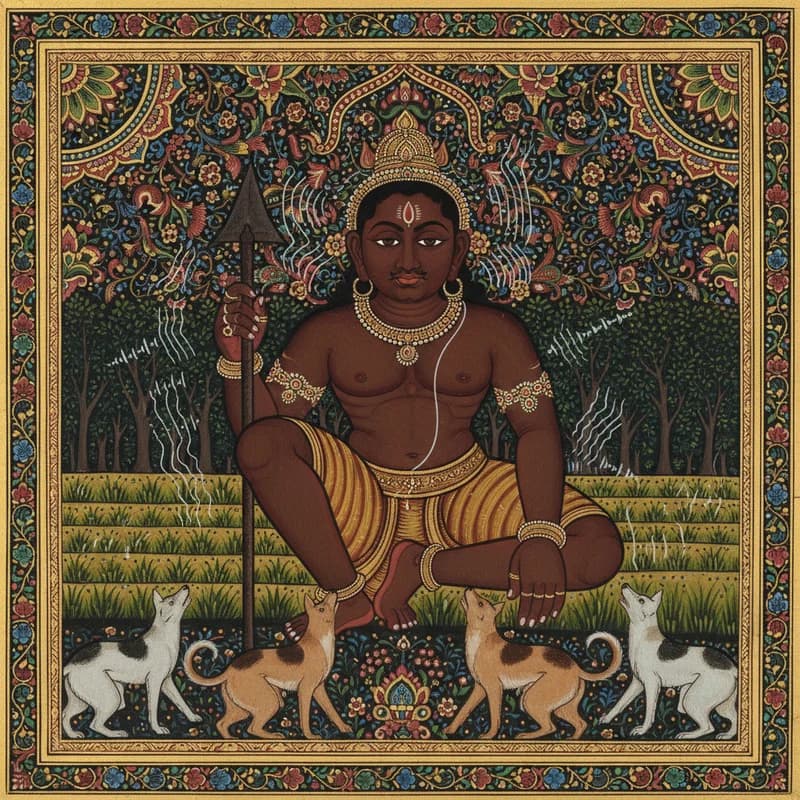
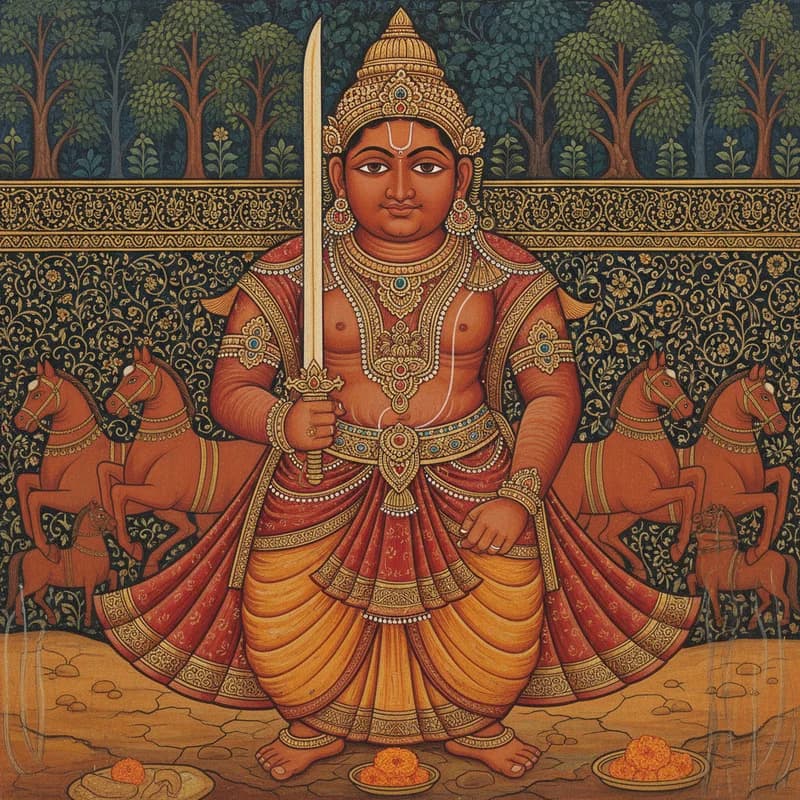
Along the red-dust roads that connect the villages of the Cauvery delta, small shrines mark the threshold between settlement and open land. Muthuchami stands at these boundaries — terracotta-faced, vermilion-daubed, armed with a vel or a short sword — installed not as a comfort but as a warning. He belongs to the warrior class of Tamil village deities, the veerar, men who died violently and incompletely, whose ferocity was too useful to let dissipate. Accounts collected from Thanjavur and Pudukkottai districts agree on the essential character: Muthuchami is not benevolent by nature. He is bound. The village that maintains his worship correctly earns his protection; the village that forgets earns something else.
His installation at the entrance road is deliberate and structural. What crosses the boundary without his permission — disease moving in from flooded paddy fields after the northeast monsoon, spirits displaced by a death in a neighboring settlement, strangers who carry bad intent or bad luck without knowing it — must pass through him first. Rooster sacrifice and camphor flame are not offerings in the devotional sense; they are payment for services rendered and renewal of contract. Fieldwork in the Palar river basin documents what happens when the contract lapses: cattle sicken without visible cause, children wake screaming before midnight, and a figure is reported at the village edge that faces outward rather than in, watching the dark instead of guarding against it. Muthuchami neglected does not leave. He simply stops working.
Muthuchami stands at the entrance to things — at the gap in the thorn fence, at the first stone before the paddy field begins, at the unmortared arch where the village road narrows before it opens into the street. Carved from laterite or cast in rough terracotta, his physical form is compact and belligerent: a broad chest thrust forward, a mustache that curves upward at both ends like a drawn bow, and eyes that are not gentle. The smell around his shrine post-offering is specific — ash and dried blood and the particular sweetness of rooster feathers in fire, a smell that collects in the Kaveri delta air and does not fully disperse before the next festival. What witnesses who have encountered him at dusk on the Pongal roads describe is a stillness in the figure that is not the stillness of stone: a held breath, a readiness, the posture of a man who has already decided to act.
In the red-dust hamlets of the Kaveri delta, Muthuchami appears most often as an aged watchman seated at the edge of a village entrance — a figure so common to Tamil Nadu's agricultural settlements that no one thinks to question him. He carries a short staff, wears a faded red cloth at the waist, and holds himself with the particular stillness of a man who has been watching the same road for a very long time. The first tell is the fire: no lamp or torch burns near him, yet the shadows around him fall as though one does, angled and shifting in the windless dark. The second is the roosters — every bird within earshot goes silent when he is present, a quiet so complete and sudden that experienced farmhands in the villages near Thanjavur's outer fields have learned to trust it absolutely.
First Documented
Muthuchami's earliest traceable presence surfaces in the oral invocation traditions of the Kaveri delta villages, where he is named alongside Ayyanar and Karuppasamy in kolam-accompanied thottil ceremonies documented by Tamil ethnographers in the late nineteenth century. No single classical text claims him; he belongs to the living, spoken record.
Last Recorded
Accounts of Muthuchami persist into the present, with field recordings from villages along the Palar River basin as recently as the 2010s documenting active propitiation rites. The deity has not receded into memory — roosters are still sacrificed at his stone posts each Panguni.
Source Language
Tamil
Origin
Muthuchami enters the documented record through the Mackenzie Manuscripts — those early nineteenth-century surveys of South Indian religious practice commissioned by Colin Mackenzie — where he is catalogued as a gram devata of the warrior caste, installed at the boundary stones of villages across the Kaveri delta and the dry plains between Madurai and Tiruchirappalli. The textual and colonial administrative record treats him as a subordinate protective figure, a gatekeeper deity ranked below the great temple pantheons of Shiva and Murugan. The oral tradition of the Vellore and Dharmapuri districts disagrees emphatically: there, Muthuchami is not subordinate but primary, the first deity approached before any agricultural season begins, before a wedding procession crosses the village boundary, before anything of consequence moves in or out. His name — pearl-lord, or lord of pearls — carries in folk etymology a specific meaning the administrative record missed entirely: the pearl here is not ornament but seed, the compressed potential of the village's own continuance. The divergence matters because it reveals how colonial documentation consistently flattened warrior-guardian cults into
Frequently Asked
Muthuchami (முத்துச்சாமி) is a warrior-class guardian deity venerated across Tamil Nadu's village traditions, stationed at the threshold between the inhabited world and the wilderness beyond. Installed at village entrances — often as a stone figure or post — he is believed to intercept malevolent forces before they reach the settlement. His worship is communal and intensely local, varying in ritual detail from one village to the next along the Kaveri delta and the drier uplands of the Deccan fringe.
Muthuchami is credited with the power to repel evil spirits, disease, and the evil eye from entering the village boundary. His warrior nature means he is understood to act with force — not mediation — making him a protector who confronts rather than negotiates. Communities along the Palar river basin describe him as especially potent during the dry months when illness and misfortune are thought to travel more freely.
Worship of Muthuchami centers on fire and blood — torch-lit processions and the sacrifice of roosters are the most widely documented offerings made to him. Priests or community elders conduct these rites at the village entrance, often at dusk when the boundary between protection and vulnerability is considered most permeable. The rooster sacrifice in particular marks him as belonging to the non-Brahminic, Dravidian stratum of Tamil folk religion, distinct from the Agamic temple traditions of Madurai or Chidambaram.
The distinction is deliberately blurred in Tamil village cosmology — Muthuchami occupies the category of a deified guardian, neither fully divine in the Sanskritic sense nor a wandering ghost. Many oral accounts collected in the Kongu Nadu region suggest he was once a human warrior whose violent death at the village boundary transformed him into its permanent protector. This pattern of the heroic dead becoming territorial guardians is well-documented in Tamil Nadu's nadukal (hero stone) tradition.
Muthuchami is placed at the entrance to the village — at the boundary marker where the settlement meets the road, field, or forest beyond. His icon, often a rough-hewn stone figure or a painted post, faces outward, watching the direction from which strangers and spirits approach. In some villages near the Nilgiri foothills, he shares this threshold position with other guardian figures such as Ayyanar, forming a collective line of defense.
Both are Tamil village guardian deities installed at settlement boundaries, but Ayyanar commands a more elaborate cult — his shrines typically feature large terracotta horses and a retinue of attendant figures, and his worship is more widely standardized across Tamil Nadu. Muthuchami is more localized and warrior-specific, associated with direct confrontation rather than the mounted patrol imagery central to Ayyanar's mythology. Where Ayyanar is a chieftain of guardians, Muthuchami reads more as a foot soldier — fierce, immediate, and bound to a single threshold.
Oral accounts consistently frame Muthuchami as protective toward the community that installs and feeds him, but dangerous to those who neglect his worship or violate the ritual protocols of his boundary. Travelers who pass his shrine without acknowledgment — particularly at night on roads through the dry thorn forests of interior Tamil Nadu — are said to invite his displeasure. His threat level is one of caution rather than malice: he is a guardian who demands respect, not a predatory spirit.
Muthuchami does not appear in the canonical Sanskrit Puranas or the Sangam corpus — his existence is preserved almost entirely in oral tradition, ritual practice, and the physical presence of his shrines. Ethnographic records from the colonial period, including district gazetteers from Madras Presidency, document guardian deities of his type under broader categories of gram devata worship without always naming him specifically. His authority rests not in written scripture but in the unbroken memory of the communities who have maintained his shrines across generations.
संबंधित लोकगाथाएं
Related Lore
Algorithmic Inference
आपको यह भी पसंद आ सकता है
You May Also Like
Community Discussion
Comments are reviewed by AI before appearing publicly. Unsafe, unrelated, or uncertain comments go to human review.
Sign in to join the discussion.
0 comments
No public comments yet.