प्रतीक्षा करें
Consulting the Shastra archives…
प्रतीक्षा करें
Consulting the Shastra archives…
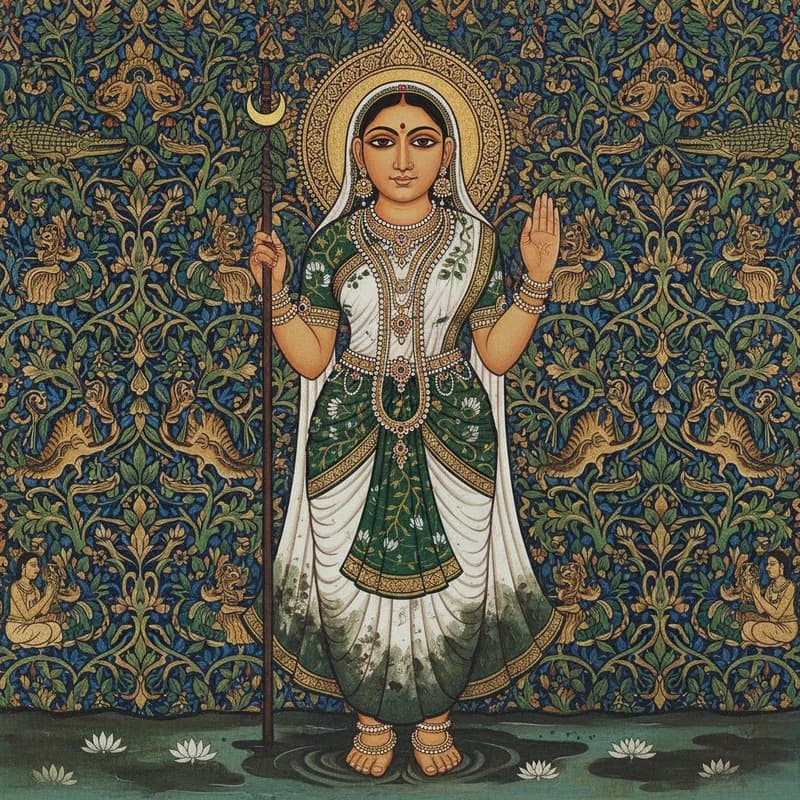

Bon Bibi
She governs the Sundarbans — not the tamed edges where the embankments hold, but the deep interior where the Matla and Raimangal rivers braid through mangrove and the tidal creeks swallow landmarks by afternoon. Woodcutters, honey-gatherers, and crab-fishermen who cross into that forest do not go without first stopping at her shrine. The ritual is not elaborate: a few words, a coconut, an acknowledgment that you are entering her house and not your own. What she demands is not worship in the temple sense. She demands honesty about why you have come.
The Baoli Pir tradition that carries her story through the Sundarbans delta describes her as born to a Muslim fakir and raised in Mecca before she was sent to subdue Dakkhin Rai, the tiger-lord of the south. Her authority in the forest is therefore older than the boundary between mosque and mandir, and the communities who depend on her — the Munda and Bedia forest workers, the Bengali Muslim fishermen of Gosaba and Basanti — do not find that duality strange. She protects those who take only what they need. Greed draws Dakkhin Rai's attention, and Bon Bibi will not intervene for a man whose nets are already too full. The accounts are consistent on this: she turns away not from danger but from excess. Enter the Sundarbans with a fair intention and she walks ahead of you; enter with hunger for more than your share, and the tigers come, and she does not.
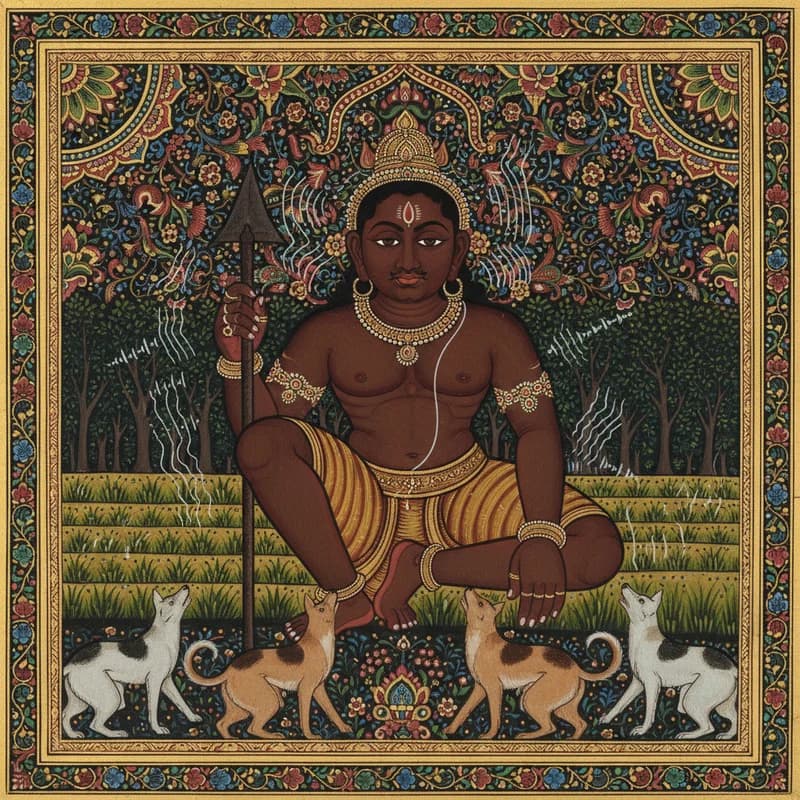
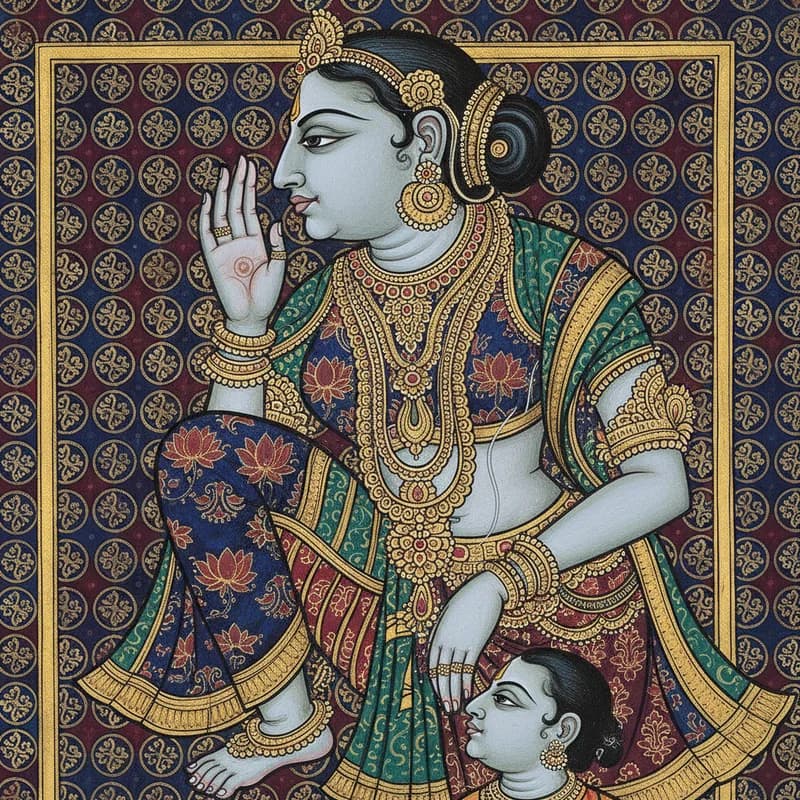
Bon Bibi appears as a young woman of indeterminate age, dressed in the white and green of a pir's dargah rather than temple cloth — the colours of the Sundarbans itself, mangrove-dark at the hem where the fabric has wicked up brackish water from the forest floor. Her face is calm in the way that still water is calm: not peaceful, but without surface disturbance, whatever moves beneath it kept private. Those who have encountered her in the creeks between Gosaba and Sajnekhali describe the smell of fresh mud and crushed neem leaf arriving before she is visible, carried on no wind. She carries a staff, and her feet, when they can be seen at all, leave no impression in the soft delta silt — the single detail that separates her from any woman who might walk that forest and survive it.
In the deep tidal creeks of the Sundarbans, where the Matla and Bidya rivers push saltwater through roots of sundari and goran, Bon Bibi has been reported walking the forest edge at the hour before the tide turns — dressed as an ordinary Muslim woman returning from collecting firewood, a worn gamcha wrapped at her waist, a bundle of dry sticks balanced on her head with the practiced ease of someone who has done it ten thousand times. The bundle never shifts, not even when she turns her head. That is the first tell: wood gathered in the Sundarbans is never dry, never — the humidity off the Bay of Bengal sees to that, and every honey-gatherer knows it. The second is quieter: the mud along the creek bank shows no footprints behind her, only ahead, as though she arrived from the direction she is walking toward.
First Documented
Bon Bibi's earliest known appearance is in the *Bon Bibir Johurnama*, an eighteenth-century Bengali manuscript that blends Islamic hagiography with local forest lore, likely composed by poets working within the oral traditions of the Sundarbans delta communities who depended on the mangrove forests for survival.
Last Recorded
Accounts of Bon Bibi remain living and unbroken — honey-gatherers entering the Sundarbans tidal forest near Gosaba and Sajnekhali still report invoking her before crossing into tiger country, and as recently as 2022, field researchers documented active puja sites at the forest edge where fresh offerings of sweets and incense marked recent visitation.
Source Language
Bengali
Origin
Bon Bibi enters the written record through the *Bon Bibir Johurnama*, an eighteenth-century Bengali manuscript composed in the *punthi* tradition — the syncretic Islamic-devotional verse form common to the lower Bengal delta — which frames her origin as a Meccan nativity, born to a Faqir father and abandoned in the forest before being raised by deer. The *punthi* text is careful to establish her Islamic credentials: she is invoked with Arabic bismillah, her brother Shah Jongoli fights a demon named Dakkhin Rai who governs the tiger, and the whole cosmology is anchored in Mecca before it relocates to the mangrove channels between the Matla and Raimangal rivers. The oral tradition of the *mawalis* — the woodcutters and honey-gatherers of Gosaba and Basanti — treats this Islamic framing as secondary, a later explanatory layer applied to a much older forest-mother figure who required no Meccan legitimacy. Where the *punthi* grants her authority through divine lineage and a specific journey
Frequently Asked
Bon Bibi is the presiding spirit of the Sundarbans, the vast mangrove delta shared by West Bengal and Bangladesh, where the Matla and Gosaba rivers braid through tiger country. She is worshipped as a protector by woodcutters, honey-gatherers, and fishermen who enter the forest, and her legend draws equally from Islamic and Hindu traditions, making her one of the most syncretic figures in Bengali folk religion. Her name translates simply as 'Lady of the Forest.'
Bon Bibi holds authority over the forest itself and can restrain Dakkhin Rai, the tiger-demon who rules the southern Sundarbans and preys on those who enter his territory without permission. Those who pray to her before crossing into the mangroves are said to travel under her protection, shielded from both the Bengal tiger and the treacherous tidal channels. She is believed to intervene directly when the faithful call her name in genuine distress.
Bon Bibi belongs to neither tradition exclusively — her origin story, preserved in the Bon Bibir Johurnama, describes her as the daughter of Ibrahim, a figure from Islamic cosmology, yet she is worshipped at forest shrines by both Hindu and Muslim communities throughout the Sundarbans. Her rituals blend Sufi devotional elements with distinctly Hindu iconographic conventions, including offerings of sweets and the use of clay idols. This shared veneration across religious lines is rare and specific to the delta's isolated, interdependent communities.
The Bon Bibir Johurnama is the primary oral-textual source for Bon Bibi's mythology, a Bengali narrative poem composed sometime in the eighteenth or nineteenth century that recounts her birth in Mecca, her journey to the Sundarbans, and her defeat of Dakkhin Rai. It is recited by professional storytellers before forest expeditions and during community rituals at the delta's mud-floored shrines. The text is not canonical scripture but functions with the weight of one among the forest-dependent people of the region.
Bon Bibi and Dakkhin Rai are opposing forces within Sundarbans cosmology — she is the protector of the poor and the righteous who enter the forest with humility, while Dakkhin Rai is the tiger-lord who demands tribute and devours those who are greedy or who enter without proper reverence. Their relationship is not simply good versus evil; Dakkhin Rai retains dominion over his territory, and Bon Bibi's protection is conditional on the forest-goer taking only what is needed. The tension between them encodes a precise ecological ethic.
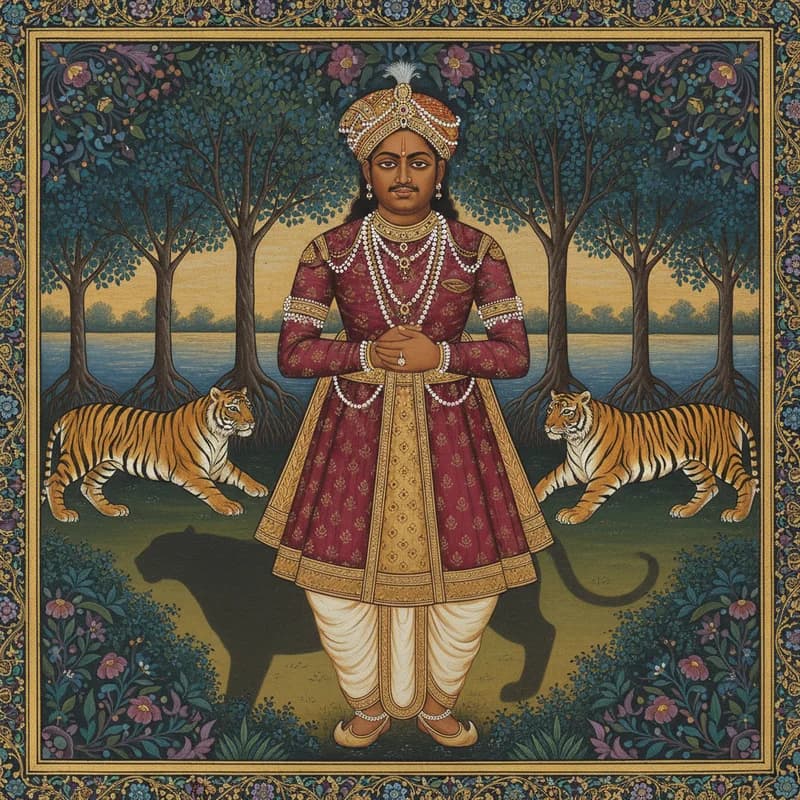
Shrines to Bon Bibi stand at the edges of villages throughout the Indian Sundarbans, particularly in areas like Gosaba, Basanti, and Patharpratima, and honey-gatherers still offer prayers and sweets before entering the forest during the spring collection season. The rituals are informal and community-led, without a priestly class, and both Hindu and Muslim families participate without distinction. Her image typically shows her mounted or standing with her brother Shah Jongoli beside her, both figures rendered in the bright pigments of Bengali folk painting.
Bon Bibi and Aranyani are distinct figures with no direct mythological connection. Aranyani appears in a single hymn of the Rigveda as an elusive, benevolent spirit of the deep forest, associated with the sounds of the wilderness at dusk, while Bon Bibi is a fully developed protective deity with a specific narrative, a specific geography, and an active cult rooted in the Sundarbans delta. The resemblance is one of function — both are female presences who govern wild spaces — but Bon Bibi's tradition is medieval and syncretic, not Vedic.
Bon Bibi's protection is explicitly conditional: she guards those who enter the Sundarbans with honest need and take only what the forest can spare, but she does not shield the greedy or the reckless. The central episode of the Johurnama turns on a merchant who attempts to sacrifice a child to Dakkhin Rai in exchange for a larger haul of forest goods, and Bon Bibi's intervention is as much a judgment on human excess as it is an act of rescue. Approaching her requires not just prayer but a demonstrated ethic of restraint.
संबंधित लोकगाथाएं
Related Lore
Algorithmic Inference
आपको यह भी पसंद आ सकता है
You May Also Like
Community Discussion
Comments are reviewed by AI before appearing publicly. Unsafe, unrelated, or uncertain comments go to human review.
Sign in to join the discussion.
0 comments
No public comments yet.