प्रतीक्षा करें
Parsing the Naga lineage records…
प्रतीक्षा करें
Parsing the Naga lineage records…

Shankhachil
Along the tidal creeks of the Sundarbans and the mudflats where the Hooghly loses its certainty before meeting the sea, the brahminy kite holds a position no other bird occupies. White-headed, rust-winged, it circles the burning ghats of Diamond Harbour and the cremation grounds behind Bakkhali with a patience that villagers do not read as hunger. They read it as attendance. The Shankhachil, in the belief that runs unbroken from the Rarh interior to the mangrove coast, is not merely a bird that resembles a spirit — it is the spirit, carrying the newly dead between what was and what comes next.
The accounts are consistent in their restraint. When a Shankhachil circles low over a household in the days following a death, family members do not shoo it away. Fishermen along the Matla river report that the bird sometimes lands briefly on the roof of the house where the body lay, then lifts without sound. To harm one is considered a serious transgression — not a taboo with theatrical consequences, but the quieter, more certain kind: a disruption of passage, a soul left circling without guidance. What the Shankhachil asks of the living is almost nothing. Observe it. Let it complete its work. The danger it carries belongs not to the living but to those who, through carelessness or contempt, might interrupt the one crossing that cannot be made twice.
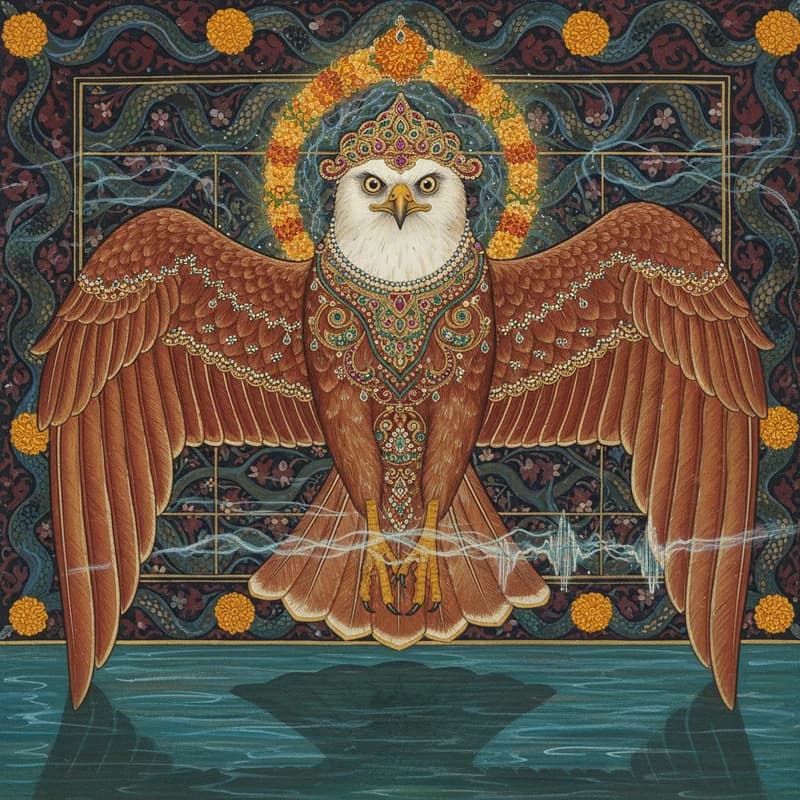
The Shankhachil appears as a brahminy kite — the rust-brown wings, the white head and breast — but something in the proportions is wrong. Seen against the flat light over the Sundarbans or circling the cremation ghats at Nimtala, the bird is slightly too large, the wingbeat slightly too slow for the body it carries, as though the air it moves through is thicker than the air around it. Those who have watched one settle report a smell that does not belong to any living bird: wet marigold and the particular mineral cold of river-silt disturbed at depth, the smell of the Hooghly in the weeks before the monsoon breaks. The sound is the detail that separates it from any ordinary kite — witnesses describe the call as arriving a moment before the bird is visible, as though the cry travels ahead of the creature that makes it. Its shadow, cast on water, does not move when the bird moves.
Along the mudflats of the Sundarbans and the tidal creeks feeding into the Hooghly, the Shankhachil takes the form of an ordinary fisherman returning home at dusk — dhoti salt-stiffened, a net folded over one shoulder, the unhurried gait of a man who has been on the water since before light. Nothing about him invites a second look in a village where every man returns from the river at that hour. The tells require patience to catch: he carries no fish, and no explanation for the absence — no gesture toward a bad day, no complaint offered to the men he passes, only silence where conversation should be. The second sign, noted by the older women of Gosaba and Basanti who have learned to watch for it, is that he does not cast a shadow eastward when the setting sun demands one.
First Documented
The Shankhachil appears most concretely in the oral traditions of Bengal's coastal fishing communities, particularly around the Sundarbans delta and the estuaries of the Rupnarayan, where boatmen have long identified the brahminy kite as a psychopomp; the spirit surfaces in written form in Rabindranath Tagore's poetry, most notably in *Shesher Kobita* (1929).
Last Recorded
Accounts of Shankhachil persist into the present, with fishermen along the Sundarbans coast and the mudflats near Diamond Harbour still reporting the bird's appearance above cremation pyres or anchored boats carrying the recently deceased — a sighting treated not as omen but as quiet confirmation that the soul has found its escort.
Source Language
Bengali
Origin
The Shankhachil enters the written record obliquely — the brahminy kite appears in the Mangalakavya tradition of medieval Bengal, particularly in the Manashamangal texts, where birds serve as divine messengers between the mortal world and the courts of the gods, though the Shankhachil as a discrete soul-carrying entity is not named there with the specificity the oral tradition demands. Along the Sundarbans coast and the mudflats of the Hooghly estuary, fishermen's communities have maintained accounts of this bird across generations that treat it not as a messenger dispatched by divine will but as a volunteer — a human soul that chose the kite's body because the living could not be trusted to conduct the dead properly. The textual tradition positions the bird as instrument; the oral account of the Medinipur and South 24 Parganas coastline makes it agent. That divergence is not minor. It shifts the entire moral weight of the dead's passage from the ritual obligations of the living onto the compassion of a soul that stayed behind to do what the living neglect.
Frequently Asked
Shankhachil is a spirit from Bengal's coastal folklore that takes the form of a brahminy kite — the rust-and-white raptor common over the Sundarbans and the estuaries of the Hooghly. Believed to carry the souls of the recently dead between worlds, it occupies a sacred threshold in the folk imagination of Bengal's fishing and farming communities.
The Shankhachil manifests as a brahminy kite (Haliastur indus), recognizable by its chestnut body and white head — a bird seen wheeling over the Bay of Bengal's shoreline and the cremation ghats along the Ganges delta. When a Shankhachil circles low over a household, many rural Bengalis read it as a sign that a departed ancestor has returned to observe the living.
Shankhachil is understood to be a psychopomp — a conveyor of souls — with the ability to cross the boundary between the world of the living and the realm of the dead. Oral accounts collected in coastal villages near Digha and the Sundarbans describe the bird as capable of delivering messages from deceased relatives, its cry interpreted as the voice of the departed.
Shankhachil is generally regarded with reverence rather than fear, though its appearance demands careful attention — it carries a threat level of caution because misreading its presence can cause ritual neglect of the dead. Families who fail to acknowledge the bird's visit are said to risk the soul of their ancestor wandering unguided.
Garuda is a divine cosmic bird of Vedic and Puranic tradition — a vahana of Vishnu, associated with solar power and the destruction of serpents, documented in texts like the Mahabharata and the Garuda Purana. Shankhachil, by contrast, belongs to the intimate, localized folk tradition of Bengal's delta country, functioning not as a deity's mount but as a quiet intermediary between grieving families and their dead.
The belief is rooted in the coastal and riverine communities of Bengal — particularly among those living near the Sundarbans mangroves, the Rupnarayan estuary, and the cremation sites along the Bhagirathi. Brahminy kites are a constant presence over these waterways, and their association with death and transition likely grew from centuries of observation alongside funerary practice.
Shankhachil does not appear in canonical Sanskrit scripture but surfaces in Bengali folk songs, baul traditions, and the oral narratives gathered by ethnographers working in the delta through the nineteenth and twentieth centuries. Rabindranath Tagore used the image of the shankhachil in his poetry as a symbol of longing and the soul's restless movement — evidence of how deeply the figure had settled into Bengal's literary consciousness.
A Shankhachil is identified not merely by the bird's species but by the context of its appearance — circling over a house shortly after a death in the family, or arriving during the shraddha rites performed on the banks of the Ganges or the Damodar. Elders in villages near Bakkhali and Namkhana describe a particular stillness in the bird's gaze as the distinguishing mark of a true visitation.
संबंधित लोकगाथाएं
Related Lore
Algorithmic Inference
आपको यह भी पसंद आ सकता है
You May Also Like
Community Discussion
Comments are reviewed by AI before appearing publicly. Unsafe, unrelated, or uncertain comments go to human review.
Sign in to join the discussion.
0 comments
No public comments yet.