प्रतीक्षा करें
Consulting the Shastra archives…
प्रतीक्षा करें
Consulting the Shastra archives…


Kshetrapala
He watches the boundary. Every village field in the agricultural belt from the Deccan plateau to the Gangetic plain has one — a rough-hewn stone smeared with vermilion, sometimes just a cairn at the edge where cultivation stops and the uncultivated begins, where the ploughed earth meets the scrub or the tree line or the dried nullah. The Kshetrapala lives there, in that margin. Farmers in the Marathwada region pour the first water of the monsoon at his stone before they pour it anywhere else. Neglect this, and the accounts are consistent: the crop rots from the root up, the well turns brackish, the cattle develop sores on their legs that no poultice reaches.
He is not malevolent by nature. What he is, precisely, is territorial — a guardian who takes his commission seriously and becomes dangerous only when that commission is ignored. Accounts from the Chambal valley and the black-soil districts of Vidarbha describe him appearing at the field's edge at dusk, a dark figure, man-sized but wrong in proportion, watching. He does not cross into the village. He does not need to. Trespassers who enter a field without acknowledgment — especially at the transitional hours, dawn or the last light before dark — report a pressure behind the eyes, a sudden disorientation, walking in circles they cannot account for. Some accounts end there. Others record the trespasser found at morning, sitting at the field's center, unable to say how they arrived or how long they waited. The Kshetrapala collects what is owed. He simply prefers that you pay before he has to ask.
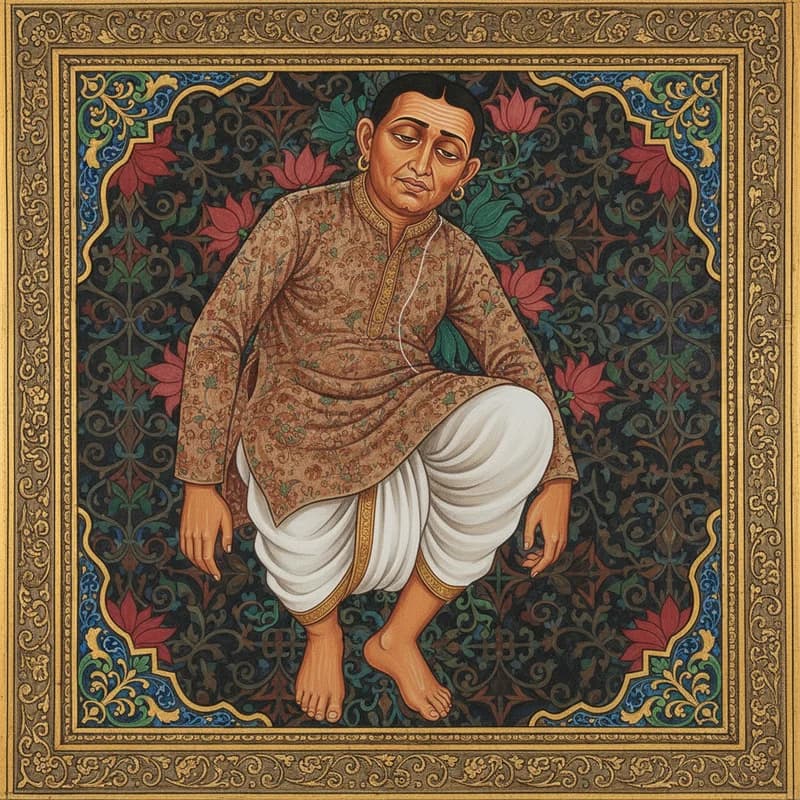
Kshetrapala appears as a dark, stocky figure — not tall, never tall — crouched at the boundary where cultivated land meets the tree line, most commonly seen at the edges of fields in the Deccan plateau when the rabi crop is still young and the nights carry the smell of turned earth. The skin is the deep reddish-brown of laterite soil after rain, and the body carries the particular stillness of something that has not moved in a very long time but could. Witnesses from villages near the Godavari's upper tributaries consistently describe a sound that precedes him: a low, rhythmic percussion, like a wooden post being driven into hard ground, heard without any visible source. He carries an implement — a staff, a club, sometimes a rusted iron spike — and the hand gripping it is always described as too large for the body, the knuckles cracked and soil-dark. The mark that separates him from any human figure is this: the dogs of the village will not face the direction he stands.
Kshetrapala moves through the agricultural margins of the Deccan and the Gangetic plain most often as an old watchman — a mali or field-guard sitting at the boundary of a ripening crop, wrapped in a rough cotton shawl against the pre-dawn cold, a lathi resting across his knees. Nothing about the figure is immediately wrong. The first tell is positional: he is always seated precisely at the field's edge, never inside it, never beyond it, as though an invisible line holds him exactly there, season after season, regardless of where the actual boundary stones have been moved. The second is noticed by those who approach close enough — his lathi casts a shadow in the torchlight, but he does not.
First Documented
Kshetrapala's earliest traceable appearances occur in the Agni Purana and Matsya Purana, where he is named among the field-guardians attendant to Shiva. Village oral traditions across Rajasthan and the Deccan plateau, however, suggest a far older, pre-textual worship rooted in agricultural boundary rites predating Sanskrit codification.
Last Recorded
Accounts of Kshetrapala persist into the present, with field interviews conducted as recently as the 2010s in agricultural villages along the Godavari basin documenting farmers who still leave offerings at field boundaries before the first plowing. The spirit has not receded into history.
Source Language
Sanskrit
Origin
Kshetrapala appears in the Agni Purana and in temple consecration manuals from the Chalukya period, where he is assigned the function of field-guardian — a minor directional deity installed at the boundary of cultivated land to keep crop-thieves and hostile spirits from the furrow. The textual tradition is administrative in tone: Kshetrapala is appointed, positioned, given a domain. Folk practice across the black-soil districts of Marathwada and the canal-fed plains of the Krishna delta tells it differently. There, farmers do not install Kshetrapala — they recognize him, the way one recognizes a man who has always lived at the field's edge, crouching near the bund where the irrigation water slows. He was not assigned; he grew from the soil's own memory of labor and loss, from generations of men who died in the field and were buried where they fell before the village had a proper cremation ground. That divergence is the thing worth holding: the Puranic text gives Kshetrapala a function, but the oral account of the Krishna and Bhima river plains gives him a
Frequently Asked
Kshetrapala is a guardian spirit of fields and agricultural land, his name drawn directly from Sanskrit — kshetra meaning field, pala meaning protector. Worshipped across rural India from the black-soil villages of Maharashtra to the paddy belts of Odisha, he is invoked before ploughing and at harvest to ensure the land yields without calamity. Unlike temple deities enshrined in stone, Kshetrapala is often represented by a simple post, a cairn of stones, or a smear of vermilion at the field's edge.
Kshetrapala holds authority over the fertility, boundaries, and safety of cultivated land — he can blight a crop, drive off thieves and wild animals, or cause livestock to sicken if his boundary markers are disturbed or his offerings neglected. Farmers along the Godavari basin traditionally credit him with the power to redirect floods away from a field or draw them toward one whose owner has shown disrespect. His jurisdiction ends precisely at the field's edge; beyond that boundary, his protection does not follow.
Kshetrapala is classified as a spirit demanding caution rather than outright fear — he is not malevolent by nature, but his anger is swift and agricultural in its consequences. Ploughing over his marker stone, urinating near his post, or failing to offer the first sheaf at harvest are the offences most consistently recorded in oral accounts from Chhattisgarh and Andhra Pradesh. Propitiated correctly, he is entirely benign; neglected, he can bring drought, infestation, or the mysterious wasting of cattle.
In Rajasthan, Kshetrapala is often conflated with a fierce, weapon-bearing form of Bhairava and receives offerings of raw grain, mustard oil lamps, and occasionally a rooster at the onset of the Rabi sowing season. Across Karnataka and Tamil Nadu, the equivalent field-guardian traditions merge with local gramadevata worship, where the spirit is propitiated at the village boundary rather than the individual plot. In the Gangetic plains, his presence is marked more quietly — a brick smeared with sindoor at the northeast corner of the field, refreshed each Kartik Purnima.
Kshetrapala is the guardian or protector of the field, a spirit-level entity tied to local agricultural land and its physical boundaries. Kshetrapati, meaning lord of the field, appears in the Rigveda (4.57) as a deity of higher cosmological standing invoked for abundance and is associated with Indra's agricultural bounty rather than boundary enforcement. The distinction matters in practice: village priests in Vidarbha will tell you that Kshetrapati is prayed to for rain and yield, while Kshetrapala is the one you appease when something has gone wrong at the field's edge.
The Rigveda's Kshetrapati hymn (4.57) provides the earliest textual ancestor of the field-guardian concept, though the specific name Kshetrapala gains currency in later Puranic and Agamic literature, particularly in texts dealing with Shaiva subsidiary deities and village protection rites. The Matsya Purana and certain Tantric manuals list Kshetrapala among the ashtadikpalas' subordinate guardians, assigning him the protection of terrestrial rather than cosmic boundaries. Much of his living tradition, however, has never been written down — it moves through the mouths of Gond and Kurmi farmers, not through manuscripts.
A Kshetrapala shrine is rarely elaborate — look for an upright stone, a wooden post, or a terracotta figure at the corner or threshold of a cultivated field, often daubed with red ochre and garlanded with marigolds left to dry and brown between offerings. In many villages of Madhya Pradesh and Telangana, a small iron trident planted in the earth marks his presence, distinguishing him from the smoother, more domesticated household spirits. The shrine sits outside, exposed to sun and monsoon, because Kshetrapala belongs to the open land, not to the shelter of a roof.
In many Shaiva traditions, Kshetrapala is understood as one of Bhairava's subordinate forms or attendants, inheriting that deity's fierce, boundary-keeping aspect and his association with dogs — animals considered sacred to Bhairava and frequently seen prowling field edges at dusk. Certain Agamic texts from South India position him explicitly within the Shaiva cosmological hierarchy, where Bhairava guards the cremation ground and Kshetrapala guards the ploughed earth, two kinds of liminal, charged territory. The connection is strongest in Rajasthan and Karnataka, where temple iconography sometimes shows Kshetrapala armed with a club and accompanied by a dog, unmistakably Bhairava's shadow cast over the agricultural world.
संबंधित लोकगाथाएं
Related Lore
Algorithmic Inference
आपको यह भी पसंद आ सकता है
You May Also Like
Community Discussion
Comments are reviewed by AI before appearing publicly. Unsafe, unrelated, or uncertain comments go to human review.
Sign in to join the discussion.
0 comments
No public comments yet.