प्रतीक्षा करें
Parsing the Naga lineage records…
प्रतीक्षा करें
Parsing the Naga lineage records…
Munjya
He died before the sacred thread touched his shoulders. That is the specific grief the Munjya carries — a Brahmin boy taken between the munja ceremony and his upanayana, suspended in the threshold between childhood and initiated manhood, belonging fully to neither world. Across the Konkan coast and the Deccan plateau, particularly in the older villages between Pune and Kolhapur where the ceremonies still hold their weight, people speak of him with a mixture of pity and wariness. He is not malicious by nature. Mischief is what he does, compulsively, because he never grew past the age when mischief was the whole business of living.
Accounts describe small, specific disturbances — milk souring before morning, knots appearing in freshly combed hair, the sound of a child laughing from the mango grove after the children have been called in. He attaches himself to households, particularly to boys of roughly his own age at death, and the attachment can curdle if he is ignored too long or mocked. The Chitpavan Brahmin communities of the Ratnagiri district treat him with careful informality — an offering of sesame and jaggery left near the tulsi plant, a few words addressed to the air as one might address a younger brother who has gone sullen. Neglect him and the mischief sharpens. Acknowledge him and he settles, at least for a season.
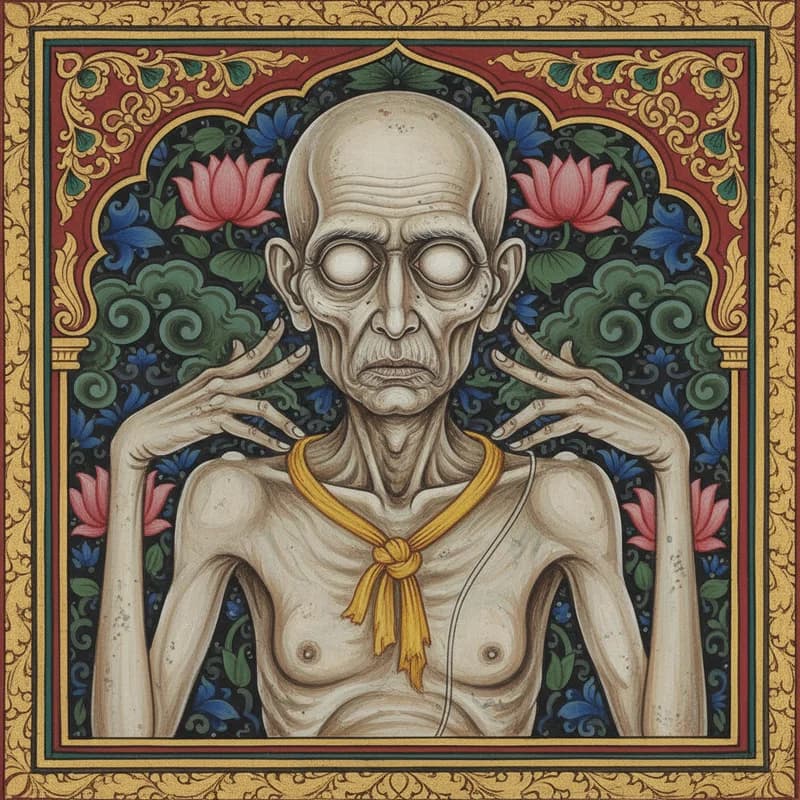
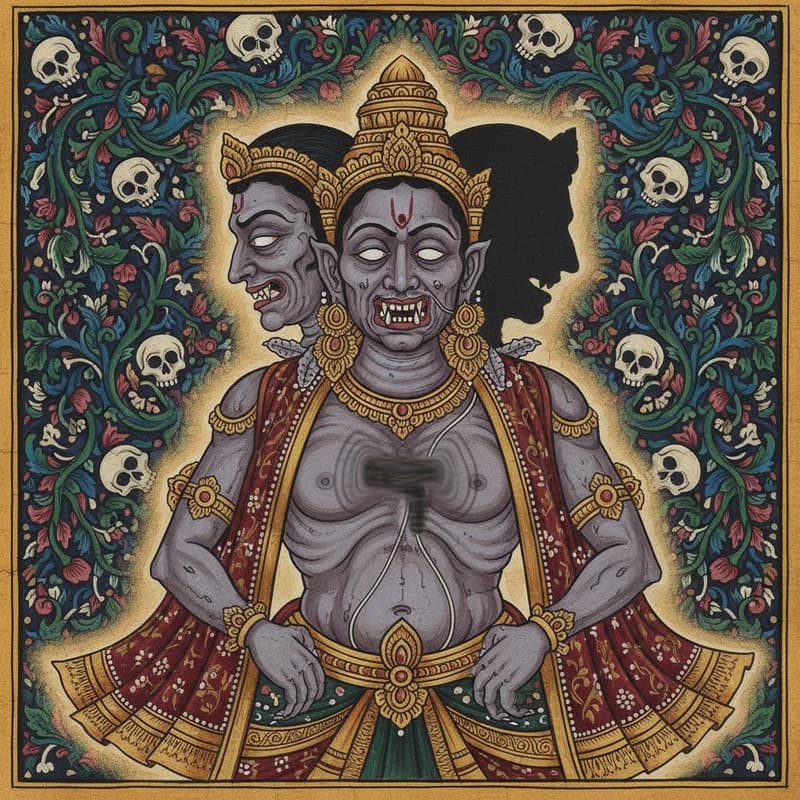
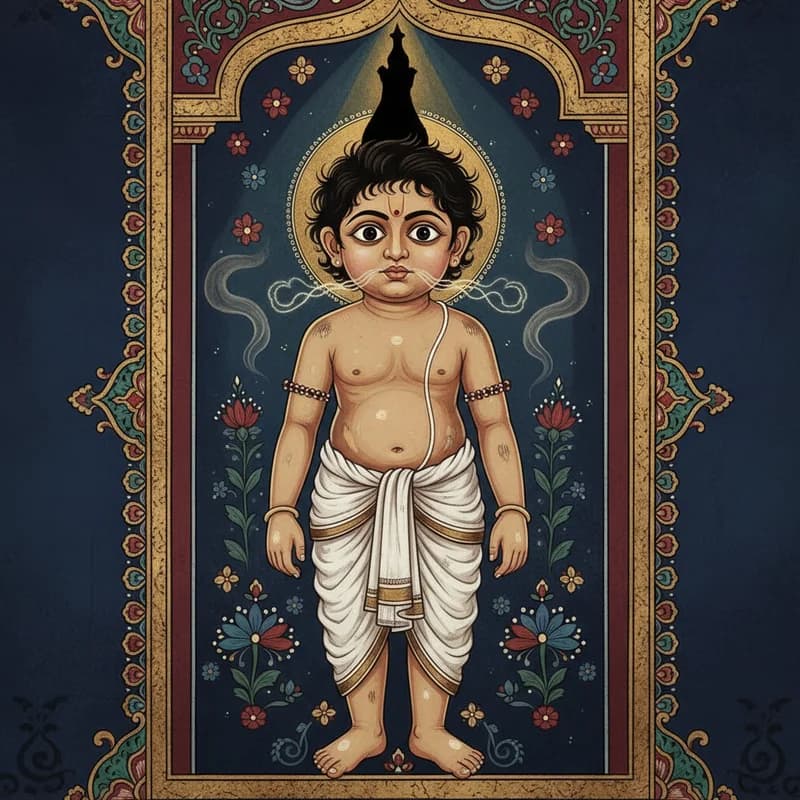
Munjya appears as a boy of eight or nine, slight and barefoot, wearing the soiled white cotton of an interrupted munja ceremony — the sacred thread visible but never properly consecrated, hanging loose across an unwashed chest. The face is the face of a child who has been waiting too long: not frightened, not malevolent, but insistently expectant, the way a child looks when a promised sweet has not arrived. Accounts from the Konkan coast and the ghats east of Pune describe a sound that precedes him — a low, repetitive humming, the kind a bored child makes to fill silence. He smells of raw sesame and wet earth, the smell of rituals abandoned mid-step. The single detail that separates him from a living child: his shadow falls in the wrong direction, regardless of where the light stands.
Munjya appears most often as a young Brahmin boy of eight or nine, freshly initiated — the sacred thread still bright against his bare chest, the shikha at the back of his skull neatly tied, a clay water-pot balanced at his hip as though he has just returned from the Godavari or the village well. He is the kind of child no one questions, the kind invited inside without thought. The first tell is the thread itself: it sits on the wrong shoulder, crossing right to left, the inverse of correct Upanayana practice, a detail only a priest or an attentive mother would catch in dim lamplight. The second is that the clay pot never sweats, never shows the dark watermark of actual water inside it, however long the afternoon sun has been at work.
First Documented
Munjya belongs to the oral traditions of Maharashtra's Konkan coast, where accounts of this mischievous child-spirit have circulated in village storytelling for generations, particularly around the Sahyadri foothills. No single founding text claims him; he lives in the spoken word, passed between grandmothers and grandchildren on monsoon evenings.
Last Recorded
Accounts of Munjya persist most actively in the Konkan coastal belt of Maharashtra, where village elders in Ratnagiri and Sindhudurg districts still describe encounters as recently as the early 2000s. The spirit has not faded into archival silence — children in these communities continue to be warned of him today.
Source Language
Marathi
Origin
The Munjya appears most clearly in the oral tradition of the Konkan coast and the Deccan plateau, particularly among Marathi-speaking communities in Ratnagiri and Pune districts, where his story circulates as cautionary narrative rather than formal scripture. The name derives from *munja*, the sacred-thread ceremony that marks a Brahmin boy's initiation into Vedic studentship — and the Munjya is, specifically, a boy who died in the interval between that ceremony and his marriage, leaving him suspended in an incomplete social identity, neither child nor householder. The written Dharmashastra tradition treats this liminal state as a ritual problem requiring prescribed rites; the folk accounts of the Sahyadri villages treat it as a permanent condition, a boy still hungry for the domestic life he never reached. Where the textual sources emphasize corrective mortuary ritual, the oral tradition insists the Munjya is not malevolent but mischievous — a perpetual nuisance in the rafters, stealing oil lamps and troubling cattle, precisely because he is bored. That divergence is telling: the texts address a theological
Frequently Asked
Munjya is the ghost of a Brahmin boy who died after his munja ceremony but before his upanayana initiation, leaving him suspended between childhood and initiated manhood. He is not a malevolent spirit by nature — mischief is his condition, not his intention, because he never grew past the age when mischief was the whole business of living. His accounts are concentrated among Marathi-speaking communities along the Konkan coast and the Deccan plateau, particularly in the older villages between Pune and Kolhapur.
Munjya appears as a boy of eight or nine, barefoot, wearing the soiled white cotton of an interrupted munja ceremony, with a sacred thread hanging loose and unconsecrated across his chest. Two details separate him from a living child: his shadow falls in the wrong direction regardless of where the light stands, and when he appears carrying a clay water-pot, the pot never sweats or shows the dark watermark of actual water inside it. A low, repetitive humming — the kind a bored child makes to fill silence — is said to precede his arrival.
Munjya is classified as a spirit requiring caution rather than outright fear — his disturbances run to souring milk before morning, knotting freshly combed hair, and drawing young boys off the path home at dusk. The danger sharpens only when he is ignored too long or mocked; the Chitpavan Brahmin communities of Ratnagiri district treat him with careful informality, addressing him as one might address a sullen younger brother. Acknowledge him with an offering of sesame and jaggery near the tulsi plant, and he settles, at least for a season.
A Brahmarakshasa is typically a Brahmin who died with unresolved sin or violated sacred knowledge, and carries genuine malice — he is a predatory entity, not a restless one. Munjya, by contrast, died in a state of ritual incompleteness rather than moral failure, which is why his behavior is compulsive mischief rather than harm. Where a Brahmarakshasa must be propitiated or repelled with considerable force, Munjya responds to the quiet gestures of domestic acknowledgment.
Munja grass tied at the doorframe is the most direct repellent, invoking the very ceremony that defines his unfinished state. Neem branches placed across the threshold at dusk, turmeric water sprinkled at entry points, and mustard oil spilled on the ground are all recorded as barriers in the oral accounts of the Sahyadri villages. Scattering sesame seeds at a crossroads is said to break an established attachment, and reciting the name of the initiating priest aloud is considered particularly effective.
The Munjya does not appear in formal scripture; his story lives in the oral tradition of Marathi-speaking communities in Ratnagiri and Pune districts, circulating as cautionary narrative rather than theological text. The Dharmashastra tradition does address the ritual problem of a boy dying between munja and upanayana, prescribing corrective mortuary rites — but the folk accounts of the Konkan coast treat that liminal state not as a solvable ritual problem but as a permanent condition. That divergence between textual prescription and oral insistence is itself significant.
Munjya attaches to boys of roughly his own age at death because they occupy the social position he was denied — on the threshold of initiation, still young enough to be mischievous, still belonging to the domestic world of the household courtyard. His attachment is less predatory than envious in the way a child is envious, wanting proximity to the life he did not finish. The attachment can curdle if the boy or his family mocks or ignores the spirit, but it begins as something closer to companionship than haunting.
The core identity — a Brahmin boy suspended between munja and upanayana — holds consistently across the Konkan coast and the Deccan plateau, but the specific ritual responses differ by community. Among the Chitpavan Brahmins of Ratnagiri district, the approach is one of careful informality, small domestic offerings and spoken acknowledgment. In the villages of the ghats east of Pune, accounts place greater emphasis on the physical barriers — neem branches, mustard oil, the continuous wearing of the janeu — suggesting a community that treats him with slightly less familiarity and slightly more wariness.
संबंधित लोकगाथाएं
Related Lore
Algorithmic Inference
आपको यह भी पसंद आ सकता है
You May Also Like
Community Discussion
Comments are reviewed by AI before appearing publicly. Unsafe, unrelated, or uncertain comments go to human review.
Sign in to join the discussion.
0 comments
No public comments yet.