Flesh draws it. Not living flesh — decaying flesh, the kind found at burning ghats along the Ganga between Haridwar and Varanasi, in the cremation grounds outside Ujjain where the Shipra runs low in April, in the charnel fields the old texts call shmashana. The Pishacha feeds on the recently dead, on grief-soaked offerings left at crossroads, on the meat of animals slaughtered without ceremony. Accounts from Kumaon hill villages and the Deccan plateau both describe the same thing independently: a figure that looks almost right, almost human, but moves through peripheral vision in a way that direct sight cannot confirm. Witnesses report a smell first — something between rot and iron — before any visual contact.
The Atharva Veda names it among the lower orders of malevolent beings, distinct from the Rakshasa and the Vetala, and the distinction matters. Where a Rakshasa hunts with something like intention, the Pishacha operates closer to compulsion, drawn to pollution and grief the way a jackal follows a funeral procession. It haunts cremation grounds, yes, but also hospitals in the accounts collected from Pune and Bhopal, slaughterhouses, any place where the boundary between living and dead has grown thin from repeated use. Possession is its primary mechanism — the body taken quietly, the original person retreating, the family noticing only that something in the eyes has changed. Traditional protection runs through ritual purity: bathing in the Pushkar lake during Kartik Purnima, the recitation of specific stotras at dusk, the maintenance of clean fire in the household. What the folklore record makes clear is that the Pishacha does not choose its hosts for any reason the living would recognize as logic. Proximity and vulnerability are enough.
First Reference —Circa 1000–800 BCE (late Vedic period)
Last Recorded —Present
Appearance
स्वरूप
Natural Form
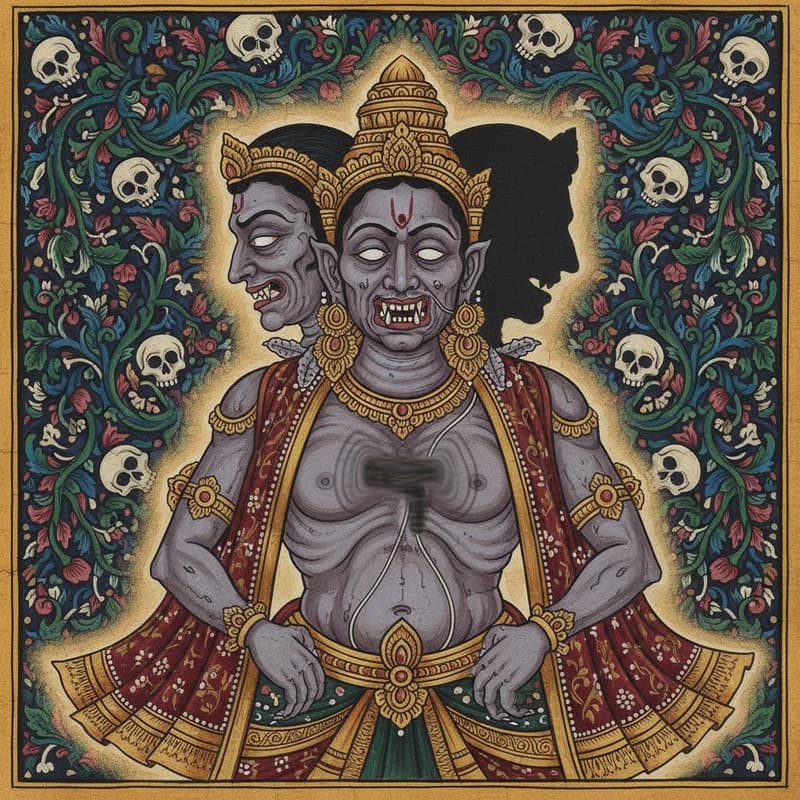
The Pishacha arrives before it is seen — a smell like meat left in standing water through the Assam rains, sweet and wrong in a way that bypasses the nose and registers somewhere older in the body. Witnesses from the cremation grounds near the Shipra at Ujjain and from the forest margins around Vindhyachal describe a figure that is recognizably human in proportion but wrong in every particular: the skin has the quality of something that has been wet for too long, a greyish purple like the inner flesh of a bruised jamun, and it hangs slightly loose, as though the body beneath has shrunk since the skin last fit. The movement is the detail that marks accounts from Rajasthan to Bengal as describing the same thing — it does not walk so much as redistribute itself, the weight shifting in a sequence that does not correspond to any human gait, the head arriving at a new position a half-second after the body, like a man turning to look at something he has already seen. The sound it makes is not a voice. Survivors describe a wet clicking from somewhere inside the chest, and beneath that, barely audible, the sound of something being chewed. The single feature that closes all argument about what has been encountered: the shadow falls toward the light source, not away from it, sharp and absolute even at noon.
Alternate Forms
The Pishacha moves through cremation-ground villages and the lanes behind dharamshalas in the form of a wandering ascetic — matted hair, ash-smeared forehead, the saffron cloth that grants a man passage anywhere in India without question. In the accounts gathered near the burning ghats of Haridwar and the Kamakhya precincts in Assam, it favors this disguise precisely because no one looks too closely at a sadhu, and hospitality demands water and a place to rest. The tells are not dramatic. Villagers who have survived the encounter report that the ascetic's begging bowl, however long he has been walking, contains no dust, no grain, no residue of any prior stop — as though it had never been used. Dogs do not bark at him; they go silent and press against walls. The most consistent tell, noted in accounts from the Vindhya foothills to the Brahmaputra plains, is that he speaks your name before you have offered it, casually, as though it had simply slipped out — and then watches to see if you noticed.
Powers & Weaknesses
शक्ति और दुर्बलता
Known Powers
◆Feeds on grief lodged in the liver
◆Speaks only in languages the host once forgot
◆Turns mustard oil rancid at the moment of entry
◆Recognized by dogs before the Kartik lamps are lit
◆Cannot cross ground where a widow has scattered sesame
◆Leaves the possessed craving raw meat near cremation grounds
Known Weaknesses
◆Salt circle drawn at the sleeping threshold
◆Neem branch tied above the doorframe at dusk
◆Recitation of the Atharva Veda's Kanda 8 hymns
◆Cannot cross ground sprinkled with black sesame seeds
◆Camphor burned continuously in a clay lamp repels approach
◆Iron ring worn on the right index finger
◆Loses hold when the afflicted bathes in the Shipra at dawn
◆Panchagavya poured at the four corners of the house
Known Locations
ज्ञात स्थान
Cremation-ground edges of Manikarnika Ghat during Kartik Amavasya, Varanasi, Uttar Pradesh
Sal-forest clearings of Saranda in the month of Shravan, Jharkhand
Abandoned step-wells of the Thar scrubland at midsummer noon, Barmer district, Rajasthan
Battlefield ruins near Kurukshetra during Pitru Paksha fortnight, Haryana
Mangrove creek mouths of the Mahanadi delta at ebb tide, Kendrapara district, Odisha
Old plague-village sites in the Malwa plateau after the first rains, Dewas district, Madhya Pradesh
Deodar-shadow ravines of the Kullu valley in the dead of winter, Himachal Pradesh
Toddy-palm groves of the Godavari lowlands on moonless October nights, West Godavari district, Andhra Pradesh
Historical Record
ऐतिहासिक अभिलेख
First Documented
Circa 1000–800 BCE (late Vedic period)
Last Recorded
Present
Source Language
Sanskrit
Origin
The Pishacha appears in the Atharvaveda as one of the oldest named adversaries in the Sanskrit textual record, catalogued alongside Rakshasas and Asuras in hymns designed to repel them — AV 8. 6 lists specific counter-formulae, which tells us the compilers assumed an audience that already knew what the Pishacha was. Manusmriti later codifies the Paisacha vivaha, the most degraded of eight marriage forms, named for these beings because it involves seizing a woman when she is unconscious or asleep — the Pishacha's characteristic mode, an entity that enters through the unguarded threshold of the body. The theological account, scattered across the Mahabharata and the Vishnu Purana, describes them as born from Kashyapa's progeny through Krodha or Pishacha, depending on the lineage being cited, placing them in the same cosmological family as Nagas and Gandharvas but at the darker end of the spectrum, creatures of flesh and blood corruption rather than fire or ether. Oral tradition, however, diverges sharply from this genealogical framework. In the villages east of the Narmada valley and in the forested margins of the Vindhyas, field accounts collected through the twentieth century consistently describe the Pishacha not as a cosmic lineage but as what a person becomes when they die in extreme moral defilement — an eater of raw or rotten meat, a violator of sleeping bodies, a creature whose hunger in life was for what was forbidden. The distinction matters: the Puranic account makes the Pishacha a species, something you might encounter as you might encounter a predatory animal; the oral account of the Vindhya foothills makes it a condition, a specific trajectory of a specific soul. Practitioners in the Shabar and Aghor traditions of Varanasi's southern cremation grounds have historically treated the Pishacha as addressable — a being with a name, a history, a grievance that can sometimes be identified — which aligns more closely with the folk account than with the impersonal taxonomies of the Puranas. Where the two traditions converge is on the body: the Pishacha is always interested in flesh, in the physical rather than the spiritual, and this consistency across centuries of text and oral stream suggests it encodes something older than either — a dread of what appetite, unchecked, ultimately makes of a person.
Frequently Asked
Questions About Pishacha
The Pishacha is one of the oldest named malevolent beings in the Sanskrit textual record, catalogued in the Atharvaveda alongside Rakshasas and Asuras as a flesh-eating entity associated with cremation grounds, grief, and bodily pollution. Unlike the Rakshasa, which hunts with intention, the Pishacha operates closer to compulsion — drawn to decaying flesh, unclean slaughter, and places where the boundary between living and dead has grown thin. Its primary mechanism is possession, entering through the unguarded body and displacing the original person so gradually that families notice only a change in the eyes.
The Pishacha appears in Atharvaveda 8.6, which lists specific counter-formulae against it, indicating the compilers assumed an audience already familiar with the entity. The Manusmriti later names the most degraded of the eight marriage forms the Paisacha vivaha after these beings, and the Mahabharata and Vishnu Purana place them in Kashyapa's lineage through Krodha — the same cosmological family as Nagas and Gandharvas, but at the end associated with flesh and blood corruption rather than fire or ether.
The Rakshasa hunts with something recognizable as will and strategy; the Pishacha is driven by compulsion, drawn to pollution and grief the way a jackal follows a funeral procession rather than choosing its prey. Rakshasas are associated with fire, pride, and the disruption of sacred rites, while the Pishacha is bound to the physical — decaying meat, charnel grounds, the unclean threshold of the sleeping body. Possession, not direct attack, is the Pishacha's characteristic mode.
Witnesses across accounts from Ujjain's Shipra cremation grounds to the forest margins near Vindhyachal consistently report the same first sign: a smell like meat left in standing water, registering somewhere deeper than the nose before any visual contact. The possessed show a specific tell — a craving for raw meat near cremation grounds, and the mustard oil in the household turns rancid at the moment of entry. Dogs go silent rather than barking, and the afflicted person's eyes carry something the family cannot name but immediately recognizes as wrong.
The Puranic texts treat the Pishacha as a cosmic lineage — a species descended from Kashyapa, something encountered as one might encounter a predatory animal. Oral tradition from the villages east of the Narmada valley and the Vindhya foothills diverges sharply, describing the Pishacha instead as a condition: what a person becomes after death when their life was defined by extreme moral defilement — eating raw or forbidden meat, violating sleeping bodies, appetite without restraint. The distinction is not merely academic; Aghor and Shabar practitioners at Varanasi's southern cremation grounds have historically treated the Pishacha as addressable, a being with a name and a grievance, which aligns with the folk account rather than the impersonal Puranic taxonomy.
Traditional protections are specific and material: a salt circle drawn at the sleeping threshold, neem branch tied above the doorframe at dusk, and camphor burned continuously in a clay lamp will repel approach. The Pishacha cannot cross ground where black sesame seeds have been scattered, and loses its hold on the possessed when the afflicted bathes in the Shipra at dawn during the appropriate season. Recitation of the Atharvaveda's Kanda 8 hymns — the same hymns that first named the entity — remains the textual prescription, and an iron ring worn on the right index finger is the most portable individual protection recorded in field accounts from Kumaon to the Deccan.
In accounts gathered near the burning ghats of Haridwar and the Kamakhya precincts in Assam, the Pishacha favors the form of a wandering ascetic — matted hair, ash-smeared forehead, saffron cloth — because no one looks too closely at a sadhu, and hospitality demands water and shelter without question. The tells are quiet rather than dramatic: the begging bowl contains no dust or residue of any prior stop, dogs go silent and press against walls rather than barking, and the ascetic speaks your name before you have offered it, then watches to see if you noticed.
The Pishacha has its deepest textual roots in the northwestern Sanskrit tradition, and the Paisachi language — attested in early Buddhist and Jain sources — is named for these beings and associated with the Kashmir-Gandhara region, suggesting the entity was particularly vivid in that cultural landscape. Regional variation is real but operates at the edges: the core description — the wrong movement, the smell of rot and iron, the shadow that falls toward the light — appears independently in accounts from Rajasthan, Bengal, the Vindhya foothills, and the Assam plains, which argues for something older than any single regional tradition. What shifts between regions is the remedy, not the creature.
PrayagrajNight of Mahalaya Amavasya, September 1961
Ramkhelawan Dubey, a forty-three-year-old ferry operator who worked the Naini crossing, reported that the figure standing on the road at midnight spoke the name of his recently deceased brother — a name Dubey had told no living person since the funeral rites — before Dubey had said a single word. The figure's feet, he noted with the precision of a man accustomed to reading water and weather, were turned heel-forward, toes pointing back toward the tree line. Dubey did not flee; he sat down in the road and recited the Hanuman Chalisa until the figure dissolved into the mist off the river.
Source: Field notes of Dr. Priya Iyer, Department of Anthropology, Banaras Hindu University, collected October 1961; cross-referenced with Sub-Divisional Officer Tripathi's incident register, Prayagraj district, entry dated 4 October 1961