प्रतीक्षा करें
Summoning entity profiles from the Grimoire…
प्रतीक्षा करें
Summoning entity profiles from the Grimoire…

Preta
The dead do not always leave cleanly. When a person dies without proper funeral rites — a body unclaimed on the banks of the Ganga at Haridwar, a soldier fallen in a monsoon field with no family to perform the *shraddha* — something remains behind, suspended between the world of the living and whatever lies past it. The Preta is this remainder: not a soul at peace, not a demon by nature, but a being caught in a state the Sanskrit texts describe with clinical precision as *pretayoni*, the condition of the unhoused dead. Gaunt, hollow-bellied, with a mouth too small to take in food or water, the Preta wanders in a state of permanent hunger that cannot be satisfied. The *Garuda Purana* devotes considerable attention to its anatomy of suffering — this is a text less concerned with comfort than with consequence.
Across the Gangetic plain, from the cremation ghats of Varanasi to the *peepal*-shadowed crossroads of rural Bihar, the Preta appears in accounts as pitiable rather than monstrous. Families who neglect the annual *pitru paksha* offerings in the fortnight before the Ashwin new moon risk drawing it close — not as an attacker, but as a claimant. It returns to the threshold of the house it knew, sometimes as a cold draught in the afternoon, sometimes as a faint sound of weeping that the neighbours cannot locate. The threat is not violence. It is the particular grief of something that needs only to be acknowledged and cannot make itself understood. Performing the proper rites, offering water and sesame seeds at the river's edge, is less an act of appeasement than of completion — the final word in a sentence the dying person never got to finish.
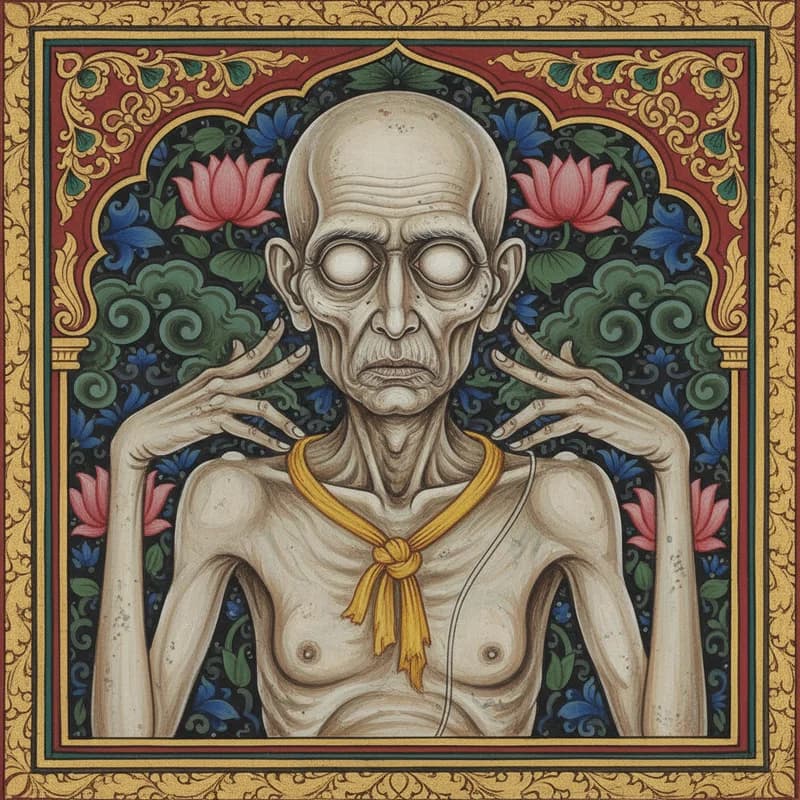
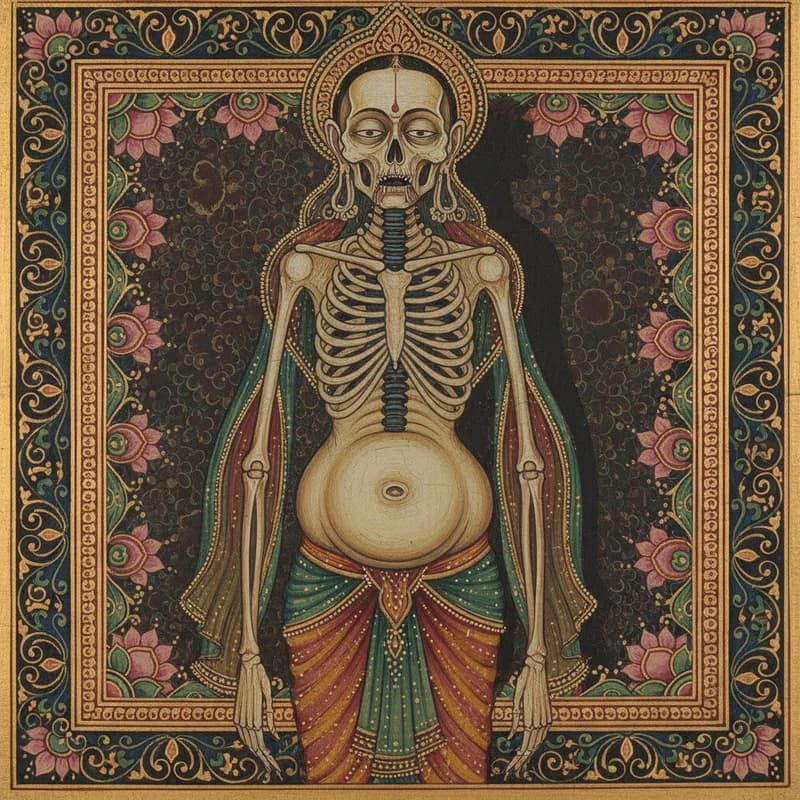
The Preta appears as a human figure reduced to its least — a skeleton dressed in the thinnest possible suggestion of flesh, the abdomen swollen to grotesque proportion against limbs like dried sugarcane after the pressing. Accounts collected along the Ganga between Allahabad and Varanasi describe the mouth as the defining feature: a needle-thin opening, barely wide enough for breath, set in a face whose hunger is total and continuous. The throat is visible from outside, a dark column beneath translucent skin, and witnesses consistently note that the Preta is always swallowing — working the jaw in small, compulsive movements even when nothing is present to eat. The smell that precedes it is specific: overripe fruit left in standing water, the sweetness that has crossed into rot, the odour that hangs over the burning ghats in the monsoon months when the river runs high. What marks it as something other than a starved man is the shadow — cast in the wrong direction, falling toward the light source rather than away.
The Preta most commonly appears as a wandering ascetic — a gaunt sadhu moving between cremation grounds and riverbanks, which in the Gangetic plain means he is never far from Varanasi's burning ghats or the sandbars of the Ganga at Allahabad where the silt smells of old ash. The disguise is plausible because such men are everywhere, their thinness unremarkable, their silence expected. The tells are two, and both require patience to register. First, the figure eats — pretas are defined by insatiable hunger — but nothing it consumes diminishes: a handful of rice, a banana offered by a householder, disappears into the mouth and the hollowness of the face does not change by a fraction, the way a genuinely starving man's expression softens, briefly, at the first swallow. Second, flies do not land on it. In the hot months between Holi and the first monsoon rains, when insects settle on every living and dead thing along the river road, the absence of a single fly on that still, seated figure is the detail that stops a careful man
First Documented
Circa 1000 BCE (late Vedic period)
Last Recorded
Present
Source Language
Sanskrit
Origin
The Preta enters the formal record in the Garuda Purana's extensive taxonomy of post-mortem states, where it is defined as the condition of a soul denied proper funerary rites — the pinda offerings, the shraddha ceremonies performed on the banks of the Gaya's Phalgu River or the Varanasi ghats during Pitru Paksha. The textual account frames the Preta as victim of circumstance: a man who died violently, without family, or whose kin failed their obligation. Folk tradition from the Gangetic plains and the villages around Gaya's Vishnupad temple complicates this considerably — there, collectors in the early twentieth century, including Crooke in his *Religion and Folklore of Northern India*, recorded accounts insisting that certain Pretas chose their condition, refusing to cross because they did not trust the living to manage what they left behind. That distinction — passive victim versus reluctant refuser — is not merely theological. It reveals a folk anxiety about inheritance, land dispute, and the unfinished business of property that the Puranic text, concerned with ritual obligation, had no interest
Frequently Asked
A Preta is an unhoused dead — a soul suspended between the living world and whatever lies past it because proper funeral rites were never performed. The Sanskrit texts call this condition pretayoni, and the Garuda Purana describes it in precise, unsentimental detail: a gaunt figure with a swollen belly and a mouth too small to take in food or water, condemned to permanent, unsatisfiable hunger.
Accounts collected along the Ganga between Allahabad and Varanasi describe the Preta as a skeleton with the thinnest suggestion of flesh, limbs like dried sugarcane, and a needle-thin mouth set in a face of total hunger. Its most reliable identifying feature is its shadow, which falls toward the light source rather than away from it — the one detail that cannot be disguised.
The Preta's threat is not violence but a kind of relentless, grief-laden proximity — it returns to the threshold of the house it knew, deepens thirst in those it follows, and causes rice left uncovered to taste of ash. Families who neglect the pitru paksha offerings during the fortnight before the Ashwin new moon are considered most at risk of drawing one close.
A Bhuta is typically the ghost of someone who died violently or unnaturally, often carrying malice as its defining quality. The Preta, by contrast, is defined not by anger but by deprivation — it is a being caught in hunger and incompletion, more claimant than attacker, and the Garuda Purana frames it explicitly as a victim of failed ritual obligation rather than a malevolent force.
The Garuda Purana contains the most systematic account of the Preta, laying out its anatomy of suffering and the precise ritual failures that produce it — missed pinda offerings, neglected shraddha ceremonies on the banks of the Phalgu River at Gaya or the Varanasi ghats during Pitru Paksha. This is a text less interested in comfort than in consequence, and it reads the Preta's condition as the direct result of the living's negligence.
The sapindikarana ritual performed on the eleventh day after death is considered the primary release, formally incorporating the Preta into the community of ancestors. Pinda offerings made at the Vishnupad temple in Gaya, or sesame seeds and water offered at the river's edge during Pitru Paksha, are understood not as appeasement but as completion — the final act of a ceremony the dying person never got to finish.
The Preta appears across the Gangetic plain — from the cremation ghats of Varanasi to the peepal-shadowed crossroads of rural Bihar and the villages surrounding Gaya — and the Garuda Purana gives it pan-Hindu textual authority. Bengali folk tradition, however, gives the figure particular density, preserving accounts of Pretas who refused to cross not from ignorance but from distrust of the living, a detail rooted in anxieties about land, inheritance, and unfinished property disputes that the Puranic record never addressed.
Folk accounts from the Gangetic plain describe the Preta most commonly disguising itself as a wandering sadhu, plausible among the many gaunt ascetics who move between cremation grounds and riverbanks. Two tells require patience: food it consumes produces no visible relief in its expression, and in the hot months between Holi and the first monsoon rains, not a single fly will settle on it — a conspicuous absence along any river road in that season.
संबंधित लोकगाथाएं
Related Lore
Algorithmic Inference
आपको यह भी पसंद आ सकता है
You May Also Like
Community Discussion
Comments are reviewed by AI before appearing publicly. Unsafe, unrelated, or uncertain comments go to human review.
Sign in to join the discussion.
0 comments
No public comments yet.