प्रतीक्षा करें
Cross-referencing the Yaksha field-notes…
प्रतीक्षा करें
Cross-referencing the Yaksha field-notes…

Vanara
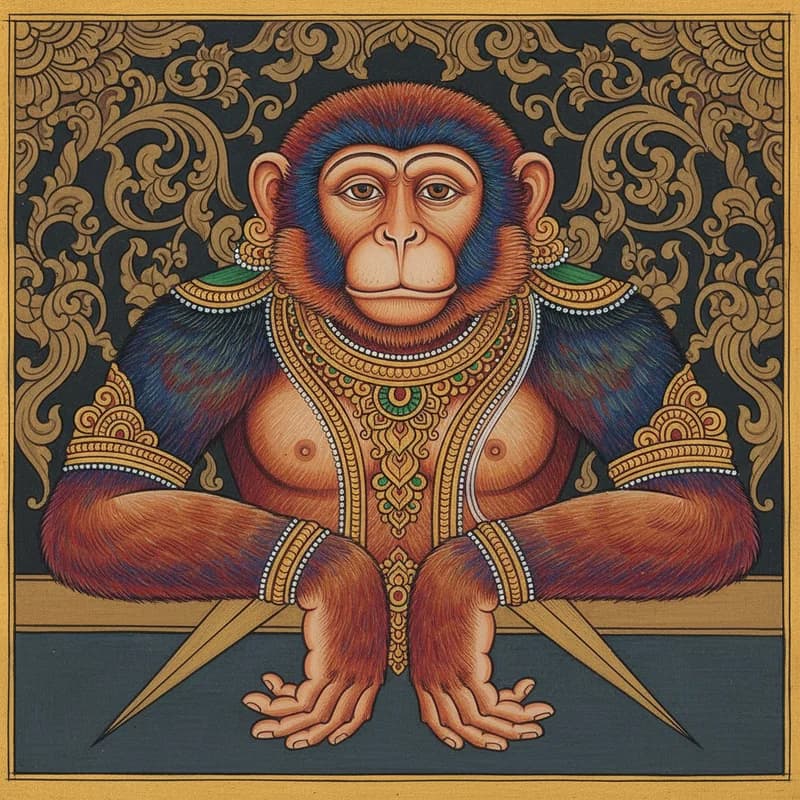
They move through the canopy in ways that do not quite match the movement of wind. Across the forest belts of the Western Ghats and the sal corridors of Jharkhand, oral accounts describe beings that wear the shape of monkeys but carry something behind the eyes that ordinary animals do not — a recognition, a waiting. The Vanara of folk tradition is not the divine warrior of the Ramayana's Kishkindha passages, though that text shaped how people interpret what they see. What the village accounts describe is older and less heroic: a presence that watches from the upper branches of banyan and ficus, that appears at forest margins when someone is about to make a decision they cannot undo.
The threat is rarely violence. Collectors working the Nilgiri foothills and the forests above the Godavari's upper tributaries note consistent reports of disorientation — travellers who followed what they took to be a familiar path, only to emerge miles from where they intended, hours unaccounted for. Some accounts describe the Vanara leading a person deliberately, not away from danger but toward something the person needed to see. Whether this constitutes malice or a form of correction depends entirely on who tells the story and what they found at the end of the path. The folklore does not resolve the ambiguity. Approach the forest edge at dusk with that ambiguity firmly in mind.
The Vanara appears as a large monkey — rhesus or langur depending on the forest — but the proportions are wrong in ways that take a moment to register. The limbs are slightly too long, the knuckles when it rests them on the ground sit at an angle no living animal achieves, and the face holds an expression of recognition rather than animal wariness, as though it already knows why you have come. Witnesses along the Vindhya foothills and in the sal forests east of the Narmada consistently describe the same sound: not chittering or alarm-barking, but a low, rhythmic exhalation that resembles someone counting under their breath. The fur carries the smell of camphor and wet stone — temple precincts, the inside of old sanctuaries. What marks it is the eyes: not luminous, but still, holding the particular stillness of a being that has stopped needing to blink.
The Vanara moves through market towns and forest-edge settlements as an old man carrying firewood — stooped, unhurried, the bundle on his back lashed with the particular knot used by the Gond communities of the Maikal hills. Nothing about him invites a second look. The first tell is the bundle itself: it never shifts weight, never sways when he turns, sitting against his back with the stillness of something painted rather than carried. The second is noticed most reliably by children and dogs — the old man's eyes track upward before they track level, moving first to branches and canopy before settling on whoever has addressed him, a reflex no earthbound person carries.
First Documented
The Vanara appear most prominently in Valmiki's *Ramayana*, composed between 500 and 100 BCE, where they are depicted as a distinct forest-dwelling race centered in the Kishkindha kingdom near the Tungabhadra River. Earlier Vedic texts contain scattered references to simian beings, suggesting an oral tradition predating the epic's written form.
Last Recorded
Accounts of the Vanara persist well beyond the Ramayana's composition — villagers near the Kishkindha hills of Karnataka and along the Tungabhadra's forested banks still report encounters, with oral testimonies collected as recently as the 1990s by regional folklorists, and occasional sightings claimed even today during the monsoon season.
Source Language
Sanskrit
Origin
The Vanara appears first as a collective noun in the Valmiki Ramayana's Kishkindha Kanda, where the forest peoples of the Vindhya and the Tungabhadra basin are rendered as semi-divine monkey warriors — a description that most Kannada and Tamil oral traditions receive with quiet skepticism. The folk accounts collected along the Pampa Sarovar near Hampi, and in the forest villages of the Dandakaranya, do not describe the Vanaras as monkeys at all; they describe them as a tribe with animal totems, whose priests wore pelts and whose war-paint mimicked the face of the langur. Where the Sanskrit text fixes them as a species, the oral tradition insists they were a people — and the difference is not incidental. To make them animals is to make Rama's alliance with them miraculous; to make them human is to make it political, a coalition of forest peoples against a northern king, which is a far more uncomfortable story. The Gondi and Soliga traditions of the Deccan preserve this second reading without apology.
Frequently Asked
The Vanara are a race of powerful, semi-divine monkey beings described in the Valmiki Ramayana as forest-dwellers of the Kishkindha region, near the Tungabhadra River in present-day Karnataka. They are not ordinary animals but intelligent, spiritually potent beings capable of speech, strategy, and devotion. Some traditions hold them to be the offspring of gods who took simian form at Brahma's command.
Vanara are broadly benevolent, aligned with dharmic purpose — their most celebrated act is aiding Rama in the recovery of Sita from Lanka. That said, folk traditions from the forests of Chhattisgarh and Odisha describe certain Vanara spirits as mischievous and unpredictable, capable of leading travelers astray near dense sal groves. The threat they pose is one of caution, not malice.
Vanara possess extraordinary physical strength, the ability to leap vast distances, and in the case of figures like Hanuman, the power to alter their size at will. Many carry boons granted by solar, wind, or fire deities — Hanuman himself is the son of Vayu, the wind god, which accounts for his speed and near-invulnerability. Certain regional oral accounts also credit Vanara with the ability to become invisible within forest canopies.
The Valmiki Ramayana is the primary Sanskrit source, dedicating the entire Kishkindha Kanda to the Vanara kingdom and its warriors. The Mahabharata also references Vanara, most notably in the Vana Parva where Bhima encounters the aged Hanuman near the Gandhamadana mountain. Later Puranic texts, including the Skanda Purana, expand on individual Vanara lineages and their divine parentage.
Vanara and Rakshasa stand in direct mythological opposition — the Vanara serve as Rama's army while the Rakshasas, ruled by Ravana from Lanka, are the antagonists of the Ramayana. Rakshasas are associated with night, deception, and the disruption of Vedic rites, while Vanara are creatures of the forest dawn, loyal and physically courageous. The war between them across the sea is one of Indian mythology's most enduring images of dharma confronting adharma.
Across the Deccan plateau and into the tribal belts of Jharkhand, Vanara spirits are invoked in oral traditions as forest guardians who protect sacred groves from those who would cut them without ritual permission. In parts of Tamil Nadu, particularly near the Anamalai hills, local shrine traditions include monkey-spirit propitiation rites distinct from mainstream Hanuman worship. These regional Vanara are less heroic figures and more liminal presences — watchful, territorial, demanding respect.
Hanuman is a Vanara by birth and classification, son of Anjana and the wind god Vayu, raised among the Vanara people of Kishkindha. Over centuries of Bhakti tradition, however, Hanuman transcended his Vanara identity to become a deity in his own right, worshipped independently at thousands of temples from the ghats of Varanasi to the coastal shrines of Kerala. The distinction matters: all Vanara share a mythological category, but Hanuman alone achieved the status of a pan-Indian god.
In folk accounts collected from villages along the Vindhya range, a Vanara presence is often identified by the sound of movement high in the forest canopy when no wind is blowing, or by the sudden scattering of monkeys from a tree without visible cause. Offerings of jaggery and roasted grain left at the base of old peepal trees are a common propitiatory practice meant to acknowledge their presence. Unlike many malevolent spirits, a Vanara is said to withdraw when addressed with respect rather than fear.
संबंधित लोकगाथाएं
Related Lore
Algorithmic Inference
आपको यह भी पसंद आ सकता है
You May Also Like
Community Discussion
Comments are reviewed by AI before appearing publicly. Unsafe, unrelated, or uncertain comments go to human review.
Sign in to join the discussion.
0 comments
No public comments yet.