प्रतीक्षा करें
Summoning entity profiles from the Grimoire…
प्रतीक्षा करें
Summoning entity profiles from the Grimoire…
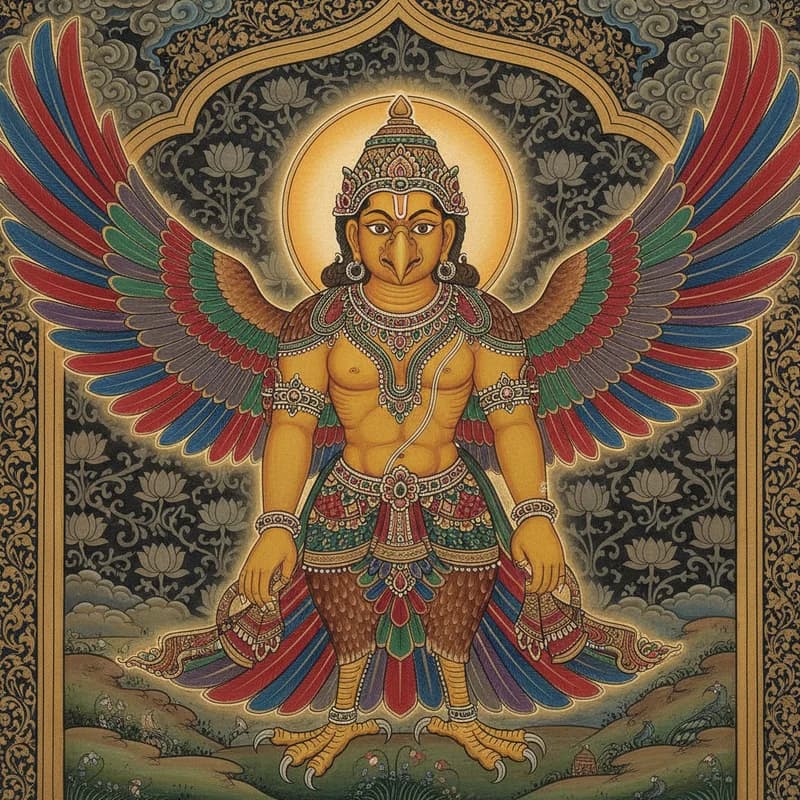

Garuda
The great eagle-god moves through the Puranic imagination with the force of something inevitable. Across the temple friezes of Belur and Halebidu, across the stone pillars of Tirumala where his image flanks every entrance, Garuda carries two contradictions without apparent strain: he is the devoted vehicle of Vishnu, bound in absolute service, and he is also the son of Vinata, born into a debt of slavery so crushing that he stole the amrita from Indra's heaven to pay it. The Mahabharata's Astika Parva records this theft in detail — the scorched earth of Indra's garden, the two serpents guarding the soma, the blinding speed that left even the thirty-three gods scrambling. He won his mother's freedom. He returned the nectar before anyone drank it. Both things are true.
The caution the folklore record attaches to Garuda is not the caution you feel near a malicious thing. It is the caution you feel near something of enormous and indifferent power — the way fishermen on the Godavari speak of the river in flood, respectfully, without assuming it wishes them well. Garuda's enmity with the Naga lineage is ancient and unresolved, and communities in the Deccan plateau and the forests of the Western Ghats who venerate serpent-deities treat his iconography carefully, never placing it carelessly near the shrines of Nagamma or Manasa. His breath, in the older Vedic stratum, destroys poison. His wings, when he descended from Meru, made the heavens shake and the seasons stutter. Encountering his presence in dream or omen is read as neither blessing nor threat but as signal — something significant is in motion, and you would do well to pay attention.
Garuda is immense in the way that stops thought before fear can form — the wingspan measured not in feet but in the shadow it throws, which arrives before the bird does, cooling the air like the moment before the Yamuna floods. The body is a man's from the chest upward, the face broad and beaked, the skin the colour of burnished gold leaf on the Tirupati vimana after a century of devotion. His lower body is that of an eagle, the talons each the length of a forearm, worn smooth at the tips not from use but from the weight of what they have carried. Witnesses near the Vindhya foothills describe a sound that precedes him — not wingbeats but a sustained harmonic pressure, like a temple bell's resonance after the bell itself has gone silent. The single feature no account contradicts: he casts no shadow of his own, only light, even at noon.
Garuda does not often walk among people, but when he does, the accounts from the Vindhya foothills and the Chambal basin describe him as a large-framed man carrying a snake-charmer's basket, moving through weekly markets with the unhurried certainty of someone who has nowhere to be and nothing to fear. The basket is always sealed. Older women who sell marigolds near the Ujjain ghats say the first tell is his eyes — they do not blink at the rate of a man's, but slower, once every several minutes, the way a raptor holds its gaze over open ground. The second is what he leaves behind: wherever he rests, even briefly, the grass beneath him is pressed flat in the precise spread of two enormous wings, though no wings were ever seen.
First Documented
Garuda appears first in the Rigveda as Śyena, the great falcon who steals soma from the heavens, a myth elaborated with full narrative force in the Shatapatha Brahmana and later crystallized into the eagle-king we recognize in the Mahabharata's Ādi Parva, where his birth from Vinata is told in precise, genealogical detail.
Last Recorded
Garuda's presence in living oral tradition has never truly lapsed — fishermen along the Godavari's upper reaches still invoke his name before crossing storm-swollen waters, and priests at Tirumala report devotional accounts of vast winged shadows passing at dusk. The accounts continue, unbroken, to the present day.
Source Language
Sanskrit
Origin
Garuda enters the written record in the Mahabharata's Astika Parva, where his birth from Vinata and his theft of amrita from Indra's heaven are narrated with the precision of a lawyer's brief — genealogy, motive, consequence, debt. The Vaishnava Agamas and the Garuda Purana elaborate him as vahana and cosmic figure, the vehicle of Vishnu, the enemy of serpents, the one whose wingbeats stirred the first wind. What the Rigvedic hymns suggest, though without naming him directly, is an older raptor-deity absorbed into the Vaishnava synthesis, a solar bird whose identity was already ancient when the Puranic compilers gave him parents and a storyline. The folk tradition of the Naga communities along the Godavari's upper tributaries — the same communities that maintain the oldest serpent-worship sites in the Deccan — holds a version the Puranas do not: that Garuda and the Nagas were once brothers, not enemies, and that the enmity was manufactured to justify a conquest. That divergence
Frequently Asked
Garuda is a vast, eagle-bodied divine being who serves as the mount of Vishnu and the sworn enemy of all serpents. Born to the sage Kashyapa and Vinata, his emergence from the egg is described in the Mahabharata as so blinding that the gods mistook him for Agni, the fire deity. Across village traditions from the Deccan plateau to the banks of the Ganga, he is understood as a force of celestial order — fierce, but aligned with dharma.
Garuda occupies a position between deity and creature — he is a divine being with human arms and torso, golden wings, and the hooked beak of an eagle, yet he is not worshipped as a primary god. The Garuda Purana, one of the eighteen Mahapuranas, treats him as a vehicle and messenger of Vishnu rather than an independent object of devotion. In temple iconography at sites like the Tirupati Venkateswara complex in Andhra Pradesh, his stone pillar — the Garuda stambha — stands directly before the sanctum, marking his role as eternal guardian.
Garuda possesses the power to fly at speeds that darken the sky, to carry Vishnu across the three worlds, and to neutralize the venom of any serpent with his gaze or touch. The Mahabharata records that he once stole the amrita, the nectar of immortality, from Indra's heaven — a feat that required defeating the gods, the serpents, and the celestial guardians simultaneously. His wind alone, generated by his wings, is said to have the force to scatter mountains.
The enmity between Garuda and the Nagas originates in a wager between his mother Vinata and her co-wife Kadru, the mother of serpents. Kadru won through deception, and Vinata was enslaved — Garuda's entire early life was spent in servitude to the Nagas until he secured amrita as ransom for her freedom. That ancient grievance, recorded in the Adi Parva of the Mahabharata, calcified into a cosmic and hereditary hostility that persists across every retelling.
In South Indian temples, particularly those of the Vaishnava tradition along the Kaveri river corridor, Garuda is carved in a posture of anjali — hands folded in devotion — with wings furled and a human body from the waist up. Northern traditions, especially in the Vaishnava shrines of Vrindavan and Mathura, tend toward more dynamic depictions showing him in mid-flight. The Hoysala temples at Belur and Halebidu in Karnataka show some of the most intricate Garuda friezes surviving in stone.
The Garuda Purana is one of the Vaishnava Mahapuranas, structured as a dialogue between Garuda and Vishnu, in which Garuda asks about the fate of the soul after death. Much of the text describes the journey of the atman through the afterlife, the punishments of Yama's court, and the rites that ease a soul's passage — which is why it is traditionally recited during the mourning period following a death in many Hindu households. Its association with mortality has made Garuda himself a figure who bridges the living world and whatever lies beyond it.
Garuda's presence in Southeast Asia is striking in its political dimension — he became the royal symbol of the Khmer empire, appears on the national emblem of Indonesia, and is the official symbol of Thailand, where he is known as Krut. In these traditions, absorbed through centuries of Indic cultural transmission, he carries more emphasis on sovereignty and protection than on his role as Vishnu's mount. Back in India, particularly in the Vaishnava heartlands of Tamil Nadu and Karnataka, the devotional relationship with Vishnu remains the core of his identity.
Garuda's threat level in folk tradition is one of caution rather than malice — he is not a being that harms humans, but his power is so immense that proximity to his true form is considered overwhelming. Village traditions in Odisha and coastal Andhra Pradesh hold that a Garuda sighting, even in dream, signals imminent confrontation with a serpent or a serious illness. Protective amulets bearing his image are common across these regions precisely because his presence is understood to repel nagas and their associated misfortunes.
संबंधित लोकगाथाएं
Related Lore
Algorithmic Inference
आपको यह भी पसंद आ सकता है
You May Also Like
Community Discussion
Comments are reviewed by AI before appearing publicly. Unsafe, unrelated, or uncertain comments go to human review.
Sign in to join the discussion.
0 comments
No public comments yet.