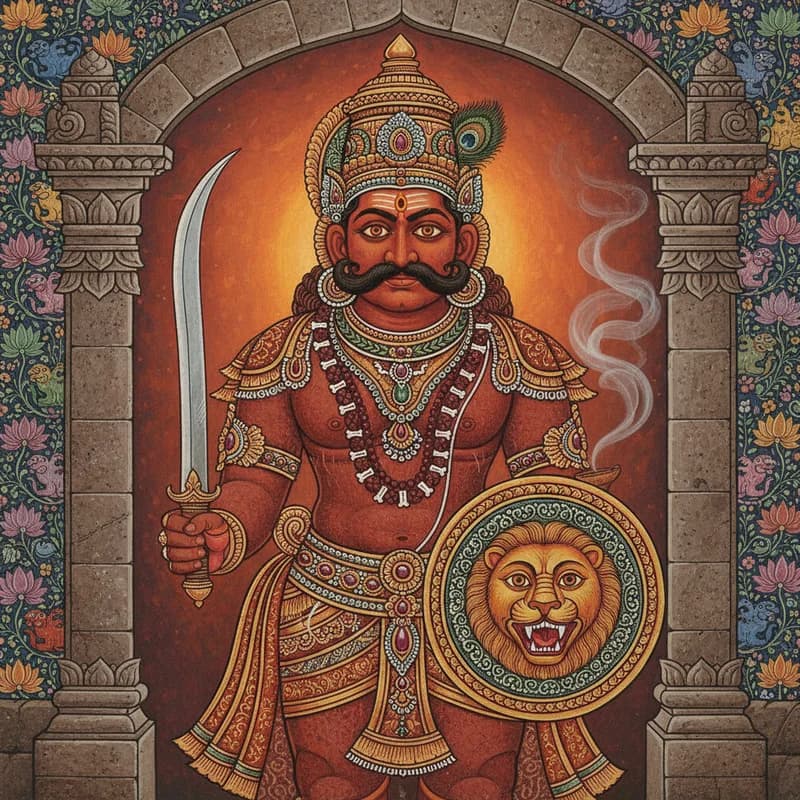
Portrait of Yaksha
हिन्दी
0:00

यक्ष

Yaksha

Benevolenttreasure guardianPan India2 Views

They guard things. That is the oldest, simplest account — Yakshas watch over buried wealth, over forest groves, over the thresholds of places that matter. The texts are explicit: the Atharvaveda names them among the first beings to inhabit the world before human settlement pushed into the forests of the Gangetic plain, and the Mahabharata's Yaksha Prashna places one at a still lake in the wilderness, killing Yudhishthira's brothers one by one for drinking without permission. Permission is the central word in all Yaksha encounters. They do not hunt. They enforce.

Accounts cluster most densely in the foothills of the Himalayas, along the old trade corridors between Mathura and the mountain passes, and in the dense sal forests of Chhattisgarh where shrines to pot-bellied, club-bearing figures still receive offerings of raw rice and toddy before the monsoon breaks. Field accounts from the Narmada valley describe Yakshas as capable of appearing as prosperous merchants — well-fed men with an excess of gold on their person, seated at the edge of a market or beneath a banyan at the wrong hour. Something about them is slightly too still. Animals notice before people do. The wealth they offer is real. The conditions attached to it are never fully disclosed at the time of offering.

Threat here is conditional rather than predatory. A Yaksha ignored at its own site, or a tree felled that it inhabited, or a hoard disturbed without ritual acknowledgement — these are the triggers the oral record consistently identifies. The Jain tradition absorbed them as guardian deities of the Tirthankaras, softening their older, more volatile character considerably, but the village accounts of the Vindhya range have not followed that revision. There, the Yaksha remains what it always was: a custodian with a long memory and no particular interest in human intentions, only human actions.

First Reference — Circa 1000–800 BCE (late Vedic period)

Appearance

स्वरूप

Natural Form

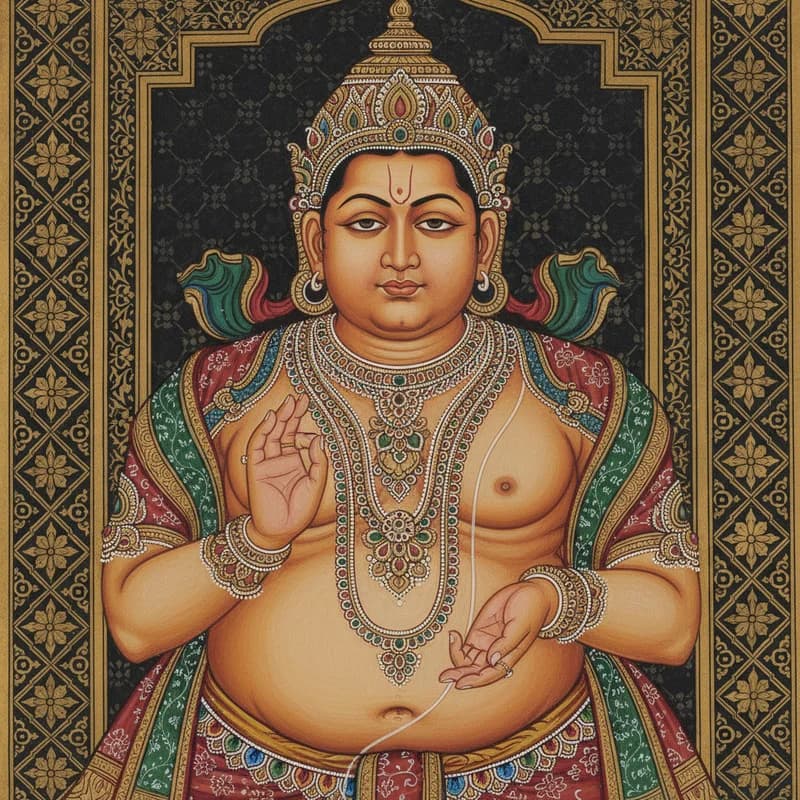
The Yaksha appears as a man — always a man — of unusual physical abundance. Broad through the chest and shoulders, belly full in the way that suggests not excess but authority, the body of someone who has never been refused a meal. The skin carries a quality that witnesses from the Vindhya foothills and the sal forests of Jharkhand both describe independently: a faint luminosity, not light exactly, but the look of a surface that has absorbed more sun than it has given back. The face is handsome in a way that becomes unsettling only after a moment's study — the proportions correct, the features arranged pleasingly, yet the overall impression somehow too composed, as if the expression has been selected rather than arrived at.

He smells of wet earth and old coin-metal, copper and iron together, the smell of a riverbank where the Narmada has pulled back in the dry months to expose what it has been carrying. Beneath that is something sweeter and more troubling — crushed mahua flowers beginning to ferment. Those who have encountered him near the yaksha shrines of Madhya Pradesh, the small stone platforms heaped with offerings at the base of old peepal trees, describe a low vibration in the air around him, not quite sound, felt more in the back teeth than the ear. He moves with the unhurried deliberateness of a man who owns the ground he walks on. Footsteps land too firmly, as if the earth receives him differently than it receives ordinary weight.

The detail that marks him apart, consistent across accounts from the Mahabharata's Yaksha Prashna down to living oral traditions near Amarkantak, is the stillness of his eyes during movement. The body turns, the head shifts, but the eyes remain fixed on a point only he can locate — somewhere behind the person he is addressing. Witnesses who have answered his riddles incorrectly speak of a cold that enters through the sternum and does not leave with warmth. Those who answered correctly describe something stranger: the brief sensation of being completely and mercilessly known.

Alternate Forms

The Yaksha's most documented disguise is that of a merchant resting at a dharamshala — a prosperous one, by the cut of his dhoti and the brass water-vessel beside him. He is never the one who approaches. He waits, and lets others sit near him, and begins to ask questions. The questions are the thing. They come in sequences, methodical and patient, and they are always questions to which the Yaksha already knows the answer. Accounts from the villages along the Chambal's eastern bank describe a figure who asked a ferryman the name of his father, his father's father, the name of the river at flood-season, the correct hour for the evening prayer. The ferryman, who answered everything correctly, crossed safely. His companion, who grew irritated and answered carelessly, did not reach the other side.

Near the sal forests of Bastar and the tank-fed fields outside Ujjain, the Yaksha appears as a tree-warden — an old man sitting with his back against a peepal, overseeing nothing in particular. He looks like a man who has been there all morning. The tell that the Gond communities have passed down for generations is this: the shadow of the peepal moves with the sun, as shadows do, but the old man's shadow does not. It stays where it was when he arrived. A second detail, rarer but consistent across three separate accounts collected near the Kshipra river: he does not blink. Not infrequently. Never.

In the Mahabharata's Vana Parva the Yaksha appears as the voice of a crane beside a forest pool — the Dwaita forest, deep in the years of exile. That particular account has bled into folk memory across the subcontinent, and in the oral versions collected from Rajasthan to Odisha the detail that survives every retelling is not the questions themselves but the stillness of the water. The pool does not ripple when the crane moves. Nothing disturbs it. Villagers who grew up near jheels and seasonal tanks know what a bird does to still water. That absence is the warning, and it comes, always, just before the first question.

Powers & Weaknesses

शक्ति और दुर्बलता

Known Powers

  • Hoards wealth beneath specific banyan roots
  • Answers riddles only with another riddle
  • Causes gold to tarnish at a touch
  • Guards forest pools against the impure-hearted
  • Grants boons that arrive one season late
  • Speaks in the voice of running water

Known Weaknesses

  • Riddle answered correctly breaks the Yaksha's hold
  • Offering of raw sesame seeds at forest crossroads
  • Cannot cross a line of mustard seeds at dusk
  • Reciting the Kubera Stotram aloud at the banyan's roots
  • Iron anklet bells worn by children near river ghats
  • Camphor burned continuously at the threshold after Kartik Purnima
  • Correct naming of the presiding river dissolves the enchantment

Known Locations

ज्ञात स्थान
  • Sal-forest clearings of Bastar plateau during Dussehra, Chhattisgarh
  • Banyan-shaded treasure mounds along the Shipra riverbank at dusk, Madhya Pradesh
  • High-altitude deodar groves of Kedarnath valley before the first snowfall, Uttarakhand
  • Ancient yaksha-shrine crossroads of Mathura district in the month of Kartik, Uttar Pradesh
  • Sandstone quarry settlements of Chunar during the dry Jeth heat, Uttar Pradesh
  • Tank-fed paddy country of Banavasi in the post-monsoon stillness, Karnataka
  • Hilltop boulder formations of Vidisha near the Udayagiri caves at equinox, Madhya Pradesh
  • Teak-forest paths of Pench valley when the mahua flowers fall, Maharashtra

Historical Record

ऐतिहासिक अभिलेख

First Documented

Circa 1000–800 BCE (late Vedic period)

Last Recorded

Present

Source Language

Sanskrit

Origin

The Yaksha appears across a span of sources so wide that establishing any single origin is impossible — and the tradition itself seems aware of this. The Atharva Veda names Yakshas without fully defining them, using the word in a register closer to "mysterious being" or "wonder" than to any fixed category. By the time of the Shatapatha Brahmana, they have acquired a more settled identity as ambiguous nature powers, neither straightforwardly benevolent nor demonic, associated with crossroads and the roots of large trees. Kubera, their eventual lord, is described in the Mahabharata as a half-brother of Ravana — which places Yaksha origin at the oldest fault line in Sanskrit cosmology, between the orderly and the transgressive, between the north and the south of the mythic map.

What the texts handle as taxonomy, the oral traditions of Madhya Pradesh and the Vindhya belt treat as lived geography. Along the Narmada between Amarkantak and Jabalpur, certain very old trees — the clusters of figs and banyans that root themselves into the riverbank — are understood to house Yakshas who predate the village, predate the temple, predate the cultivation of the field around them. The forest-dwelling communities of the Baiga and Gond do not use the Sanskrit term consistently; they describe these beings with local names that scholars like Verrier Elwin, working the Mandla district in the 1940s, recorded and tentatively mapped onto the Yaksha category. The beings are guardians of buried treasure and of forest margins — not generous by nature, but available to compact, to negotiation. Offerings left at the base of a palash tree at the onset of the monsoon are not prayers so much as business. This is the Yaksha as the oral tradition knows him: a party to contract, not a recipient of devotion.

Kalidasa's Meghaduta opens the most famous Yaksha account in the literary canon — a Yaksha exiled from Alaka, the city of Kubera in the high Himalayas, condemned to spend a year separated from his wife somewhere in the Vindhya-Ramagiri hills. The poem is often read as lyric elegy, but the Yaksha's condition carries a specific theological weight. His exile is the consequence of negligence in divine duty — a failure of attention, not of malice — and his punishment is longing itself, the sharpest instrument the tradition possesses. Oral commentators in the Malwa region, where the Ramagiri hill in Ramtek near Nagpur has long been identified as the poem's setting, have maintained a tradition that the poem is not Kalidasa's invention but his transcription of an account already circulating in the area. This is almost certainly unprovable, and most textual scholars dismiss it. Still, it points to something real: the Yaksha, across both written and oral streams, is never fully domestic, never fully wild, never entirely beyond reach, and never entirely safe to approach.

Case Reports

प्रकरण विवरण
BadrinathCirca 1887

A village headman in the Vindhya foothills — the account collected third-hand, the original teller unnamed, the season unrecorded — described a figure seated on a boulder above a dry streambed who answered every question put to him correctly, including the headman's unspoken ones. The figure had no shadow at midday. When the headman looked back from the treeline, the boulder was bare and the streambed, which had been dry for two seasons, was running with clear water up to his ankles.

Source: Oral account recorded by Pt. Harimohan Shukla, Folklore Research Unit, Banaras Hindu University, 1963.

View Full Case →