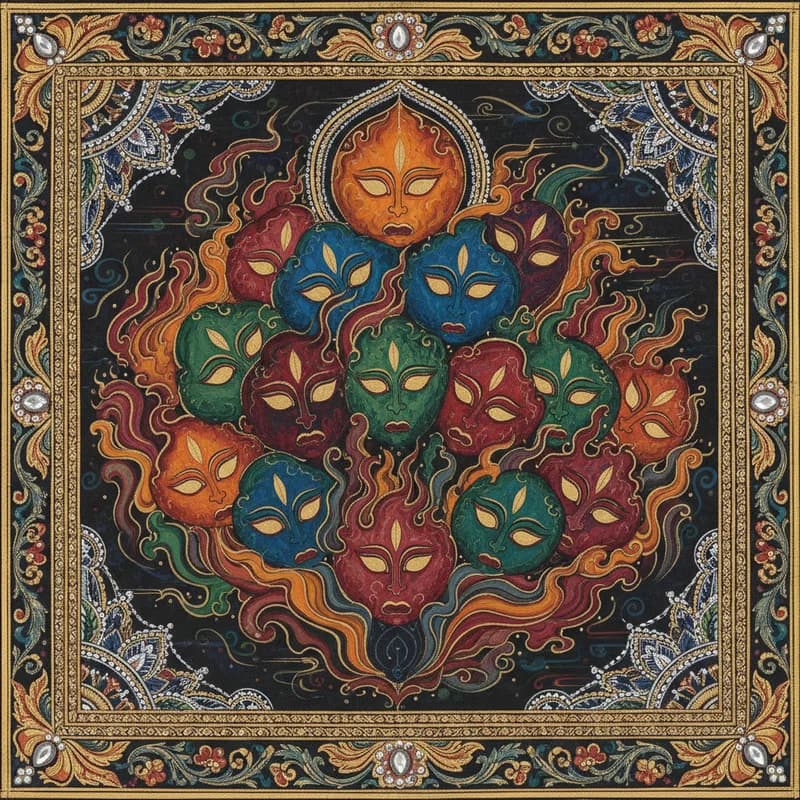
Portrait of Rakshasa
हिन्दी
0:00

राक्षस

Rakshasa

Dangerousflesh-eating demonPan-India4 Views

Older than the texts that attempt to catalogue them, the Rakshasas predate the temple complexes of Madurai and the ghats of Prayagraj alike. The Valmiki Ramayana names them, the Mahabharata fears them, but the oral traditions of the Deccan plateau and the forests of Dandakaranya — where Rama himself was said to have encountered them — carry accounts that the Sanskrit texts quietly domesticate. Village informants in the Bastar region describe something rawer than the epic versions: shape-shifters who wear borrowed faces, who smell of blood even when they appear as priests or merchants, whose shadows fall wrong at noon.

They eat flesh. This is the one constant across every regional variant, from the paddy-field stories of coastal Odisha to the hill-tribe accounts collected near the Vindhya ranges. A Rakshasa does not haunt or whisper or lure through longing — it hunts with appetite, and it prefers the dark of the new moon, when the Narmada runs low and the forest roads between villages are empty of lamp-light. Accounts from the Chhattisgarh interior describe them as enormous, dark-skinned, with teeth that catch light when there is no light to catch. Some assume the appearance of a dead relative to gain entry to a home. Others, the older stories insist, do not bother with disguise at all.

What complicates the record is that not all Rakshasas are identical in disposition. Vibhishana in the Ramayana was one, and he chose righteousness. Folk tradition in Tamil Nadu acknowledges this division — between those bound by hunger and those who retain something like will. The protective measures vary accordingly: doorways marked with neem leaves before the monsoon, iron nails driven into threshold wood, the recitation of specific stotras at dusk. Whether these work, the accounts do not say with confidence. They only note that the households which omitted them sometimes had reason, afterward, to wish they had not.

First Reference — Circa 1500–1200 BCE (Rigvedic period)

Appearance

स्वरूप

Natural Form

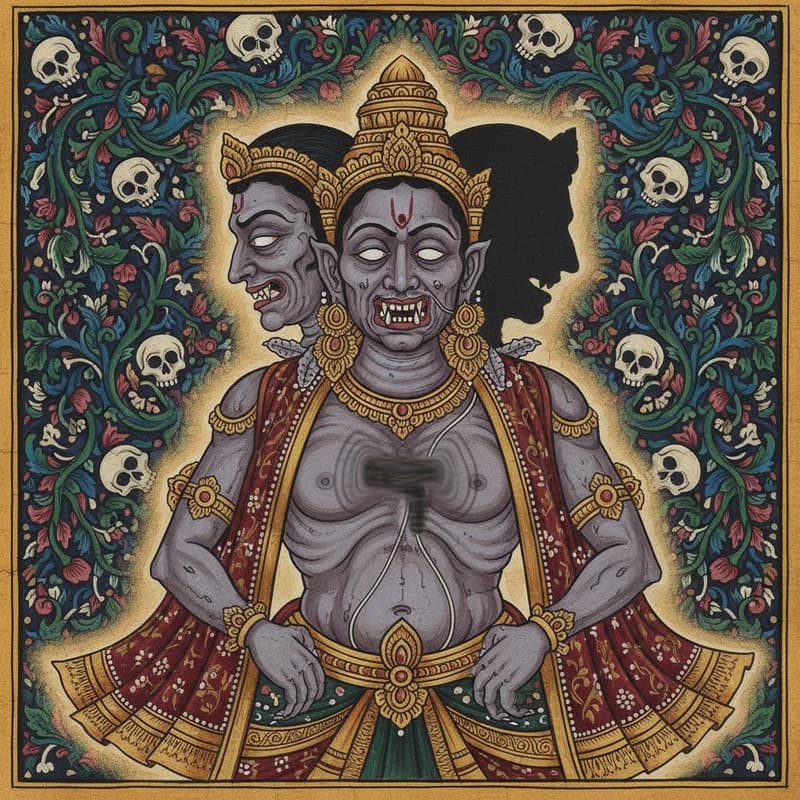
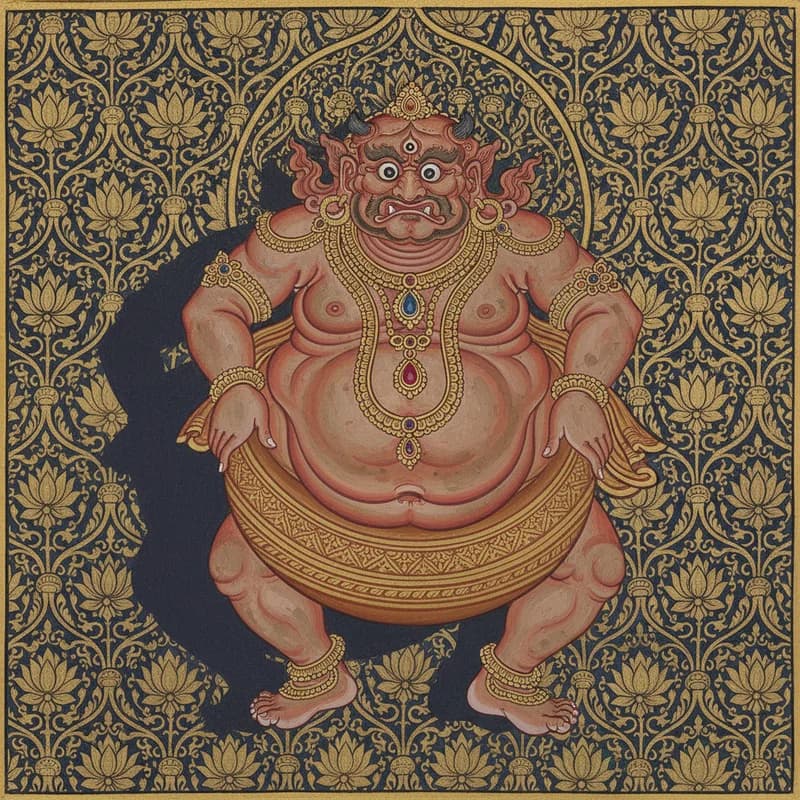
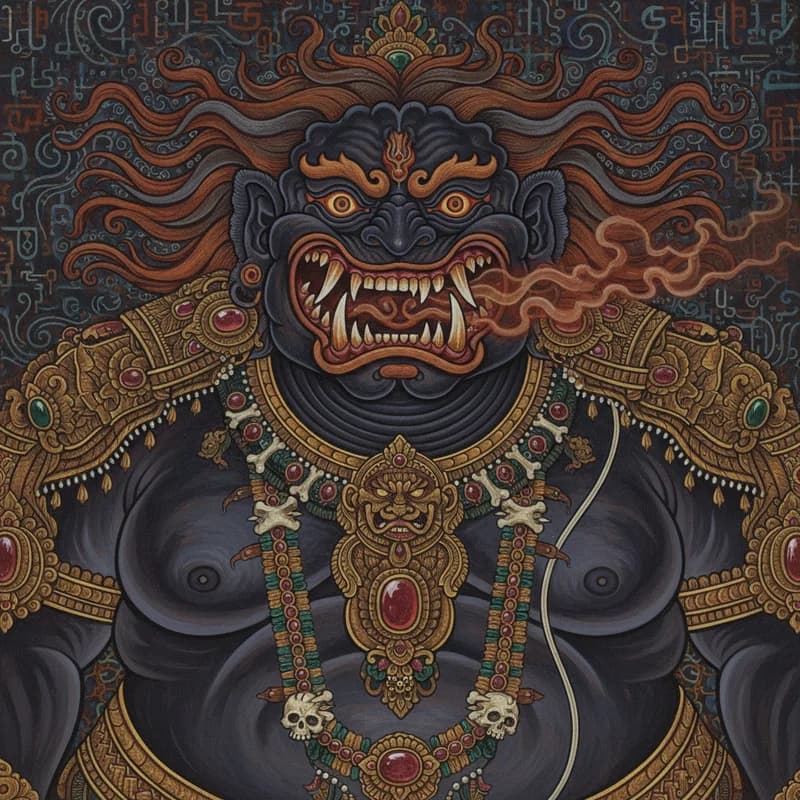
The Rakshasa is large — not in the way of a tall man, but in the way of something that has not learned to fit itself to human scale. The body shifts between states of excess: too broad, too heavy, too present in a room. Accounts from the forests east of the Godavari describe a figure that seems to occupy more space than its outline should allow, as though the air around it has been compressed into service. The skin runs dark — the colour of storm-bruised clouds over the Vindhyas in July, or the blackened earth around an old cremation ground. The hair, when described, is described as moving. Not in wind. In its own time.

The mouth is the feature that appears most consistently across the oral records from Karnataka, Odisha, and the older Valmiki passages both. It is too large for the face and understands this about itself. The teeth are described as copper-coloured in some accounts, iron-dark in others — the variation may be regional, or it may be that the Rakshasa shows different things to different witnesses. What does not vary is the smell: raw meat left in monsoon heat, iron and old blood, and beneath that something sweeter and more disturbing — the smell of cooked food, of a kitchen, of hospitality corrupted at its root. The Mahabharata's forest sections carry this detail without laboring it. The smell of welcome, wrong.

Movement is heavy and deliberate on the ground. In the air — and many accounts insist on flight, particularly in the older coastal traditions near Rameswaram — there is a sound like something very large displacing wind that should not be displaced. Witnesses near the Dandakaranya accounts describe a low subsonic pressure before arrival, felt in the chest before anything is seen. The eyes, when visible, are not luminous in the decorative sense. They are described as lit from behind by something that is not light — the way the interior of a kiln glows without flame, heat visible as colour, colour suggesting an interior process that has been running for a very long time.

Alternate Forms

The Rakshasa most commonly presents as a wandering sadhu — staff, ash-smeared forehead, the saffron of renunciation. It is a near-perfect choice of disguise. A sadhu travels alone, arrives at odd hours, eats whatever is offered, and asks for shelter without explanation. Rural hospitality codes make refusal difficult. The accounts from the Dandakaranya forest belt, which stretch from Bastar down into the Eastern Ghats, describe this figure appearing at the edge of firelight during the month of Ashwin, when the nights have just turned cold enough to justify a fire but not cold enough to keep doors shut. In the Bihar accounts, it appears near the ghats of the Gandak river at low water, when the sandbanks are exposed and the light plays tricks.

The tells are consistent across centuries of oral record, from the Ramayana's own interior testimony to the accounts I collected in Chhattisgarh in the 1990s. The sadhu's shadow does not behave correctly — it is larger than the body casting it, and in firelight it moves with a slight delay, as though it belongs to something heavier. Dogs will not approach, but they will not bark either. They simply leave. The offered food disappears too fast, without the sounds of chewing, and the sadhu's eyes, if you catch them in direct firelight, do not reflect orange — they reflect nothing, a flatness that experienced villagers in the Vindhya foothills describe as looking into a dry well. The hands are the most reliable sign: the fingers are one joint too long, and the nails, even on a figure presenting as ascetic, are immaculate.

A secondary form appears in the urban-adjacent accounts from Tamil Nadu's Kaveri delta — the Rakshasa as a well-dressed stranger at a funeral feast, someone whom every mourner assumes another mourner invited. It eats from the leaf plate with apparent normalcy. It offers condolences in the correct register. What breaks it is the eating itself: it finishes before everyone else, and then it watches. Not the bereaved, not the food. It watches the body.

Powers & Weaknesses

शक्ति और दुर्बलता

Known Powers

  • Shifts form mid-sentence without pause
  • Smells human flesh across three kos
  • Disrupts Vedic recitation by proximity alone
  • Grows stronger between the two twilights, sandhya
  • Cannot enter ground salted with Ganga water
  • Feeds on offerings left at unmaintained shrines

Known Weaknesses

  • Iron weapon forged on an auspicious Tuesday repels
  • Recitation of the Hanuman Chalisa at the threshold
  • Mustard seeds scattered across the sleeping area nightly
  • Sesame oil lamp burning through the Kartik night
  • Darbha grass woven into a ring worn on the finger
  • Cow urine sprinkled along the boundary of the home
  • Cannot cross a line drawn with red sandalwood paste

Known Locations

ज्ञात स्थान
  • Cremation-ground peripheries of Manikarnika Ghat during Kartik moonless nights, Varanasi, Uttar Pradesh
  • Dense sal-forest clearings of Saranda during the post-monsoon hunting season, Jharkhand
  • Abandoned river-island shrines of the Godavari delta at high flood, Andhra Pradesh
  • Crossroads of old caravan routes through the Vindhya foothills after dusk, Madhya Pradesh
  • Mangrove creek mouths of Bhitarkanika during the crab-harvest season, Odisha
  • Cliff-face temples of Badami in the dry months when pilgrims thin out, Karnataka
  • Bamboo-grove edges of Bastar plateau settlements on Diwali's darkest night, Chhattisgarh
  • Desiccated tank-beds of Hampi's ruined precinct in the height of summer, Karnataka

Historical Record

ऐतिहासिक अभिलेख

First Documented

Circa 1500–1200 BCE (Rigvedic period)

Last Recorded

Present

Source Language

Sanskrit

Origin

The Rakshasa's oldest textual life is in the Rigveda, where the word appears not as a proper class of being but as a functional description — one who does harm, who opposes the sacrifice. The Shatapatha Brahmana elaborates: when Brahma breathed out the first living beings, some cried *rakshama* — protect us — and became the protective Yakshas, while others cried *adama* — let us eat — and became the Rakshasas, the devourers. This etymology is almost certainly a later rationalization, the kind of neat cosmic accounting that Sanskrit commentators imposed on older, stranger material. The forest traditions of the Dandakaranya — that dense corridor running through what is now Chhattisgarh and Odisha — carry no such origin story. In those accounts, the Rakshasa was here before the sacrifice, before the Brahmin's fire, before the need for a name.

The Ramayana fixed the popular image in ways that are difficult to overstate. Valmiki's Rakshasas of Lanka — Ravana, Kumbhakarna, Vibhishana — are not simple monsters. They are scholars, warriors, devotees of Shiva, beings of immense cultivation and catastrophic appetite. The Uttara Kanda traces their lineage to Pulastya, a mind-born son of Brahma, which places them inside the same genealogical web as Brahmin sages. Oral traditions along the Godavari, particularly in the Nashik and Panchavati tracts where Rama's forest exile is locally mapped onto the landscape, preserve a more complicated Rakshasa than the textual villain. Several accounts collected around the Tryambakeshwar temple describe Rakshasas not as fallen creatures but as the original inhabitants of the forest — beings whose relationship to the sacred was lateral rather than subordinate, who recognized no obligation to the Vedic yagna and were therefore named its enemies.

The tension between these two streams — the Puranic account that makes Rakshasas cosmic deviants, and the forest oral tradition that makes them prior claimants — has never been resolved, and likely cannot be. In the Bastar region, where the Gondi oral tradition runs independently of Sanskrit textual authority, the being referred to as *Rakshas* in Hindi overlay corresponds to entities whose nature is not evil but territorial: they govern specific trees, specific river confluences, specific hours of the night. The Indravati River basin accounts, collected in the early twentieth century by Verrier Elwin himself, describe Rakshas-figures who punish trespass but do not devour randomly — who operate by a logic that is consistent, if alien to the Brahminical frame. That the Sanskrit tradition absorbed these regional beings under a single threatening name tells us more about the expansion of textual authority than it does about the beings themselves.

Discover More

संबंधित लोकगाथाएं

Related Lore

Case Reports

प्रकरण विवरण
Unverified
Deoghar3 March 1947

A village elder from somewhere in the Deccan — the informant would not name the place, only that it sat between two dry riverbeds — described a figure that appeared at the edge of the sorghum fields three nights before the monsoon broke, taller than the tallest man he had known, smelling of raw meat and iron, its shadow falling in the wrong direction relative to the moon. He had heard the old accounts from his own grandfather, knew the names one was not supposed to say aloud after dark, and said nothing. When asked what it wanted, he was quiet for a long time before saying he believed it was counting the children in the houses.

Source: Reconstructed field notes of Pandit Suresh Narayan Mishra, Santal Parganas Ethnographic Survey, Deoghar District Office, 1947.

View Full Case →