प्रतीक्षा करें
Consulting the Shastra archives…
प्रतीक्षा करें
Consulting the Shastra archives…

Aiyanar
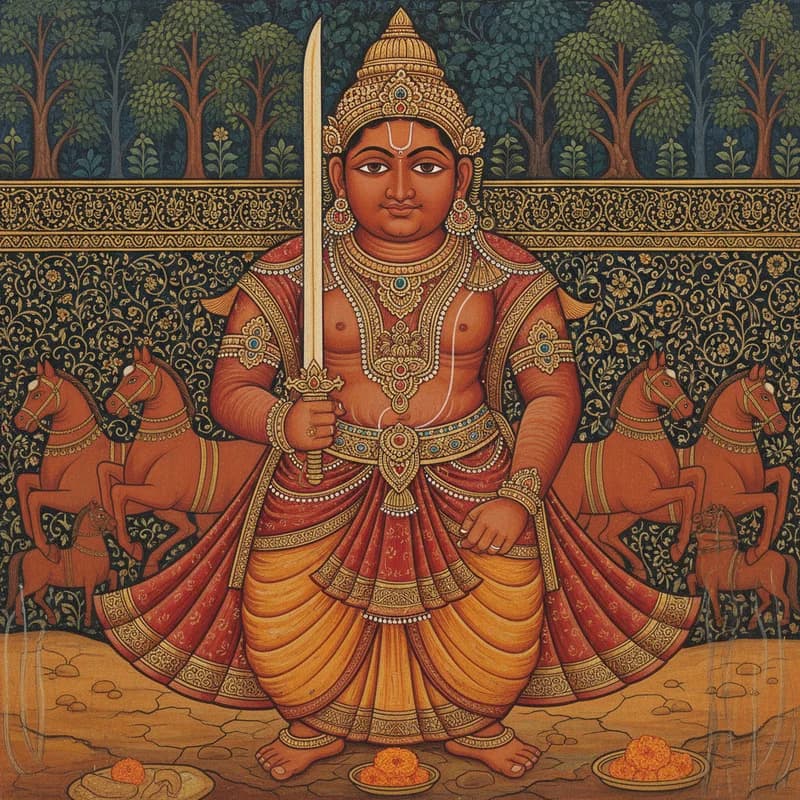
He guards the boundary, not the village. This distinction matters enormously to the communities of the Kaveri delta and the dry interior plains of Tamil Nadu, where Aiyanar's shrines sit precisely at the edge of cultivated land — not within it — facing outward toward the scrub jungle and the roads that arrive from elsewhere. The terracotta horses that flank his shrine can stand taller than a man, their necks thick as pillars, their painted eyes fixed on whatever approaches. Villagers commission new horses when they need something from him: safe passage through fever season, a good yield from the black cotton soil, a child who travels to Chennai and comes back whole. The horses accumulate over generations at some shrines, dozens of them in various states of weathering, the oldest ones crumbling back into the earth they were made from.
Aiyanar does not threaten those who acknowledge him. The caution in his record attaches to those who cross his boundary at night without the right understanding — travelers who take the field paths after dark during the month of Karthigai, or outsiders who treat the shrine as a curiosity rather than an active presence. Offerings here are not symbolic: toddy poured directly into the dust, meat left on banana leaf, the ritual completed without abbreviation. Accounts from the villages south of Madurai describe a heaviness that settles over a man who passes the shrine disrespectfully — not illness exactly, but a wrong-footedness that follows him home and doesn't lift until he returns and makes the thing right. His power is contractual. Honour the boundary he keeps, and he keeps it faithfully.
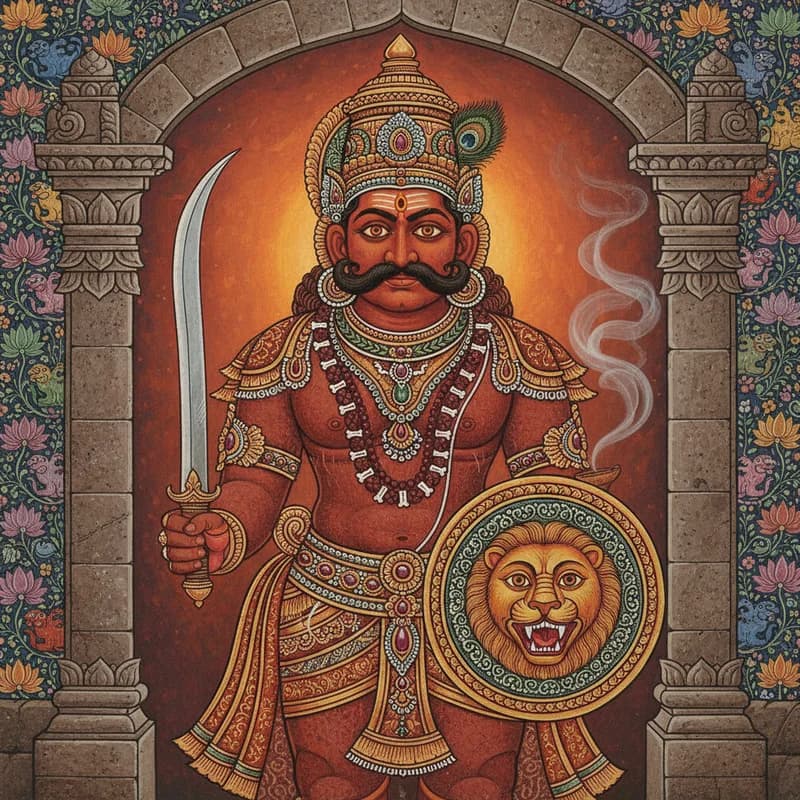
Aiyanar stands at the edge of things — the last field before the tree line, the unmaintained path between the paddy and the forest beyond Thanjavur's canal roads — and the accounts agree on his scale before they agree on anything else: a figure whose head clears the tops of the neem breaks, dressed in the red and ochre of a warrior-chieftain, with a sword held not raised but resting, the point touching the earth as though testing it for something. The face is broad and still, painted the deep terracotta of the horses that surround him, and in the accounts from Madurai's southern villages the skin carries that same kiln-fired quality — not flesh, not clay, but something between the two that has been standing in open weather for a very long time. What witnesses remark on most consistently is the sound that precedes him: the soft, rhythmic percussion of horse hooves on dry laterite, though no living horse is visible and the terracotta statues at the boundary shrine have not moved. The smell is toddy and old marigold, the specific sweetness of offerings left in the Tamil heat.
At the boundary paths between rice fields, particularly in the weeks after Pongal when the harvest is cleared and the paths are quiet, Aiyanar has been reported walking in the form of an older village watchman — the kind of figure whose presence at dusk raises no alarm, carrying a short staff and moving with the unhurried authority of a man who has patrolled the same ground for years. The tells are two, and both require attention. His footsteps produce no sound on dry laterite soil, even when the path is strewn with stubble that would crackle under any living weight. The second is stranger: the terracotta horses outside the boundary shrine, which stand fixed in all weathers, are said to be facing a different direction by morning — turned, always, toward wherever the figure was last seen walking.
First Documented
Aiyanar's earliest traceable presence surfaces in Sangam-era literature, where boundary guardian figures echo his protective function, though his name consolidates in inscriptions and temple records from the Pallava period onward, around the 7th century CE, rooted in the red-soil villages of the Kaveri delta and the Vaigai plains.
Last Recorded
Accounts of Aiyanar's presence at boundary shrines along the Kaveri delta and in the red-soil villages of Chettinad continue to be recorded into the 2020s, with Tamil farmers still reporting nocturnal sightings of a mounted figure patrolling field edges during the Karthigai season.
Source Language
Tamil
Origin
Aiyanar enters the written record in medieval Tamil Shaiva literature, most explicitly in the Tiruvilayadal Puranam, where he appears as a son of Shiva and Vishnu — the latter having assumed the form of Mohini — making him a sibling of Sastha, the deity worshipped at Sabarimala. The Brahmanical textual tradition works hard to domesticate him this way, folding a ferociously local presence into a manageable genealogy. The folk tradition of the dry interior districts — the red-soil country between Madurai and Tirunelveli, along the seasonal courses of the Vaigai's smaller tributaries — does not recognize this parentage as primary. There, Aiyanar is first and simply the boundary itself made watchful: not born of divine union but coeval with the village, called into being when the first field was marked off from the forest. The divergence matters because it locates authority differently — in the Puranic account, Aiyanar's power derives from celestial inheritance, but in the oral tradition of the tank-irrigation villages of the Kaveri delta
Frequently Asked
Aiyanar is a Tamil guardian deity who presides over village boundaries, forests, and the fields that lie between settled land and wilderness. Worshipped across Tamil Nadu and parts of Kerala, he is understood as a protector who patrols the margins of human habitation after dark, riding his horse through the night to ward off disease and malevolent spirits.
The colossal terracotta horses placed at Aiyanar shrines — often standing six to twelve feet tall — are mounts offered to the deity so he may ride out and guard the village through the night. Potters in villages near Thanjavur and Madurai have crafted these horses for generations, and a freshly installed horse is considered an active gift, not mere decoration.
Aiyanar is propitiated with toddy, meat, and occasionally roosters — offerings that mark him as a deity outside the Brahminic vegetarian tradition. These are left at boundary shrines, particularly before the harvest season and during the Tamil month of Aadi, when the boundary between the living world and other presences is considered thin.
Aiyanar is protective rather than predatory, but he demands respect and correct ritual observance — neglect him and the village boundary he guards grows porous to harm. Field accounts from villages along the Kaveri delta describe him as a deity of caution: generous to those who honor him, indifferent and potentially dangerous to those who do not.
Later Puranic traditions absorbed Aiyanar into the Shaiva fold, identifying him as a son of Shiva and Vishnu — the latter having taken the form of Mohini. This origin story, found in texts like the Skanda Purana, grafted a pan-Indian theological framework onto what was almost certainly an older, localized boundary deity of Dravidian folk religion.
Where Muniyandi and Karuppasamy are often associated with fierce, unpredictable energy and are propitiated to prevent active harm, Aiyanar occupies a more sovereign, patrolling role — he is the guardian of the threshold itself, not simply a force to be appeased. His shrines sit at the edge of the village, facing outward toward the forest or the uncultivated land, a spatial distinction that reflects his specific function.
In Tamil Nadu, Aiyanar shrines are typically open-air boundary sanctuaries with terracotta horses and attendant figures like Karuppasamy flanking him. Across the Palghat Gap into Kerala, he appears as Sastha or Ayyappa, a figure whose mythology diverges significantly, though scholars like David Shulman have traced the shared substratum of the boundary-guardian concept beneath both traditions.
Aiyanar appears in the Skanda Purana and in later Tamil Shaiva literature, though his deepest roots lie not in Sanskrit scripture but in oral tradition and the ritual knowledge of village priests called Pujaris, many of whom belong to specific hereditary communities in the districts around Tirunelveli and Pudukkottai. The terracotta horse tradition itself is documented in the ethnographic records of Edgar Thurston's early twentieth-century surveys of Madras Presidency.
संबंधित लोकगाथाएं
Related Lore
Algorithmic Inference
आपको यह भी पसंद आ सकता है
You May Also Like
Community Discussion
Comments are reviewed by AI before appearing publicly. Unsafe, unrelated, or uncertain comments go to human review.
Sign in to join the discussion.
0 comments
No public comments yet.