प्रतीक्षा करें
Awakening the Churel dossier…
प्रतीक्षा करें
Awakening the Churel dossier…

Ayyappan
Born of an impossible union — Shiva's seed and Vishnu's feminine form, Mohini — Ayyappan carries a contradiction at his core that the Sabarimala tradition has never tried to resolve, only to honour. He is celibate and fierce, a hunter-god who chose the forest over the court, the cold granite of Periyar's high ranges over any temple in the plains. His shrine sits at 914 metres in the Western Ghats, reachable only through the tiger reserve that once bore his name, through sal and teak and the sound of the Pamba river below. The mountain does not accommodate the casual visitor. It demands the forty-one days of vratha — bare feet, black cloth, a name surrendered for the duration: Swami.
What separates Ayyappan from the managed deities of the lowland temples is the quality of encounter his tradition insists upon. Pilgrims do not visit Sabarimala. They become temporarily other — celibate, barefoot, fed only twice a day, forbidden from mirrors. Accounts collected in Pathanamthitta district and among the Mala Araya communities of the Cardamom Hills describe him not as benevolent but as exacting: a god who tests rather than comforts, who withdraws his presence from those who arrive without preparation. The irumudikettu, the twin-sack carried on the head through the forest path, holds coconut oil for the lamp and provisions for the journey — but the old accounts say what it really carries is proof. That you came willing. That you came ready to be changed by cold, by dark, by the long climb through the Makara night.
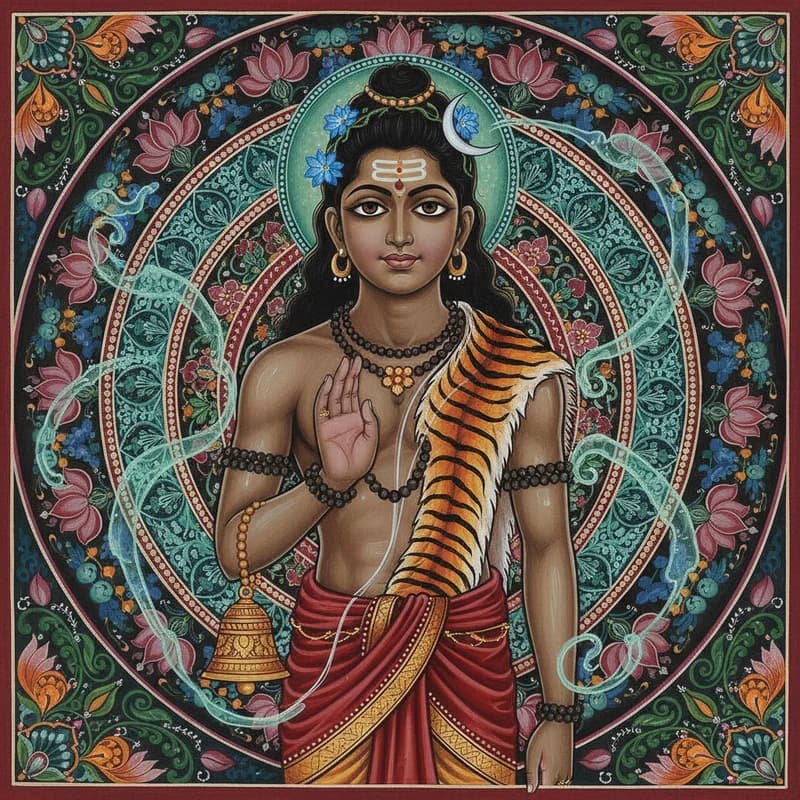
Ayyappan appears as a young man caught at the precise edge of adolescence — not a child, not yet fully a man, the body lean and dark-complexioned in the way of someone who has walked the Periyar forest for weeks without rest. He wears a simple loincloth, sometimes a tiger-skin draped across one shoulder, and carries a small bell whose sound, in the accounts of pilgrims who encountered his presence alone on the ghats of Pampa before dawn, arrives a full breath before any visible approach. The smell is camphor and wet forest floor — the specific cold-green smell of the Sahyadri undergrowth in the Mandalam season. What marks him as something beyond mortal is the stillness: witnesses consistently describe eyes that hold the focused vacancy of deep samadhi, open and unblinking, seeing something arranged behind the visible world.
Along the forest trails between Erumeli and the Sabarimala peak, during the Mandala season when pilgrims move in black-clad columns through the Periyar forest, Ayyappan is said to appear as a fellow devotee — a young man, lean and dark, wearing the same black dhoti and rudraksha beads as the thousands around him, carrying a small irumudi on his head with the ease of someone who has made this climb before. He falls into step with tired pilgrims near the Pamba riverbank, speaks little, and his Malayalam carries the flat, unhurried cadence of the hill districts. The tells are two: his irumudi, unlike every other pilgrim's, never shifts or requires adjustment across hours of steep climbing, sitting perfectly balanced without a steadying hand. And at the Shabarimala ghee-lamp light, where every face catches orange and shadow, his face catches neither.
First Documented
The earliest textual references to Ayyappan appear in the *Bhoothanatha Upakhyana*, a Sanskrit text likely composed between the 12th and 14th centuries, though oral traditions among the hill communities of the Western Ghats — particularly the Mala Arayan and Kadar tribes — suggest a far older, pre-Brahminic forest deity beneath the later Puranic overlay.
Last Recorded
Accounts of Ayyappan's presence in the forests of the Western Ghats — sightings of light moving through the Periyar tiger reserve at night, attributed to the deity's patrol — continue to be reported by pilgrims on the Sabarimala trek to this day, with the most recent oral accounts collected as recently as the 2023 Mandala season.
Source Language
Malayalam
Origin
Ayyappan enters the textual record through the Bhoothanatha Geetham, a Malayalam devotional text, and receives his fullest mythological treatment in the Bhoothanatha Upakhyana section of the Brahmanda Purana, where his birth from the union of Shiva and Vishnu's Mohini form is rendered as a cosmic necessity — the child produced to destroy the asura Mahishi. The Pandalam royal chronicles of central Kerala offer a parallel account, situating him as an abandoned prince discovered on the banks of the Pampa River and raised by the king of Pandalam before his divine identity was confirmed. Where the Puranic account emphasizes celestial origin and demon-slaying, the oral tradition of the Sabarimala foothills — preserved among the Mala Arayan and Kadar tribal communities who inhabit the Periyar forests — insists on his continuous, embodied presence in the Sahyadri hills, not as a historical figure but as a living forest intelligence still accessible to those who observe the forty-one-day vratha with genuine austerity. That divergence
Frequently Asked
Ayyappan is a Hindu deity born of the union between Shiva and Mohini, Vishnu's female form — making him the son of two of Hinduism's supreme gods. Worshipped primarily across Kerala and Tamil Nadu, he is the presiding deity of the Sabarimala temple, deep in the Periyar forests of the Western Ghats. His nature is that of a celibate warrior-ascetic, lord of the wild hills and guardian of those who undertake his pilgrimage.
Ayyappan commands the wilderness — the tigers, the dense shola forests, the unpredictable terrain of the Sahyadri hills are all under his protection and authority. He is credited with granting boons to sincere devotees, curing illness, and destroying demonic forces, most famously the demoness Mahishi, whom he slew on the banks of the Pampa river. His power is considered especially potent for those who observe the forty-one-day Mandala Kalam fast before ascending to Sabarimala.
When the demon Mahishi could only be killed by a son born of two male gods, Vishnu took the enchanting female form of Mohini and united with Shiva, and from that union Ayyappan was born. Found as an infant on the banks of the Pampa river in Kerala, he was raised by the childless king of Pandalam, who named him Manikandan. His divine identity was revealed when he rode a tigress back to the palace, an image still central to his iconography.
Black or dark blue clothing signals the period of strict celibacy, vegetarianism, and austerity that devotees observe for forty-one days before the Sabarimala pilgrimage — a physical marking of their vow. The irumudi, a double-compartment cloth bundle, carries coconuts filled with ghee for the deity's abhishekam in its front pouch and personal provisions in the rear. Carrying the irumudi on the head is considered mandatory; without it, no devotee may climb the eighteen sacred steps of the Sabarimala temple.
Both are warrior deities of South India associated with hills and forests, but their origins and temperaments are distinct. Murugan, son of Shiva and Parvati, is a god of war, beauty, and divine knowledge, worshipped at coastal and hilltop temples like Tiruchendur and Palani with music and elaborate ritual. Ayyappan, by contrast, is a celibate ascetic whose worship demands physical hardship, and his forest shrine at Sabarimala is deliberately austere — no women of menstruating age were traditionally permitted, a rule that has been the subject of significant legal and social debate.
Ayyappan does not appear in the ancient Vedic corpus or the major Puranas in the way Shiva or Vishnu do; his mythology is preserved primarily in the Bhoothanatha Gita and regional Malayalam and Tamil devotional literature. The Kanda Puranam and certain Shaiva texts reference the circumstances of his birth obliquely. Much of what is known about him comes from oral tradition maintained by the Pandalam royal family of Kerala and the priests of the Travancore region.
Ayyappan occupies a position that blurs the boundary between a fully realized deity and a deified hero — a category Indian tradition handles with considerable flexibility. In Kerala folk belief, he is sometimes spoken of as a Kshetrapalan, a guardian spirit of territory, whose presence is felt most acutely in the forests around the Periyar Tiger Reserve. Over centuries, however, his worship has been formalized into mainstream Shaiva-Vaishnava devotion, and today he is venerated as a full deity across South India and among the South Indian diaspora worldwide.
The trek to Sabarimala cuts through dense forest in the Pathanamthitta district of Kerala, a route that historically passed through territory with wild elephants, leopards, and the Pampa river in unpredictable monsoon flood. The pilgrimage season falls in the Mandala and Makaravilakku months — roughly December to January — when the forest is cold, wet, and difficult. Ayyappan's own mythology frames the hardship as intentional: the god of the wild demands that his devotees meet the wilderness on its own terms before they may stand before him.
संबंधित लोकगाथाएं
Related Lore
Algorithmic Inference
आपको यह भी पसंद आ सकता है
You May Also Like
Community Discussion
Comments are reviewed by AI before appearing publicly. Unsafe, unrelated, or uncertain comments go to human review.
Sign in to join the discussion.
0 comments
No public comments yet.