प्रतीक्षा करें
Tracing the Vetala’s last known location…
प्रतीक्षा करें
Tracing the Vetala’s last known location…
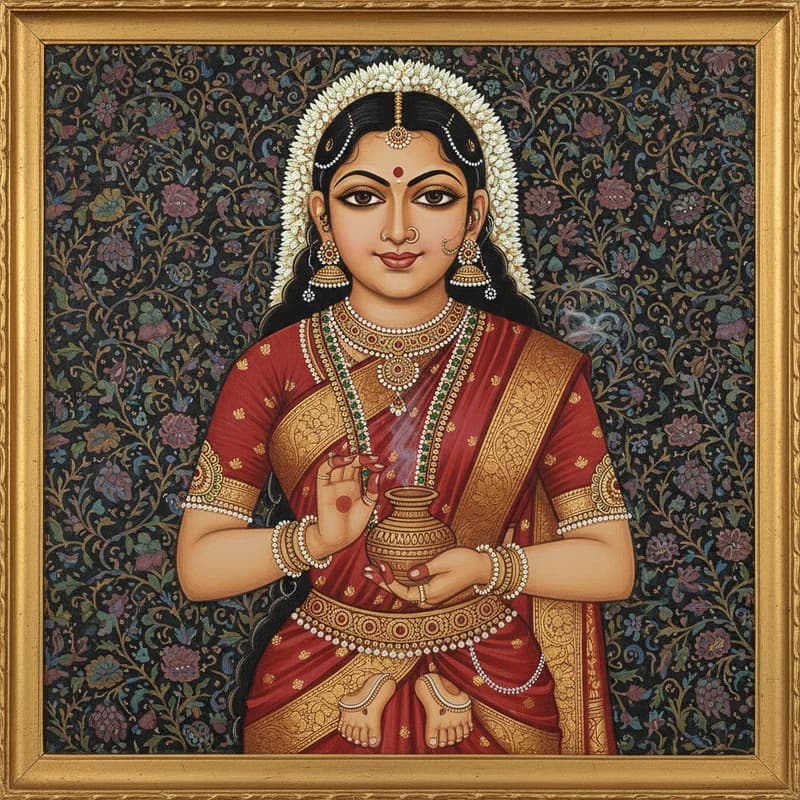

Mohini
She appears at the edge of villages, at the hour when the last oil lamp gutters out and the dark becomes complete. Every account collected from Kerala's Malabar coast to the ghats above Pune describes the same first detail: she is beautiful in a way that registers before the mind can form a thought. Travellers on the forest roads near Palakkad report stopping without knowing why, turning toward a figure they could not have seen in that darkness, feeling the decision to follow arrive in them like a memory rather than a choice.
What she wants differs by account, and that inconsistency is itself the warning. In the Ramayana she appears as Vishnu's own deception — the form taken to reclaim the amrita from the asuras at the churning of the Kshirsagar, a divine instrument of cosmic correction. But the Mohini of the folk record carries none of that sanction. She leads men into the teak forests of the Western Ghats and does not lead them out. She appears on the banks of the Periyar at monsoon's height, when the river runs brown and fast and a body carried into it will not surface for days. The Kattunayaka communities of the Nilgiris keep a specific prohibition: if a woman you have never seen before smiles at you on a forest path and turns away without speaking, you do not follow. You sit down where you stand, you do not look up, and you wait until you hear birds again.
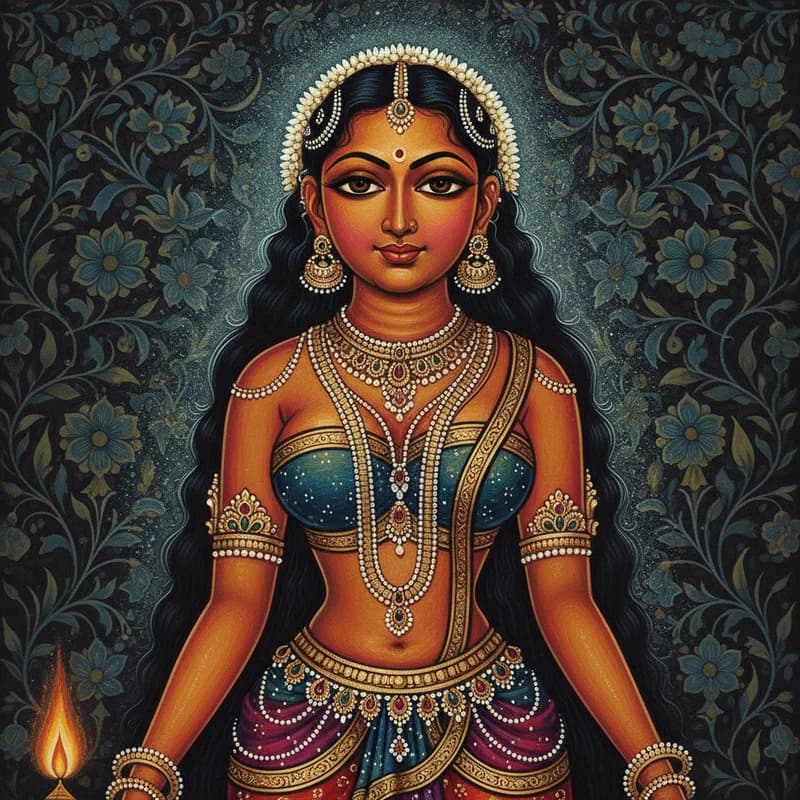
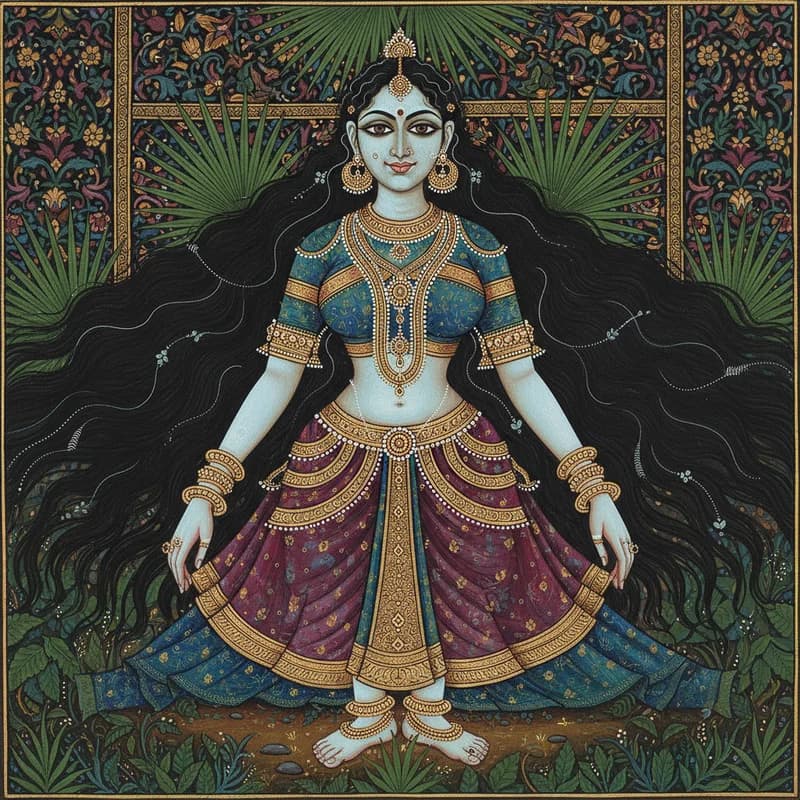
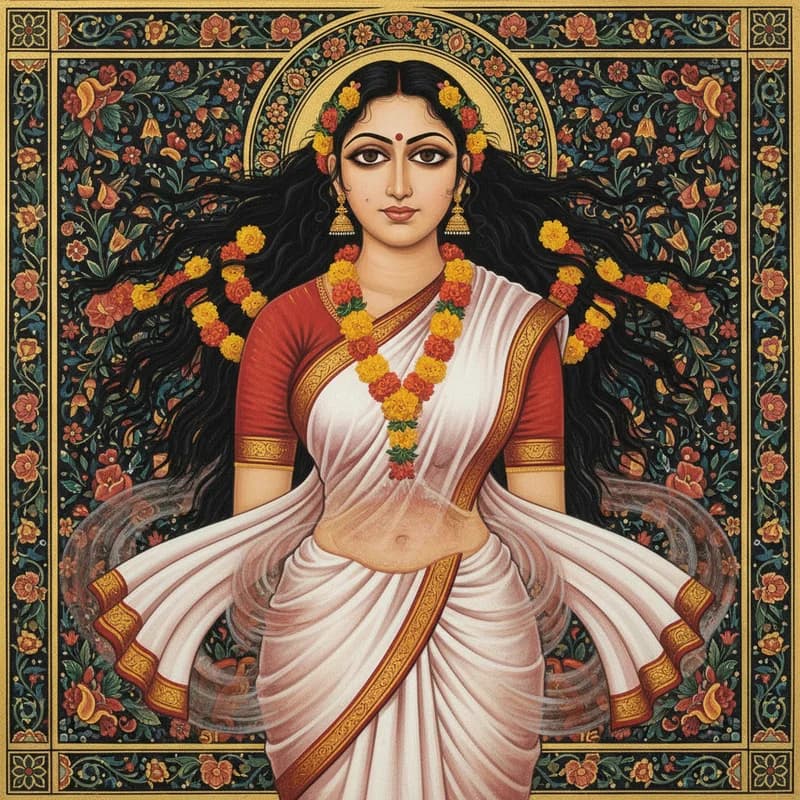
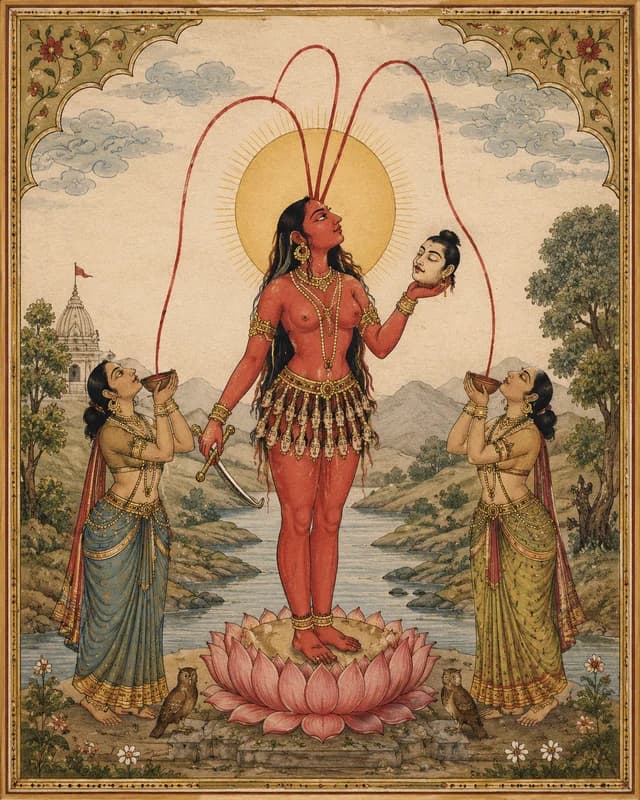
Mohini appears as a young woman of extraordinary conventional beauty — dark hair oiled and dressed with jasmine, a silk saree in the deep red of hibiscus or the pale gold of early-morning mustard fields, the kind of appearance that registers as perfection before the mind has time to question it. Accounts collected from the ghats of the Godavari and the teak forests of the Western Ghats describe her as the most beautiful woman a man has ever seen, which is precisely the problem: she is calibrated to the specific viewer, not universally identical, and two men standing side by side will each see something slightly different. She smells of fresh jasmine and something beneath it — water left standing in a copper vessel, faintly metallic, faintly wrong. The single consistent marker across all accounts is the feet: they face backward. Every other detail shifts, adjusts, perfects itself for the observer, but the feet do not lie.
At ferry crossings on the Krishna and the Godavari, particularly in the hour before the boatmen light their lamps, Mohini appears as a woman waiting passage — sari tucked correctly for wading, a brass water-pot balanced at her hip, the whole posture of someone who has simply missed the last crossing and is patient about it. The first tell is the pot: it never catches the sound of water shifting inside when she moves, though it should. The second is harder to name but easier to feel — she does not blink when the river-wind carries ash from the burning ghats across the water, and experienced cremation workers, who know what it means when eyes do not flinch from smoke, will not approach her under any condition. Both signs require composure to notice. Most men are not composed when a beautiful woman is waiting alone in the dark.
First Documented
Mohini appears first in the Bhagavata Purana and the Mahabharata, where Vishnu assumes her form during the churning of the cosmic ocean to deceive the asuras and distribute amrita to the gods alone. Her earliest literary presence is thus Vedic-adjacent, rooted in Sanskrit text
Last Recorded
Accounts of Mohini persist into the present day, with sightings reported as recently as the 2010s along the rubber plantation roads of Kerala's Thrissur and Palakkad districts, where truck drivers and night-shift workers describe a luminous woman who vanishes at the tree line. Oral accounts collected from
Source Language
Sanskrit
Origin
Mohini enters the written record in the Bhagavata Purana's eighth book, where Vishnu assumes the form of an enchantress to reclaim the amrita from the asuras during the churning of the cosmic ocean — a theological device, in that account, for demonstrating divine will working through illusion. The Mahabharata's Adi Parva carries a parallel telling, though the emphasis shifts toward seduction as a weapon of dharmic necessity rather than cosmic administration. Folk traditions of the Western Ghats, particularly among communities along the Periyar River in Kerala and the Sharavathi basin in the Malnad region, preserve an older and stranger account: here, Mohini is not a form Vishnu took and relinquished, but a spirit who inhabited Vishnu briefly and remained — a presence that escaped the god's control and wandered into the forests after the deception was complete. The Teyyam oral tradition of northern Kerala does not record her as a divine avatar but as a dangerous, autonomous figure, neither fully divine nor demonic, who takes mortal men into the rubber and teak groves and does not
Frequently Asked
Mohini is a shapeshifting enchantress who appears in the Bhagavata Purana's eighth book as the form Vishnu assumed to reclaim the amrita from the asuras during the churning of the cosmic ocean. In the folk traditions of Kerala's Western Ghats and the Periyar River basin, she is understood as something older and more dangerous — a presence that escaped divine control after that deception and has wandered the teak forests ever since. The Teyyam oral tradition of northern Kerala does not record her as an avatar at all, but as an autonomous spirit, neither fully divine nor demonic.
Mohini appears as a young woman of extraordinary beauty — jasmine-oiled hair, a silk saree in deep hibiscus red or pale mustard gold — calibrated precisely to the specific observer, so two men standing side by side will each see something slightly different. The single consistent marker across every account collected from the Godavari ghats to the Palakkad forest roads is her feet: they face backward. Every other detail shifts and perfects itself, but the feet do not lie.
Her classification depends entirely on which tradition you consult. The Bhagavata Purana and the Mahabharata's Adi Parva treat Mohini as a divine form — Vishnu's own illusion, a theological instrument of cosmic correction. Among the Kattunayaka communities of the Nilgiris and the Teyyam practitioners of northern Kerala, she is something else entirely: an autonomous, dangerous figure who inhabits the space between the divine and the demonic and belongs fully to neither.
Mohini can erase a man's memory of his wife's face and draw the devoted toward rivers like the Tungabhadra at dusk, where the current does the rest of her work. She appears only when jasmine blooms after midnight, speaks in the cadence of Vishnu's own voice, and causes sandalwood paste to melt on contact — a detail that experienced temple priests in the Malnad region treat as a reliable field sign. Her glamour is not universal but personal, which makes it far harder to resist.
Vishnu's name spoken aloud breaks the enchantment, and a tulsi mala worn at the throat repels her entirely. The Kattunayaka communities of the Nilgiris follow a more immediate protocol: if an unknown woman smiles at you on a forest path and turns away without speaking, you sit down where you stand, do not look up, and wait until you hear birds again. A brass lamp kept burning through the night will prevent her from entering a dwelling.
In the Bhagavata Purana and the Mahabharata, Mohini is a sanctioned divine deception — Vishnu's temporary form, relinquished once the amrita was reclaimed, a demonstration of dharmic will working through illusion. The folk record of the Periyar River basin and the Sharavathi valley in Malnad preserves a stranger account: here, Mohini is a spirit who inhabited Vishnu briefly and then escaped his control, wandering into the rubber and teak groves as something the god could no longer govern. That rupture between the theological and the folkloric is precisely where she becomes dangerous.
Accounts concentrate along Kerala's Malabar coast and the forest roads near Palakkad, with a significant cluster of reports from the banks of the Periyar at monsoon's height, when the river runs brown and fast. Ferry crossings on the Krishna and the Godavari — particularly in the hour before boatmen light their lamps — carry their own distinct tradition of her appearing as a woman waiting passage, a brass water-pot at her hip that never sounds of water when she moves. The Western Ghats, from the Nilgiris north through the Malnad teak forests, form the densest zone of oral record.
The connection is direct in the scriptural record: the Bhagavata Purana's eighth book names Mohini as Vishnu's own form, assumed to outwit the asuras at the churning of the Kshirsagar and reclaim the nectar of immortality. The Mahabharata's Adi Parva carries a parallel account that emphasises seduction as a weapon of dharmic necessity. What the folk traditions of the Western Ghats add — and what the Puranas do not — is the possibility that the form, once taken, did not fully return to the god.
संबंधित लोकगाथाएं
Related Lore
Algorithmic Inference
आपको यह भी पसंद आ सकता है
You May Also Like
Community Discussion
Comments are reviewed by AI before appearing publicly. Unsafe, unrelated, or uncertain comments go to human review.
Sign in to join the discussion.
0 comments
No public comments yet.