प्रतीक्षा करें
Illuminating the manuscript…
प्रतीक्षा करें
Illuminating the manuscript…
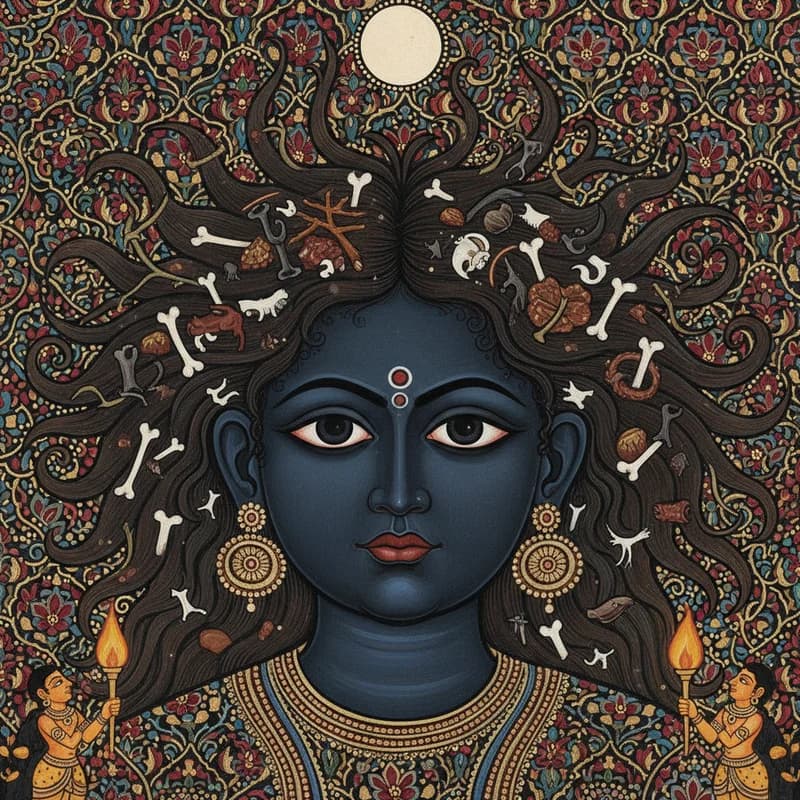

Kali
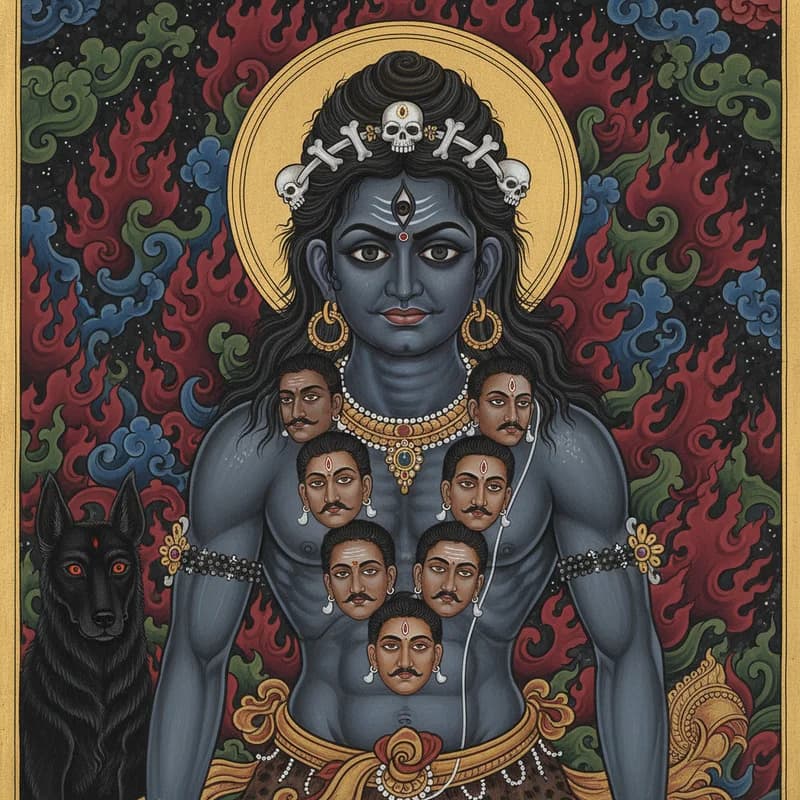
She moves through the margins — the edge of the teak forest where the path from Madurai's outer settlements loses confidence, the dry riverbeds of the Vaigai in summer when the water has pulled back and left white sand and silence. This is not the Kali of temple iconography, the cosmic destroyer garlanded in skulls above Shiva's chest. That figure belongs to stone and ritual and the Shaiva theological tradition. This one belongs to no institution. She is older than the temples built in her approximate image, and the distinction matters: the villagers of the Cumbum Valley and the forest-edge communities near Kodaikanal's lower slopes understand immediately and precisely which Kali you mean when you speak of her in the wrong place at the wrong time.
She does not stalk. She waits, and her waiting has a quality that hunters and woodcutters describe the same way across accounts separated by decades and a hundred kilometers — a sudden heaviness in the air, a cessation of birdsound, the feeling that the tree line has moved closer than it was a moment ago. Menstrual blood, the first blood of a newly slaughtered goat, a coconut broken at a forest boundary stone: these are not worship in any devotional sense but negotiation, the acknowledgment of a prior claim. Failing that acknowledgment does not guarantee encounter, but the accounts from the Palani foothills suggest it removes whatever buffer ordinarily exists between her attention and the person who has entered her ground. She has never been fully propitiated, only temporarily satisfied.
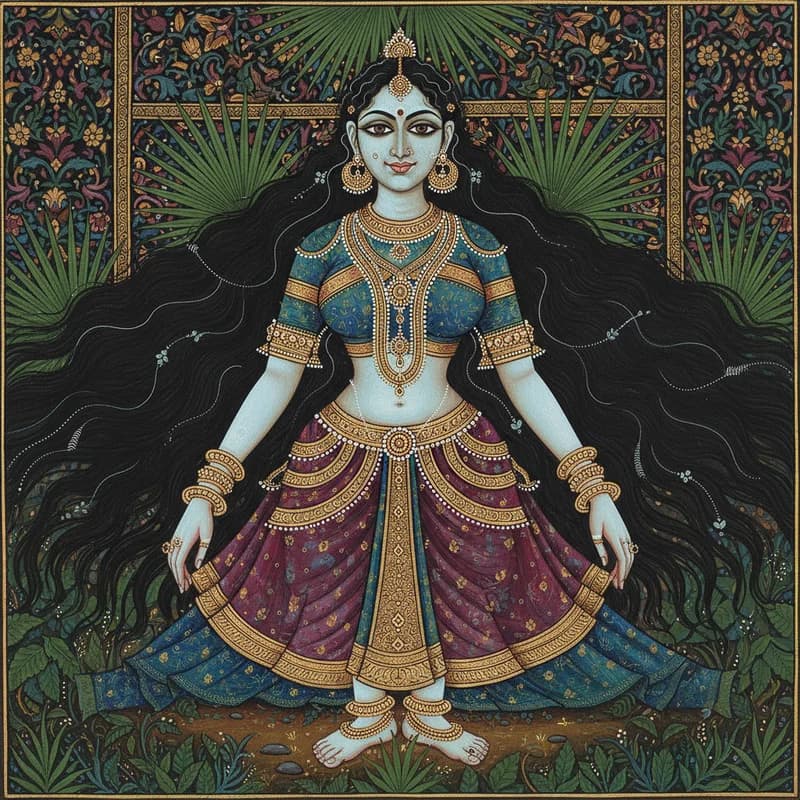
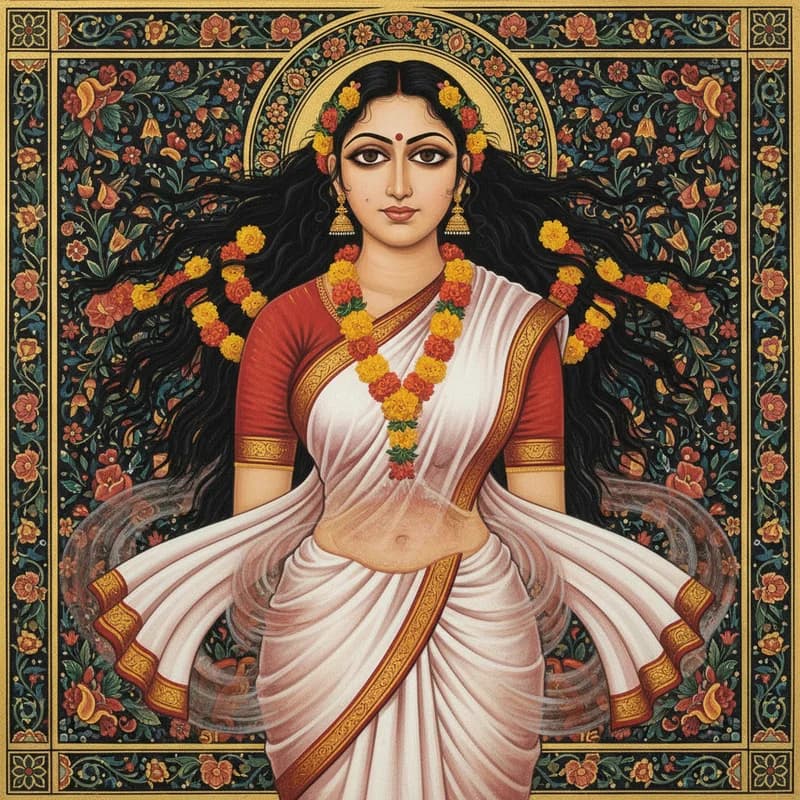
She appears as a woman of extreme height — accounts from the Nilgiri foothills and the Palni forest margins describe her as taller than the tallest teak, her proportions human but wrong in the way a shadow thrown at noon is wrong. The skin is the colour of deep water at the Kaveri's monsoon peak, almost black, with a surface that seems to absorb rather than reflect the torchlight brought to her shrines. Her hair is unbound and matted with forest debris — broken twigs, red earth, the small bones of what she has eaten — and moves without wind. The smell that precedes her arrival is iron and wet soil, the specific smell of a freshly opened pit in laterite country. The single feature witnesses cannot explain away: she casts no shadow, even when the moon at Kodaikanal is full and the forest floor is bright enough to read by.
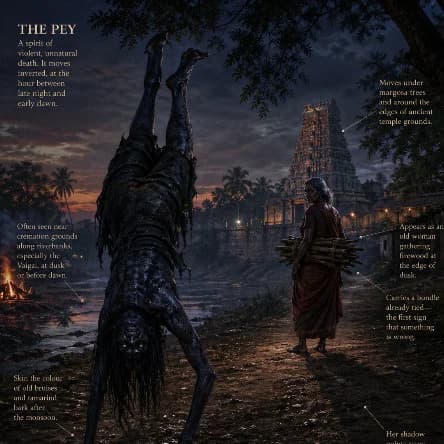
In the forests edging the Javadu Hills, where the Palar's tributaries run shallow and red with laterite silt through the dry months, Kali is most often reported in the form of an older woman gathering firewood at the wrong hour — not midnight, which anyone would question, but the hour just before dusk when the light fails unevenly under the canopy. She carries a proper headload, properly bound. The first tell is the wood itself: it does not creak or shift as she walks, though green wood always moves. The second is the direction she walks — always deeper in, never toward any settlement, regardless of how the path bends, as though the village at the path's end simply does not register in whatever she is navigating toward.
First Documented
The Tamil Kali, distinct from the Sanskritic goddess, surfaces in Sangam-era poetry — particularly within the Akananuru and Purananuru — where she haunts cremation grounds and forest margins, a wild, blood-hungry presence invoked by warriors before battle and by women cursing faithless lovers.
Last Recorded
Accounts of Kali as a forest spirit — distinct from the Shaiva goddess — persist in oral testimonies collected from villages bordering the Kalakkad-Mundanthurai forests, with the most recent documented sightings reported during the 2019 Panguni Uthiram season; she has not receded into the past.
Source Language
Tamil
Origin
The Tamil Kali — காளி — must be distinguished from the Śākta goddess of the Devi Mahatmya, though the two have been in conversation for centuries in ways that obscure the older figure. The earliest textual trace appears in Sangam-era poetry, where a goddess called Korravai presides over the forest and the battlefield, demanding blood, and scholars including Kamil Zvelebil have argued that the Tamil Kali of village tradition descends from this Korravai stratum rather than from the Puranic synthesis. Where the textual tradition absorbed the forest spirit into a cosmological framework — giving her a husband, a mythology, a role in the churning of cosmic events — the oral tradition of the Nilgiri foothills and the Javadhu Hills preserves a figure who answers to no such structure. In accounts collected in settlements along the Palar River's upper reaches, she is not a deity who can be propitiated through devotion so much as a presence in the teak and bamboo that must be acknowledged before any tree is felled or any land is broken. That divergence is revealing: the
Frequently Asked
The Tamil Kali (காளி) is a fierce female spirit tied to wilderness and boundary spaces — forests, cremation grounds, the edges of cultivated land — distinct from the pan-Indian goddess Mahakali of the Shakta tradition. Where the goddess belongs to temple theology and Sanskrit texts like the Devi Mahatmya, this spirit belongs to oral tradition, propitiated at small shrines beneath neem trees or at the margins of villages in Tamil Nadu. Conflation of the two is common but misleading.
She is most strongly associated with dense forest tracts, uncultivated scrubland, and the cremation grounds that sit outside Tamil village boundaries — spaces the living cross with unease. Accounts collected near the Palani Hills and along the Kaveri's upper tributaries describe her presence as a sudden cold in the air, a smell of turmeric and blood where neither should be. She is a spirit of thresholds, not temples.
Both, depending entirely on whether she has been properly acknowledged. Neglected, she brings illness, crop failure, and madness to those who disturb her forest spaces without offering respect. Appeased through the correct rituals — which in many villages still include animal sacrifice during the Panguni Uthiram season — she can shield a community from outside harm and disease.
Blood sacrifice is the traditional core of her propitiation, most commonly a rooster or goat offered at a boundary shrine, often a rough stone daubed with vermilion rather than a carved image. Cooked rice, raw turmeric, and arrack are placed alongside the offering. The ritual is typically conducted by a community priest from non-Brahmin traditions, and the ceremony intensifies during the dry summer months when the forest feels most hostile.
Oral accounts from villages near the Nilgiri foothills describe her as a tall, dark woman with loose, unbound hair — a significant marker of dangerous female power in Tamil folk belief — and eyes that glow faintly in darkness. She is sometimes said to carry a severed head or a sickle, and her feet are described as turned backward, a common identifier of malevolent spirits across South Indian traditions. She is rarely seen fully; most accounts describe only a glimpse at the edge of torchlight.
She does not appear in Sanskrit canonical texts, which is itself significant — her authority comes from oral transmission, village ritual manuals called puja paddhatis, and the songs of local Amman traditions rather than from written scripture. Some scholars trace her lineage to the Korravai, the ancient Tamil war goddess described in Sangam-era poetry like the Purananuru, a fierce deity of the forest and battlefield who predates Brahminic influence in the region. The connection is debated but the temperament is unmistakably similar.
Mariamman is a goddess of disease and rain, worshipped in established temples with a settled, if fearsome, relationship to the community — she punishes but she also heals, and her iconography is relatively standardized. The Tamil Kali spirit is wilder, less domesticated, and her shrines are deliberately kept outside the village proper. Mariamman belongs to the settlement; Kali belongs to what lies beyond it.
Possession is well-documented in accounts from Tamil Nadu's rural interior, particularly among women and during periods of communal stress such as drought or epidemic. The possessed individual, called an aaviyal in some village traditions, is understood to be a vehicle for Kali's communication rather than a victim — she speaks through them to announce grievances or demands. Exorcism is rarely the goal; the community listens, negotiates, and offers what is asked.
संबंधित लोकगाथाएं
Related Lore
Algorithmic Inference
आपको यह भी पसंद आ सकता है
You May Also Like
Community Discussion
Comments are reviewed by AI before appearing publicly. Unsafe, unrelated, or uncertain comments go to human review.
Sign in to join the discussion.
0 comments
No public comments yet.