प्रतीक्षा करें
Unfolding the scroll…
प्रतीक्षा करें
Unfolding the scroll…
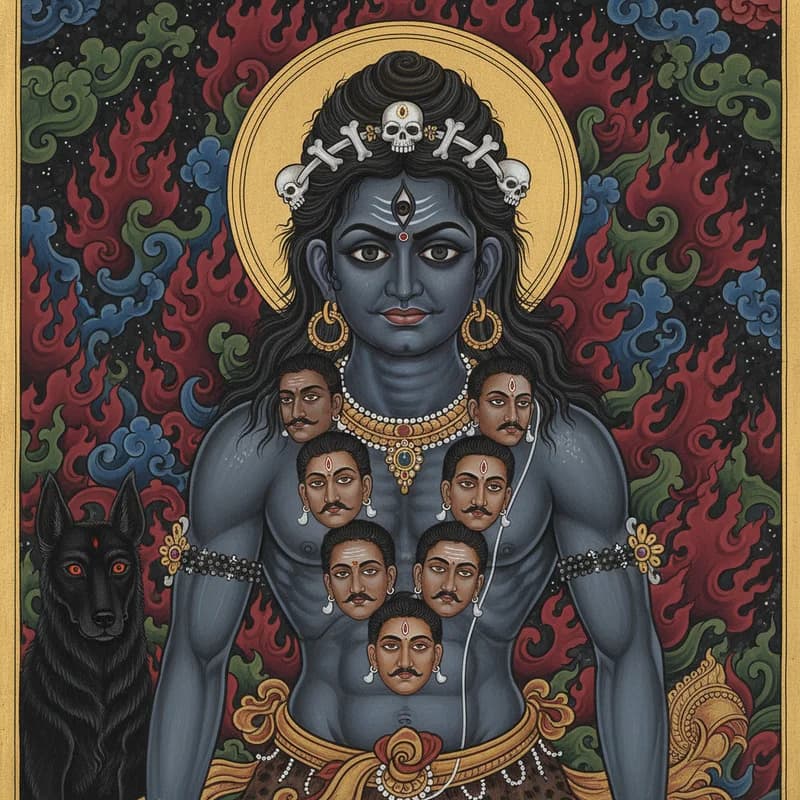

Bhairava
He walks the cremation grounds at Manikarnika before the first boats reach the Ganga in the morning, and the priests there will tell you — quietly, without meeting your eyes — that certain offerings left at the burning ghat disappear before dawn in ways that cannot be attributed to dogs or wind. Bhairava is not a demon, and treating him as one is the kind of error that accumulates consequences. He is Shiva's most terrible aspect made autonomous: the punisher of transgression, the guardian of thresholds, the one who takes what the orderly world refuses to process. The *Kashi Khanda* places him as the permanent lord of Varanasi, and that text is not speaking metaphorically. Every death in that city passes through him.
His iconography is consistent across the Shaiva traditions of Rajasthan, the Deccan, and the Himalayan foothills: black-skinned, carrying a severed head, attended by a dog that most accounts treat as his true form when he moves unrecognised among people. Temples at Ujjain and Bhairavgarh maintain his worship with offerings of meat and liquor that orthodox Vaishnavas find scandalous, but the offering logic is sound — Bhairava governs what exists outside the boundaries of the pure and the sanctioned. He does not threaten the righteous. He becomes the threat when rules are broken and the ordinary mechanisms of accountability fail. Accounts from the Malwa plateau describe him appearing to those who have escaped human justice, not with violence but with a proximity that does not relent — following at the edge of vision, patient as debt.
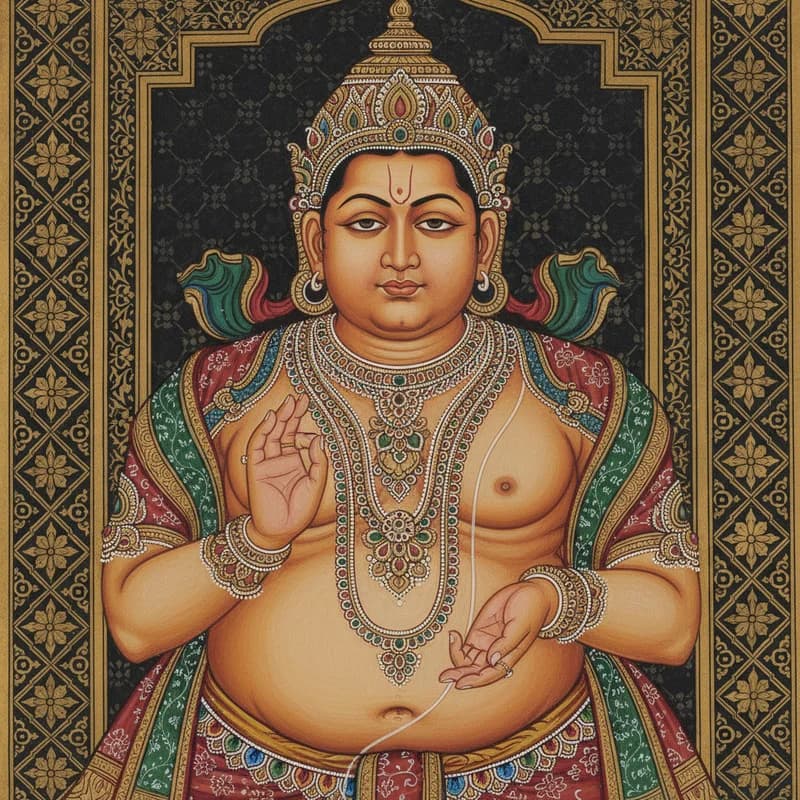
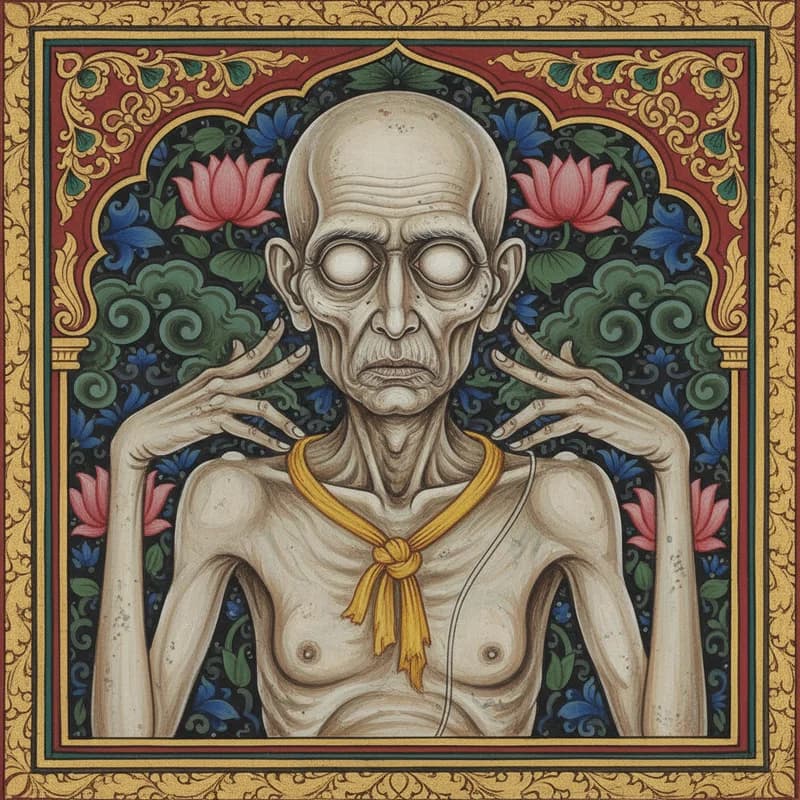
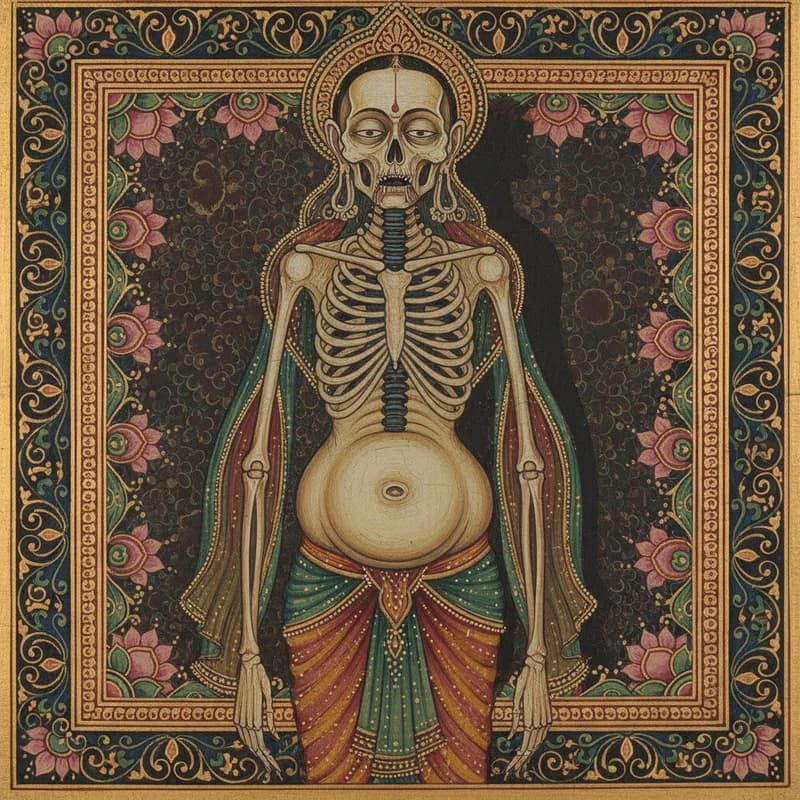
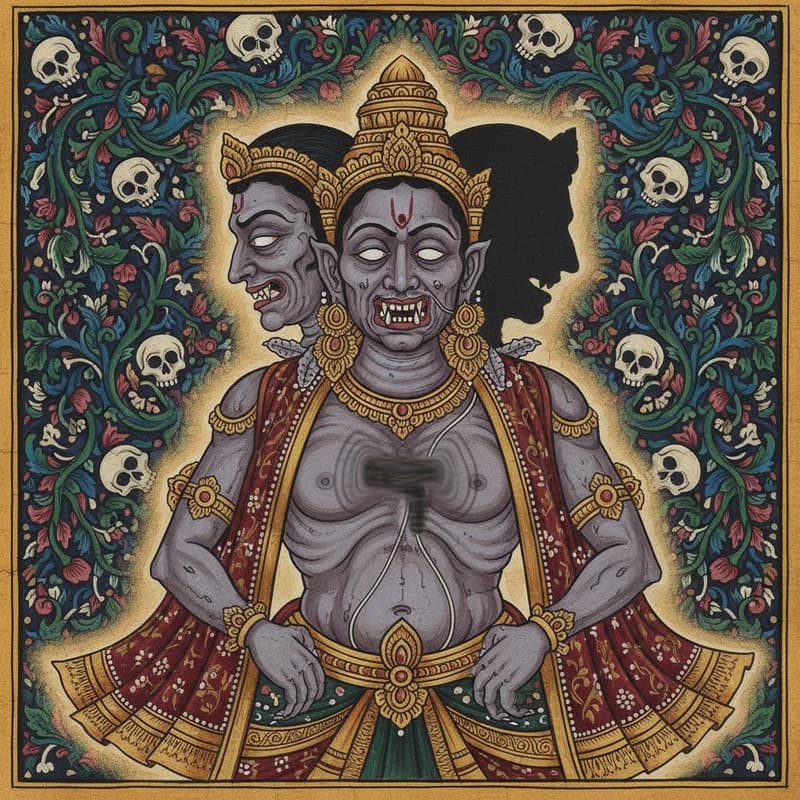
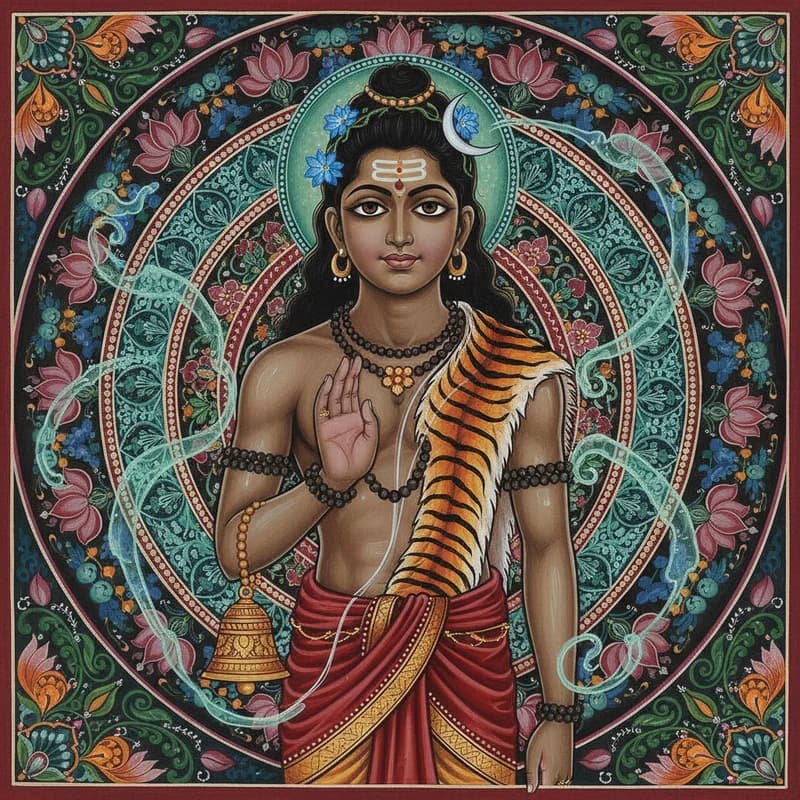
Bhairava appears as a man of middle years whose body carries the contradictions of extreme austerity and extreme excess — the ribs countable beneath skin the colour of a monsoon sky at dusk, deep blue-grey, yet the arms thick with the kind of strength that suggests something other than muscle. The matted locks are piled and pinned with fragments of bone, not decoratively but practically, the way a laborer ties back hair before work. Around the throat, the garland is not flowers but severed heads, each face wearing the specific expression of its final moment, neither horror nor peace but something between. The smell that precedes him is cremation ash carried on cold air, the particular cold of the burning ghats at Manikarnika in January before dawn. The single detail that undoes the human reading: his dog — always present, always watching the witness rather than its master.
Bhairava moves through the lanes of Varanasi as an ash-smeared ascetic — not unusual near the Manikarnika ghat, where sadhus are as common as crows. He carries a staff and a begging bowl, walks barefoot on the burning-ground stones without flinching, and speaks in the clipped Awadhi of someone who has been on the road a long time. The first tell is the dog. There is always one at his heel, a lean, dark animal that does not sniff at food scraps or flinch at cart-wheels, but watches the faces of passers-by with an attention that no dog has any business showing. The second is subtler: the ash on his body does not shift or smear, not in rain, not when he sweats — it sits on the skin like something painted there before birth.
First Documented
Bhairava's earliest textual appearance is in the *Shiva Purana* and the *Kurma Purana*, where his origin is narrated as the moment Shiva severed Brahma's fifth head in cosmic rage. Oral traditions from the ghats of Varanasi, however, suggest his cult predates these Sanskrit codifications by several centuries.
Last Recorded
Accounts of Bhairava persist without interruption — village priests at the Kal Bhairav temple in Varanasi still report visitations during the moonless nights of Kartik, and field recordings from Rajasthan's Thar settlements as recently as 2019 document offerings made after unexplained disappearances of livestock near crossroads shrines.
Source Language
Sanskrit
Origin
Bhairava enters the written record in the Shiva Purana's Rudra Samhita, where his origin is fixed as a specific violent act — the severing of Brahma's fifth head — and the subsequent wandering as expiation, Brahma's skull fused to Shiva's hand until he reached the ghats of Varanasi and the city's earth itself absorbed his sin. The Kashi Khanda of the Skanda Purana elaborates this into a theology of place: Varanasi becomes the only ground where such a debt can be discharged, which is why Bhairava remains its Kotwal, its city guardian, to this day. The oral tradition of the Nath Panthi lineages in Rajasthan and the Shaiva cremation-ground practitioners of Ujjain do not begin with the beheading at all; in their telling, Bhairava existed before Brahma's creation and the episode is merely the moment he made himself legible to gods who had not yet learned to see him. That divergence is not incidental — it separates a Puranic narrative
Frequently Asked
Bhairava is a fierce, uncompromising form of Shiva, born from divine wrath when Brahma spoke with arrogance and Shiva severed one of his five heads. Worshipped across India from the ghats of Varanasi to the cremation grounds of Ujjain, he presides over time, death, and the dissolution of ego. His name derives from the Sanskrit root meaning 'terrible' or 'one who destroys fear.'
Bhairava commands dominion over time — the Kala Bhairava form is explicitly called the Lord of Time, believed to govern the cosmic clock at Kashi. He grants protection to sincere devotees while punishing transgressors with swift, merciless consequence. Tantric texts like the Kaulajnananirnaya credit him with the power to bestow siddhi, or supernatural attainment, to initiated practitioners.
Shiva in his benevolent aspect — Shankara, the auspicious one — is the meditating ascetic of Mount Kailash, serene and withdrawn. Bhairava is that same deity stripped of gentleness, the aspect that wanders cremation grounds, skull-bowl in hand, accompanied by dogs and ghosts. Where Shiva represents transcendence, Bhairava embodies the terrifying immediacy of divine justice in the material world.
The severed head Bhairava carries is Brahma's fifth skull, the consequence of his act of Brahmahatya — the sin of killing a brahmin. Condemned to wander as a penitent, he roamed until he reached Varanasi, where the skull fell from his hand and his sin was absolved at the site now known as Kapalamochana Tirtha. This narrative, recorded in the Shiva Purana, transforms Bhairava from executioner into penitent, making him a deity who understands transgression from the inside.
Regional variation in Bhairava's worship is striking. In Varanasi, Kala Bhairava is the city's Kotwal — its divine magistrate — and devotees offer him wine at his temple on Bhairava Kund lane. Across Maharashtra and into the Deccan, he appears as Bhairavnath, a village guardian whose shrines sit at crossroads and field boundaries, protecting crops and livestock through the monsoon months.
The Shiva Purana contains the foundational account of Bhairava's origin and his wandering penance. Tantric literature, particularly the Bhairava Tantras — a cluster of sixty-four texts within the Shaiva Agama tradition — treat him as the supreme deity of esoteric practice. The Skanda Purana also records his role as guardian of Kashi, the city on the Ganga that no soul may leave without his permission.
The black dog that accompanies Bhairava is not merely a pet but his vahana — his vehicle and an extension of his nature. Dogs in Indian folk belief are liminal creatures, comfortable at thresholds between the living and the dead, and Bhairava's association with them marks him as a deity of boundaries and the in-between. Feeding stray dogs, particularly on Sundays and the eighth lunar day, is considered an act of direct devotion to Bhairava across northern India.
Bhairava is catalogued at a caution level — not because he is malevolent, but because he is exacting. Oral accounts collected from priests at the Kal Bhairav temple in Ujjain consistently describe him as a deity who rewards sincerity and punishes pretense without delay. Approached with genuine humility and proper ritual observance, he is considered among the most protective forces in the Shaiva tradition.
संबंधित लोकगाथाएं
Related Lore
Algorithmic Inference
आपको यह भी पसंद आ सकता है
You May Also Like
Community Discussion
Comments are reviewed by AI before appearing publicly. Unsafe, unrelated, or uncertain comments go to human review.
Sign in to join the discussion.
0 comments
No public comments yet.