प्रतीक्षा करें
Consulting the Shastra archives…
प्रतीक्षा करें
Consulting the Shastra archives…
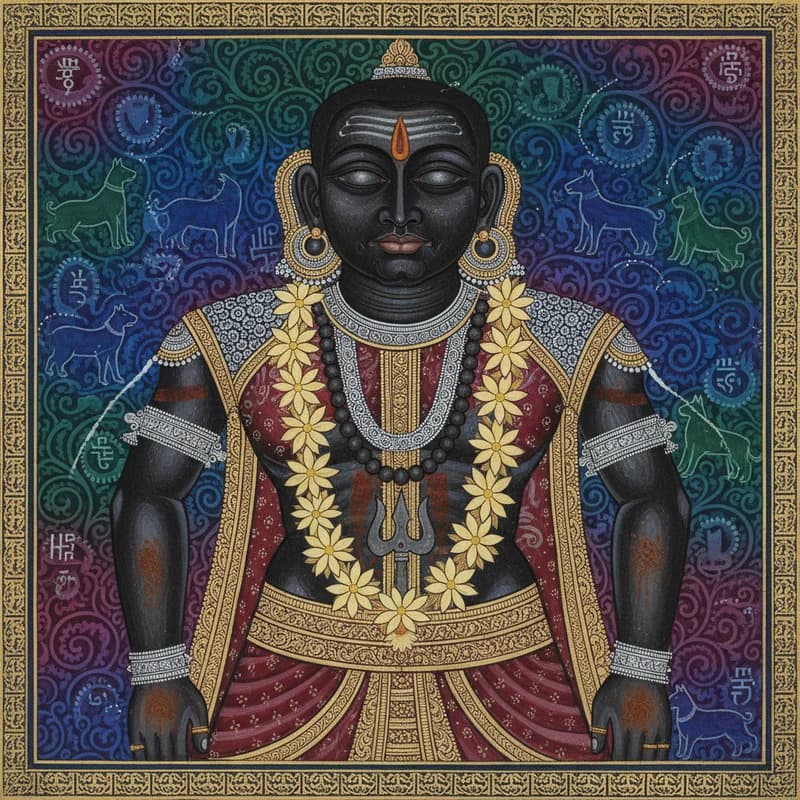

Bhairu
At the edge of almost every village in Rajasthan — past the last house, before the scrub desert begins — you will find him. A rough stone smeared with sindoor, a clay lamp, sometimes a small iron trident driven into the cracked earth. Bhairu watches the boundary. He is the localized, weathered-down form of Bhairava, Shiva's most ferocious aspect, but centuries of village life have shaped him into something more intimate and immediate than any temple deity. Herdsmen from the Thar know his name before they learn to write. Potters in the villages outside Jodhpur still pour a little liquor on his stone before a long journey, and women carrying new infants across a village boundary whisper his name before they cross.
His protection is conditional and his memory is long. Oaths sworn at his stone — over water rights, over the division of inherited land, over the settling of blood disputes — carry a weight that ordinary contracts do not. Break one, and the accounts from the Marwar region are consistent: the cattle sicken first, then the well turns brackish, then something begins to follow the offender along the paths between fields at dusk, keeping just at the edge of vision. He does not pursue across the boundary into the wider world. His jurisdiction is local, fixed, and entirely serious. Priests at the Bhairava shrines along the Chambal's upper reaches will tell you that Bhairu is not cruel — but they say it carefully, the way you describe a man whose goodwill you depend on and whose anger you have seen.
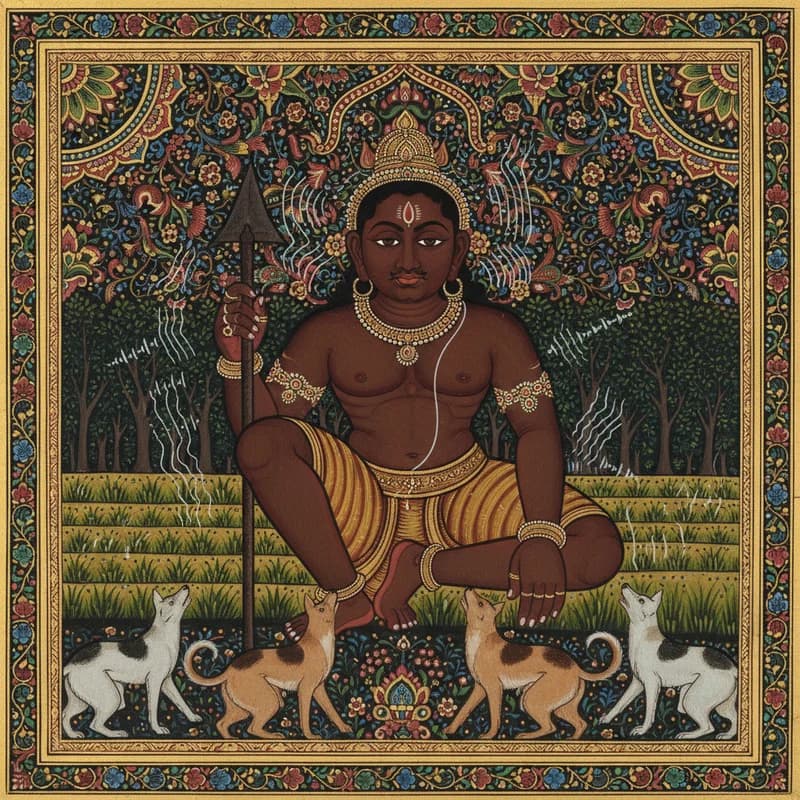
Bhairu appears as a squat, dark-complexioned man, barely five feet tall, with a soldier's breadth through the shoulders and arms that seem slightly too long for the body — the proportions of something carved in haste from black basalt. The face is flat and wide, the eyes not luminous but deeply matte, absorbing light rather than reflecting it, like the surface of a tank in the Thar summer before the rains. He smells of raw mahua flowers and iron — the specific iron-smell of a blade kept oiled but never sheathed. Witnesses near Jodhpur and along the Luni basin describe an accompanying sound: a low, continuous vibration felt in the back teeth rather than heard, the frequency of a bell struck and never allowed to stop ringing. The single mark that separates him from a living man is that dogs go completely silent in his presence — not frightened, but stilled, as if they have recognized an authority older than fear.
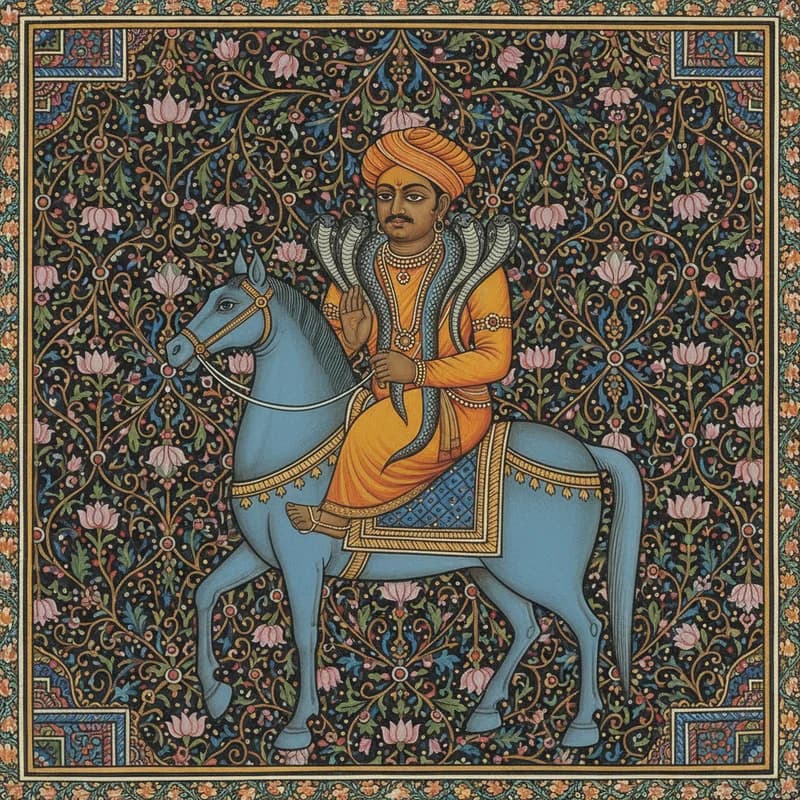
At the edge of Rajasthani villages — near the boundary stones along the road from Jodhpur to Barmer, or at the dried-out nullahs where the scrub desert begins — Bhairu appears as an old watchman, turbaned and wrapped in a dark shawl, seated with his back against a boundary wall at the kind of hour when no legitimate traveler would stop to question him. He carries a lathi across his knees. The first tell is the dogs: every village dog within earshot falls silent when he is present, not cowering but simply still, as though waiting for a command. The second is that those who have made an oath and broken it report that when they pass him, his head turns to follow them — not quickly, not threateningly, but with the slow, complete certainty of recognition.
First Documented
Bhairu's earliest traceable presence surfaces in the Rajasthani oral tradition of the medieval period, where village boundary stones bearing his name appear alongside references in the *Nath Panth* devotional literature circulating through the Marwar and Mewar regions; his identification with Bhairava connects him to the *Shiva Purana's* account of Bhairava's origin from Shiva's wrath.
Last Recorded
Accounts of Bhairu persist into the present, with field recordings from the Thar's edge villages near Nagaur and Barmer as recent as the 2010s documenting oath-taking rituals at boundary shrines; in Rajasthan's rural interior, his presence is treated not as history but as ongoing fact.
Source Language
Rajasthani
Origin
Bhairu enters the textual record as a regional refraction of Bhairava, Shiva's wrathful form catalogued in the Shiva Purana and elaborated in the Tantric corpus of the Kaula tradition, where Bhairava presides over cremation grounds and the dissolution of ego. The Rajasthani village form, however, diverges sharply from this cosmological inheritance. At the boundary stones of villages in Marwar and Shekhawati — rough-hewn rocks smeared with sindoor and mustard oil, sometimes nothing more than a fissured stone beneath a khejri tree — Bhairu is not the destroyer of cosmic illusion but a local functionary: keeper of oaths sworn on his name, punisher of cattle thieves, enforcer of the word given between neighbors. Oral accounts collected from Nagaur and Barmer districts insist he was once a man, a headman killed at the village's edge while defending it, absorbed into the boundary he died protecting. The textual Bhairava transcends locality; the folk Bhairu is irreducibly particular to one
Frequently Asked
Bhairu is the folk form of Bhairava — Shiva's fierce, uncompromising aspect — worshipped across Rajasthan as a guardian spirit installed at village boundaries and crossroads. Unlike the Bhairava of Sanskrit texts, Bhairu belongs to the soil: rough-hewn stone icons smeared with sindoor, garlanded with marigolds at the edge of fields where the settled world meets the wild. He is protector, oath-keeper, and punisher of those who break their word.
Bhairava is the pan-Indian, Shaiva theological figure described in the Bhairava Tantras and worshipped in temples from Varanasi's Kashi Vishwanath precinct to the Kal Bhairav shrine on the ghats. Bhairu is his village cousin — localized, immediate, and deeply embedded in the oral traditions of Rajasthan's Marwar and Shekhawati regions. Where Bhairava is approached through Sanskrit ritual, Bhairu is propitiated with raw liquor, goat blood, and the kind of vow a farmer makes before a monsoon planting.
Bhairu shrines are concentrated across Rajasthan — in the arid stretches between Jodhpur and Nagaur, along the banks of the Luni river, and at the thresholds of villages in the Aravalli foothills. His presence is marked by a stone daubed in red ochre, often placed beneath a khejri or neem tree at the village's edge. Similar boundary-guardian spirits under related names appear in Madhya Pradesh and parts of Gujarat, though the Rajasthani tradition is the most densely documented.
Bhairu is credited with protecting villages from disease, cattle theft, and malevolent spirits that wander in from the desert at night. He is considered an enforcer of oaths — a promise sworn before his stone is believed to carry consequences far heavier than any legal contract. Those who violate such vows, according to accounts collected in villages near Pushkar and Pali, suffer illness, livestock loss, or a creeping misfortune that follows the family across generations.
Bhairu sits at the boundary between protector and threat, which is precisely why he is placed at boundaries. Properly propitiated — with regular offerings of oil lamps, liquor, and the occasional animal sacrifice during festivals like Navratri — he shields the village from harm. Neglect him, or worse, break an oath sworn in his name, and that same protective ferocity turns inward.
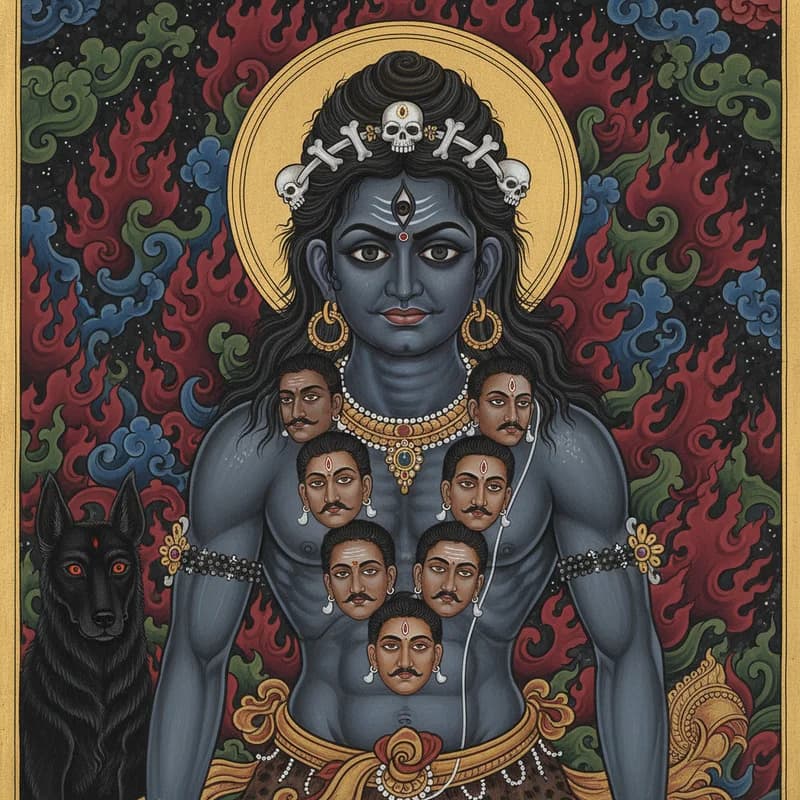
Formal iconography is rare; Bhairu is more often a presence than an image. When depicted, he appears as a dark, fierce male figure with bulging eyes, carrying a trident and a skull-cup — attributes borrowed from his Bhairava origins. In most Rajasthani villages, however, he is simply a rough stone or a brick platform painted red, his identity announced by the sindoor and the small clay lamps left burning through the night.
Bhairu himself does not appear in Sanskrit canonical texts; his lineage runs through oral tradition, local vrat kathas, and the folk songs sung by Rajasthani bhopa priests during all-night performances. His theological ancestor, Bhairava, is described in the Shiva Purana and the Bhairava Agamas as the form Shiva took after severing Brahma's fifth head. The village Bhairu carries that mythic weight but transmits it through the spoken word rather than the written page.
Worship is direct and unmediated — no elaborate priestly ritual is required. Villagers pour mustard oil, offer raw liquor called desi sharab, and tie red threads at his shrine before undertaking journeys, legal disputes, or marriages. During the dry months before the monsoon breaks over the Thar, offerings intensify as communities ask Bhairu to hold back disease and keep the boundary between the living village and the dangerous open desert firmly in place.
संबंधित लोकगाथाएं
Related Lore
Algorithmic Inference
आपको यह भी पसंद आ सकता है
You May Also Like
Community Discussion
Comments are reviewed by AI before appearing publicly. Unsafe, unrelated, or uncertain comments go to human review.
Sign in to join the discussion.
0 comments
No public comments yet.