प्रतीक्षा करें
Tracing the Vetala’s last known location…
प्रतीक्षा करें
Tracing the Vetala’s last known location…

Brahm
Most spirits make themselves known through action — they call, they appear, they follow. The Brahm does none of these things. It occupies. Found across the plains of Haryana, the dry scrubland of Rajasthan, and the older villages of western Uttar Pradesh, it attaches itself to a place rather than a person: a particular well, the shadow side of a banyan on the edge of a field, the stretch of road between two settlements where no lamp burns at night. Accounts collected near the Ghaggar riverbed describe a heaviness in the air, a stillness that the cattle feel before any human does. The Brahm does not pursue. It waits with the patience of something that has confused permanence for purpose.
What makes it dangerous is its subtlety. Unlike spirits that announce their presence through noise or form, the Brahm works through erosion — a man who walks its territory regularly begins to lose things: sleep first, then appetite, then the thread of his own thoughts. Oral accounts from villages near Kurukshetra describe this as a slow loosening, the way a knot comes undone not all at once but over weeks of small pulls. The entity is not malicious in any deliberate sense; most field accounts suggest it is simply indifferent, the way a dry well is indifferent to thirst. Traditional countermeasures involve iron buried at the threshold and the recitation of specific couplets from the Alha cycle at dusk, though whether these work or merely give the frightened something to do remains, in the accounts, genuinely unclear.
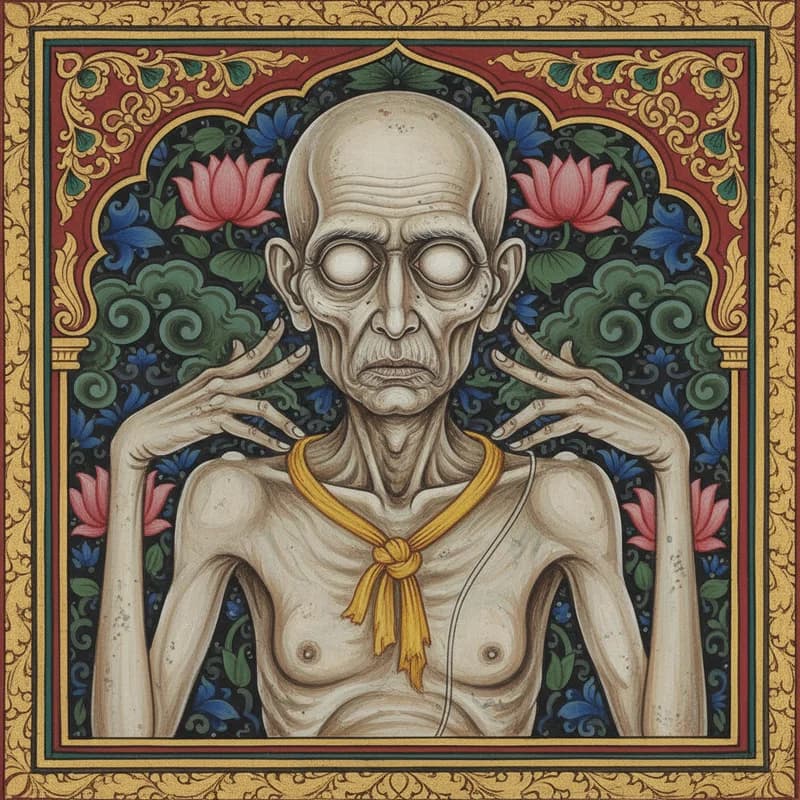
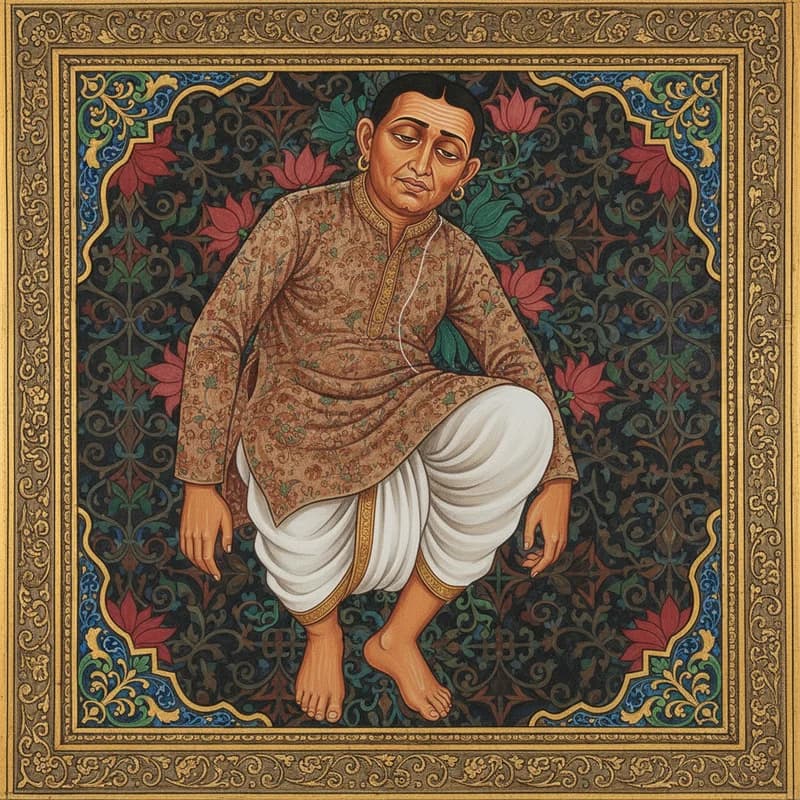
The Brahm appears as a man caught in the last moment before sleep — eyes half-closed, body listing slightly forward as though gravity has already begun its negotiations. Accounts from the villages along the Ghaghra in eastern Uttar Pradesh describe ordinary clothes: a dhoti, sometimes a kurta, the specific unremarkable dress of whoever went missing from that district last. The skin holds colour correctly, which is the first wrongness — no pallor, no luminescence, only a stillness to the flesh that is subtly incorrect, the way wax fruit is incorrect. Witnesses report a sound before recognition: a low, continuous exhalation, not quite breathing, closer to the sound a clay pot makes settling in the kiln. The single detail that does not vary across accounts is the feet — bare, clean, and pointing in the wrong direction.
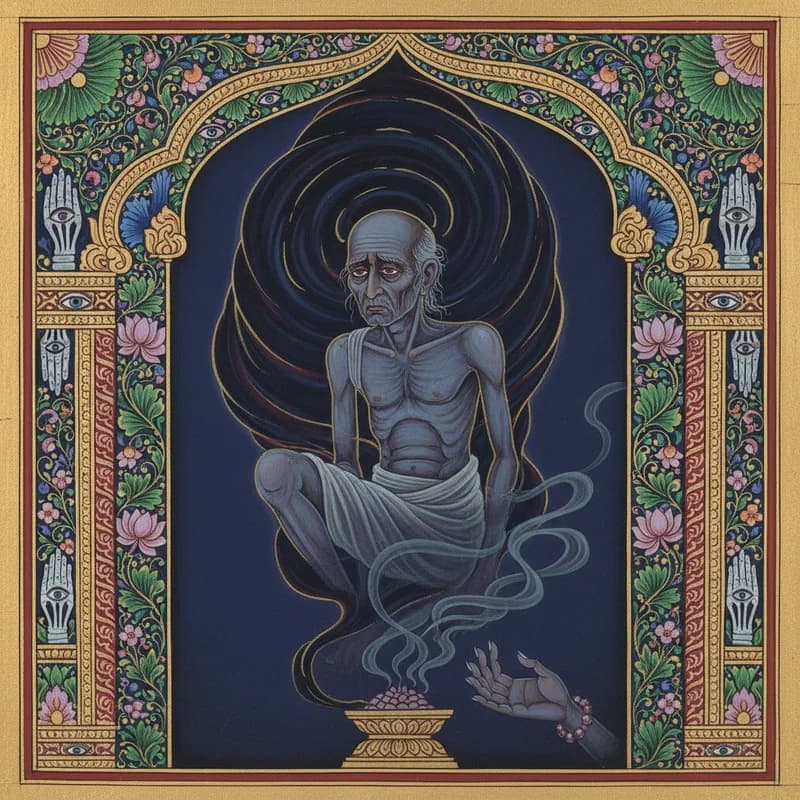
Brahm appears most commonly as an elderly man sitting beneath a peepal tree at the edge of a village — plausible enough, since old men do rest at such trees in the late afternoon heat of the Gangetic plain. He is usually seen between the last light of dusk and full dark, dressed in the plain white dhoti of a retired farmer, sometimes holding a lota as though he has just returned from the fields. The first tell is the stillness: he does not shift his weight, scratch, or blink at the frequency a living body requires, and those who have watched him for more than a minute report a growing unease they cannot immediately name. The second is the tree itself — the peepal above him carries no sound, no leaf-tremor, even when the evening wind moves through every other tree on the path.
First Documented
The Brahm — a restless male ghost believed to haunt crossroads and cremation grounds across the Gangetic plains — surfaces most clearly in the oral traditions of rural Uttar Pradesh and Bihar, with early textual echoes found in the *Skanda Purana's* accounts of wandering spirits denied proper last rites.
Last Recorded
Accounts of Brahm — the restless male ghost said to haunt crossroads, old wells, and the margins of agricultural fields across the Gangetic plains — were actively collected by William Crooke in the 1890s and persist in oral testimony from villages in eastern Uttar Pradesh and Bihar to this day.
Source Language
Hindi
Origin
The Brahm appears in the oral tradition of the Gangetic plain before it surfaces in any written catalogue — field notes from H. H. Risley's late-nineteenth-century surveys of Bihar and the United Provinces record the term as already common, already old, already requiring no explanation to informants. In the textual tradition, the Brahm is understood as the ghost of a man who died a sudden, violent, or untimely death — a category of spirit defined by what interrupted it. The folk accounts of the Bhojpur region tell it differently: here, the Brahm is specifically the spirit of an upper-caste man who died without completing a religious vow, his unfinished obligation binding him to the specific stretch of road, well, or peepal tree where he last drew breath. Collected accounts from villages near the Sone River's confluence with the Ganga describe the Brahm as territorial rather than predatory — it does not chase, it presides. That distinction matters: where the textual reading positions the Brahm among malevolent wanderers, the Bhojpur oral tradition positions him as a kind of displaced householder,
Frequently Asked
A Brahm is the restless ghost of a Brahmin who died with unfinished earthly business — unpaid debts, broken vows, or a violent end that left no proper funeral rites. Unlike ordinary ghosts, the Brahm carries the residual authority of its caste, making it more willful and harder to dismiss than common spirits. Oral accounts collected across the Gangetic plains describe it as a presence that lingers near old pipal trees, abandoned wells, and crossroads at the edge of villages.
The Brahm sits at a middle register of threat — not a predator like the Vetala, but far from benign. It can cause illness, misfortune, and psychological disturbance in those who disturb its resting place or fail to acknowledge it with proper respect. Villagers in the Awadh region traditionally leave small offerings of water and sesame seeds at suspected Brahm sites to keep the spirit from turning hostile.
A Preta is any unquiet dead soul still bound to the material world before completing its passage through the afterlife — a broad category addressed extensively in the Garuda Purana. The Brahm is more specific: it is a Preta of Brahmin origin, and that caste identity persists into death, lending the spirit a particular kind of stubborn, hierarchical authority. Where a Preta may simply wander in hunger, a Brahm is often described as demanding acknowledgment of its former status.
Accounts of the Brahm are densest across the northern plains — Uttar Pradesh, Bihar, and parts of Rajasthan — regions where Brahmin communities have historically been concentrated and where oral traditions of ghost lore remain strong. The banks of the Gomti near Lucknow and the older cremation grounds along the Ganga between Allahabad and Varanasi appear repeatedly in field accounts. Monsoon season, when the earth softens and old burial sites shift, is considered the time when Brahm activity intensifies.
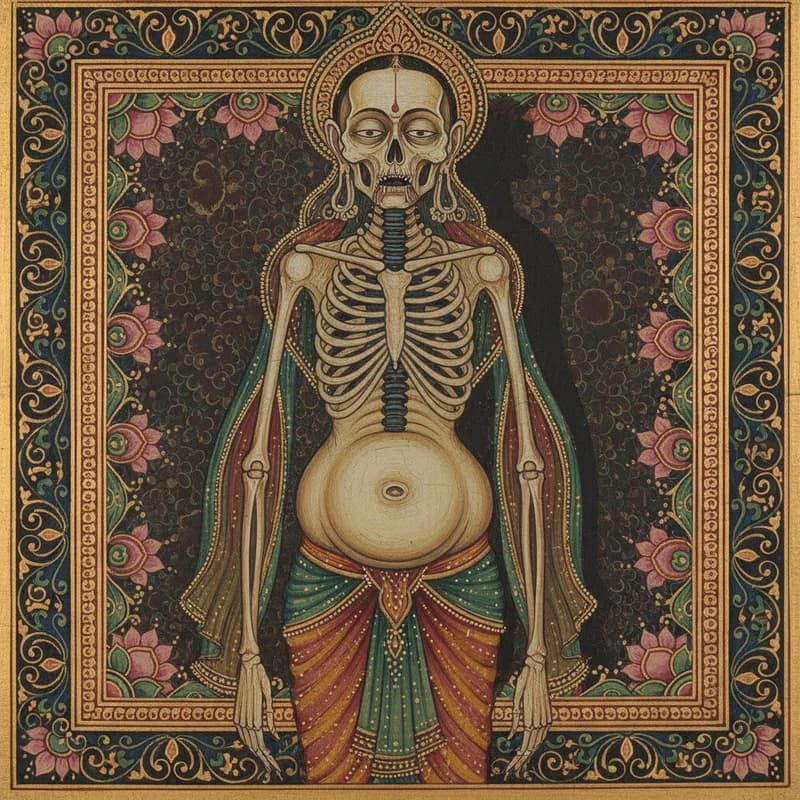
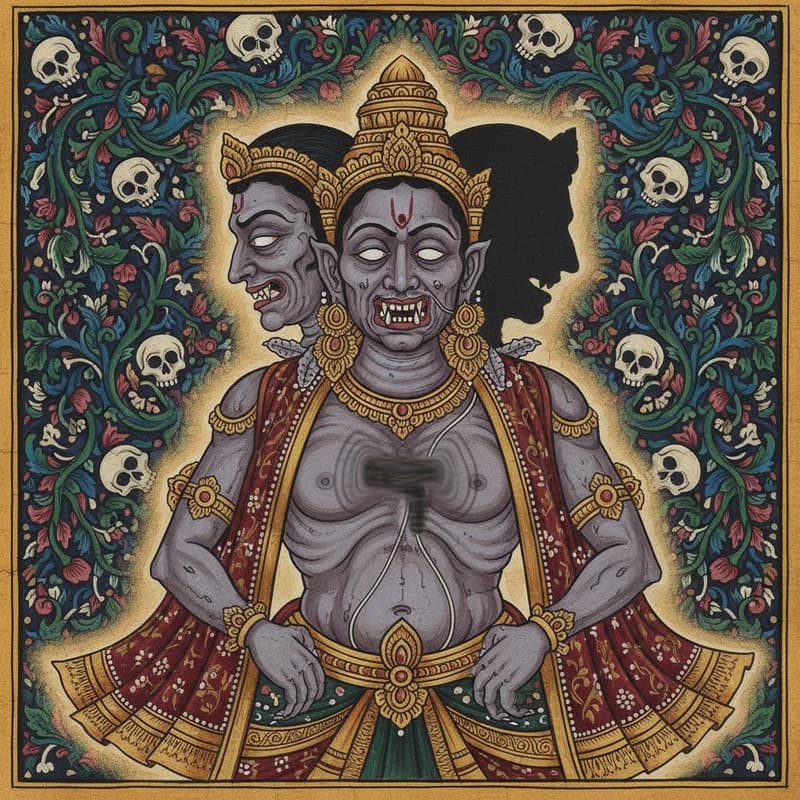
A Brahm is rarely seen directly; its presence is inferred from a cluster of signs — a sudden drop in temperature near a pipal or banyan tree, the smell of ash without any visible fire, and an inexplicable heaviness that settles on a person who has crossed a particular threshold or path. Some accounts from eastern Uttar Pradesh describe the Brahm as appearing briefly as a tall, pale figure in white, visible only at the periphery of vision. Animals, particularly dogs and cattle, are said to detect it before humans do.
The Brahm as a distinct folk entity does not appear by name in classical Sanskrit texts, but its conceptual roots run through the Garuda Purana's detailed taxonomy of the dead and the Atharva Veda's hymns addressing malevolent spirits born of improper death. Regional vernacular literature — particularly Awadhi and Bhojpuri oral poetry — preserves the most detailed descriptions. The gap between scriptural category and folk specificity is itself telling: the Brahm is a creature of lived experience, not of theological codification.
Protection against a Brahm typically involves ritual acknowledgment rather than confrontation — offering water, sesame, and sometimes a small lamp at the site where the spirit is believed to reside. Recitation of Brahmin funeral hymns, particularly those from the Garuda Purana, is considered effective in settling an agitated Brahm. In parts of Bihar, a local priest or ojha may be called to perform a shanti puja specifically designed to release the spirit from its earthly attachment.
Yes, and this is considered both possible and morally necessary in the communities where Brahm belief is strong. The spirit is thought to persist because of an unresolved obligation — a debt uncollected, a ritual left incomplete, a wrong unacknowledged — and addressing that specific grievance, symbolically or practically, is what releases it. Families who discover that an ancestor died without proper last rites will sometimes commission a belated Shraddha ceremony on the banks of the Ganga or the Falgu river at Gaya, which is traditionally considered the most efficacious site for settling the dead.
संबंधित लोकगाथाएं
Related Lore
Algorithmic Inference
आपको यह भी पसंद आ सकता है
You May Also Like
Community Discussion
Comments are reviewed by AI before appearing publicly. Unsafe, unrelated, or uncertain comments go to human review.
Sign in to join the discussion.
0 comments
No public comments yet.