प्रतीक्षा करें
Consulting the Shastra archives…
प्रतीक्षा करें
Consulting the Shastra archives…
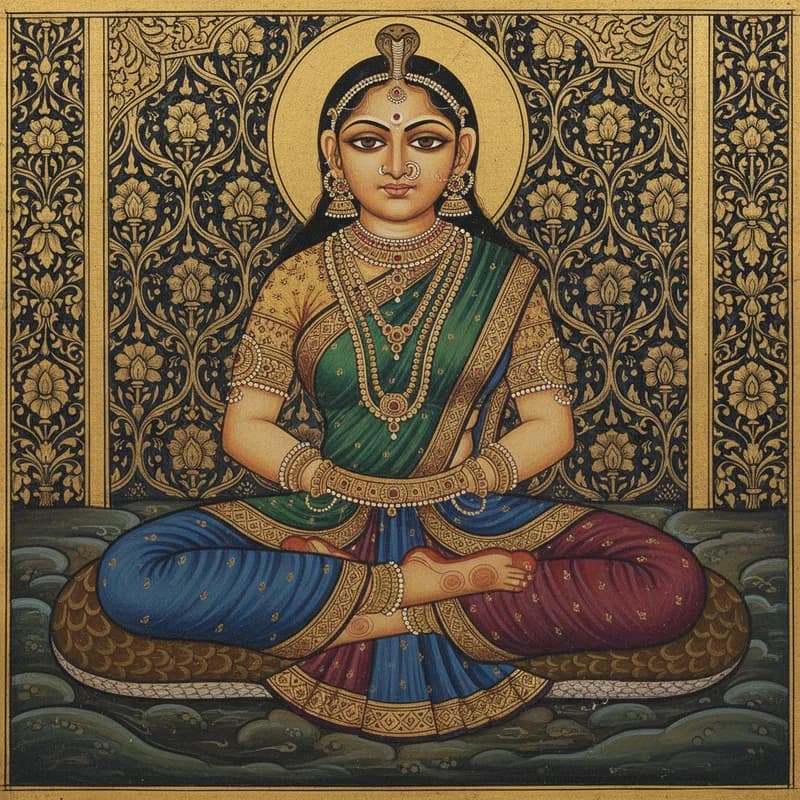

Nagini
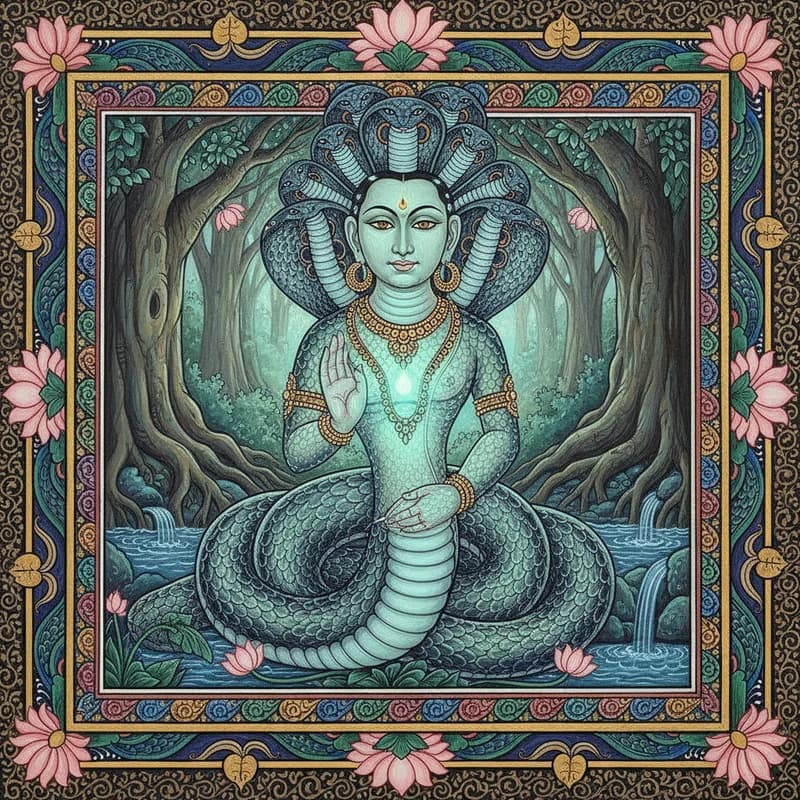
She moves through the oldest water first — the Narmada at Amarkantak, the still tanks behind Nageshwar temple in Gujarat, the lotus ponds of Manipur that no village child will swim in after the monsoon breaks. Accounts of her span every linguistic region of the subcontinent, yet the core image holds with unusual consistency: a woman of extraordinary beauty above the waist, serpentine below, coiled in the shallows or resting on a flat stone in the hour before the rains arrive. The Mahabharata names her kind in passing; the Puranas give them kingdoms beneath the earth's rivers. Folk accounts, collected along the Godavari and the Chambal both, are less interested in cosmology and more interested in warning.
She is not uniformly dangerous. The folklore record distinguishes carefully between the Nagini encountered with respect and the one encountered carelessly, and the outcomes differ accordingly. Fishermen on the Chilika Lake speak of her as a guardian of deep-water channels — propitious, if addressed correctly, lethal if startled or insulted. She takes particular offence at the killing of snakes during Nag Panchami, and accounts from the Bundelkhand region describe men who did so returning home to find their wells dry and their cattle refusing to drink. Her wrath is patient and hydraulic: it moves like water does, finding every crack. Those who earn her favour, however — and the conditions vary by region, by season, by the specific body of water — report protection from drowning, from drought, from the particular misfortune that comes to a household that has lost its footing with the land.
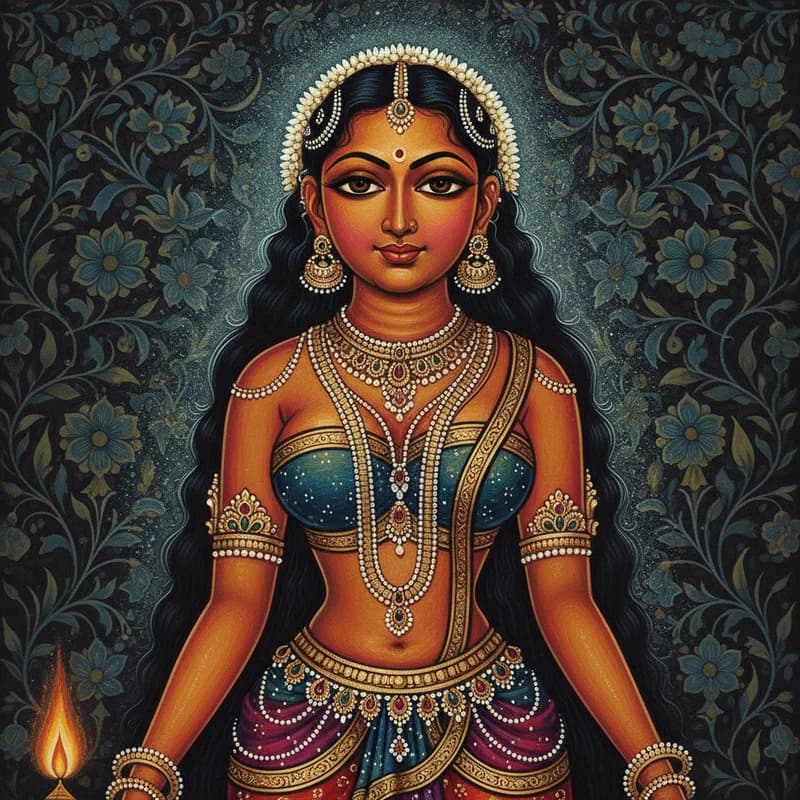
The Nagini appears as a woman of exceptional stillness — not the stillness of patience, but of a creature for whom movement is a considered expenditure. Witnesses along the Godavari's western bank and in the sal forests of Bastar describe her consistently as beautiful in a way that takes a moment to become unsettling: the proportions correct, the features symmetrical, but the skin carrying a faint iridescence, like the underside of a cobra's scale caught in lamplight. She smells of wet stone and river mud, the specific cold smell of water that has not seen sun. When she moves, accounts note the absence of the small adjustments that human bodies make — no shift of weight, no unconscious sway — she translates from one position to another as water moves through a crack in rock. The single feature that resolves all doubt is the lower body: in moments of agitation or desire, the sari or the shadow beneath it does not fall correctly, and witnesses describe the ground beneath her as disturbed in long, continuous furrows, as though something heavy has been dragged.
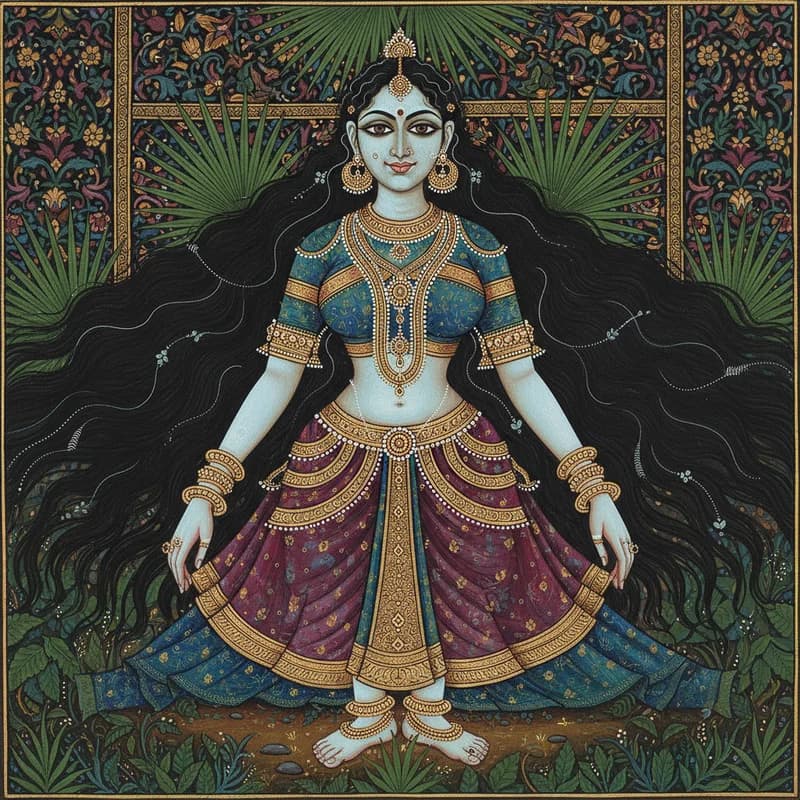
Along the banks of the Yamuna below Mathura, and in the forested margins of the Narmada valley where women still carry water in clay pots from the river at dawn, the Nagini appears as a married woman returning from an early bath — wet hair loose down her back, a brass kalash balanced at her hip, vermillion still fresh in the parting of her hair. The disguise is entirely plausible at that hour. The first tell is her stillness when she stops: no woman balancing a full water vessel holds herself that motionless, without the small constant adjustments of weight and breath that the body makes without thinking. The second is documented consistently across accounts from both the Narmada ghats and the Vrindavan riverbank — her wet hair, however long she has been walking in the morning heat, does not dry.
First Documented
Circa 300 BCE–200 BCE
Last Recorded
Present
Source Language
Sanskrit
Origin
The Nagini appears in the Atharvaveda's serpent hymns and is codified in the Mahabharata's Astika Parva, where she enters the record as kin to Manasa and subject to the great snake sacrifice at Janamejaya's court near the Naimisha forest. The textual tradition insists on her dual nature — goddess and serpent, benevolent and lethal — resolved through the Brahminic ritual frame that brings her under devotional control. Folk accounts from the Ganga-Yamuna doab and the wetland communities around Chilika Lake in Odisha resist this resolution. There, the Nagini is not domesticated by worship but encountered at her own discretion: she surfaces at the monsoon's first rain along the banks of the Gandak, sometimes wearing the form of a woman with the smell of wet earth and old copper about her, sometimes not wearing a form at all. The divergence is significant — the Puranas transform her into a figure who receives supplication, while the oral tradition insists she does not require it.
Frequently Asked
A Nagini is a serpent deity of the feminine form — half-woman, half-snake — documented across Sanskrit texts and oral traditions from the Atharvaveda's serpent hymns through the Mahabharata's Astika Parva. She is distinct from the male Naga in that folk accounts, particularly from Bengal and the wetland communities around Chilika Lake, treat her as a figure encountered on her own terms rather than one subdued by ritual. Her presence is most strongly associated with still water, monsoon-season rivers, and the hour before the first rains break.
The folklore record does not settle this cleanly — the Nagini encountered with respect differs entirely from the one encountered carelessly, and the outcomes differ accordingly. Fishermen on the Chilika Lake describe her as a guardian of deep-water channels, propitious if addressed correctly, lethal if startled or insulted. Her wrath is patient and hydraulic, moving like water through every available crack, but those who earn her favour report protection from drowning, drought, and the misfortune that comes to a household that has lost its footing with the land.
Witnesses along the Godavari's western bank and in the sal forests of Bastar describe her as beautiful in a way that takes a moment to become unsettling — the proportions correct, the features symmetrical, but the skin carrying a faint iridescence like the underside of a cobra's scale in lamplight. She smells of wet stone and river mud, the specific cold smell of water that has not seen sun. The detail that resolves all doubt is her stillness: she makes none of the small unconscious adjustments of weight and breath that a human body makes without thinking.
She enters the textual record in the Atharvaveda's serpent hymns and is codified in the Mahabharata's Astika Parva, where her kind appear as kin to the goddess Manasa and as subjects of the great snake sacrifice at Janamejaya's court near the Naimisha forest. The Puranas extend this, giving her kind kingdoms beneath the earth's rivers and bringing her under devotional control through Brahminic ritual. Folk traditions from the Ganga-Yamuna doab and Bengal resist this domestication — there, she surfaces at the monsoon's first rain along the Gandak's banks at her own discretion, not in response to supplication.
Manasa is a fully codified deity with a fixed iconography, a dedicated festival cycle, and a substantial textual tradition — the Manasa Mangal Kavya of Bengal is composed in her honour and, significantly, reciting it is documented as one of the means of breaking a Nagini's hold. The Nagini, by contrast, resists this kind of institutional framing; she is encountered rather than worshipped, and her relationship to any given body of water is local, seasonal, and governed by conditions that vary by region. Where Manasa receives temples and formal puja, the Nagini receives the more cautious acknowledgement of a presence that has not asked to be approached.
Accounts from the Narmada valley and the Vrindavan riverbank converge on two consistent tells: a woman whose wet hair does not dry regardless of how long she has walked in the morning heat, and ground beneath her disturbed in long continuous furrows, as though something heavy has been dragged. Iron bangles tarnishing without cause and milk offerings turning sour are documented in Bundelkhand accounts as early warnings of her displeasure. The smell of wet stone and old copper in a place where neither should be present is noted by collectors working along the Godavari as the earliest signal.
Protection in the Bengal tradition draws heavily on the Manasa Mangal Kavya, whose recitation is held to break a Nagini's hold on a household or a person. Practical measures documented in the region include placing a peacock feather above a sleeping child's head, smearing haldi on the doorstep at Nag Panchami, and ensuring that no snake is killed during that festival — accounts from Bundelkhand describe men who did so returning to find their wells dry and their cattle refusing to drink. Women during the monsoon months are advised to wear an iron anklet, which the oral tradition holds as a barrier against approach.
The association is both ecological and mythological — cobras and water snakes surface visibly during the monsoon as their underground habitats flood, making the season one of heightened serpent encounter across the subcontinent. The Nagini is said to shed her skin at the confluence of sacred rivers, an act tied to the monsoon's arrival, and she is described as surfacing along the Gandak and the Narmada at the first rains. Folk accounts from Bengal and Odisha treat the period between the monsoon's break and Nag Panchami as the interval of greatest caution, when the boundary between her world and the human one is at its most permeable.
संबंधित लोकगाथाएं
Related Lore
Algorithmic Inference
आपको यह भी पसंद आ सकता है
You May Also Like
Community Discussion
Comments are reviewed by AI before appearing publicly. Unsafe, unrelated, or uncertain comments go to human review.
Sign in to join the discussion.
0 comments
No public comments yet.