प्रतीक्षा करें
Cross-referencing the Yaksha field-notes…
प्रतीक्षा करें
Cross-referencing the Yaksha field-notes…

Yakshi
She waits in the old trees — the kadamba, the ashoka, the banyan at the edge of cultivation where the fields give out and the forest begins to insist on itself. Accounts from the Malabar coast, from the ghats above Thrissur, from the tank-fed villages of Thanjavur district, all describe the same figure: a woman of extraordinary beauty standing alone at dusk or deep night, her feet turned backward, her hair unbound in the manner of the ritually impure. Men travelling alone report a fragrance before any sighting — heavy, floral, wrong for the season. Those who follow it rarely offer coherent accounts of what followed.
What the Yakshi wants is contested across traditions. The Kashmiri Shaivite texts name her a semi-divine attendant, a guardian of fertility and hidden wealth, propitiated at the roots of sacred trees with turmeric paste and red hibiscus. The folk traditions of Kerala tell a different story. There she is a woman who died in betrayal — abandoned, murdered, consumed by a grief that calcified into hunger — and what she takes from men is not merely life but the capacity for recognition, for memory, for knowing one's own name. The Tulu-speaking communities along the Netravati river distinguish between the yakshi who guards and the one who hunts, and treat the distinction as the most important knowledge a young man can carry.
Protection varies by region and by the nature of the encounter. Iron is cited frequently — a nail driven into the tree she inhabits, a blade kept unsheathed. The Kamba Ramayana and the Matangalila both reference her as a figure requiring acknowledgment rather than avoidance: ignored, she pursues; properly addressed, she may simply let a traveller pass. The Kerala tradition holds that a Yakshi can be permanently bound to a tree through tantric ritual performed by a specific class of exorcist-priests, and that certain very old trees on temple grounds in Palakkad and Kozhikode district hold one still.
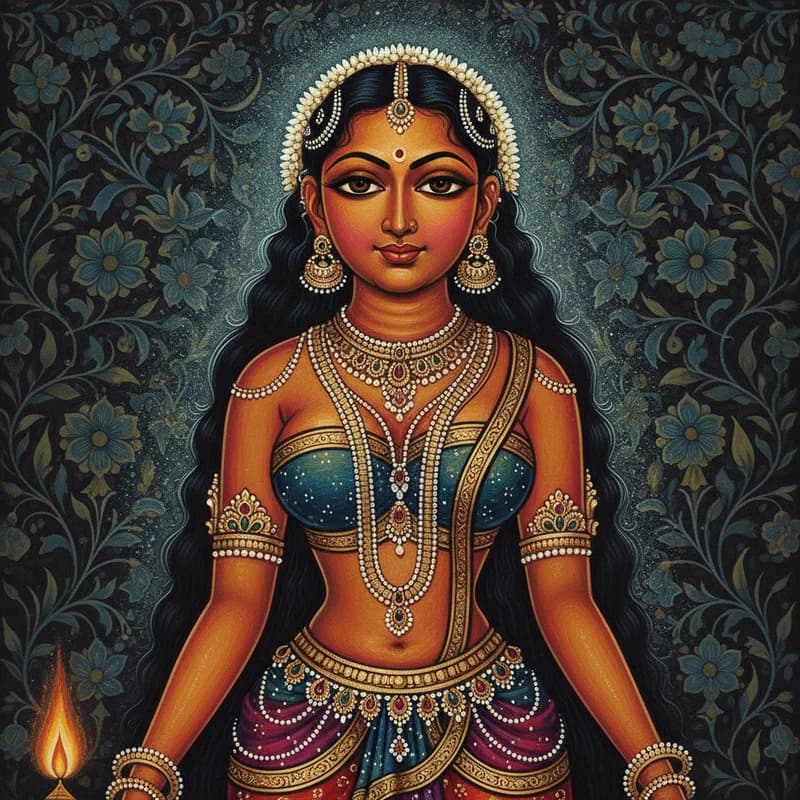
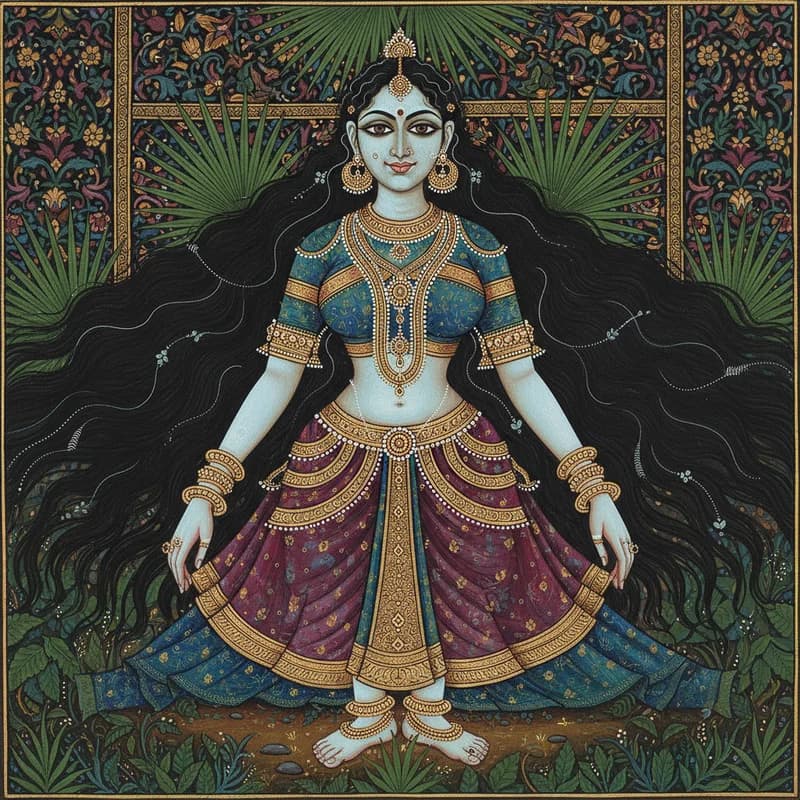
The Yakshi appears as a woman of exceptional beauty — this is not a variable in the accounts but the constant, the one detail that holds across Kerala's rubber estates, the tamarind groves of Andhra, and the mango orchards of coastal Karnataka. She is tall, often described as slightly too tall, the proportions just beyond what the eye expects. The hair is always loose and very long, black as the Periyar at monsoon flood, and it moves independently of wind. In the older Malabar accounts, collected near the Thirunelli temple complex, witnesses note that the hair seems to breathe — expanding and settling like something alive and patient.
The smell arrives before she does. Parijata blossoms, the night-flowering variety, crushed and slightly overripe — a sweetness that accumulates rather than drifts, that fills the back of the throat. Beneath it, in accounts from the Palakkad gap region, there is something cooler and darker: the smell of wet laterite after rain, of deep well-water, of the earth opened. Her skin catches light that is not present. Under a moonless sky on the banks of the Chaliyar, a schoolteacher in 1967 described her as faintly phosphorescent — not glowing, he insisted, but refusing shadow in the way that certain river stones do when wet.
What marks her as something other than human is not any single grotesque feature but an accumulation of small wrongnesses. The feet, in the southern accounts almost universally, face backward — the heels forward, the toes pointing behind her, so that her tracks in soft mud lead away from where she stands. She does not blink at the frequency the living do. When she moves through undergrowth, the leaves do not touch her; she passes through dense palmyra without displacement, without sound, while her bangles — always present, always gold — ring clearly in the still air.
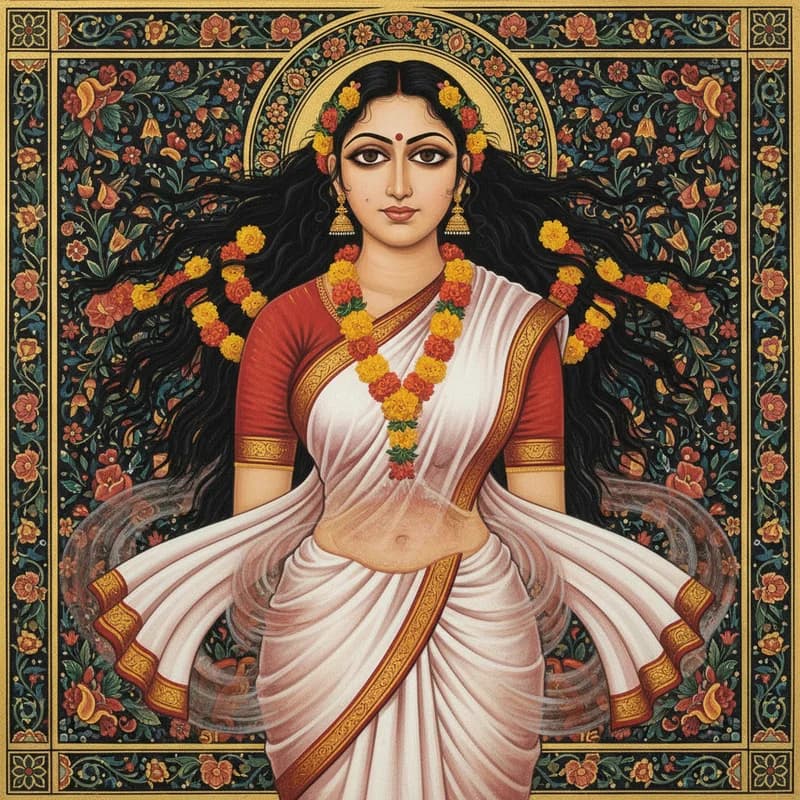
Along the roads that cut through rubber plantations in Malabar and beneath the pala trees that line the edges of Kerala's paddy fields, the Yakshi appears most commonly as a woman of exceptional beauty traveling alone at dusk — or standing at the base of a large tree, apparently waiting. The waiting is important. She is never in motion when first seen; she is always already there. In the older accounts from the Thrissur region she appears as a Nair woman in a white mundu, hair oiled and braided with jasmine, the flowers still fresh at an hour when no flower seller has been out for hours. In accounts from the forests east of Palakkad she sometimes takes the form of a young widow, or a woman whose husband has gone to the Gulf and who is, she explains, walking to her mother's house. The explanation is always slightly too complete.
The tells require a certain steadiness to notice. Her feet are clean — not merely undusty, but clean in the way of someone who has just bathed, even when the laterite track is wet from the previous night's rain. The jasmine in her hair does not wilt. Experienced toddy-tappers in the Kottayam belt note something more specific: pala trees in flower produce a smell that is heavy and sweet and slightly wrong after dark, and when a Yakshi stands beneath one, that smell intensifies rather than disperses, as though the tree itself is participating. A few accounts mention that when she turns her head, the movement is a fraction too smooth — no tendon-catch, no human hesitation at the extreme of the neck's range.
She does not approach. This is consistent across nearly all accounts. The Yakshi creates the conditions under which the person approaches her — a question asked in a voice pitched just low enough that one must step closer to hear it, a lamp or torch that flickers at the precise moment she gestures toward the darkness beyond the road. The violence in the tradition is always framed as something the victim walked into. Whether this is supernatural mechanics or the archive's way of distributing blame is a question the accounts themselves do not answer.
First Documented
Circa 3rd century BCE
Last Recorded
Present
Source Language
Sanskrit
Origin
The Yakshi appears in the Atharvaveda as a member of a broader class of female beings associated with trees, fertility, and the dangerous margins of cultivated land — the edge where the rice field ends and the old growth begins. She is not created in any single cosmological event. The texts do not give her a birth narrative. She is, in the Vedic stratum, simply present, as the forest is present, as the monsoon is present, carrying her own logic. The Yakshas and Yakshis together form a category of beings understood to inhabit the material world's abundance — Kubera is their lord in the later Puranic arrangement, but this is a brahmanical imposition on something older and less hierarchical. The yakshi who waits beside the kadamba tree on the Narmada's bank in Madhya Pradesh oral accounts acknowledges no lord. She predates the arrangement.
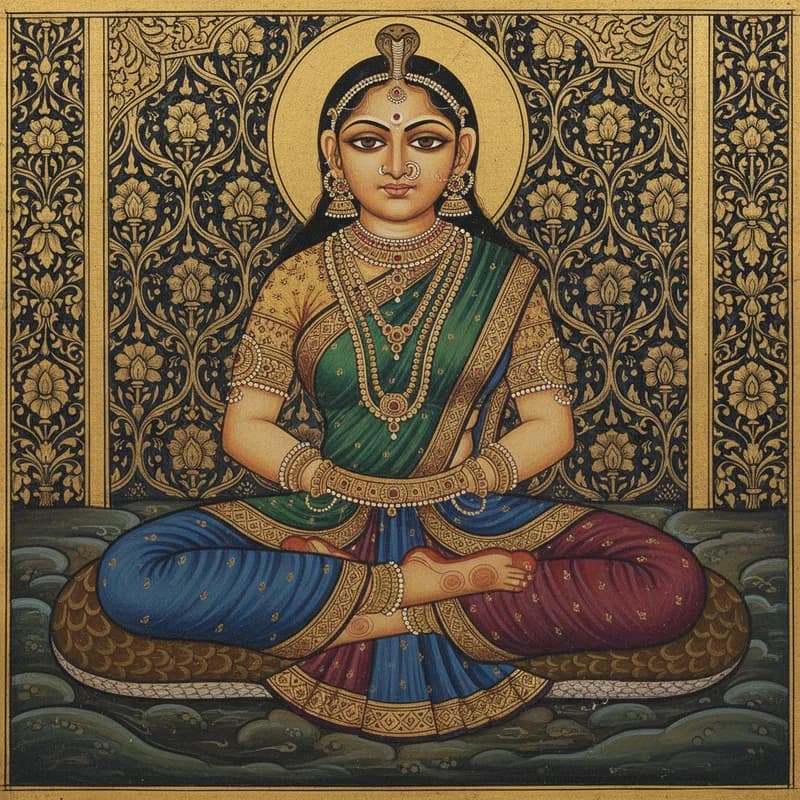
The archaeological record complicates the textual one. The voluptuous female figures carved at Sanchi's northern gateway, dated to the first century BCE, are identified as Yakshis in scholarly consensus, and they are shown grasping the branches of sala or ashoka trees in the *shalabhanjika* pose — a gesture so old it appears in Patanjali's Mahashabhasya as a known performance form. What the carvings do not settle is whether these figures were understood as propitious or perilous. The Jain canon, particularly the Aupapatika Sutra, lists Yakshis as attendant spirits to the Tirthankaras, benevolent and guardian in function. The Katha Sarit Sagara, assembled by Somadeva in eleventh-century Kashmir, tells a different story: the Yakshi there is a predator, beautiful and carnivorous, drawn to men who travel the Vindhya passes alone after dark. The two traditions have coexisted for over two thousand years without resolving each other.
It is in Kerala that the oral tradition holds its most specific and elaborated form. The Yakshi of the Malabar coast, documented in part through the colonial-era ethnographies of Fawcett and in the later fieldwork of M. V. Vishnu Namboodiri, is understood as the spirit of a woman who died in circumstances of betrayal or abandonment, her desire for life so forceful it did not conclude with her body. She is associated with the pala tree — *Alstonia scholaris* — whose white flowers bloom at night along the old roads between Thrissur and Palakkad, and the smell of those flowers in darkness is still understood, in certain households, as a warning. The textual Yakshi and the Yakshi of Namboodiri Brahmin family memory are not fully the same being. The first is a cosmic category; the second is a specific woman, with a specific grievance, attached to a specific road. The oral tradition does not consider this a contradiction. It considers it an explanation.
Frequently Asked
A Yakshi is a female spirit associated with trees, fertility, and the dangerous margins between cultivated land and forest, appearing in Indian tradition from the Atharvaveda onward. She inhabits specific trees — the kadamba, the ashoka, the pala — and is understood simultaneously as a guardian of hidden abundance and a predatory being drawn to solitary travelers after dark. The tradition does not resolve these two natures; it holds them together.
The Yakshi appears as a woman of exceptional, slightly wrong beauty — tall, with loose black hair that moves independently of wind and skin that catches light not present in the surrounding darkness. Her most consistent identifying feature across Kerala, Andhra, and coastal Karnataka accounts is her feet, which face backward, heels forward, so her tracks in soft mud lead away from where she stands. A heavy, overripe floral scent — parijata blossoms, or the night-blooming pala flower — arrives before she is seen.
The Yakshi carries a threat level that varies sharply by tradition and by the nature of the encounter. The Jain Aupapatika Sutra presents her as a benevolent guardian spirit, while the Katha Sarit Sagara, assembled by Somadeva in eleventh-century Kashmir, describes her as a predator haunting the Vindhya passes. In Kerala folk tradition, she is specifically the spirit of a woman who died in betrayal, and what she takes from men is not merely life but memory — the capacity to know one's own name.
Yaksha is the masculine form of the category — a class of semi-divine beings associated with material wealth, forests, and Kubera's retinue in the Puranic arrangement — while Yakshi is the feminine, more specifically tied to tree-fertility and the dangerous margins of settled land. The Yaksha in classical texts tends toward guardianship and treasure-keeping; the Yakshi, particularly in southern oral traditions, carries a more ambiguous and often predatory character. Tulu-speaking communities along the Netravati river treat the distinction between the Yakshi who guards and the one who hunts as the most important knowledge a young man can carry.
The Yakshi is most consistently linked to the pala tree — Alstonia scholaris — whose white flowers bloom at night along the old roads between Thrissur and Palakkad, and whose scent in darkness is still understood in certain households as a warning. She also inhabits the kadamba, the ashoka, and the banyan at the edge of cultivation, as documented in accounts from the Malabar coast, the ghats above Thrissur, and the tank-fed villages of Thanjavur district. The shalabhanjika carvings at Sanchi's northern gateway, dated to the first century BCE, show Yakshi figures grasping sala and ashoka branches — placing this tree-association in the archaeological record over two thousand years ago.
Iron is the most widely cited protection — a nail driven into the tree she inhabits, or a blade kept unsheathed while traveling after dark. Regional traditions add more specific measures: neem branches laid across the threshold at dusk, a kolam drawn in rice flour at the courtyard gate, or jackfruit wood smoke to drive her from a compound. The Kamba Ramayana and the Matangalila both suggest that the Yakshi responds to acknowledgment — properly addressed, she may let a traveller pass; ignored, she pursues.
The Yakshi appears in the Atharvaveda as part of a broader class of female beings inhabiting the fertile, dangerous margins of cultivated land, though she is given no birth narrative — she is simply present, as the forest is present. The Jain canon, particularly the Aupapatika Sutra, lists Yakshis as attendant spirits to the Tirthankaras, while Somadeva's eleventh-century Katha Sarit Sagara presents her as a carnivorous predator of the Vindhya passes. Patanjali's Mahashabhasya references the shalabhanjika gesture — a woman grasping a tree branch — as a known performance form, suggesting the Yakshi's image was already culturally legible by the second century BCE.
In the broader Vedic and Puranic framework, the Yakshi is a cosmic category — a class of being, not an individual. In Kerala, documented through colonial-era ethnographies by Fawcett and the later fieldwork of M.V. Vishnu Namboodiri, she becomes a specific woman: someone who died in betrayal or abandonment, her desire for life so forceful it did not end with her body, attached to a particular road between Thrissur and Palakkad. The oral tradition does not consider this a contradiction with the textual record — it considers it an explanation of how a cosmic category becomes a local, grieving, dangerous presence.
संबंधित लोकगाथाएं
Related Lore
Algorithmic Inference
आपको यह भी पसंद आ सकता है
You May Also Like
Community Discussion
Comments are reviewed by AI before appearing publicly. Unsafe, unrelated, or uncertain comments go to human review.
Sign in to join the discussion.
0 comments
No public comments yet.