प्रतीक्षा करें
Parsing the Naga lineage records…
प्रतीक्षा करें
Parsing the Naga lineage records…
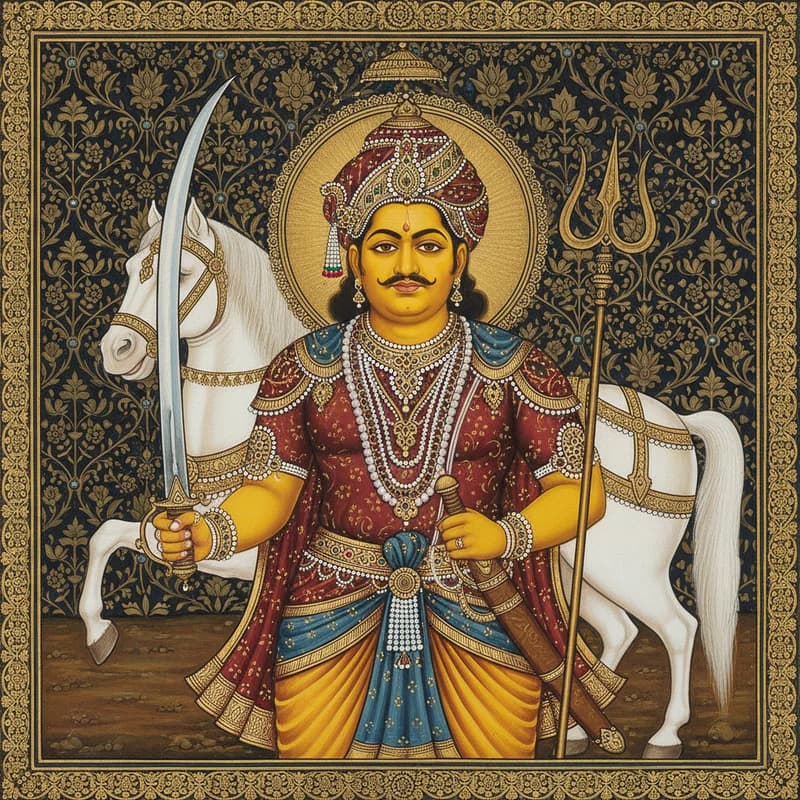

Khandoba
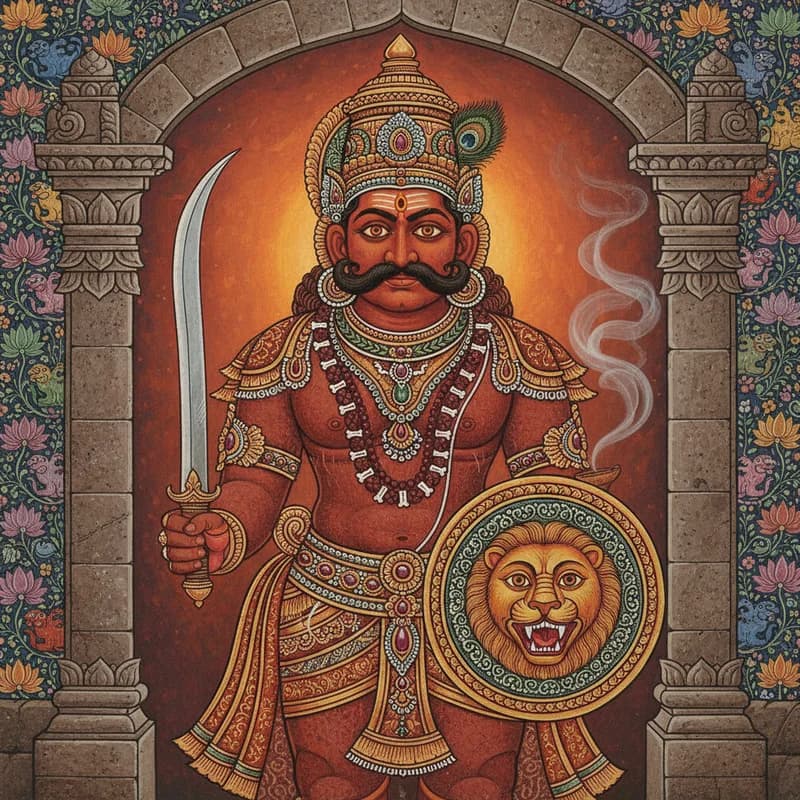
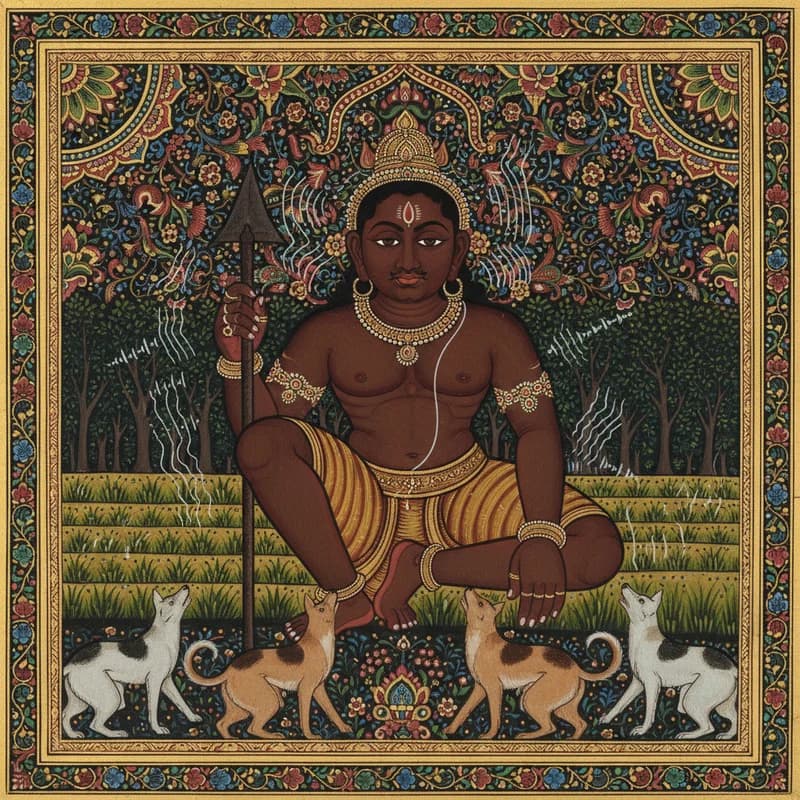
He rides a white horse across the Deccan plateau, and the turmeric thrown by his devotees at Jejuri coats the black stone of his temple in a yellow so dense it looks like the hill itself is on fire. Khandoba is not a gentle god. Worshipped across Maharashtra and into northern Karnataka — particularly among Dhangar shepherds, Koli fisherfolk, and the Mang communities of the Godavari basin — he carries a sword and a dog walks at his side, both details that mark him as something older and stranger than the Brahminic pantheon absorbed him into. His origins are disputed across the oral traditions: some accounts make him a form of Shiva descending to defeat the demons Mani and Malla on the hills above Pune; others insist he was always local, a regional warlord or hunter deified by the communities who needed a protector who understood bloodshed.
Approach him with precision or not at all. His devotees — the Waghyas and Muralis who dedicate their lives to his service — describe a deity who rewards absolute fidelity and punishes half-measures with a particular coldness. During the Champashashthi festival, when the air above Jejuri turns yellow with turmeric dust and the sound of dhol carries down to the banks of the Karha river, the atmosphere is celebratory but the undertone is one of obligation. Petitions made at his shrine and then abandoned have consequences in the folklore record — illness in cattle, failed harvests, a persistent bad luck that the Dhangar communities attribute to his displeasure rather than chance. He does not pursue. He simply withdraws his protection, and the world that remains without it has its own dangers.
Khandoba arrives in the accounts not as a ghost but as a presence that insists on being recognized — a warrior in his middle years, broad through the chest, with the particular posture of someone who has never doubted his right to stand where he stands. His skin carries the unmistakable yellow cast of raw turmeric, not as pigment but as something beneath the surface, as though the offerings poured over the stone at Jejuri temple have soaked inward over centuries. The white horse, when it appears, makes no sound on packed earth — not the muffled quiet of careful hooves, but a total absence, the ground refusing to register the weight. Witnesses in the Bhimashankar foothills report the smell before the vision: turmeric and something sharper beneath it, iron or old blood, the smell of a sword kept oiled but used. The single feature no account disputes is his eyes — not luminous, not strange in colour, but fixed on something behind you, something you have not yet done.
In the villages south of Pune, along the dried-grass plateau between Jejuri and Saswad in the weeks before Champashashthi, Khandoba is said to appear as a wandering gosavi — a mendicant sadhu, ash-smeared and staff-carrying, asking directions to the next temple or requesting water at a well. The disguise is plausible because such men are common on that road in that season, and hospitality to them is expected. The first tell is the turmeric: a fine, unaccountable yellow dust clings to his forearms and the creases of his knuckles, too deeply settled to have come from a recent offering or a spice market, as though the skin itself produces it. The second is his horse — there is no horse, and yet, in the red laterite dust behind him, a second set of prints.
First Documented
Khandoba appears in Marathi literature as early as the 13th and 14th centuries, with devotional songs attributed to the saint-poets of the Mahanubhava and Varkari traditions referencing his cult at Jejuri. His earliest textual anchoring is the *Malhari Mahatmya*, a Sanskrit Purana that codifies his mythology as the slayer of the demons Mani and Malla.
Last Recorded
Accounts of Khandoba's presence have never ceased — devotees at the Jejuri hill temple in Pune district continue to report visions of a mounted figure during the Champashashti festival each December, when turmeric dust turns the air gold. Shepherds in the Deccan plateau villages still invoke him before the kharif harvest.
Source Language
Marathi
Origin
Khandoba enters the written record in the Malhari Mahatmya, a Sanskrit text likely composed between the twelfth and fourteenth centuries, which identifies him as a form of Shiva who defeated the demons Mani and Malla on the hilltop at Jejuri in the Pune district — the same yellow-dusted shrine where devotees still hurl fistfuls of bhandara, turmeric powder, into the dry Deccan air at every festival. The textual tradition insists on this Shaiva genealogy with some care, folding Khandoba into the Puranic hierarchy as Martanda Bhairava, a solar-martial aspect of the great god. The oral tradition of the Dhangar shepherd communities and the Waghya-Murali devotional lineages of the Godavari basin tells it differently: Khandoba was never secondary to Shiva but was always already here, a god of the land before the Sanskrit poets arrived to reclassify him. That divergence is not merely theological — it marks the fault line between brahmanical textual authority and the older,
Frequently Asked
Khandoba is a warrior deity venerated across Maharashtra and Karnataka, understood as a manifestation of Shiva who descended to vanquish the demons Mani and Malla. He presides over the hilltop temple at Jejuri, near Pune, where the air turns gold each season with the turmeric powder — called bhandar — that devotees fling skyward in his honor. Shepherds, farmers, and the Dhangar community have kept his worship alive for centuries through oral ballads called kirtan and povada.
Khandoba is widely regarded as a regional avatar of Shiva, though his character carries distinct martial and folk qualities that set him apart from the ascetic Shiva of the Puranas. The Malhari Mahatmya, a Sanskrit text dedicated to his mythology, traces his lineage directly to Shiva and Parvati. In practice, many devotees in the Deccan plateau experience him as an autonomous deity with his own personality, his own wives — Mhalsa and Banai — and his own fierce, protective temperament.
Turmeric, or bhandar, is Khandoba's sacred substance, and the Jejuri temple complex is perpetually dusted in its yellow-orange hue. One oral tradition holds that Khandoba smeared himself with turmeric after his victory over the demons Mani and Malla, and his devotees replicate this act of triumph at every festival. The throwing of bhandar during the Champashashthi festival in the month of Margashirsha is among the most visually striking ritual acts in the Deccan.
Khandoba is credited with powers of protection, justice, and the curing of disease — particularly ailments believed to be caused by supernatural affliction. Riding a white horse and carrying a sword, he is invoked by soldiers, hunters, and those who work the land along the Bhima and Nira river valleys. Devotees who enter a state of possession during his festivals are believed to channel his divine authority directly, walking on fire or piercing their skin without harm.
The Jejuri temple, set on a basalt hill in Pune district, Maharashtra, is the principal seat of Khandoba's worship and draws pilgrims from across the Deccan year-round. The steep stone steps leading to the sanctum are flanked by vendors selling bhandar, and the entire hill glows yellow on festival days. Smaller but significant shrines exist at Pali, Naldurg, and Mailara in Karnataka, where he is known as Mailara or Mallanna.
Khandoba and Mallanna are regional names for the same warrior deity — Khandoba is the Marathi name dominant in Maharashtra, while Mallanna or Mailara is the Kannada and Telugu form venerated in Karnataka and Andhra Pradesh. The core mythology remains consistent: a Shiva-derived warrior who defeats demonic forces and protects pastoral communities. Regional variations do shift his consorts, his mount, and the specific rituals offered to him, reflecting centuries of local adaptation.
The Dhangar shepherds, the Gavli cowherds, and the Vani trading community of Maharashtra count Khandoba as their kuldaivat — their hereditary clan deity. Certain communities of Vaghyas and Muralis, male and female devotees who dedicate their lives to his service, maintain his temples and perform his oral epics. The deity's reach extends across caste lines in a way that is unusual, drawing both upper-caste Marathas and communities of hunters and nomads into a shared devotional world.
The Malhari Mahatmya is the primary Sanskrit text narrating Khandoba's origin, his battles against the demons Mani and Malla, and the establishment of his worship at Jejuri. Alongside this textual source, a vast body of Marathi povada — oral ballads performed by gondhali singers — preserves his mythology in living form at village festivals across the Deccan. The oral tradition is often richer in local detail than the Sanskrit text, recording his marriages, his quarrels, and his interventions in human affairs with striking specificity.
संबंधित लोकगाथाएं
Related Lore
Algorithmic Inference
आपको यह भी पसंद आ सकता है
You May Also Like
Community Discussion
Comments are reviewed by AI before appearing publicly. Unsafe, unrelated, or uncertain comments go to human review.
Sign in to join the discussion.
0 comments
No public comments yet.