प्रतीक्षा करें
Tracing the Vetala’s last known location…
प्रतीक्षा करें
Tracing the Vetala’s last known location…

Murugan
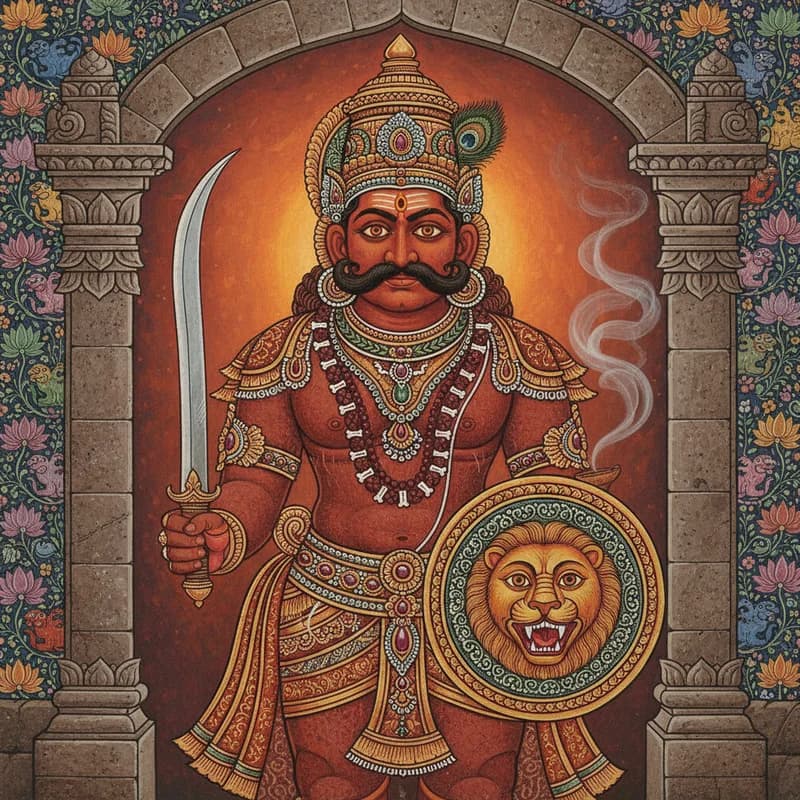
He comes through the mountains first — through the Nilgiris, through the granite shoulders of Palani, through the red-dust paths above Tiruchendur where the Bay of Bengal hammers the cliffs below his southernmost temple. Six faces, twelve arms, a vel in his hand like a needle of pure intention. His peacock carries him where horses cannot go. His mount, the rooster, announces him before dawn when the world has not yet decided what it will be.
The caution attached to Murugan is not the caution of malice. He is not a being you fear meeting — he is a being you fear approaching without honesty, because he is young in the way that mountains are young, which is to say not young at all. The Kandha Puranam, sung in village squares from Madurai to the Kaveri delta during Thaipusam, is unambiguous: he sees through performance immediately. Devotees who approach him with bargaining in their hearts rather than surrender have reported the vel turning inward — not as punishment but as revelation, exposing precisely what they hoped he would not notice. The kavadi bearers who walk the long road to Palani Andavar in January, flesh pierced, feet raw on hot stone, are not performing suffering. They are making the interior visible. That is what he requires.
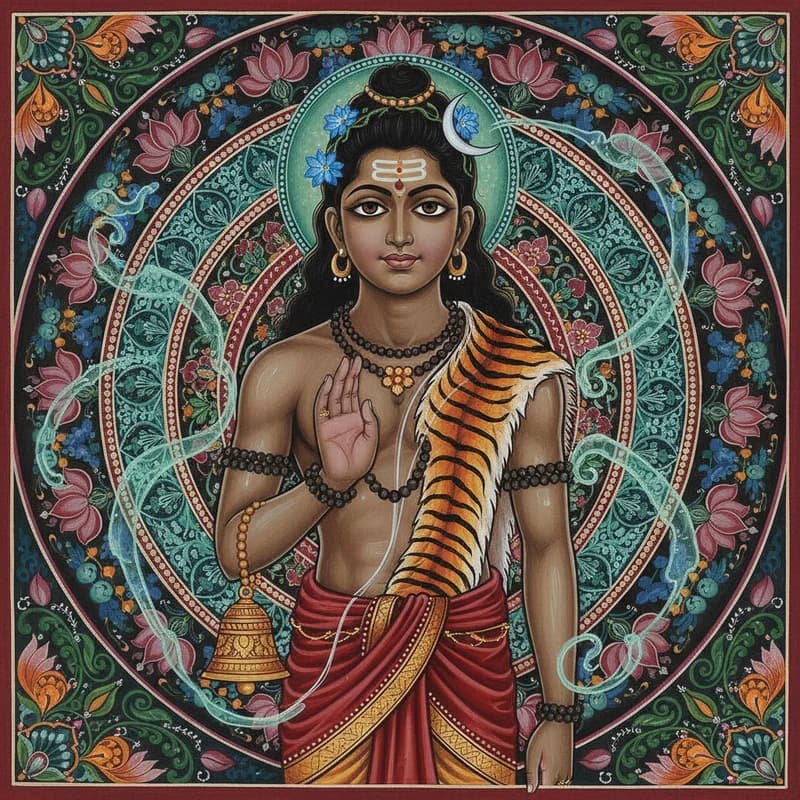
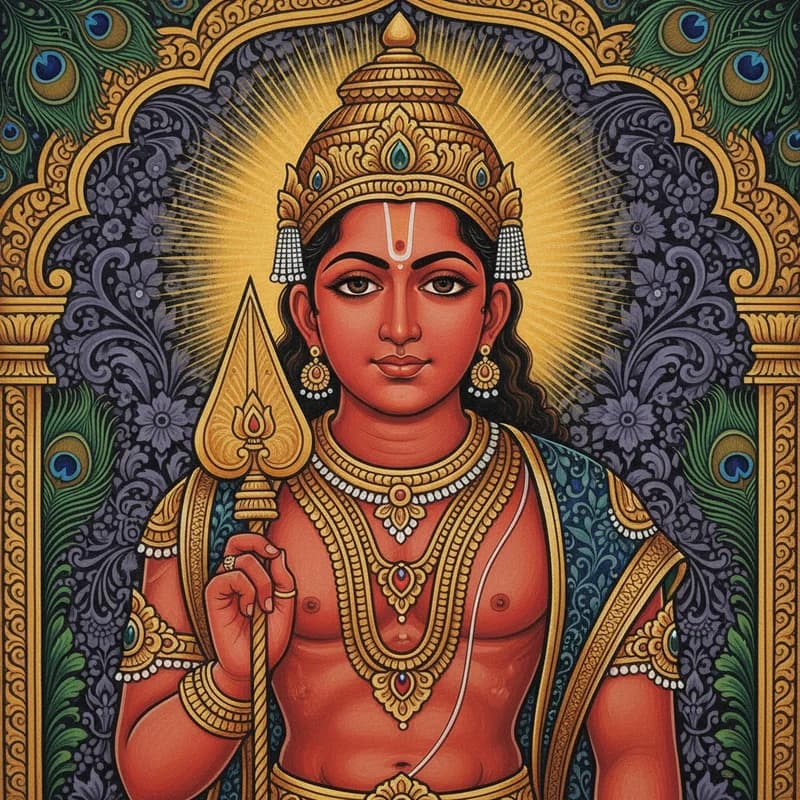
Murugan appears as a young man at the precise edge of adolescence — not a boy, not yet a man — whose beauty carries the particular sharpness of something that has never aged and never will. The skin holds the colour of polished red laterite, the kind exposed along the Nilgiri foothills after monsoon strips the topsoil away, and the vel, his spear, appears fused to his right hand as though the weapon and the arm grew together. Accounts from devotees at the Palani hilltop temple describe a faint warmth radiating from him even in the cold months of Margazhi, not the warmth of a body but of sun-heated stone — stored heat, ancient heat. Peacock feathers appear at the periphery of every sighting, though no bird is ever present. The single detail that breaks the human reading of him: his eyes move like a hawk tracking something the witness cannot see, focused on a distance that does not exist in the visible world.
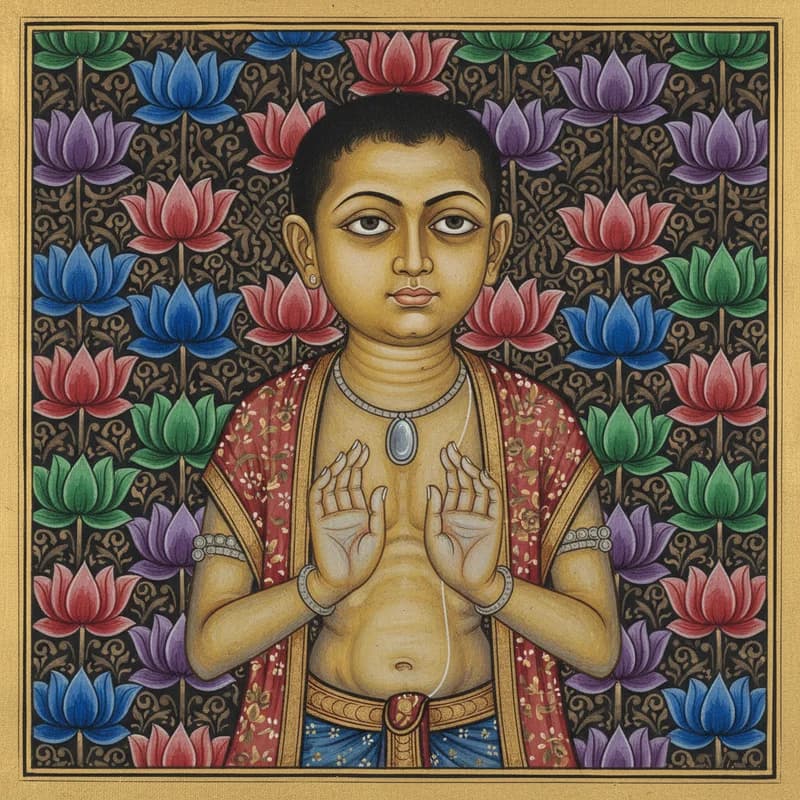
Along the red-dust roads that climb toward Palani or wind through the Nilgiri foothills during the Thaipusam season, Murugan has been reported appearing as a young boy of perhaps twelve — bare-chested, wearing a single rudraksha thread, carrying a vel that witnesses initially mistake for a sharpened walking stick. He asks for directions to the nearest kovil, which is always the tell, because no child born within fifty kilometers of these hills would need to ask. The second tell is quieter: dogs do not bark at him, and the ones that were barking fall silent the moment he rounds the corner into view — not frightened into silence, but stilled, the way animals go when something older than fear walks past.
First Documented
Murugan's earliest traceable presence surfaces in the Sangam-era poems of the *Purananuru* and *Akananuru*, composed roughly between 300 BCE and 300 CE, where he appears as Seyon — the Red One — worshipped on the kurinji hillsides of the Western Ghats. The *Tirumurukārruppatai* of Nakkirar, one of the Ten Id
Last Recorded
Accounts of Murugan's presence have never ceased — devotees at the Palani hilltop shrine and along the Kaveri's banks continue reporting visions during Thaipusam, and kavadi bearers in trance states describe direct encounters to this day. His is a living worship, unbroken.
Source Language
Tamil
Origin
Murugan enters the textual record in the Tolkappiyam, the earliest surviving Tamil grammatical text, where the landscape called kurinji — the mountain zone of flowering Strobilanthes, blooming once in twelve years — is directly assigned to his presence, making him not a deity who inhabits a place but a deity who constitutes one. The Sangam corpus, particularly the Purananuru and the Akananuru, treats him as already ancient, a god whose worship required no founding myth because it preceded the category of founding. The Paripatal, a later Sangam anthology, gives him his most elaborate textual treatment, describing the Kaveri's tributaries and the Palani hills as sites of direct manifestation. Yet the oral tradition of the Nilgiri foothills and the Courtrallam region diverges sharply: where the Sanskrit-inflected Skanda Purana absorbs him as Kartikeya, son of Shiva, born to slay Surapadman, the Tamil folk tradition of Murugan knows no such parentage as primary — he is Seyon, the Red One
Frequently Asked
Murugan is the Tamil god of war, mountains, and eternal youth, worshipped with an intensity that has shaped Tamil spiritual life for over two thousand years. Born from the six sparks of Shiva's third eye, he was raised by the six Krittikas on the banks of the Saravana lake in the Himalayas before descending to the Kurinji hills of the Tamil south. His oldest hymns appear in the Sangam-era text Tirumurugaatruppadai, composed by the poet Nakkirar.
Murugan wields the Vel, a divine spear forged by his mother Parvati and hurled to split the demon Surapadman into a peacock and a rooster — both of which became his mount and banner. He commands armies of celestial warriors called the Ganas and is said to bestow both military victory and the grace of spiritual knowledge. Devotees at Palani and Tiruchendur believe his Vel can cut through ignorance as cleanly as it cuts through flesh.
Kartikeya is the Sanskrit-tradition name for the same deity, prominent in the Skanda Purana and worshipped widely in North India and among Bengali communities. Murugan, however, is the Tamil form — older in some respects, rooted in the Kurinji landscape of the Western Ghats, and carrying a distinct emotional register of longing and union that the Sangam poets called akam. The Tamil tradition gives him two wives, Valli and Devasena, a pairing that carries its own layered meaning about the union of tribal and celestial worlds.
The peacock, called Mayil in Tamil, was once the demon Surapadman, whom Murugan defeated at the shores of the sea near present-day Tiruchendur on the Tamil Nadu coast. Transformed by the god's mercy rather than destroyed outright, Surapadman became Murugan's vahana — a permanent reminder of conquered ego carrying the divine. The peacock's cry at dusk near hill shrines like Swamimalai is still considered an auspicious sign by local devotees.
The Arupadaiveedu — six battle-houses of Murugan — are the canonical pilgrimage circuit: Tiruchendur on the Coromandel coast, Palani in the Dindigul hills, Swamimalai on the Kaveri delta, Thiruparankundram near Madurai, Tiruttani in the Arani hills, and Pazhamudircholai in the Nilgiris. Each site corresponds to a specific episode in his mythology and draws hundreds of thousands of pilgrims during the Thai Poosam festival in January. The climb to Palani, barefoot on stone steps in the dry-season heat, is itself considered an act of devotion.
The Vel is not merely a weapon but a symbol of discriminating wisdom — the capacity to pierce illusion and perceive truth. In the Tirumurugaatruppadai, Nakkirar describes the Vel as luminous, capable of distinguishing the righteous from the wicked with absolute precision. Kavadi bearers at Thai Poosam pierce their skin with small vel-shaped skewers as an act of surrender to this same principle.
Murugan is broadly benevolent but carries the caution of a war god — his grace is fierce, and his displeasure, particularly toward the arrogant or the impure, is swift. Oral traditions collected in villages near the Palani foothills describe him as a god who tests devotion before granting it, sometimes appearing as a young wandering ascetic to expose false piety. He is not a deity one approaches casually; the protocols of worship — fasting, abstinence, the carrying of kavadi — reflect a relationship built on discipline.
The earliest and most authoritative Tamil source is the Tirumurugaatruppadai, one of the Ten Idylls of Sangam literature, dating to roughly the 1st–3rd centuries CE. The Sanskrit Skanda Purana expands his mythology considerably, detailing his birth, wars, and marriages across thousands of verses. Later, the 15th-century Tamil poet Arunagirinathar composed the Tiruppugazh — hundreds of devotional hymns still sung at dawn in temples along the Kaveri and Tamiraparani rivers.
संबंधित लोकगाथाएं
Related Lore
Algorithmic Inference
आपको यह भी पसंद आ सकता है
You May Also Like
Community Discussion
Comments are reviewed by AI before appearing publicly. Unsafe, unrelated, or uncertain comments go to human review.
Sign in to join the discussion.
0 comments
No public comments yet.