प्रतीक्षा करें
Summoning entity profiles from the Grimoire…
प्रतीक्षा करें
Summoning entity profiles from the Grimoire…
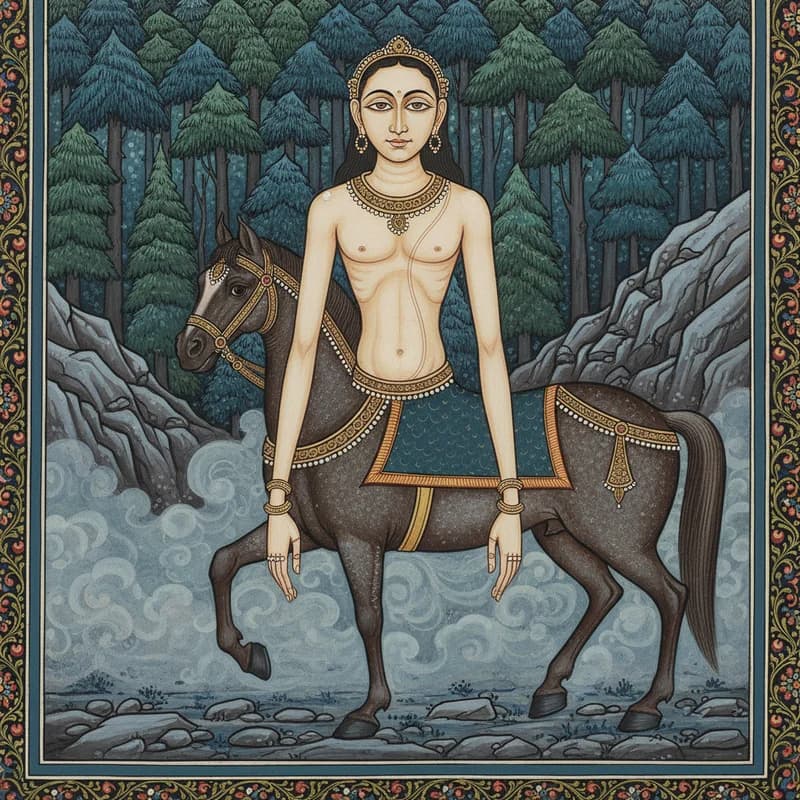

Kimpurusha
Half-human, half-horse, the Kimpurusha occupies a peculiar position in the Puranic ordering of beings — neither fully divine nor entirely earthly, assigned to the northern slopes of the Himalayas in texts like the Vishnu Purana and the Mahabharata's geographical passages, where the world is mapped in concentric rings of mountain and forest rather than by the names we use today. The Kimpurusha's territory sits between Bharatavarsha and the higher celestial regions, a middle country of perpetual snow and cedar forest that no pilgrim path reaches. They are not malevolent. The threat they carry is more subtle — an encounter with a Kimpurusha, according to accounts gathered from Garhwali storytellers near the Bhagirathi's upper reaches, leaves a man uncertain of his own category, unsure where the human ends and something older begins.
What they look like is consistent across widely separated sources. The torso is human, sometimes described as luminous or copper-skinned; below the waist, the body is horse. They speak in a language that sounds like Sanskrit rendered imprecisely, as though heard through moving water. Oral traditions from the villages above Uttarkashi describe them appearing at the treeline in the weeks before the high-altitude passes close for winter, when the light flattens and distances become unreliable. They do not harm those they encounter. They ask a question — the accounts never agree on what question — and the man who cannot answer correctly wanders for days before finding his way back to the valley, unable to recall exactly where he went or what he saw.
The Kimpurusha is encountered most often at the treeline where the deodar forest thins into bare rock — the body from the waist up is unmistakably human, lean and pale as bleached birch, with long arms that hang lower than they should, the knuckles almost level with the knee. Below the waist the horse-body begins, not in the smooth anatomical logic of classical sculpture but abruptly, as if two separate creatures were pressed together while the clay was still wet. What arrests witnesses is not the hybrid form itself but the silence of it: a horse of that size on loose shale should produce sound, yet the Kimpurusha moves without the crack of hoof on stone. The smell that precedes it is cold in a specific way — not winter air but the interior cold of a cave that hasn't held warmth in centuries, carrying with it something faintly resinous, like juniper burnt at altitude. The single feature that marks it as outside the natural order is the eyes, which are set in a human face but do not blink — not with the fixed stare of the dead, but with the patient, un
Along the upper Kali Gandaki trade routes where Kumaoni muleteers have walked for centuries, the Kimpurusha appears as a travelling merchant — a man of middling age, turbaned and road-worn, leading a single pack horse loaded with cloth or salt. The disguise is calibrated to the landscape: nothing draws less attention on those passes than a trader and his animal. The first tell is the horse itself, which never tires, never stumbles on loose shale, and does not drink when offered water at the stone troughs above Pithoragarh — a horse that has walked all day without drinking is a horse that does not need to. The second is subtler: the merchant's gait and the horse's gait are perfectly synchronized, stride for stride, as though the two move from a single intention rather than a lead rope.
First Documented
The Kimpurusha appear among the earliest strata of Puranic cosmography, named in the Vishnu Purana and the Mahabharata's Bhishma Parva as inhabitants of one of the nine divisions of Jambudvipa, their half-human, half-horse forms already fixed in the tradition by the time these texts were compiled, roughly between the 4th and 9th centuries CE.
Last Recorded
Accounts of the Kimpurusha persist in oral traditions collected from villages along the Sutlej valley and the higher reaches above Kinnaur, with shepherds as recently as the 1990s describing horse-bodied figures moving through the rhododendron forests at the snowline; such sightings have grown rarer but have not entirely ceased.
Source Language
Sanskrit
Origin
The Kimpurusha enters the written record in the Vishnu Purana and the Mahabharata's Bhuvanakosha passages, where they are positioned as one of the seven or nine dvipas — continental zones of beings — occupying the northern slopes above the Himalayas, adjacent to the Gandharva territories. The textual tradition is consistent on their form: human above the waist, horse below, inhabitants of a middle geography between the mortal world and the divine. What the Puranic accounts do not preserve, but the oral traditions of Kumaon and the Spiti valley do, is a specific behavioral quality — the Kimpurusha is described in mountain village accounts as a witness-being, one who watches the high passes in the months before the snowmelt, seen at distances that prevent certainty. The Garhwali shepherds who summer near Niti Pass and the Zanskar traders have no unified name for what they see, yet the description — upright, horse-limbed, still — persists across communities with no apparent contact. That divergence matters: the Puranas place the
Frequently Asked
Kimpurusha are half-human, half-horse beings described in Puranic cosmography as inhabitants of the northern Himalayan slopes. The name itself — किम्पुरुष — translates roughly as 'what kind of man?' or 'is this a man?', a question that captures the unease their hybrid form provokes. Texts like the Vishnu Purana place them among the semi-divine races occupying the outer edges of the known world.
Puranic geography assigns the Kimpurushas to Kimpurusha-varsha, one of the nine divisions of the known world described in texts such as the Vishnu Purana and the Bhagavata Purana. This territory sits along the northern Himalayan ranges, beyond the reach of ordinary human settlement. The cold passes above the Char Dham pilgrimage routes were, in folk imagination, the threshold of their country.
Kimpurushas are generally treated with caution rather than outright fear — they are not malevolent demons, but their hybrid nature places them outside the moral categories that govern humans and gods alike. Oral traditions collected along the upper Ganga valley describe them as unpredictable, capable of both aid and harm depending on how a traveller conducts himself in their territory. Approach them with respect, and the old accounts suggest they will not trouble you.
Both Kimpurushas and Gandharvas are semi-divine beings associated with the Himalayan north in Puranic literature, and the two are sometimes listed together in the same cosmological catalogues. Gandharvas are celestial musicians with fully human or luminous divine forms, whereas Kimpurushas carry the unmistakable mark of the horse in their bodies. The Mahabharata occasionally conflates the two, but the physical distinction — and the earthier, more territorial nature of the Kimpurusha — generally holds.
The Vishnu Purana, the Bhagavata Purana, and the Mahabharata all reference Kimpurushas, typically within passages that enumerate the races of beings populating the world's outer regions. The Ramayana also places Kimpurushas in the northern mountains, describing them as witnesses to cosmic events beyond the Himalayan passes. These references are brief but consistent, suggesting a well-established place in the Puranic imagination.
A Kimpurusha is identified by its composite form — the upper body of a human joined to the lower body of a horse, a configuration that distinguishes it from the Kinnaras, who are sometimes depicted as bird-human hybrids in the same textual traditions. Iconographic representations are rare, but manuscript illustrations from the Himalayan foothills occasionally show them in procession along mountain ridges. The horse-half is always the defining mark.
Kimpurushas and Kinnaras are closely related and frequently confused, even within the Puranic texts themselves. Some scholars, including those working from the Kishkindha Kanda of the Ramayana, treat them as near-synonymous, while others insist the Kinnara is a horse-headed human and the Kimpurusha a human-headed horse-bodied being — a distinction that matters enormously in iconography. Regional oral traditions along the Sutlej and Beas river valleys tend to use the names interchangeably.
In the layered geography of the Puranas, Kimpurushas populate one of the concentric divisions of Jambudvipa, the central continent of the world, occupying a zone that is neither fully divine nor fully mortal. Their presence marks a boundary — between the ordered human world and the wilder, less mappable territories that press against the Himalayan snowline. They are, in this sense, custodians of a threshold.
संबंधित लोकगाथाएं
Related Lore
Algorithmic Inference
आपको यह भी पसंद आ सकता है
You May Also Like
Community Discussion
Comments are reviewed by AI before appearing publicly. Unsafe, unrelated, or uncertain comments go to human review.
Sign in to join the discussion.
0 comments
No public comments yet.