प्रतीक्षा करें
Unfolding the scroll…
प्रतीक्षा करें
Unfolding the scroll…
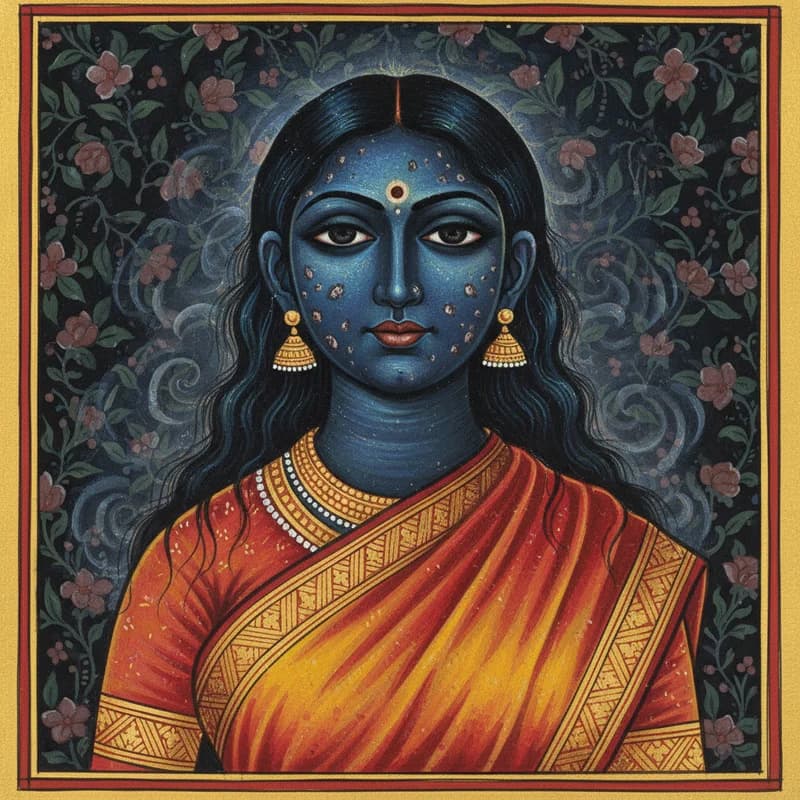

Mari
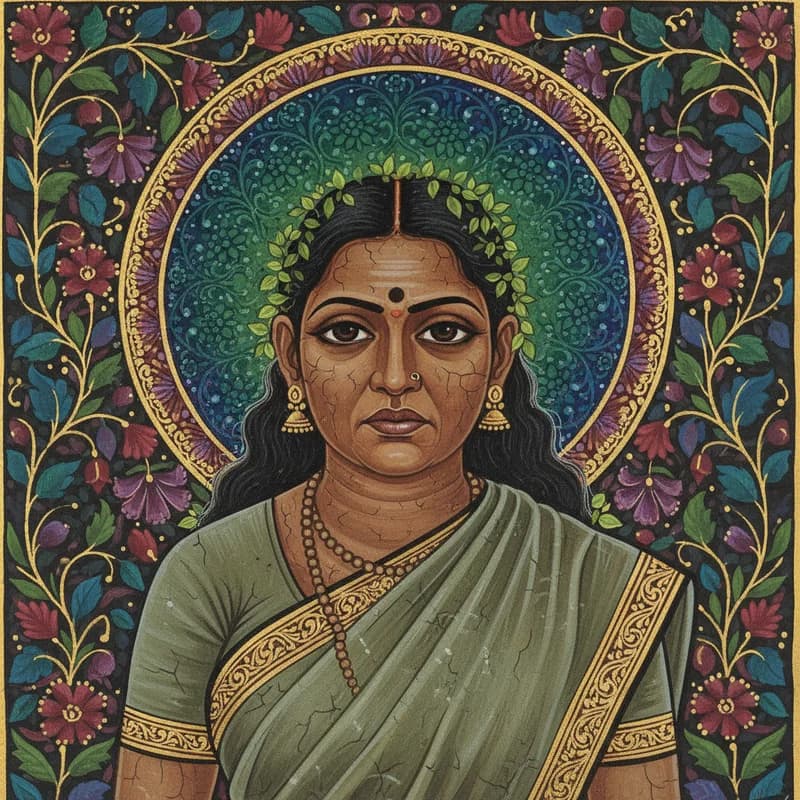
She arrives before the rains do. In the weeks when the Cauvery runs low and the red laterite of the Kongu Nadu cracks underfoot, when the air over Madurai smells of dust and something older than dust, the first cases appear — a child's forehead burning without reason, a rash spreading across a shoulder like a map of some unknown country. The old women of the delta villages know what this means. Mari is thirsty.
Across Tamil Nadu, from the temple towns along the Vaigai to the fishing settlements below Kanyakumari, she occupies a category that sits outside the comfortable division between goddess and threat. Smallpox was her touch; the monsoon was also her touch. The same hand that raised fever could break it. Oral accounts collected in the Tirunelveli district describe her as neither malevolent nor benevolent but demanding — a force that requires acknowledgment in the way that weather requires acknowledgment. Her shrines are frequently outside the main village boundary, under a margosa tree, facing north, marked with red-daubed stones and small terracotta horses left by those who survived what she sent. The Mariamman temples of Samayapuram and Uraiyur carry her in a more formal register, but the village tradition is older and less forgiving. When the epidemic passed and the rains finally came, it was not relief the survivors described in their accounts — it was the feeling of having been noticed, weighed, and, this time, let go.
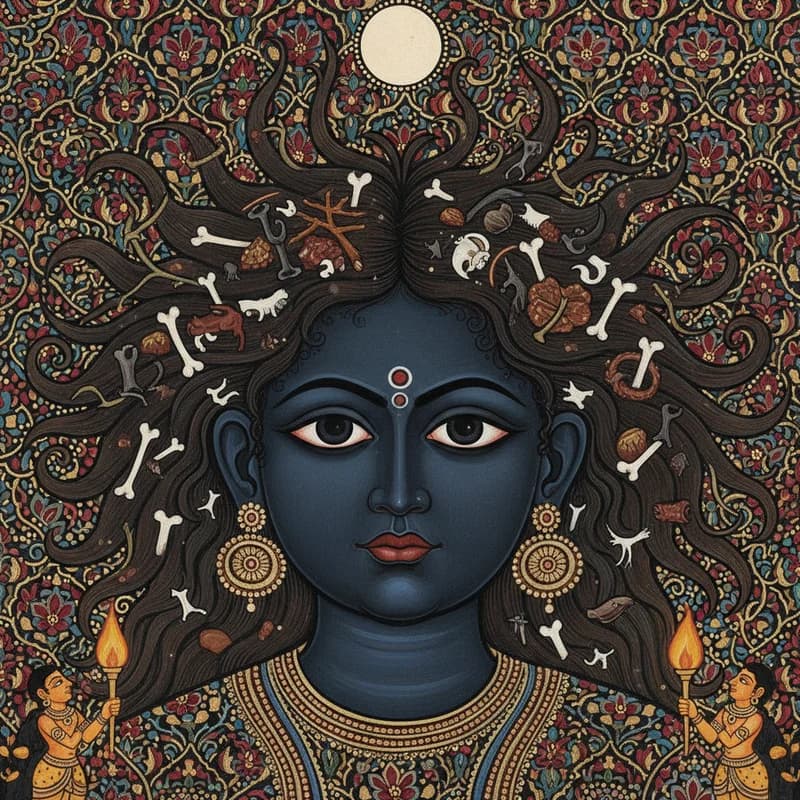
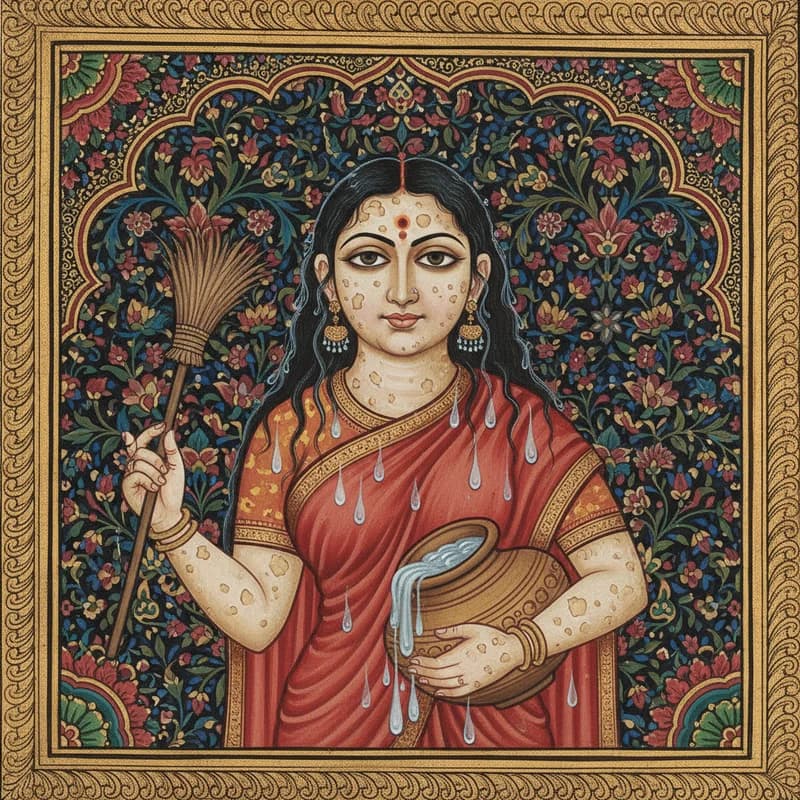
Mari appears as a tall woman, blue-black as a rain-laden sky over the Kaveri delta in late May, her hair unbound and wet as though she has just risen from the river. The skin carries a faint iridescence — not beauty, but the particular sheen of a fever-patient's forehead at the third hour of the night. She is dressed in red and yellow, the colours bleeding into each other like turmeric dissolved in blood, and her eyes hold the flat, impersonal attention of standing water before it begins to move. The smell that precedes her is specific: wet earth, neem smoke, and beneath both, the faint sweetness of infected skin that those who have nursed smallpox patients recognize immediately. What marks her as something other than a woman is this — the pockmarks on her cheeks appear and disappear, cycling through eruption and healing in the span of a breath.
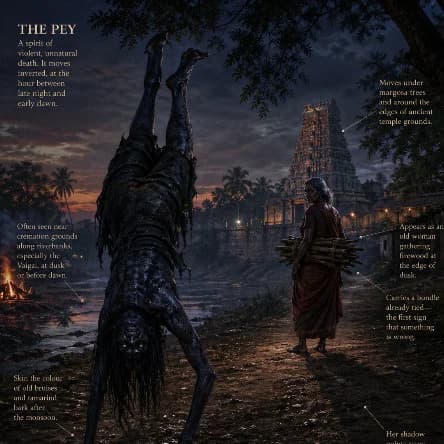
In the Tamil districts between Madurai and Thanjavur, during the weeks before the northeast monsoon when the air sits heavy and still over the Vaigai's dried sandbanks, Mari is said to walk as an elderly woman selling neem branches door to door — the kind of vendor who appears every season, whose presence nobody questions. The neem is correct, even auspicious; it is the two tells that the oldest women in these villages still name without hesitation. First, the bundles she carries do not wilt. Cut neem wilts within hours in that heat, but hers stays green and glossy through the full afternoon. Second, her eyes water constantly, as though she weeps without cause or shame — and the liquid, those who have looked closely report, runs yellow.
First Documented
Mariamman appears in Tamil Sangam-era oral traditions, her earliest textual traces surfacing in the Paripāṭal, a late Sangam anthology likely composed between the 3rd and 6th centuries CE, where goddess-worship along the Vaigai river already carried the fever-and-rain duality central to her cult.
Last Recorded
Accounts of Mari persist without interruption — village healers near the Kaveri delta still report her presence during outbreak seasons, and the annual Mariamman festivals at Samayapuram outside Tiruchirappalli draw hundreds of thousands who understand her not as history but as immediate, living force.
Source Language
Tamil
Origin
Mari enters the written record in the Sangam-era commentaries and later in the Tevaram hymns of the Nayanmars, where she appears alongside Murugan and Korravai as part of a pre-Brahminic stratum of Tamil divinity — fierce, undomesticated, answering to no male consort. The textual tradition, consolidated through temple practices at shrines like Samayapuram near Tiruchirappalli, frames her as a goddess whose anger must be ritually managed: turmeric water, neem leaves, the rolling of bodies across temple courtyards during the Panguni Uthiram festival. Folk accounts from the Kaveri delta and the dry-belt villages of Pudukkottai district diverge sharply here — in those oral traditions, Mari does not wait to be angered. She arrives with the southwest monsoon, already moving, already deciding, her presence announced by the first pustules on a child's skin or by the smell of rain on cracked laterite earth. The textual record frames her as a punishing deity appeased by devotion; the oral tradition insists she
Frequently Asked
Mari is a Tamil goddess of rain, epidemic disease, and smallpox, worshipped across Tamil Nadu and parts of Karnataka and Andhra Pradesh. Her name derives from the Tamil word for rain, and she governs the thin boundary between the monsoon's gift and its destruction. Village shrines to Mari appear at crossroads and field edges, particularly in the dry Deccan interior where rain is both prayer and threat.
Mari is neither cleanly divine nor demonic — she is a gramadevata, a village deity whose power precedes the Sanskritic pantheon and operates outside its moral categories. Her anger manifests as smallpox, cholera, and flood; her favor brings the northeast monsoon that fills the Kaveri and Vaigai rivers. Communities in the Madurai and Tirunelveli districts have propitiated her for centuries precisely because she cannot be reduced to benevolence or malice.
Mari commands rain, fever, and epidemic illness — the same force that scorches a village with disease can break a drought that has cracked the red earth of the Coromandel plain. She is said to ride a donkey and carry a trident or neem branch, the neem being both her symbol and a traditional remedy against the pox she sends. Offerings of lemon, turmeric, and cooked rice are made to cool her heat and redirect her power toward healing.
Smallpox was understood in Tamil folk medicine not as a disease but as Mari's presence in the body — the pustules were called her flowers, and the afflicted were said to be 'wearing Mari.' Families would not use the word smallpox during an outbreak, fearing to name the illness would intensify the goddess's attention. This belief persisted in rural Tamil Nadu well into the twentieth century, documented in accounts from the Thanjavur delta region.
Mariamman is the most widely worshipped form of Mari, her name combining Mari with Amman, the Tamil honorific for mother-goddess. While Mari is the raw, older force — rain and plague undifferentiated — Mariamman is her domesticated, temple-housed expression, given iconography, festival cycles, and priestly ritual. The Samayapuram Mariamman temple near Tiruchirappalli is among the most visited shrines in Tamil Nadu, drawing pilgrims who walk barefoot from Kaveri's banks during the summer festival.
Worship of Mari extends into Karnataka, Andhra Pradesh, and Maharashtra, where she appears under names like Maremma, Muthumari, and Yellamma, each carrying the same core association with epidemic and rain. Tamil diaspora communities carried her cult to Sri Lanka, Singapore, and Malaysia, where Mariamman temples were among the first permanent religious structures built. The goddess crossed the Palk Strait and the Indian Ocean long before her mythology was written down.
Mari does not appear in the Vedic corpus or the major Puranas — her roots are in oral tradition and the Sangam-era understanding of kanni, the dangerous, untamed feminine. Later Tamil Sthala Puranas attached to individual temples, such as those of Samayapuram and Thirukadaiyur, incorporate her mythology into a Shaiva framework, linking her to Parvati or Renuka. These temple texts are the closest thing to canonical scripture for her worship, though the living tradition of kolam patterns drawn at her shrines carries as much theological weight as any written account.
A Mari shrine is typically a small open-air platform at the edge of a settlement or beneath a neem tree, marked by a terracotta or stone figure painted red and yellow, often garlanded with lemon strings. The smell of camphor and the sight of broken coconuts on the ground are reliable signs of recent propitiation. During the Tamil month of Panguni, when the heat before the monsoon is most intense, these shrines become the center of firewalking ceremonies that draw the whole village to the field's edge.
संबंधित लोकगाथाएं
Related Lore
Algorithmic Inference
आपको यह भी पसंद आ सकता है
You May Also Like
Community Discussion
Comments are reviewed by AI before appearing publicly. Unsafe, unrelated, or uncertain comments go to human review.
Sign in to join the discussion.
0 comments
No public comments yet.