प्रतीक्षा करें
Retrieving sighting coordinates from the Map…
प्रतीक्षा करें
Retrieving sighting coordinates from the Map…

Mohana
Along the Mahanadi's lower reaches, where the river spreads wide and slow before meeting the Bay of Bengal, fishermen cast their nets before dawn and do not whistle. Whistling draws the Mohana. It lives in the deep channels where the current turns cold without reason, where a man's oar will sometimes catch and hold as if gripped from below, and the water shows no explanation. The fishing communities of the Chilika lake district know it as a presence rather than a shape — something that moves beneath the surface during the monsoon months when the river runs swollen and opaque with silt from the Deccan plateau. Those who have felt it describe a sudden weightlessness, as if the water has briefly chosen to let them go, before the pull begins.
What the Mohana takes is not the body. Accounts from the Kendrapara delta and the lower Hooghly communities agree on this: a man pulled under and returned is wrong afterward, not in any way you can point to and name, but wrong in the way a familiar room is wrong when something has been moved in the dark. He fishes the same waters, mends the same nets, speaks the same words. The emptiness is interior. Old accounts from the Jagannath temple priests of Puri, who maintain records of coastal calamities, suggest the Mohana does not act from hunger or malice but from a kind of compulsion — as rivers themselves carry things they did not choose to carry. No ritual reclamation of a replaced soul is documented as successful.
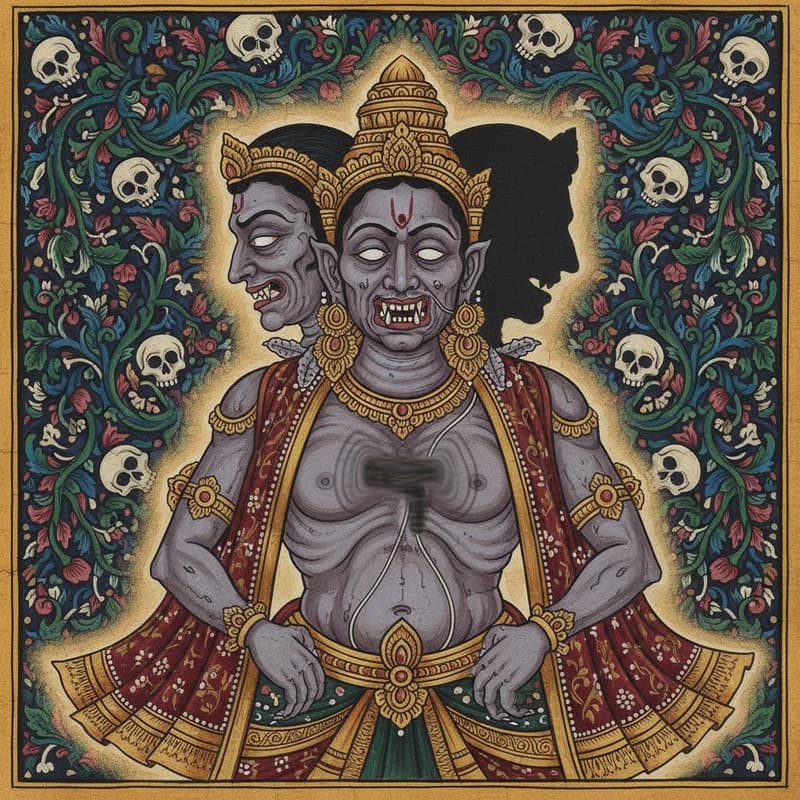
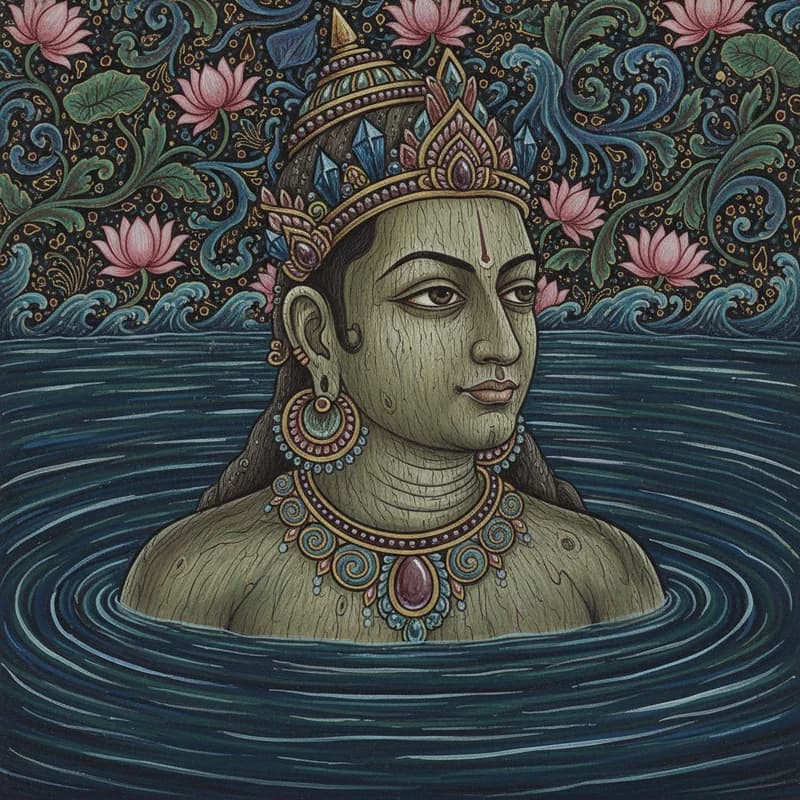
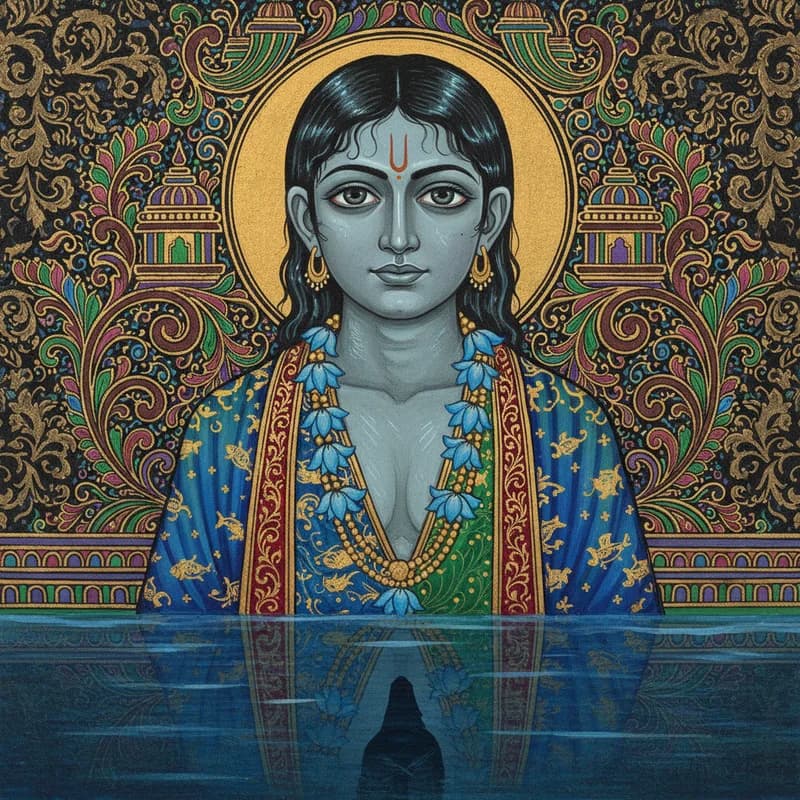
Mohana appears as a young man of perhaps twenty years, skin the waterlogged grey-blue of a body recovered from the Mahanadi three days after drowning — not decomposed, but wrong in the way that preserved things are wrong, too intact for what it has endured. The hair lies flat and wet against the skull regardless of weather, leaving a damp outline wherever he has rested his head against a boat's hull or a riverbank's mud. Fishermen along the Chilika's eastern channels describe his smell before they see him: cold silt and something sweeter beneath it, the particular sweetness of water hyacinth rotting at the stem. His voice, when he speaks, carries an underwater quality — not muffled exactly, but delayed, as though sound must travel up through fathoms to reach the air. The single feature no account disputes is this: he casts no shadow on the water's surface, only into it, the darkness falling downward into the river rather than across it.
Along the Mahanadi's sandbanks during the lean months between the monsoon's retreat and the winter chill, Mohana appears as a fellow fisherman — a man from the next village, recognizable enough to invite trust, unfamiliar enough that no one can quite place him. He carries a net over one shoulder, the correct weight, the correct drape, the kind of detail that would fool most men on a grey morning before the light has settled. The first tell is the net itself: it is always dry, regardless of the hour or the river's spray. The second is his direction of travel — he is always walking toward the water, never away from it, even when the boats are already out and there is nothing left on the bank worth approaching.
First Documented
Mohana surfaces most clearly in the oral traditions of Odia fishing communities along the Mahanadi delta, where accounts collected in the early twentieth century by colonial-era district gazetteers describe her as an ancient presence predating written record. Her name appears in scattered Bengali folk manuscripts from the Sundarbans region, though no single canonical text claims her origin.
Last Recorded
Accounts of Mohana persist along the Mahanadi delta and among the fishing villages of the Chilika Lake shore, where disappearances during the monsoon months still draw whispered attribution to the spirit rather than to current or storm. Collectors working the Bengal coast as recently as the 2010s recorded her name from elderly fishermen.
Source Language
Odia
Origin
The Mohana enters the oral record through the fishing communities of the Chilika Lake coastline and the Mahanadi delta, where accounts collected by Sarat Chandra Roy in the early twentieth century describe a being inseparable from brackish, transitional water — neither river nor sea but the uncertain stretch between. The Odiya textual tradition, drawing on later Tantric catalogues, frames the Mohana as a byproduct of unperformed last rites for those who drowned without witness, a spirit produced by ritual failure. The fisher communities of Paradip and the mouths of the Rushikulya River reject this framing entirely. In their telling, the Mohana was never human — it is the water's own hunger, shaped like a drowned man only to be recognized at the surface before it pulls you under. What this divergence reveals is significant: the Tantric account requires a traceable origin and therefore a traceable remedy, while the coastal oral tradition forecloses remedy entirely, which is perhaps the more honest account of what the sea has always done to the people who trust it.
Frequently Asked
Mohana is a water spirit from the folklore of Odisha and Bengal, believed to haunt the rivers and estuaries where fishing communities have worked for generations. Oral accounts collected along the Mahanadi delta describe Mohana as an entity that lures fishermen beneath the surface, leaving their bodies hollow — present in form but emptied of soul. The name itself carries the Sanskrit root for enchantment or bewitchment, which speaks directly to the spirit's method.
According to accounts gathered from fishing villages near the Chilika Lake shoreline and the lower Mahanadi, Mohana does not simply drown its victims — it displaces the soul and leaves the body walking, breathing, but fundamentally absent. Families describe returning fishermen who no longer recognize their children, who stare at the cooking fire without blinking, who forget the names of the nets they have used for thirty years.
Mohana is distinct from the Jaldevis and river goddesses of Bengali worship, who are generally propitiated and considered protective when properly honored. Where a Jaldevi demands ritual and reciprocity, Mohana operates outside that contract — it takes without negotiation, and no temple on the Hooghly's western bank is dedicated to its appeasement. The distinction matters: one is a deity, the other is a predator wearing the river's face.
Fishermen along the Bhitarkanika waterways speak of a particular stillness before Mohana's approach — the kind that falls in the hour before the monsoon breaks, when even the egrets stop moving. Some accounts mention an unusual sweetness in the water's smell, and others describe a figure seen just below the surface that mirrors the fisherman's own posture exactly. These are the signs that experienced elders teach young men before their first solo night on the water.
Unlike the Jinn of Islamic folk tradition or the Nagas of Brahminic scripture, Mohana carries no cosmic role and no negotiable will — it is not a guardian, not a punisher of sin, not a keeper of treasure. What separates Mohana from comparable water spirits across South Asia is this specific act of soul-replacement, a hollowing rather than a killing, which places it closer to possession entities than to the drowner-spirits found in Rajasthani or Punjabi folklore.
The densest concentration of Mohana accounts comes from the river mouths and backwaters of coastal Odisha — the Devi River, the Rushikulya estuary, and the labyrinthine channels feeding into Chilika Lake appear most frequently in oral records. Bengal's Sundarbans, where the Matla and Gosaba rivers braid through mangrove forest, also carry strong Mohana traditions, particularly among the Malo fishing caste. These are places where the boundary between river and sea is never quite fixed.
Protective measures vary by community, but the most consistent practice recorded across Odishan fishing villages involves tying a red thread around the left wrist before night fishing and reciting a short invocation to Maa Tarini, whose shrines dot the Ganjam coast. In the Sundarbans, some Malo fishermen carry a small clay figure of Bonbibi — the forest and water guardian — as a counter-presence against entities like Mohana. Neither practice is considered foolproof; elders are careful to say they reduce risk, not eliminate it.
Mohana does not appear in the canonical Sanskrit Puranas or in the Tantric catalogs of spirits compiled in texts like the Mantramahodadhi. Its existence is preserved almost entirely through oral transmission — the cautionary stories told by Keuta and Malo fishermen before the Kartik full moon, when night fishing on open water is considered most dangerous. This absence from written record is itself significant; Mohana belongs to the knowledge that travels by word of mouth along the river, not by manuscript.
संबंधित लोकगाथाएं
Related Lore
Algorithmic Inference
आपको यह भी पसंद आ सकता है
You May Also Like
Community Discussion
Comments are reviewed by AI before appearing publicly. Unsafe, unrelated, or uncertain comments go to human review.
Sign in to join the discussion.
0 comments
No public comments yet.