प्रतीक्षा करें
Tracing the Vetala’s last known location…
प्रतीक्षा करें
Tracing the Vetala’s last known location…

Nagadevata
Across the subcontinent, from the cobra-haunted paddy margins of coastal Andhra to the termite mounds along the Narmada's upper banks, a single understanding holds: the serpent spirit is not merely a creature of the natural world but a custodian of something older than the temples built to contain it. Farmers in the Konkan belt will not break ground in the month of Shravan without first making an offering at the nearest snake stone — a flat granite disc worn smooth by generations of oil and turmeric — because the Nagadevata's authority over soil, water, and fertility is not symbolic. It is administrative. Neglect the stone and the well runs bitter. Disturb a cobra's nest without propitiation and the illness that follows, the accounts insist, does not respond to medicine.
What makes the Nagadevata distinct from other protective spirits is the precision of its conditions. It does not threaten indiscriminately. Oral accounts collected from the Sarpam Thullal tradition in Kerala's Malabar region and from Nag Panchami observances along the Godavari describe an entity that responds to specific violations — the felling of a tree sheltering a mound, the ploughing-over of a kavu grove, a woman crossing a snake's path and failing to pause. Appeasement follows a grammar as strict as any legal code: milk poured at dusk, sandalwood paste on the stone, a song sung by a woman who has not eaten since morning. Ignore the grammar and the protection inverts. The Nagadevata does not leave a household it has decided to punish. It simply changes what it guards.
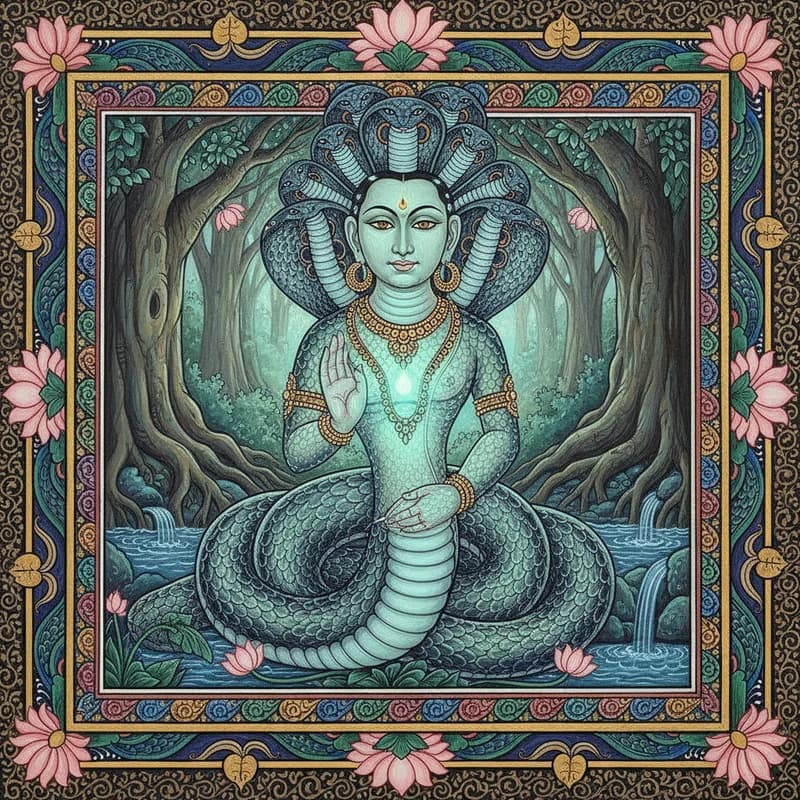
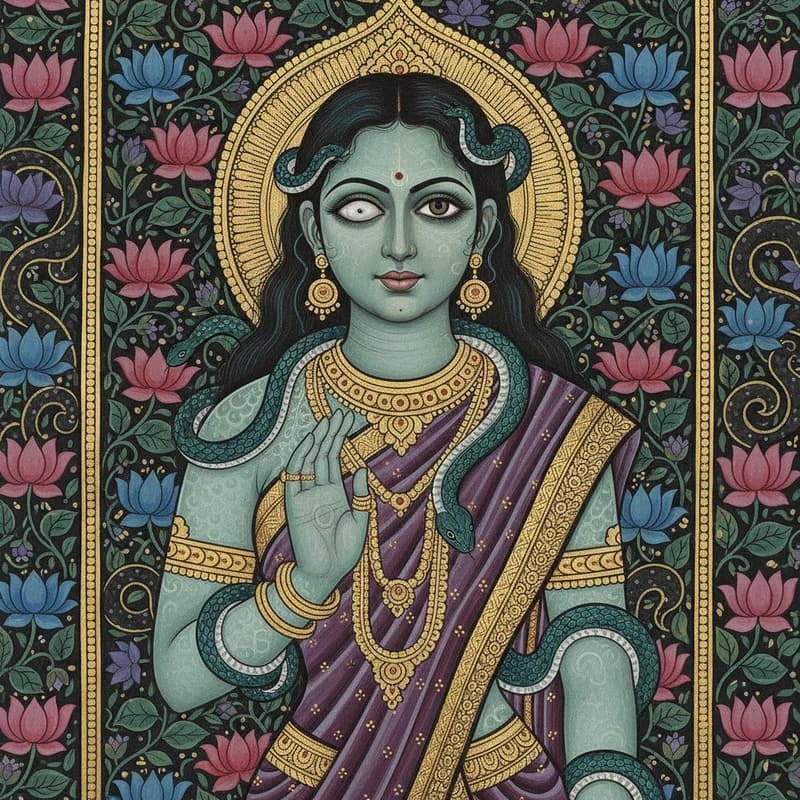
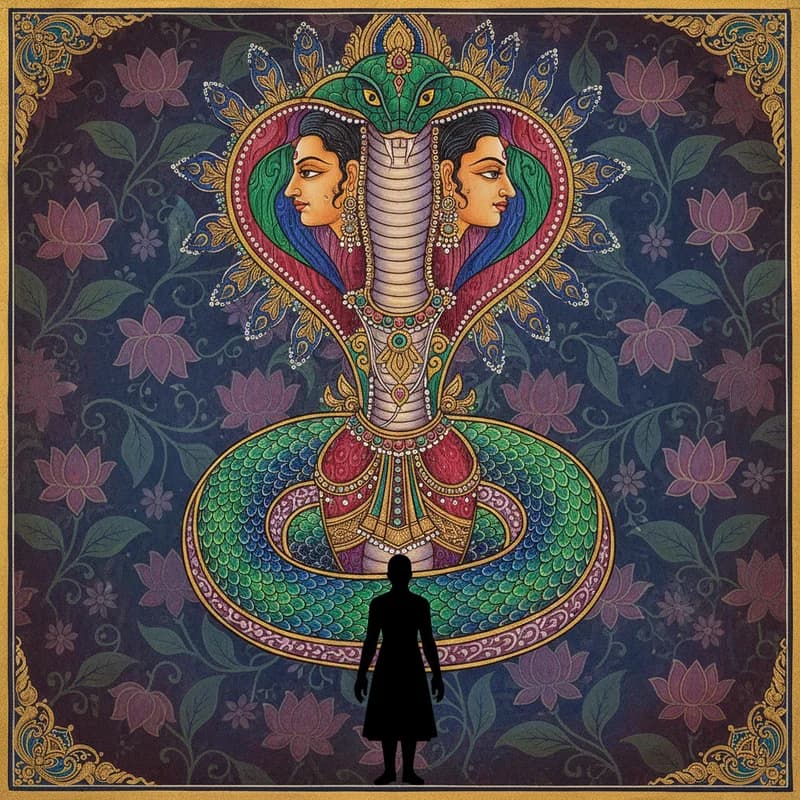
The Nagadevata appears most often as a cobra of unusual size — not monstrous, but wrong in the way a thing is wrong when it is too still, too aware. The hood, when spread, carries markings that witnesses from the Narmada basin consistently describe as resembling a human face in profile, not painted but inherent, the way grain appears in old wood. Accounts from the snake-groves behind the Mannarasala temple in Kerala note a smell that precedes its appearance: wet laterite and crushed tulsi, the particular cold-green smell of a well that has not been used in years. The sound it makes is not a hiss but something lower, felt in the sternum rather than heard. The single detail that separates it from any natural serpent is this: its shadow does not match its body — it falls as a human silhouette, upright, arms at its sides.
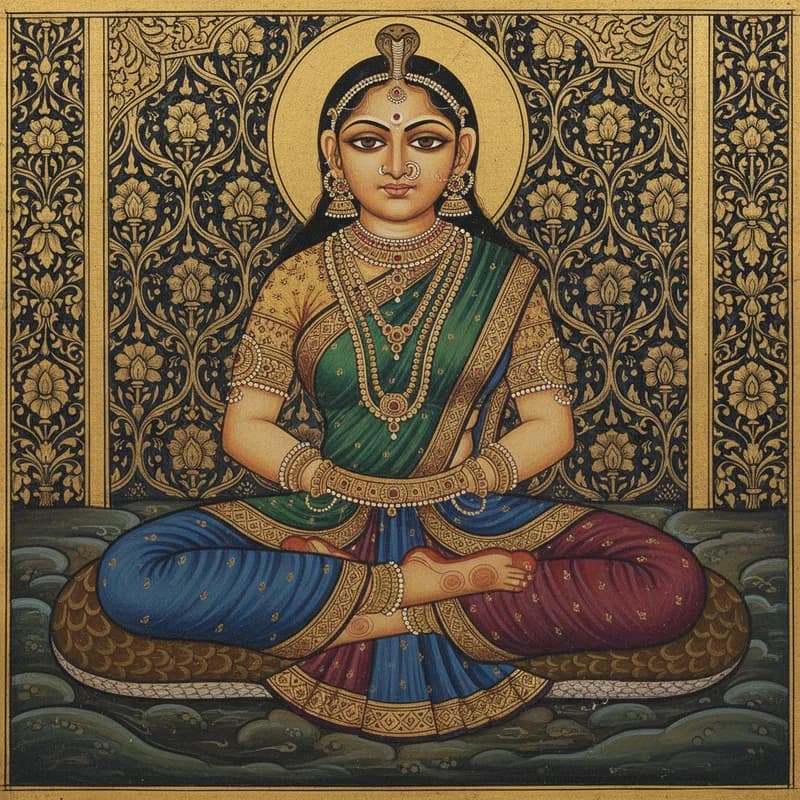
Along the banks of the Godavari during the monsoon planting season, Nagadevata appears as an elderly woman selling terracotta votive figures at the edge of temple compounds — the kind of vendor so ordinary she is invisible. She carries a flat basket lined with dried neem leaves, and she haggles with the patience of someone who has done this for decades. The first tell is her wrists: no matter the heat, she wears no bangles, and the skin there is scaled in a pattern that widows who have helped her count change describe afterward as something like fish leather, smooth in one direction and catching in the other. The second is that she will not cross a line of turmeric powder, even a faded one — she pauses, reroutes, pretends to examine something on the ground, but she does not cross.
First Documented
Naga worship predates the Vedic period, with serpent deity imagery appearing in the Indus Valley seals of Mohenjo-daro around 2500 BCE. The Atharvaveda contains explicit hymns addressing serpent spirits, and the Mahabharata's Adi Parva elaborates the Naga lineage through Kadru's offspring at the banks of the Ganga.
Last Recorded
Accounts of Nagadevata persist without interruption into the present day — fieldwork along the Narmada riverbanks and in the snake-grove temples of Karnataka's Kodagu district continues to yield fresh testimonies. As recently as the 2010s, villagers near Udupi reported propitiation rituals following dreams of a hooded presence demanding neglected offerings.
Source Language
Sanskrit
Origin
The Nagadevata appears in recognizable form in the Mahabharata's Astika Parvan, where the serpent lineages of Shesha, Vasuki, and Takshaka are given genealogies and moral standing that elevate them above mere animal spirits into beings with claims on cosmic justice. But the oral traditions of the Narmada valley and the laterite plateau communities of Odisha's Koraput district carry a different insistence: the Nagadevata is not a deity who happens to inhabit a serpent body, but a specific spirit of ground-water and buried stone, whose serpent form is a location, not a character. Where the textual tradition frames propitiation as a means of securing the Naga's goodwill across lifetimes, the Koraput accounts describe a much more contractual arrangement tied to a single field, a single well, a single mound under a specific mahua tree — the spirit does not travel, does not generalize, does not respond to prayers made elsewhere. This divergence is not trivial. It suggests that the Puranic synthesis absorbed a vast body of localized
Frequently Asked
Nagadevata is a serpent deity venerated across India as a divine guardian of water sources, fertility, and the underworld. Distinct from ordinary snakes, these beings are understood as semi-divine entities capable of blessing or cursing entire lineages. Accounts collected from the Narmada basin to the rice fields of Odisha consistently describe them as ancient presences older than the temples built in their honor.
Nagadevata occupies a position of cautious reverence — neither purely benevolent nor malicious, but deeply responsive to human conduct. Those who disturb a serpent mound, fell a tree sheltering a snake deity, or neglect the Nag Panchami offering risk illness, infertility, or the curse known as sarpa dosha. Proper propitiation, however, brings rain, healthy children, and protection from poison.
In Sanskrit texts like the Mahabharata and the Puranas, Naga refers to a class of semi-divine serpent beings — Vasuki, Takshaka, Shesha — who inhabit Patala and interact with gods and kings. Nagadevata is the localized, worshipped form of this concept, the specific serpent spirit believed to reside in a particular anthill, pond, or sacred grove in a village. One is cosmological; the other is intimately territorial.
Nagadevata veneration runs deepest in Karnataka, Kerala, and Tamil Nadu, where sacred groves called Sarpa Kavu are maintained specifically for serpent deities, often beside old wells or under peepal trees. The Mannarasala Sree Nagaraja Temple in Kerala's Alappuzha district draws tens of thousands during the monsoon season for serpent rituals. Parallel traditions persist in Maharashtra, Bengal, and along the Godavari corridor, each with distinct ritual vocabularies.
Nagadevata is credited with control over rainfall, the fertility of soil, and the health of newborns — all tied to the serpent's ancient association with water and the earth's interior. Oral accounts from Chhattisgarh and Andhra Pradesh describe Nagadevata as capable of entering dreams to deliver warnings or demands for neglected worship. The power to grant or withhold offspring is perhaps the most consistently reported attribute across regional traditions.
Sarpa dosha is a ritual affliction believed to result from harming or disrespecting a Nagadevata — killing a cobra, destroying a serpent mound, or failing to observe ancestral serpent rites. Symptoms attributed to it include childlessness, recurring miscarriages, and unexplained illness within a family line. Remedies typically involve pilgrimages to temples like Kukke Subramanya in Karnataka's Western Ghats or the commissioning of a Naga Pratishtha, a consecration ceremony for a new serpent image.
On Nag Panchami, observed on the fifth day of the bright fortnight in the month of Shravan, households across India offer milk, turmeric, and flowers to serpent images or living cobras. In Maharashtra's Pune district and across Karnataka, women draw snake figures on doorways with wet clay or rice paste to invite the deity's protection. The ritual acknowledges Nagadevata's dual nature — the same force that can poison is asked, through correct observance, to protect.
Shesha Naga is a specific cosmic serpent of Vaishnava theology — the thousand-headed being upon whom Vishnu reclines in the primordial ocean, described in the Bhagavata Purana as the foundation of the universe itself. Nagadevata is a broader, more diffuse category: the living divine presence of serpents as experienced in local worship, anthill shrines, and village groves. Shesha is a named deity of scripture; Nagadevata is the unnamed, immediate sacred serpent of the land beneath your feet.
संबंधित लोकगाथाएं
Related Lore
Algorithmic Inference
आपको यह भी पसंद आ सकता है
You May Also Like
Community Discussion
Comments are reviewed by AI before appearing publicly. Unsafe, unrelated, or uncertain comments go to human review.
Sign in to join the discussion.
0 comments
No public comments yet.