प्रतीक्षा करें
Unfolding the scroll…
प्रतीक्षा करें
Unfolding the scroll…
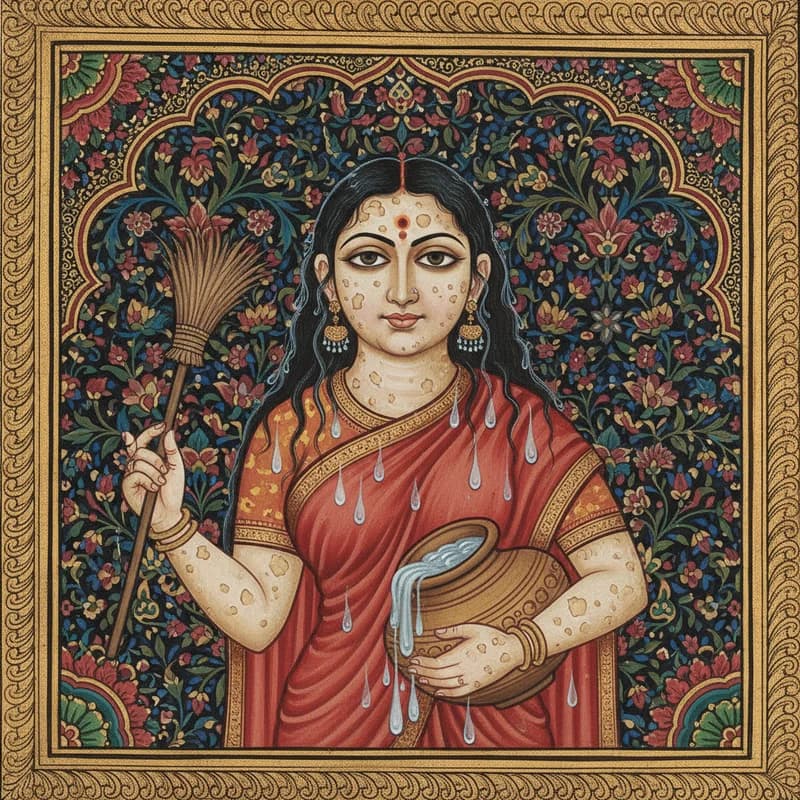

Sitaladevi
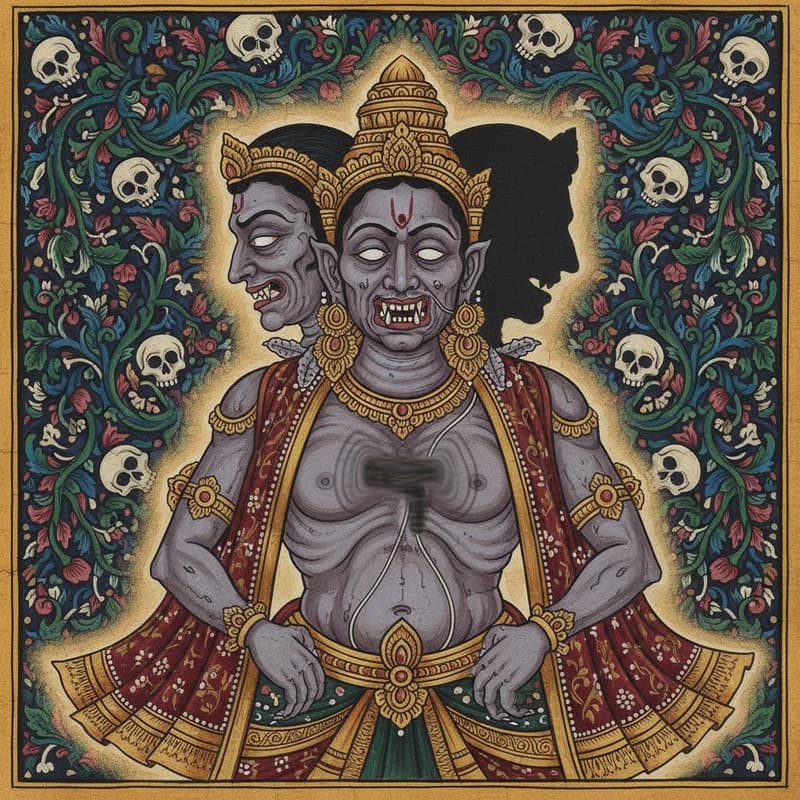
She rides a donkey and carries a broom. The broom is not ceremonial — she sweeps disease through a body the way wind sweeps chaff across a threshing floor, and whether that sweeping is cure or catastrophe depends entirely on how she has been received. Across the Gangetic plain from Varanasi west through Rajasthan, she appears in the fever-logic of smallpox outbreaks: the pustules themselves were once read as her footprints, the burning skin as her presence, the delirium of high temperature as her voice speaking in a language the body has no choice but to hear. Her name means the cool one, and the paradox is deliberate. She is invoked precisely because she is the disease, and only she can call it back.
The worship is specific in its requirements. On Shitala Ashtami, observed in the month of Chaitra when the mango trees along the Yamuna are just beginning to flower, no fire is lit in the household. Food is prepared the evening before and eaten cold the following morning — the stale offering called basoda. Lighting a flame on that day is understood not as negligence but as provocation, an insult to a goddess who governs heat by embodying its opposite. Temples to her stand at the edges of towns rather than their centres, often near the neem tree whose leaves her devotees use in ritual bathing of the sick, and her priests in districts of eastern Uttar Pradesh and Bihar report that she does not punish the faithless with anger but with indifference — which is worse. She simply does not call the fever back.
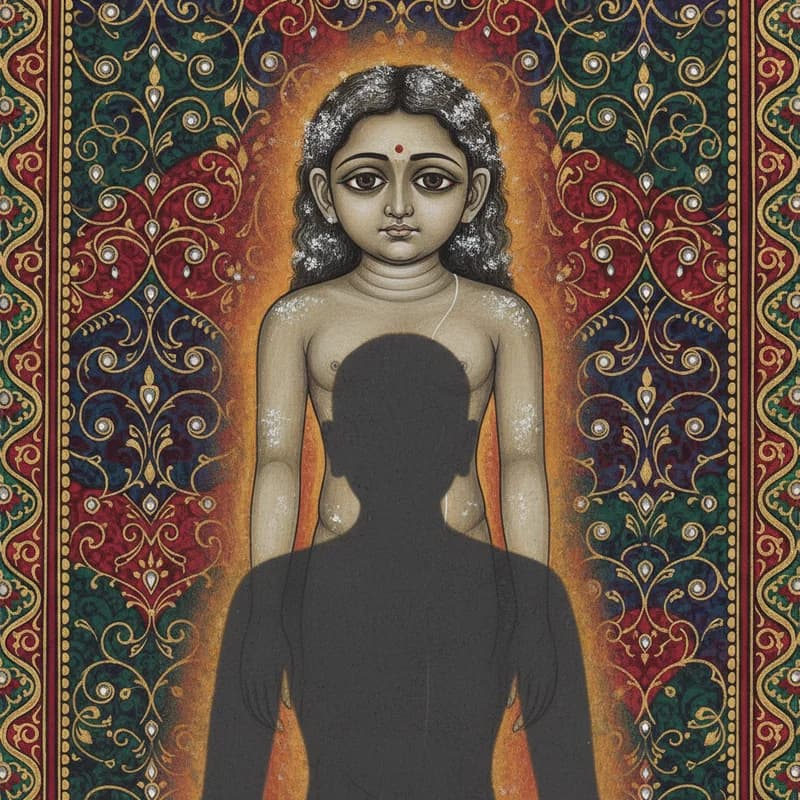
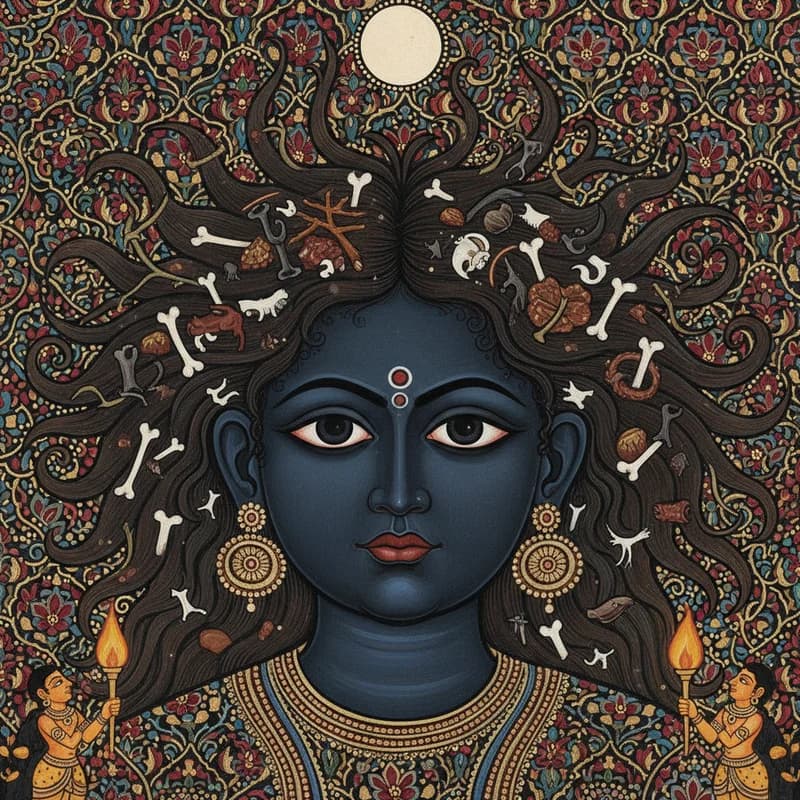
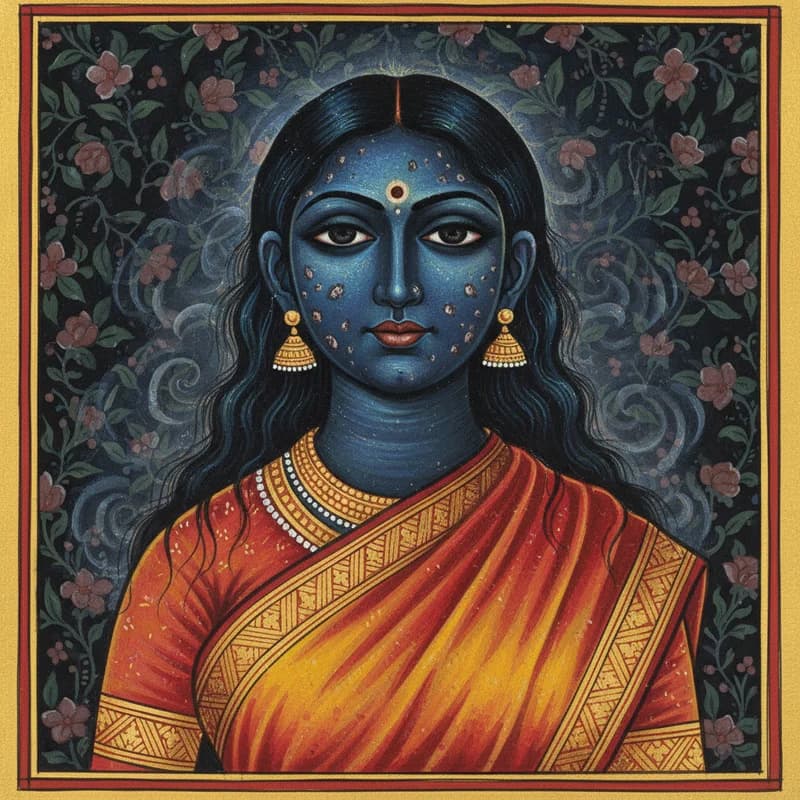
She comes cold. That is the first thing every account agrees on — not the chill of winter air or well-water, but a specific, intimate cold that settles against the skin like a damp cloth pressed to a fever. She appears as a pale woman, the colour of milk left standing too long, dressed in a single red cloth that should be bright but always reads as faded, as though it has absorbed too much of what it has witnessed. Her hair is loose and wet, never dry, regardless of season — in the Baisakh heat of the Gangetic plain, witnesses describe droplets falling from it onto cracked earth. She carries a broom of neem twigs and a clay pot, and the pot is never empty. The mark of the supernatural is this: her skin, on close account, shows the raised topography of old pox scars — the very affliction she governs — worn not as wound but as authority.
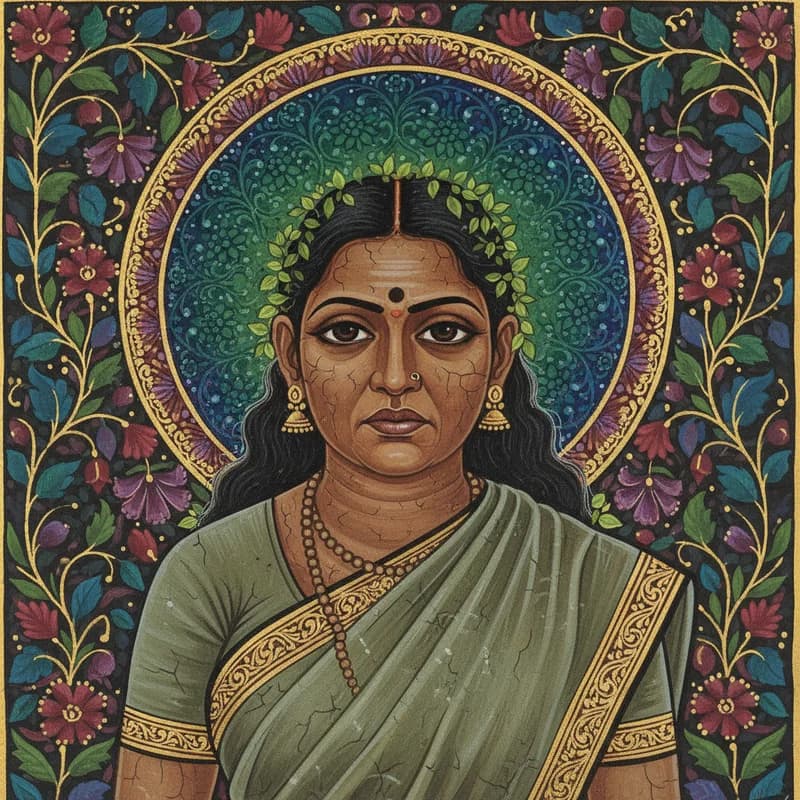
Sitaladevi moves through the lanes of villages along the Ganga plain — between Kanpur and Varanasi, in the weeks before Holi when the air first turns warm — as an old woman carrying a clay pot of water on her hip and a neem branch in her free hand, both ordinary objects of the season, both attributes of her worship that most villagers have stopped consciously recognizing. She asks for food, specifically for cold food, leftover from the previous day, which is precisely what her devotees offer her on Sheetala Ashtami; the request is so culturally legible that it disarms. The tells are these: the clay pot she carries sweats cold water even in the growing March heat, cold enough that those who brush against it pull their arm back sharply. Her donkey, which is never seen but whose hoofbeats arrive a moment before she does on hard-packed earth, stop the instant she stops — not slowing, but stopping, as though the animal itself does not breathe between one step and the next.
First Documented
Sitala appears in the *Skanda Purana* and gains her most sustained early treatment in the *Sitala Mangal* texts of Bengal, composed roughly between the sixteenth and eighteenth centuries, though her worship almost certainly predates these written accounts, rooted in village oral traditions across the Gangetic plain.
Last Recorded
Accounts of Sitaladevi's intervention in outbreaks of pox and fever were actively recorded through the mid-twentieth century across the Gangetic plains, with fieldworkers in Bihar and eastern Uttar Pradesh documenting propitiation rituals as late as the 1970s. Her worship continues today, particularly around the Sheetala Ashtami observances held each spring before Holi.
Source Language
Hindi
Origin
Shitala appears in the Skanda Purana's Kashi Khanda as a fully formed goddess, arriving at Shiva's court on a donkey, carrying a broom and a pot of cold water — her iconography already fixed, as if the text is recording an established presence rather than inaugurating one. The folk tradition of the Gangetic plain, particularly in the villages along the Gomti and Ghaghara rivers, runs considerably older and does not share the Puranic account's theological tidiness. In written sources, Shitala is a goddess who *causes* smallpox and *withdraws* it as an act of grace; the distinction between affliction and blessing is hers to determine. Oral accounts collected from the Bhojpuri belt, however, and from the priests of her temple at Bahuchara near the Ganga's winter sandbars, describe her differently: she does not send the disease but *is* the disease, embodied — the fever that takes a child is her presence entering the body, not her punishment. That divergence is not minor. It separates a theology of propitiation from a
Frequently Asked
Sitaladevi is a goddess of smallpox and skin disease venerated across North India, particularly in the Gangetic plains of Uttar Pradesh, Bihar, and Rajasthan. She is depicted riding a donkey, carrying a broom and a pot of cool water, and her name itself means 'the cool one' — a reference to the fever she both inflicts and relieves. Her worship is documented in the Skanda Purana, where she appears as a complex deity whose touch can bring pestilence or healing depending on her disposition.
Sitaladevi holds direct authority over smallpox, chickenpox, measles, and other eruptive skin fevers — conditions that rural communities across the Yamuna and Ganga river belts historically attributed to her presence in the body. When angered or neglected, she was believed to send the burning rash; when properly propitiated, she could withdraw the affliction and restore the skin. Her broom sweeps disease into the household, and her pot of cool water is the mercy that follows.
The donkey, or gadha, is her vahana — her vehicle — and in folk traditions collected from villages near Mathura and Varanasi, it signals her association with the margins of settled society, with the untamed and the unclean. Washermen and potters, communities who worked with the donkey, were historically among her most devoted worshippers. The animal also carries the weight of disease away from the afflicted, a symbolic function that oral accounts from Rajasthan make explicit.
Shitala Ashtami, falling on the eighth day after Holi in the month of Chaitra, is her primary festival — observed with particular intensity in Rajasthan, where the Sheetla Mata temple at Chaksu near Jaipur draws thousands of pilgrims. On this day, devotees offer cold, pre-cooked food called basoda, since lighting a fire in her presence is considered an offense. The cold offering mirrors her cooling nature and signals submission to her authority over the body's heat.
Sitaladevi and Mariamman are parallel but distinct regional expressions of the same deep archetype — a goddess who governs eruptive disease and demands propitiation to spare her devotees. Mariamman is worshipped across Tamil Nadu and Karnataka, often near the Kaveri and Tungabhadra rivers, while Sitaladevi's stronghold is the North Indian plains. Both ride or are associated with humble animals, both carry cooling implements, and both blur the line between divine punishment and divine protection.
Her most significant textual appearance is in the Shitala Ashtakam, a hymn attributed to the Skanda Purana, which describes her iconography in precise detail — the broom, the water pot, the winnowing fan, the donkey. Folk versions of the Shitala Mahatmya, collected from oral traditions in Bihar and eastern Uttar Pradesh, elaborate her mythology further, including a narrative in which she quarrels with Jvarasura, the fever demon, and must be appeased to prevent epidemic. These texts sit at the boundary between canonical scripture and living oral tradition.
She is both, and the distinction depends entirely on the ritual relationship between the goddess and the household. Classified at LokKatha under caution, Sitaladevi is not malevolent by nature — she is a force that must be acknowledged and correctly approached, particularly during the hot months before the monsoon when disease historically peaked across the Gangetic plains. To ignore her festival, to cook hot food on Shitala Ashtami, or to fail in her worship was understood not as superstition but as a practical failure to maintain a relationship with a power that governed survival.
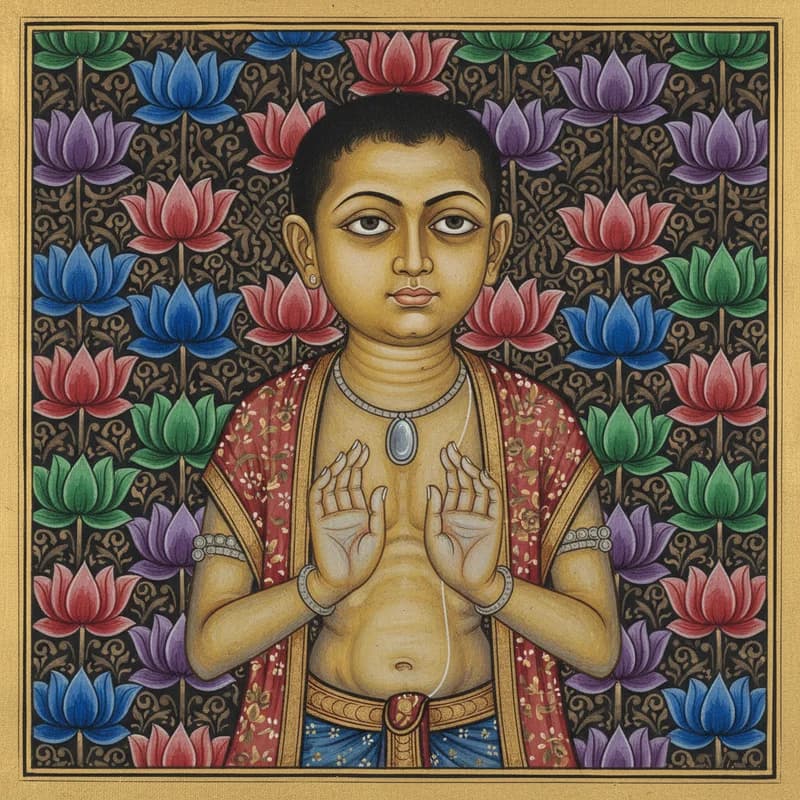
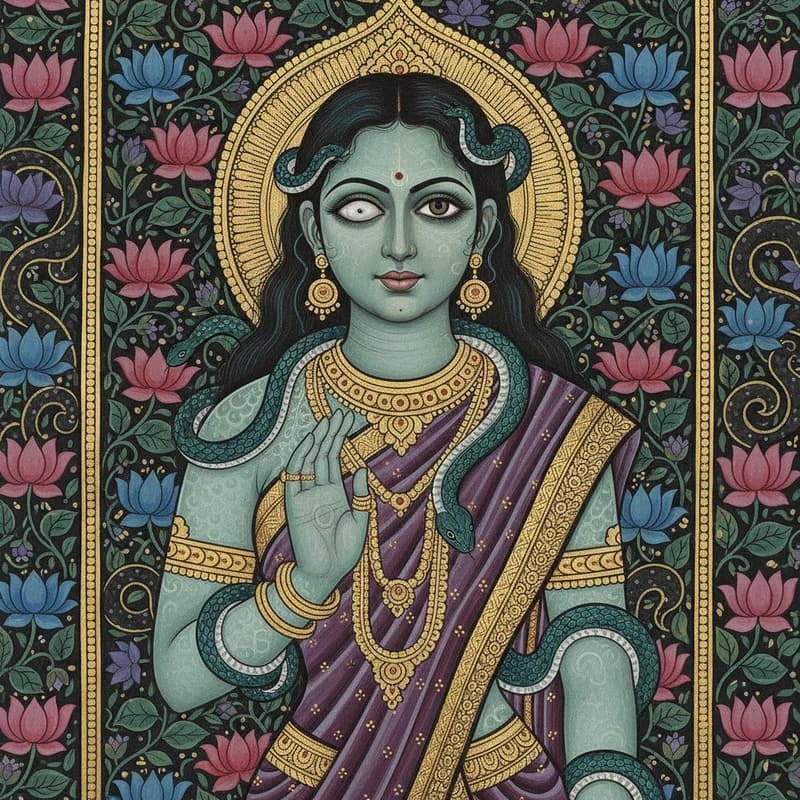
Look for a goddess seated or standing on a donkey, holding a short broom in one hand and a clay pot in the other — sometimes accompanied by a winnowing fan and a bowl of neem leaves, which are considered cooling and antiseptic in Ayurvedic tradition. Her complexion in most North Indian temple images is pale or blue-white, contrasting with the red and gold of more martial goddesses. Temples dedicated to her, like the one at Chaksu in Rajasthan or smaller shrines along the ghats of Varanasi, are often modest structures at the edge of villages, reflecting her role as a guardian of the body's most vulnerable threshold.
संबंधित लोकगाथाएं
Related Lore
Algorithmic Inference
आपको यह भी पसंद आ सकता है
You May Also Like
Community Discussion
Comments are reviewed by AI before appearing publicly. Unsafe, unrelated, or uncertain comments go to human review.
Sign in to join the discussion.
0 comments
No public comments yet.