प्रतीक्षा करें
Retrieving sighting coordinates from the Map…
प्रतीक्षा करें
Retrieving sighting coordinates from the Map…


Vetal
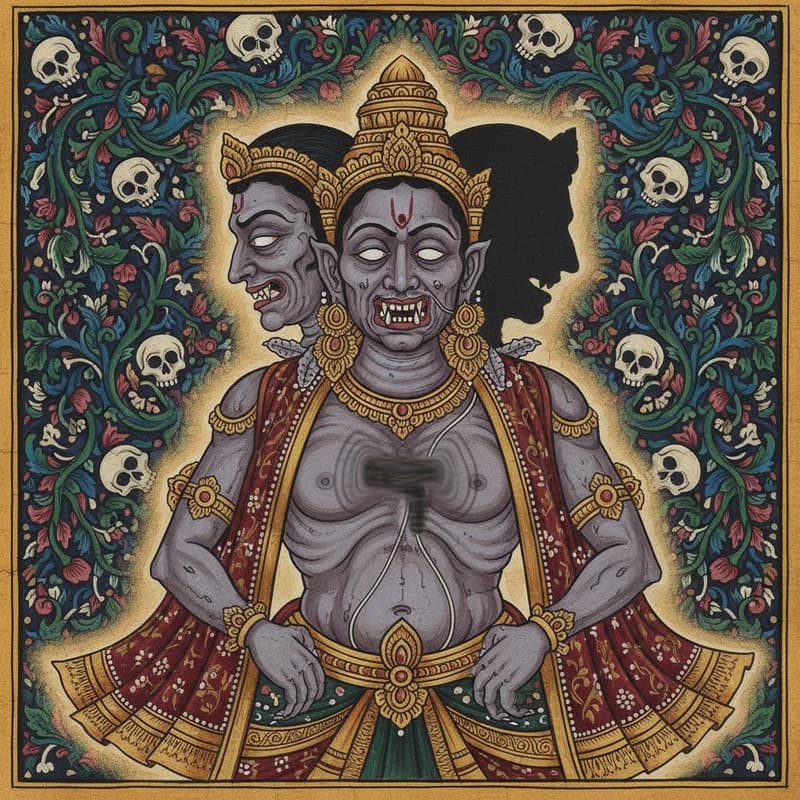
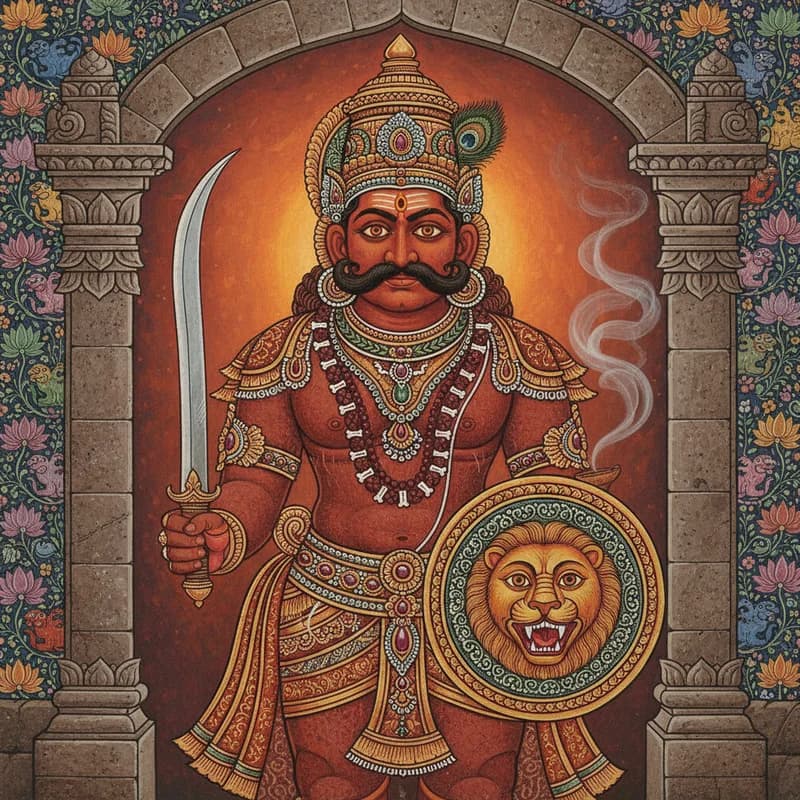
In the coastal villages south of Panaji and across the laterite plateaus of the Konkan, the Vetal occupies a position that no simple word like "spirit" adequately captures. He hangs in a body that is not his own — inverted in the branches of a kadamba or a fig at the cremation ground's edge — and he watches. The Vetalaparishishta and the older Kathasaritsagara describe a being of tremendous, uncomfortable intelligence, one who speaks in riddles not to obscure but to test whether the living are worthy of what they are asking. In the Banavali and Shantadurga temple traditions of Goa, he appears carved in black stone at the outer boundary wall, facing outward, his eyes wide and his posture alert — a guardian who holds the line between the village and whatever presses against it from the dark side of the paddy fields.
He is not straightforwardly dangerous. The Goan and Maharashtrian accounts are careful on this point. Fishermen along the Mandovi estuary and farmers in the Sahyadri foothills still address him before entering unfamiliar forest, still leave offerings of toddy and raw rice at the smashanabhumi during the dry months of Chaitra. What the accounts warn against is not the Vetal himself but the error of approaching him unprepared — without the right question, without a purpose that can withstand scrutiny. He does not suffer the casual or the dishonest. Those who come to him in desperation and speak plainly tend to receive something useful; those who come with concealed intentions report that the kadamba tree was empty, the ground cold, and that something followed them back to the village boundary and no further.
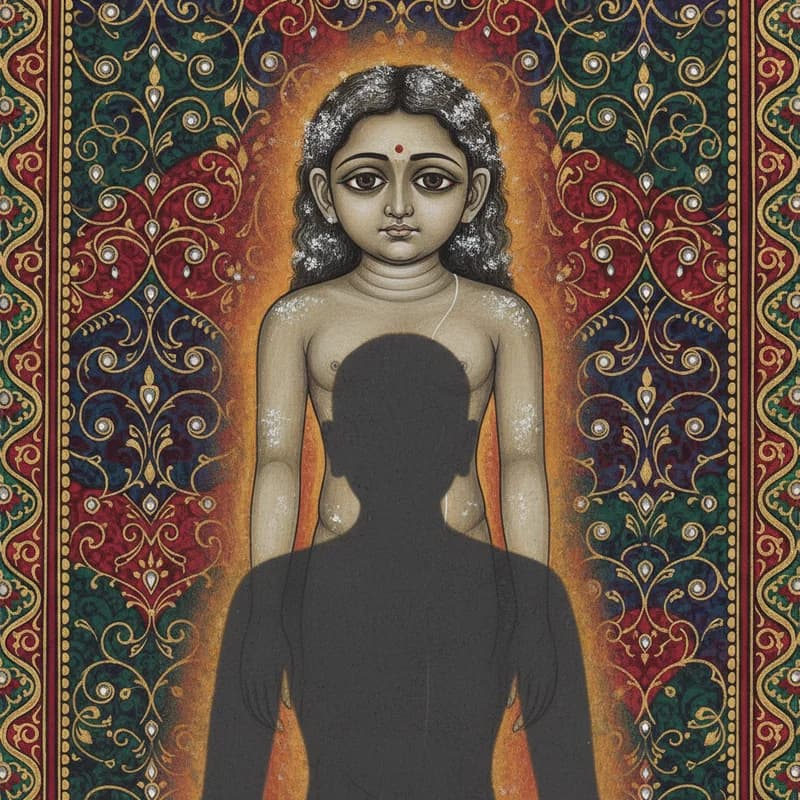
The Vetal appears as a man suspended mid-fall — the body pitched slightly forward, never quite upright, as though the muscles that once held posture have forgotten their purpose. The skin is the blue-grey of river silt left to dry on the Mandovi's banks in March, and the limbs hang with a looseness that suggests the joints have been renegotiated. Witnesses near the boundary shrines of the Konkan coast report a cold that arrives before the figure does, the specific cold of a room where someone has recently died, not winter cold but evacuation cold. The smell is wet earth and iron, the smell of the Sahyadri foothills after the first monsoon rain breaks open the red laterite soil. What marks him: the eyes are open in absolute darkness, not luminous but simply unaffected by the absence of light, seeing with the indifference of something that has already been on the other side.
In the villages east of the Sahyadris, and in the older settlements along the Mandovi's banks, the Vetal is most reliably reported in the form of a wandering mendicant — a gaunt man with ash-smeared skin and a staff of neem wood, arriving at the edge of a settlement just after the cremation fires at the smashan have cooled. He asks for water, sometimes for rice, and his speech is correct, even courteous. The first tell is the staff: neem wood cracks and bleaches in the dry season, but his remains dark and faintly wet, as though freshly cut, regardless of the month. The second is subtler — dogs will not bark at him. They go silent and press flat to the ground, which in these villages is understood as the behavior reserved not for strangers, but for the already-known.
First Documented
The Vetal's earliest literary trace appears in the *Baital Pachisi*, a Sanskrit collection embedded within the *Kathāsaritsāgara* of Somadeva, compiled in Kashmir around the eleventh century CE, though oral accounts from the Konkan coast suggest the spirit's presence in village boundary worship predates any written record by several centuries.
Last Recorded
Accounts of Vetal's presence at crossroads shrines along the Konkan coast and in the laterite-hill villages of Goa's interior have never truly ceased — fieldworkers documented active propitiation rituals as recently as the 2010s, and local families in Sindhudurg district still report encounters near boundary stones at the monsoon's edge.
Source Language
Marathi
Origin
The Vetal enters written record in the Vetālapañcaviṃśati — the twenty-five tales framed around King Vikramaditya's encounters with a corpse-possessing spirit — embedded within the Kathāsaritsāgara compiled by Somadeva in eleventh-century Kashmir. But the coastal Konkan and Goan traditions make no reference to Vikramaditya. Along the laterite plateaus between Sindhudurg and Panjim, in the groves of Peepal and Ficus behind village deul shrines, the Vetal is not a trickster or a test but a guardian installed at the edge of habitation — the last presence before the forest begins. The textual Vetala is temporary, a spirit dispossessed until the king completes his task; the folk Vetal of the Goan gaunkari system is permanent, propitiated at boundary stones before harvest and at cremations along the Mandovi's tributaries. That divergence is instructive: it suggests the Konkan tradition drew on an older stratum of boundary-deity worship
Frequently Asked
Vetal (वेताल) is a spirit from the folklore of Goa and Maharashtra who presides over the threshold between the living and the dead. Unlike the vetala of Sanskrit literature — the corpse-haunting spirit of the Baital Pachisi — Vetal in coastal western India is venerated as a village guardian, installed at boundaries, crossroads, and the edges of settlements. His shrines appear frequently along the Konkan coast, often beneath ancient trees or at the margins of rice fields before the monsoon breaks.
Vetal resists easy classification as either demon or deity. Across Goa and the Konkan belt, he is propitiated as a protective force — a guardian who keeps malevolent spirits from crossing into inhabited land — yet he is also feared for his association with death, cremation grounds, and the untamed forest beyond the village edge. His dual nature is precisely why his shrines mark boundaries: he belongs to both worlds and therefore governs the passage between them.
Vetala is the Sanskrit literary figure — a spirit that inhabits corpses and appears most famously in the Baital Pachisi, the twenty-five tales told to King Vikramaditya — while Vetal is the regionally specific, living cult form worshipped in Maharashtra and Goa. The Sanskrit vetala is primarily a literary device and a creature of graveyards; Vetal of the Konkan is a village deity with active shrines, annual festivals, and a community of devotees who regard him as their protector rather than their tormentor.
Vetal shrines are placed at the periphery of settlements — at crossroads, the last house before open forest, or along the banks of rivers like the Mandovi and Zuari in Goa. Many shrines are simple stone platforms beneath a peepal or banyan tree, marked with a rough-hewn icon smeared in vermilion. The placement is deliberate: Vetal guards the threshold, so his shrine must stand exactly where the village ends and the unknown begins.
Vetal commands authority over spirits of the dead, particularly those who died violently or without proper rites — souls that might otherwise wander and afflict the living. Devotees in coastal Maharashtra credit him with the power to repel malevolent entities, cure spirit-caused illness, and protect cattle and crops from unseen harm. His wrath, when neglected, is said to manifest as sudden illness, livestock deaths, or disturbances in the night at the village boundary.
Yes — Vetal is frequently understood as a gana, one of the attendant spirits in Shiva's retinue, which explains his comfort in cremation grounds and his dominion over the dead. In some Maharashtrian traditions, he is described as a form of Bhairava, Shiva's fierce, boundary-keeping aspect. This association gives Vetal a legitimacy within the broader Hindu framework that purely malevolent spirits do not possess.
Worship of Vetal in Goa typically involves offerings of toddy, rice, and occasionally a blood sacrifice during the village's annual boundary-purification rites, often held before the onset of the southwest monsoon. The presiding priest at many Vetal shrines belongs to specific hereditary communities who have maintained the cult across generations. Neglecting these rites, particularly during the vulnerable transition between dry and wet seasons, is considered an invitation to the very forces Vetal is meant to hold at bay.
The vetala figure appears in the Kathasaritsagara, the eleventh-century Sanskrit ocean of story compiled by Somadeva, where the spirit hangs inverted from a sinsapa tree in a cremation ground and must be carried by King Vikramaditya. Earlier references appear in the Bhavishya Purana and in Tantric literature that classifies vetala among the beings inhabiting shmashanas, or cremation grounds. The folk Vetal of Goa and Maharashtra draws on this ancient literary and ritual substrate while evolving into something distinctly local and protective.
संबंधित लोकगाथाएं
Related Lore
Algorithmic Inference
आपको यह भी पसंद आ सकता है
You May Also Like
Community Discussion
Comments are reviewed by AI before appearing publicly. Unsafe, unrelated, or uncertain comments go to human review.
Sign in to join the discussion.
0 comments
No public comments yet.