प्रतीक्षा करें
Illuminating the manuscript…
प्रतीक्षा करें
Illuminating the manuscript…
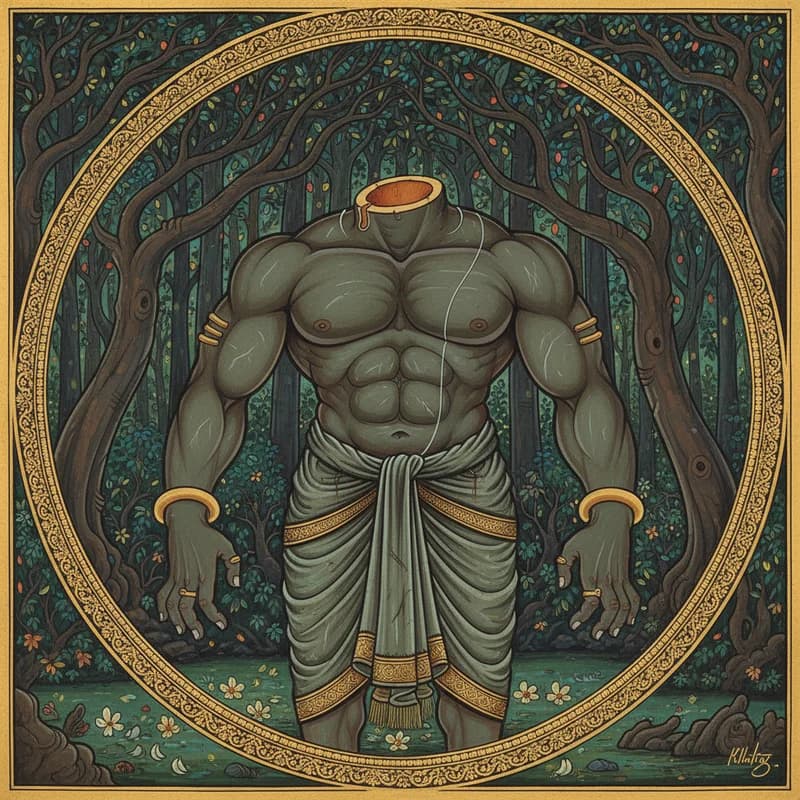

Kichak
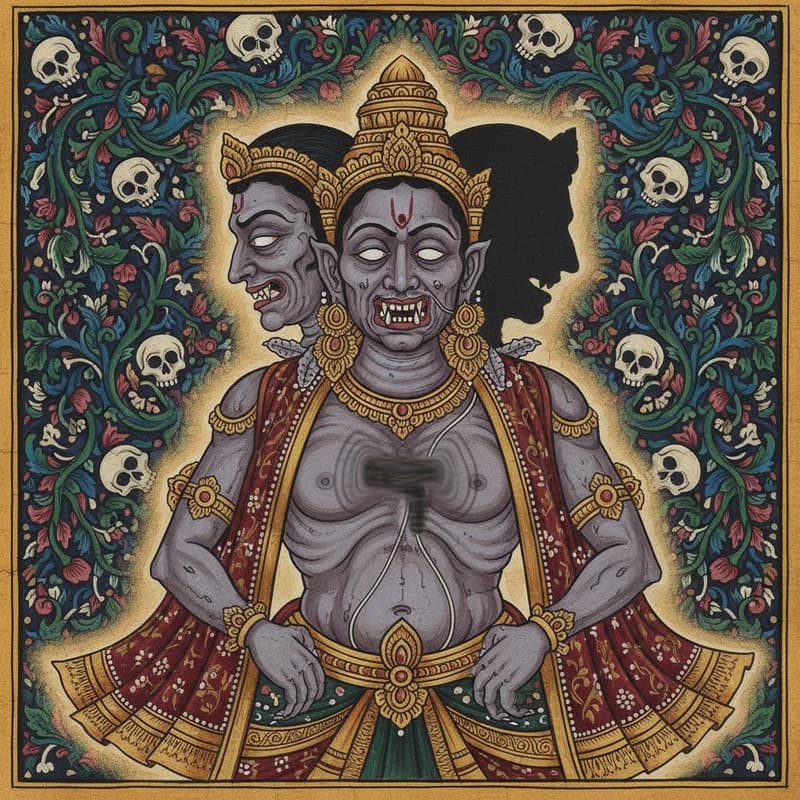
He walks without a head, and that is the first thing the accounts agree on. The ghost of Kichak — commander, braggart, the man who laid hands on Draupadi in the court of King Virata — moves through the sal forests of what is now southern Rajasthan and the scrublands bordering the Chambal valley, headless and purposeful, still carrying the shape of a soldier who believed his strength made him untouchable. Bhima killed him by crushing his body into a ball of flesh and bone, and the violence of that death left something unfinished. What walks now is the residue of humiliation: a powerful man reduced to nothing by a force he could not comprehend, still searching for the dignity he lost.
The threat he poses is specific rather than indiscriminate. Accounts collected from the forest communities near Alwar and along the older pilgrimage routes through Matsya territory describe Kichak as drawn to women traveling alone after dusk, to men who carry themselves with unchecked arrogance, and to those who sleep beneath old trees near dried riverbeds where the Banas runs shallow in the hot months. He does not speak — he has no head to speak with — but his presence announces itself through a sudden drop in temperature and the sound of heavy footsteps circling a camp without ever arriving. Older accounts recommend invoking Bhima's name aloud, three times, facing west. Whether this works is a matter the oral record leaves deliberately open.
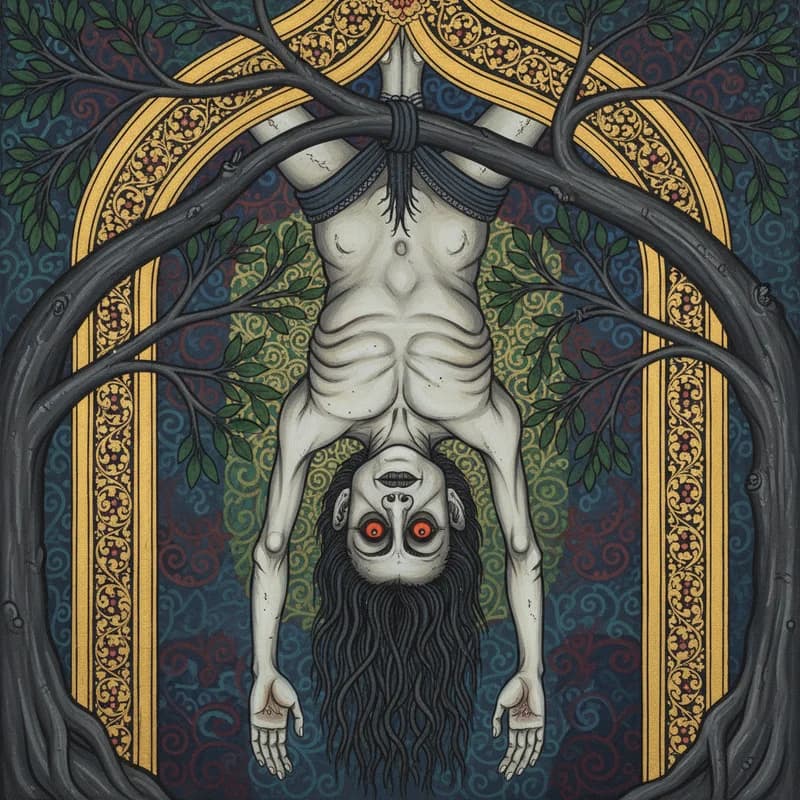
Kichak moves through the sal forests of what was once Matsya country — the tracts east of the Chambal, where the undergrowth thickens toward the Yamuna's older tributaries — as a headless man still dressed for a court that no longer exists: silk dhoti gone grey-green with forest damp, the broad chest and arms of a commander intact, the neck ending cleanly where Bhima's hands completed their work. The body is enormous, built for violence, and this is precisely what unsettles — the proportions of a man who was never afraid, still moving with the unhurried confidence of someone who believes he has somewhere to be. Witnesses near the Virata-region villages describe a sound preceding him: not footsteps but the rhythmic creak of a wrestler's joints, the sound a body makes when it is always preparing. The smell is of crushed mahua flowers going rotten in standing water. What marks him as something other than memory is that the hands reach forward as he walks, feeling for a head that the forest has never returned to him.
Kichak walks the sal forests of the Matsya country — the tracts around modern Virat Nagar in Rajasthan — as a woodcutter returning home at dusk, his axe slung across one shoulder, his gait unhurried and familiar. The disguise is plausible: woodcutters work late in the dry months before Holi, when the light holds longer and the forest floor is passable. Those who have encountered him and survived describe two details that, separately, might be dismissed. First, the axe: it rests on the wrong shoulder, the blade facing inward toward the neck — not how any man who has carried an axe for years would carry one. Second, and this is what the older Mina villagers insist upon, he has no shadow at the collar — the neck casts nothing, though the shoulders and arms cast clean lines in the evening light.
First Documented
Kichak appears first in the Virata Parva of the Mahabharata, where his death at Bhima's hands is recorded in unflinching detail — his bones crushed, his body rolled into a flesh-ball. Later folk traditions of the Matsya region transformed this slain general into a restless, headless spirit haunting the sal forests near the old Virata capital.
Last Recorded
Accounts of Kichak's headless form haunting the sal forests of what is now southern Rajasthan and northern Madhya Pradesh were still being collected by oral historians in the 1980s near villages claiming proximity to ancient Matsya territory. Sporadic sightings continue to surface, particularly during the moonless nights of Bhadrapada.
Source Language
Sanskrit
Origin
Kichak enters the written record in the Virata Parva of the Mahabharata, where his death at Bhima's hands is recorded with unusual anatomical detail — his body rolled into a ball of flesh, limbs and head crushed inward, unrecognizable as human form. The text treats his end as justice; the oral tradition of the Chota Nagpur plateau and the forested margins of what was once the Matsya kingdom does not. Tribal accounts collected from villages near the Damodar River's upper reaches describe a headless figure that wanders the sal forests around harvest season, not seeking the Pandavas but searching for his own head — unable to rest because the violence done to him denied his body its proper shape in death. Where the Puranic reading frames Kichak as deserving obliteration, the folk tradition of Jharkhand's Kurukh and Oraon communities insists on his incompleteness rather than his guilt. That divergence is significant: it reveals how communities living within landscapes of feudal power consistently remembered the dead of those landscapes differently from courts and compilers.
Frequently Asked
Kichak was a powerful military commander in the kingdom of Virata, known in the Mahabharata as the brother-in-law of King Virata and a man of great physical strength. He was killed by Bhima during the Pandavas' year of exile in disguise, after he attempted to assault Draupadi. His ghost is said to wander the forests surrounding Virata's kingdom in a headless form, restless and vengeful.
Oral traditions from the forests of eastern Rajasthan and parts of Madhya Pradesh describe Kichak's spirit as a headless figure, enormous in build, moving through dense sal and teak groves at dusk. Some accounts collected near the Chambal basin describe a low, hollow sound preceding his appearance — the echo, villagers say, of a man still searching for the head Bhima tore from his body.
Kichak is classified as a spirit of caution — not one that attacks indiscriminately, but one drawn to situations of injustice or transgression, particularly those involving women in danger. Travelers moving alone through forested areas near dusk, especially in regions once associated with the Matsya kingdom, are traditionally warned against calling out names or making loud sounds after sunset.
In the Virata Parva of the Mahabharata, Kichak was lured to the dance hall at night by Draupadi, who was living in disguise as a serving woman named Sairandhri. Bhima, disguised as a woman, waited in her place and killed Kichak with his bare hands, crushing his body into a formless mass of flesh and bone. The killing was so thorough that Kichak's corpse was unrecognizable — a detail that folklore links directly to the restless, headless nature of his ghost.
In the Mahabharata text, Kichak is entirely human — a mortal commander whose death is a pivotal episode in the Virata Parva. The spirit form of Kichak belongs to the oral folklore layer that grew around the epic, particularly in rural communities of Rajasthan and Haryana, where the forests of the old Matsya kingdom were believed to carry his unresolved anger. The transition from epic villain to haunting ghost reflects how Indian folk tradition often extends the afterlife of a character whose death was violent and incomplete.
Kichak's story appears in the Virata Parva, the fourth book of the Mahabharata, which narrates the Pandavas' thirteenth year of exile spent in disguise at King Virata's court. The episode of his killing by Bhima occupies several chapters and is considered one of the most dramatically charged passages in the entire epic. Regional retellings, including the Rajasthani oral tradition and certain Odia folk performances, expand his story considerably beyond the Sanskrit text.
Along the Banas River in Rajasthan, Kichak is remembered primarily as a spirit of the forest edge — a warning figure invoked to keep children from straying after dark. In parts of Odisha, where the Mahabharata has deep folk roots, Kichak appears in pala performances as a cautionary figure whose arrogance brought ruin not just to himself but to his entire clan, the Upakichakas, who were also killed by Bhima. The ghost tradition is strongest wherever the memory of the Matsya kingdom's forests survives in local geography and place names.
Unlike many figures from the Mahabharata who received temple worship, Kichak has no known cult or shrine tradition. His spirit is propitiated rather than venerated — small offerings of rice and oil left at forest boundaries in parts of Rajasthan are sometimes attributed to local custom around malevolent male spirits, though Kichak is rarely named directly in ritual contexts. The absence of worship reflects his status as an unambiguously transgressive figure whose ghost demands appeasement, not devotion.
संबंधित लोकगाथाएं
Related Lore
Algorithmic Inference
आपको यह भी पसंद आ सकता है
You May Also Like
Community Discussion
Comments are reviewed by AI before appearing publicly. Unsafe, unrelated, or uncertain comments go to human review.
Sign in to join the discussion.
0 comments
No public comments yet.