


Everydaycodings
29 May 2026
hi
प्रतीक्षा करें
Transcribing the Sutradhaar’s field report…

Cholai Amman
She lives where the canopy closes over you — in the margosa groves outside Madurai, in the tamarind corridors along the banks of the Vaigai, in the dense garden plots behind the old agraharam streets of Thanjavur. Farmers and woodcutters across the Tamil plains know her name before they know much else about the land they work. The rule is not complicated: you ask before you cut. You explain the need — a roof beam, a funeral pyre, a fence post against the monsoon floods — and you wait for something in the air to settle before the blade falls. Those who skip this exchange, who arrive with axes at dawn and leave with stumps, carry the debt out with them on their skin.
The punishment she issues is slow and cumulative, which makes it easy to dismiss at first. A rash along the forearms. A child who stops eating. A well that silts over in a dry season when the neighboring wells hold. Accounts collected from the villages around Palani and from the agricultural settlements near Courtallam describe the pattern consistently: the affliction begins with the body, then moves outward into the household, then into the lineage itself, spreading the way a fungal rot moves through a grove — quietly, invisibly, until the damage is already structural. Propitiation requires more than a single offering. The tree must be replaced, or its equivalent value returned to the land in some form the grove can use. Only then, the accounts say, does she withdraw — not with any visible sign, but with an absence, a stillness in the leaves that the petitioner learns, eventually, to read as forgiveness.
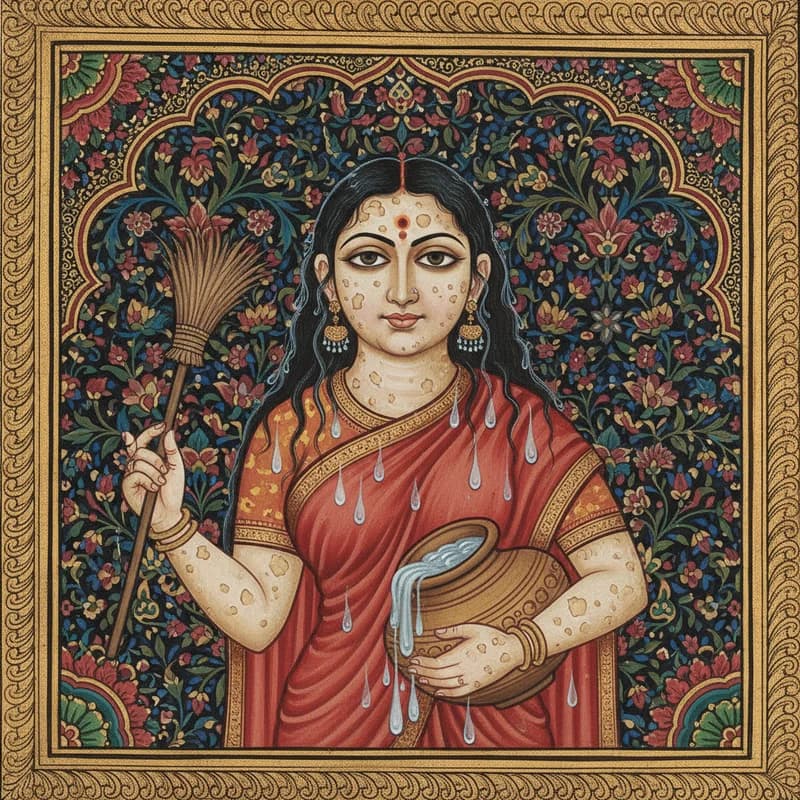
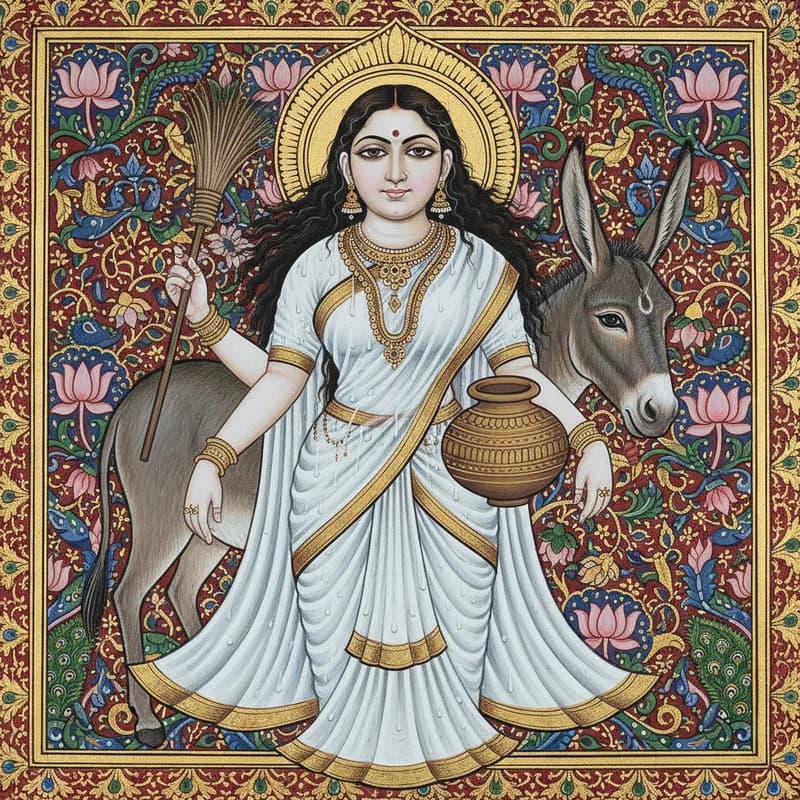
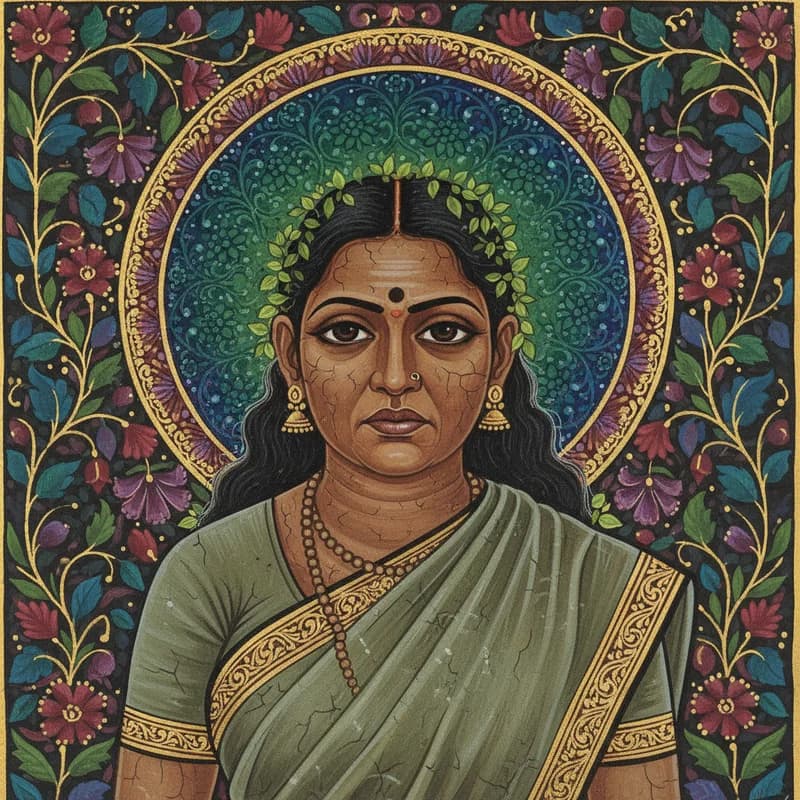
Cholai Amman appears as a middle-aged Tamil woman, dark-complexioned and unadorned, wearing a cotton sari the colour of neem bark — not the ceremonial red of temple goddesses but the working green-grey of something that belongs to shade and soil. Her hair is loose and threaded through with small leaves, not arranged there but grown, the way moss finds its way into stone. Witnesses from villages around the Palani foothills and the groves near Thanjavur describe the smell that precedes her: wet earth after the first monsoon rain, and beneath it something sharper — the sap-smell of a freshly cut branch, which those who have offended her understand immediately as accusation. She makes no sound, but those in her presence report a pressure behind the eyes, like standing too long under a canopy in still heat. The mark that cannot be explained is her skin: it is simultaneously whole and mapped with the fine cracking of old bark, visible only when she is close enough to touch.
In the Tamil districts around Madurai and Dindigul, where the drumstick and neem groves press close against village plots, Cholai Amman appears as an older woman gathering fallen twigs at the grove's edge — unhurried, ordinary, the kind of figure a man walking home from the fields at dusk would pass without a second thought. She carries a small bundle, wears a faded cotton sari in the dull green of dried curry leaf, and asks nothing of anyone. The first tell is her bundle: however long she gathers, it never grows larger, the sticks neither accumulating nor spilling. The second is her hands — those who have looked closely and survived the encounter report that her palms are mapped with bark-pattern, the deep-fissured grain of old neem, not the smooth creasing of human skin.
First Documented
Cholai Amman's presence surfaces most clearly in the Sangam-era oral traditions of Tamil Nadu, where grove deities — *kāval deivangal* — were invoked in agricultural rites tied to the Kāveri delta's sacred groves; her specific name appears in later village *sthala puranas* and temple inscriptions from the Chola period onward.
Last Recorded
Accounts of Cholai Amman persist into the present, with villagers near Madurai and the Vaigai basin still reporting cases of unexplained skin afflictions attributed to her anger after land-clearing for construction. Temple priests in the Chettinad region recorded fresh propitiation rituals as recently as 2019.
Source Language
Tamil
Origin
Cholai Amman enters the documentary record through the Sthalapurana literature associated with grove-temples along the Kaveri delta, particularly in the accounts attached to the Sirkazhi and Chidambaram corridors, where she appears as a subsidiary presence within larger Shakta shrines. The textual tradition positions her as a form of Durga domesticated to the garden — protective, bounded, ritually approachable through neem and margosa offerings. Folk practice in the Thanjavur and Nagapattinam districts diverges sharply from this tidy framing: oral accounts collected from agricultural communities along the Vennar distributary describe Cholai Amman not as a goddess who inhabits groves but as one who *is* the grove — her body continuous with the root systems of old trees, her anger activated the moment an axe enters soil without spoken apology. Where the Sthalapuranas allow for propitiation before felling, the oral tradition insists no propitiation is sufficient after the fact. That distinction is not minor. It encodes a land ethic that the temple texts, shaped by Brahminic
Frequently Asked
Cholai Amman (சோலை அம்மன்) is a Tamil goddess who presides over groves, gardens, and the living green — a guardian spirit whose authority extends to every tree rooted in her domain. She is propitiated across Tamil Nadu, particularly in villages where sacred groves called kovils or kadu are maintained at the forest edge. Her name translates directly as 'Mother of the Grove,' and she is understood not as a benevolent deity of abundance but as a strict custodian of ecological boundaries.
Cholai Amman is believed to inflict skin diseases — rashes, boils, and chronic eruptions — upon those who uproot trees from her grove without seeking her permission. Beyond bodily affliction, oral accounts collected from villages near the Kaveri delta describe her punishment extending to the offender's household: livestock deaths, failed harvests, and the unraveling of family cohesion across generations. Her power is less about spectacle and more about slow, grinding consequence.
Cholai Amman is not malevolent by nature — she is a deity of order, not cruelty, and her anger is always proportional to the transgression. Those who approach her grove with respect, who ask before cutting even a single branch, are said to receive her quiet protection. The danger lies in ignorance or arrogance: the farmer who clears her trees for a new field without ritual acknowledgment invites consequences that village elders in the Thanjavur region still recount with sober precision.
Worship of Cholai Amman typically takes place at the edge of sacred groves or beneath a specific tree designated as her seat, often a neem or peepal. Offerings of turmeric, vermilion, and cooked rice are placed at her stone — usually an uncarved or simply marked slab — before any agricultural work that might disturb the surrounding vegetation. In some villages near Madurai, a small festival is held before the dry season when tree-cutting for fuel becomes necessary, and her permission is formally sought through a priest or village elder.
Vana Durga is a pan-Hindu forest goddess, a fierce aspect of Durga worshipped from the Vindhya ranges to the forests of Odisha, associated with protection from wild animals and enemies. Cholai Amman is a distinctly Tamil, hyper-local deity whose authority is tied not to wilderness but to cultivated or semi-cultivated groves — the garden, the village tree-line, the orchard. Where Vana Durga commands the deep forest, Cholai Amman governs the threshold between human settlement and the green world.
Cholai Amman does not appear in the Puranas or Agamic literature in any named, codified form — her tradition is oral, carried through village practice rather than Sanskrit or Tamil Shaiva texts. Traces of grove-goddess worship in Tamil culture can be found in Sangam-era poetry, where the kurinci and mullai landscapes are presided over by local female spirits, suggesting a very old stratum of belief that Cholai Amman belongs to. Her authority is preserved in the memory of communities, not in manuscripts.
Across different districts of Tamil Nadu, the goddess of the grove takes slightly different names and attributes — Kadu Amman in some forest-edge villages, Thoppu Amman in areas where mango orchards dominate the landscape. In the Chettinad region, she is sometimes conflated with Mariamman, the goddess of rain and disease, reflecting how Tamil village goddesses frequently absorb and overlap with one another. The core identity, however, remains consistent: a female guardian who punishes ecological transgression with bodily and familial ruin.
A Cholai Amman shrine is rarely a built structure — look instead for a stone placed at the base of a large, old tree at the edge of a grove, often smeared with turmeric paste and circled by small terracotta figures or oil lamps. The tree itself is usually marked with a red thread or a strip of cloth, signaling that it is under her protection and must not be cut. In villages near the Palk Strait coast, fishermen's families who maintain kitchen gardens also maintain such stones, understanding that her jurisdiction extends wherever cultivated green things grow.
संबंधित लोकगाथाएं
Related Lore
Algorithmic Inference
आपको यह भी पसंद आ सकता है
You May Also Like
Community Discussion
Comments are reviewed by AI before appearing publicly. Unsafe, unrelated, or uncertain comments go to human review.
Sign in to join the discussion.
1 comment
Everydaycodings
29 May 2026
hi