प्रतीक्षा करें
Summoning entity profiles from the Grimoire…
प्रतीक्षा करें
Summoning entity profiles from the Grimoire…
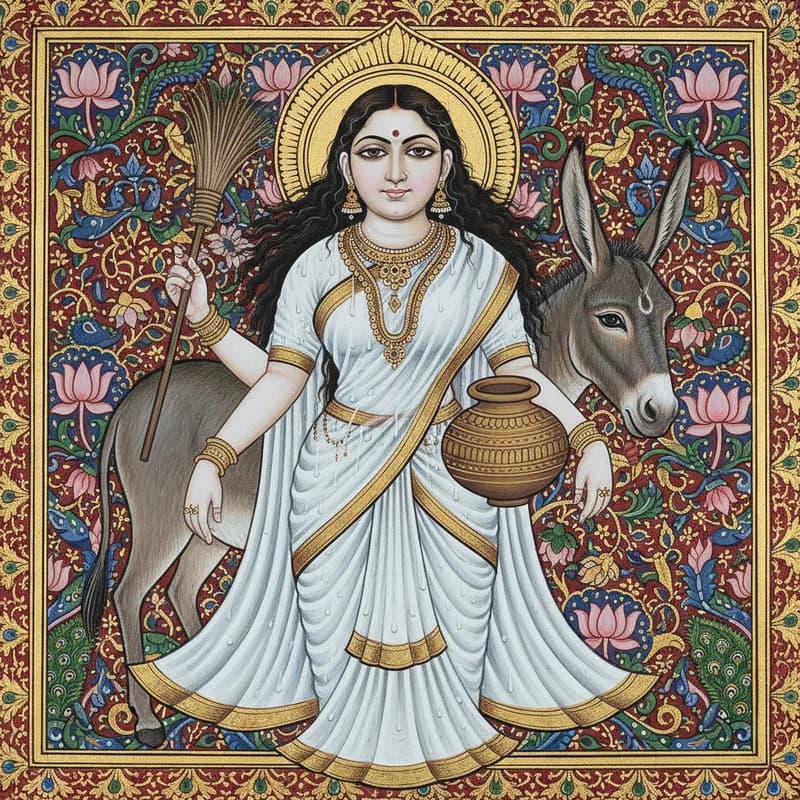

Sheetala
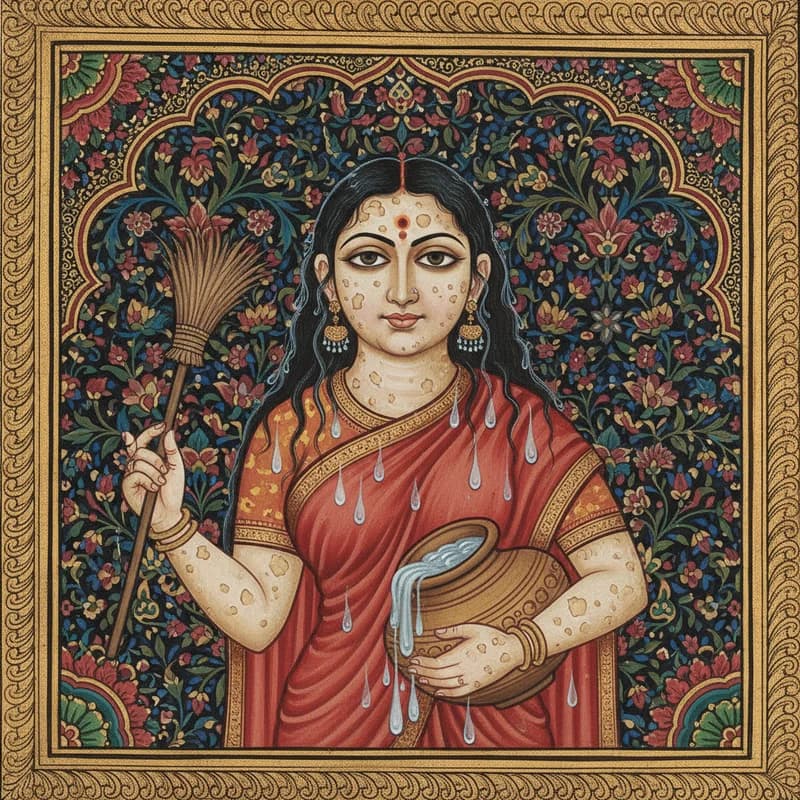
She arrives in the hot months, when the Ganga runs low at Varanasi and the air over the Gangetic plain turns white and still. Smallpox, chickenpox, measles — the pustular diseases that move through villages before the monsoon breaks — these are her domain, and the folk belief across Rajasthan, Uttar Pradesh, and Bihar does not separate her from the illness itself. She is not sending the disease. She is the disease, walking. Accounts collected from the Bhojpur region describe her as an old woman, grey-haired and unhurried, riding a donkey through the lanes of a village at dusk, carrying a clay pot of stale water and a neem broom she drags behind her. The broom sweeps illness in and sweeps it out, depending on her mood, and the distinction between those two directions is the whole of her theology.
Sheetala demands specific protocols, and the folk record is unusually consistent about them. Hot food must not be cooked in a household where her worship is observed — the Sheetala Ashtami fast, fixed to the eighth day after Holi, requires that food be prepared the night before and eaten cold, because heat offends her. Transgress this, and the pustules come. Honour it, and the broom sweeps outward. The temples at Gurgaon and Bahraich both show her with a winnowing fan and a vessel of cooling water, and the Skanda Purana names her formally, but it is the village practice — the cold meal left at the threshold, the neem leaves spread across the sickroom floor — that has always carried the real weight of negotiation with her.
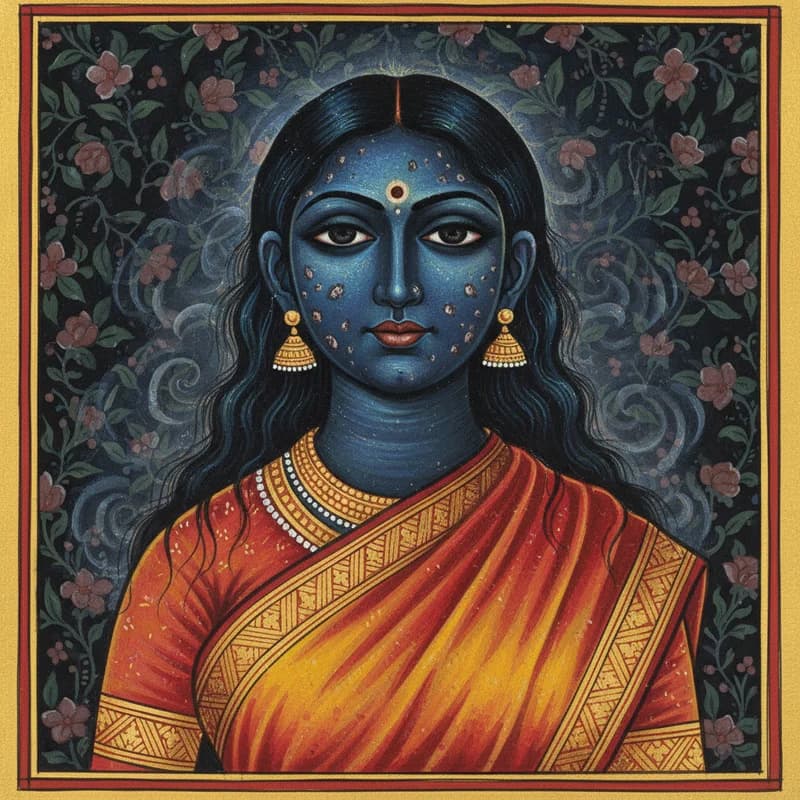
Sheetala appears as a pale woman in white or pale blue cloth, the fabric perpetually damp against her skin as though she has just crossed the Ganga at Haridwar in the pre-dawn cold of Maagh. Her hair is unbound and carries the smell of neem — not the medicinal sharpness of fresh leaves but the older, darker smell of bark left wet after rain. She carries a broom of dry grass in one hand and an earthen pot in the other; the pot is always sweating, always cool to the touch even in the Gangetic plains heat of Jyeshtha. What marks her as something other than a wandering ascetic is the donkey she rides, which leaves no hoofprints and makes no sound on packed earth. Accounts from the villages near Sambhal describe a coldness that arrives before she does — not wind, but a stillness, the particular absence of warmth that precedes fever.
Sheetala moves through the villages of the Gangetic plain most often in the weeks before Holi, when the air is still cold and smallpox historically ran hardest through the district. She appears as an older woman carrying a clay pot of water on her hip, moving house to house in the manner of a water-seller or a neighbour returning from the Ganga ghat — a sight unremarkable enough in any village in eastern Uttar Pradesh that no one stops her. The first tell is temperature: the water she pours, if accepted, is cold in a way that does not match the season or the vessel, a coldness that persists in the cup. The second is the broom she carries tucked against her back, which sweeps the threshold of a house on its own when she pauses to speak, though her hands remain still at her sides.
First Documented
Sheetala appears by name in the *Skanda Purana*, likely compiled between the 7th and 12th centuries CE, where she is addressed as a goddess of pustular disease. Her worship in the Gangetic plains — particularly along the Ganga between Kanpur and Varanasi — almost certainly predates this textual record, rooted in village propitiation rites far older than any Sanskrit codification.
Last Recorded
Accounts of Sheetala persist without interruption — village women in the Gangetic plains, particularly around Mathura and Kanpur, still observe Sheetala Ashtami each spring, leaving offerings of cold food at her roadside shrines, and rural health workers in eastern Uttar Pradesh reported as recently as 2019 that smallpox outbreaks in living memory were attributed directly to her displeasure.
Source Language
Hindi
Origin
Sheetala appears in the Skanda Purana's Kashi Khanda and in the Sheetala Ashtakam, an eight-verse hymn attributed to Shiva that circulates widely across the Gangetic plain from Varanasi to Patna, though the goddess herself is almost certainly older than either text. The Puranic account frames her as a deity created to control smallpox — a divine physician whose broom sweeps disease away and whose pot of cool water soothes the burning skin of the afflicted. Folk tradition in the villages along the Yamuna between Mathura and Agra diverges sharply on this point: there, Sheetala does not control disease from outside it but carries it within her own body, the pestilence churning in her clay pot like grain. She is not a healer who defeats illness but a vessel who chooses, from moment to moment, whether to release or contain it. That distinction matters enormously — it shifts the ritual logic from supplication to negotiation, which is why her spring festival, Sheetala Saptami, involves feeding her cold food prepared the night
Frequently Asked
Sheetala is a goddess of epidemic disease venerated across the Hindi-speaking heartland — Bihar, Uttar Pradesh, Rajasthan, and Bengal — believed to both cause and cure smallpox, chickenpox, and fevers. She rides a donkey, carries a broom and a pot of cooling water, and her name itself means 'the cool one' in Sanskrit. Oral traditions collected along the Ganga plains describe her as neither purely malevolent nor benevolent, but as a force that must be appeased with precise ritual.
Sheetala is depicted holding a broom, a water pot, and a winnowing fan — the broom to sweep disease away, the pot filled with cooling water to soothe the burning skin of the afflicted. The winnowing fan separates the living from the dead, much as grain is separated from chaff on the threshing floors of rural Awadh. Each object encodes a specific function in her role as both the sender and the healer of pustular disease.
Sheetala rides a donkey, an animal considered lowly and inauspicious in mainstream Brahmanical tradition, which marks her as a goddess of the margins — associated with the sweeper castes, the cremation grounds, and the edges of village settlement. Across the Chhattisgarh plateau and the Bundelkhand region, her donkey-mount is understood as a sign of her proximity to the poor and the outcast. This iconographic choice is deliberate: she moves through the world's refuse, and disease follows the same path.
Sheetala is both simultaneously — she sends smallpox and chickenpox as expressions of her presence in a body, and she withdraws them when properly honored. The Sheetala Ashtakam, a Sanskrit hymn attributed to Skanda Purana traditions, addresses her directly as the one who 'enters the body as fever and departs as grace.' Across the Gangetic plains, the same woman who prays to Sheetala to spare her child also understands that the goddess herself placed the illness there.
Her primary festival, Sheetala Ashtami, falls in the month of Chaitra — the dry, scorching weeks before the monsoon breaks — when epidemic disease historically peaked across northern India. Devotees offer cold, stale food prepared the previous day, since lighting a cooking fire on this day is forbidden out of respect for her cooling nature. At her shrines near the Yamuna's banks in Mathura and at the Sheetala Mata temple in Gurgaon, women carry clay pots of water and curd as the central offering.
Sheetala and Mariamman govern overlapping domains — both are goddesses of smallpox and epidemic fever — but their ritual worlds are geographically and culturally distinct. Mariamman is worshipped with fire-walking and animal sacrifice across Tamil Nadu and Karnataka, her shrines dense in the Kaveri delta, while Sheetala's worship is marked by cold offerings and the deliberate absence of fire. Where Mariamman's iconography is fierce and blood-associated, Sheetala's is defined by water, coolness, and the broom.
The Sheetala Ashtakam, embedded within the Skanda Purana, is the primary Sanskrit text dedicated to her, describing her eight forms and the specific diseases each governs. Beyond this, her mythology lives most powerfully in the Sheetala Mangal Kavya tradition of Bengal, where she appears as a wandering goddess denied shelter by a proud king — a narrative that explains why epidemic disease strikes the arrogant. Oral versions of this story are still sung by women in the villages of Mithila during Chaitra.
Active worship of Sheetala continues across Uttar Pradesh, Bihar, Rajasthan, and West Bengal, with hundreds of dedicated shrines still receiving daily offerings. The eradication of smallpox in 1977 did not diminish her following — her domain expanded in popular understanding to include chickenpox, measles, and other febrile illnesses of childhood. At the Sheetala Mata Mandir in Gurgaon, one of her most visited shrines, the queue of devotees on Ashtami morning stretches past dawn.
संबंधित लोकगाथाएं
Related Lore
Algorithmic Inference
आपको यह भी पसंद आ सकता है
You May Also Like
Community Discussion
Comments are reviewed by AI before appearing publicly. Unsafe, unrelated, or uncertain comments go to human review.
Sign in to join the discussion.
0 comments
No public comments yet.