प्रतीक्षा करें
Decoding the Pishacha encounter logs…
प्रतीक्षा करें
Decoding the Pishacha encounter logs…
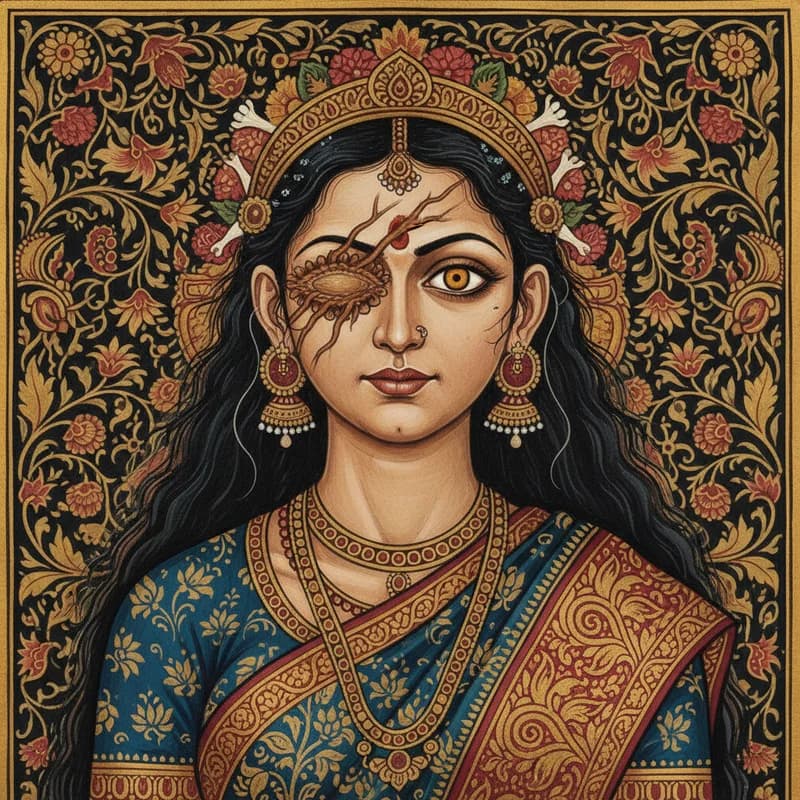

Kana Devi
She arrives before the sickness does. In the villages along the Narmada's northern bank, between Hoshangabad and Narsinghpur, people say the air changes first — a flatness to it, a held-breath quality that experienced elders associate with her proximity. Kana Devi is one-eyed, and that single eye is the point. What she looks upon directly, she marks. Cattle sicken. Children develop fevers that break wrong. A man's crops may fail in one field while the adjacent plot, belonging to his neighbour, produces without trouble. The asymmetry is the signature.
Propitiation follows a logic that is neither negotiation nor prayer — it is more like payment rendered before a creditor arrives. Households in the Satpura foothills make offerings before the monsoon breaks and again at the close of the harvest, usually a goat or a rooster, the blood drawn at the threshold rather than inside the home. The intention is specific: to redirect the eye, to give it something to settle on that is already offered, already willing. Village priests who manage these rites in the Chhindwara district speak of her without fear but with the careful respect one extends to a force that is neither malevolent by nature nor reliably benign. She does not pursue. She simply looks, and her looking has weight.
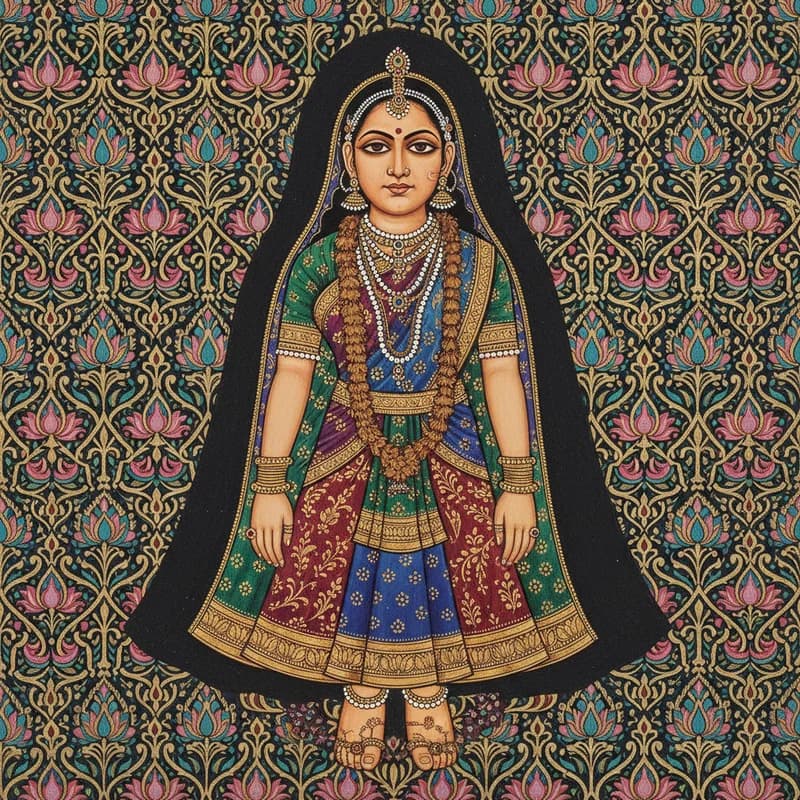
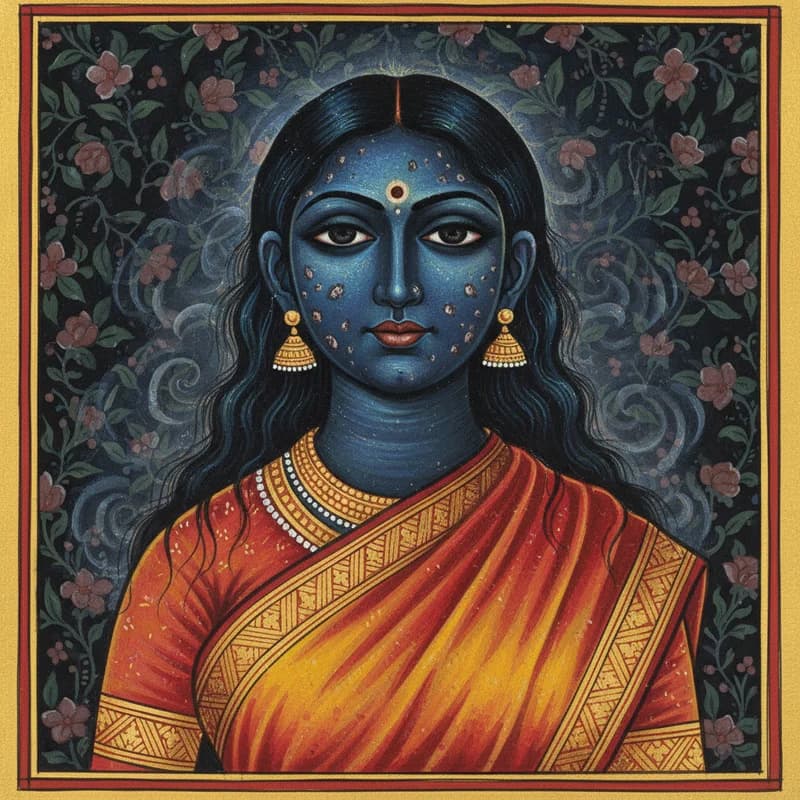
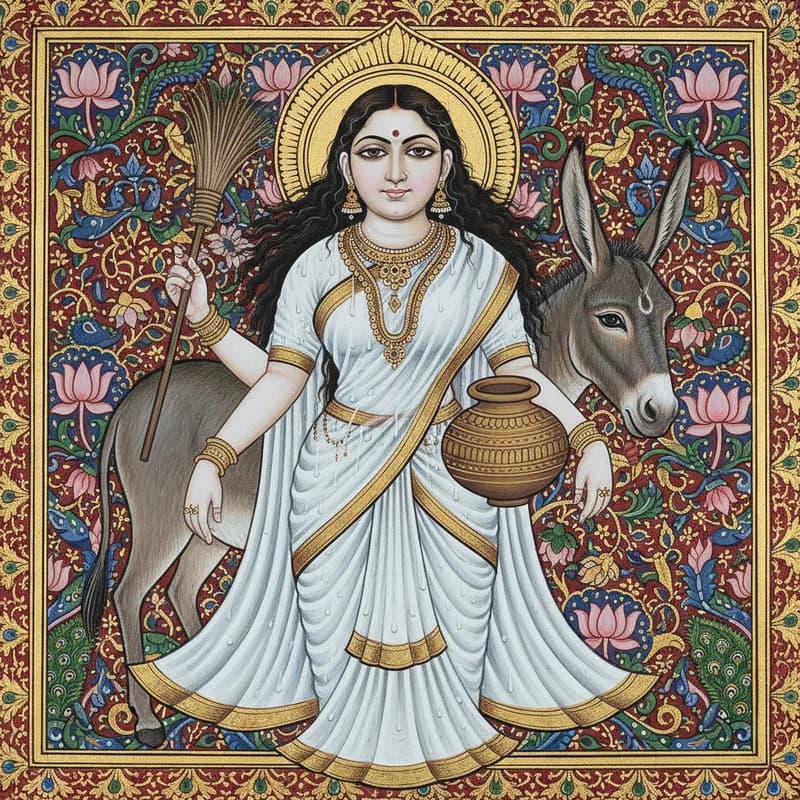
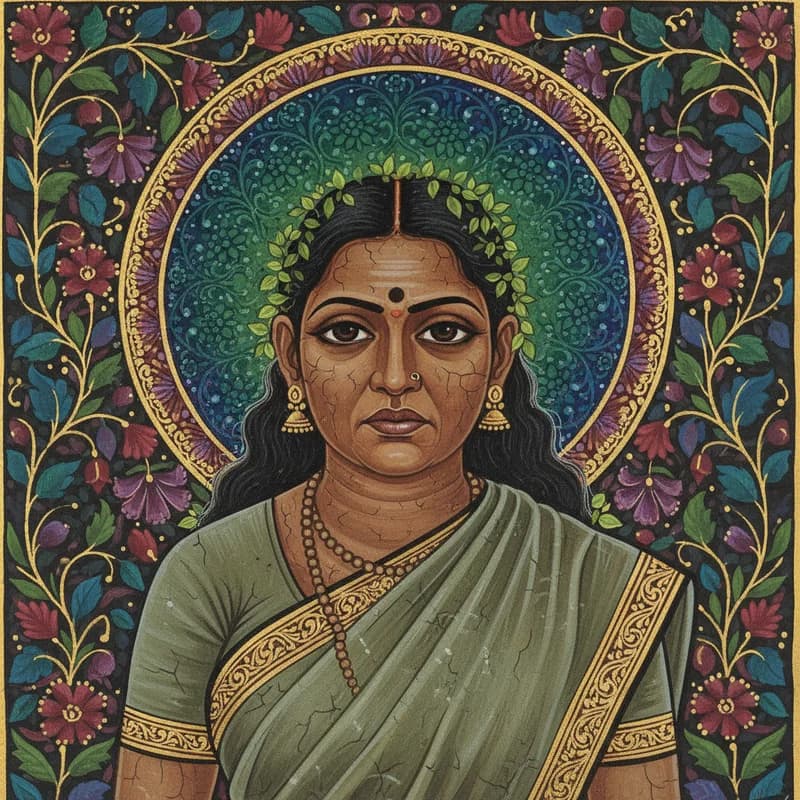
Kana Devi appears as a woman of indeterminate age — neither young nor old but suspended in that interval between — with one eye sealed shut by a thick cord of scar tissue the colour of old tamarind bark. The open eye does not blink. Accounts from villages along the Narmada's upper reaches describe it as perpetually dry, the iris a flat, matte ochre that reflects no light, not even lamplight held directly before it. She is lean without being skeletal, the kind of leanness that suggests long fasting rather than deprivation, and her hair hangs unbound and unanointed in the manner of mourning. The smell that precedes her is specific and consistent: raw jaggery fermenting in heat, and beneath it, the copper-and-iron smell of fresh blood on packed earth. What marks her unmistakably is the scar eye itself — in the accounts collected near Mandla and Jabalpur, it moves.
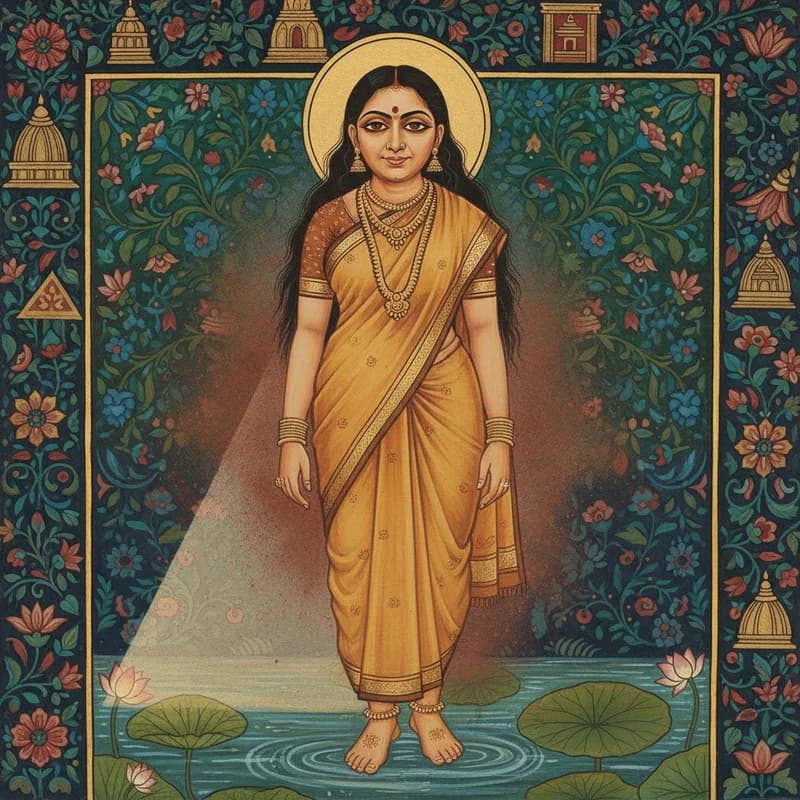
Kana Devi moves through villages in the weeks before the mango harvest, when the air over the Narmada basin carries that particular heaviness that precedes both rain and fever. She takes the form of an older woman, partly blind in one eye — a common enough affliction in the region that no one thinks twice — who arrives at the edge of settlements asking for water or a handful of grain. The disguise is ordinary, even pitiable. But those who have survived the encounter report two consistent details: the eye that remains sighted never blinks, not once across the full length of a conversation, and the grain she is given, if later examined, is found to have gone to powder between the moment she took it and the moment she turned away.
First Documented
Kana Devi surfaces most clearly in the oral propitiation traditions of the Malwa plateau and the Vindhya foothills, where Gond and Bhil communities have long invoked her in seasonal rites tied to the onset of summer epidemics. No Sanskrit textual source claims her; she belongs entirely to the living, spoken record.
Last Recorded
Accounts of Kana Devi persist into the present, with village elders in the Vindhya foothills still recounting propitiation rites performed as recently as the 2010s; a field survey near Jabalpur in 2018 documented active animal sacrifice at a roadside shrine following an outbreak of livestock disease.
Source Language
Hindi
Origin
Kana Devi enters the oral record primarily through the propitiation traditions of the Malwa plateau and the Vindhya foothills, where her name appears in village-level ritual manuals — *grampuja paddhatit* texts in Devanagari, hand-copied and held by the *pujari* families of Sehore and Raisen districts — though no Sanskrit Puranic text assigns her an origin narrative with any consistency. She is one-eyed not by wound or curse, in these accounts, but by design: the missing eye is the one turned inward, trained permanently on the household, the granary, the child sleeping under the *neem* tree. Folk traditions collected along the Betwa's upper reaches describe her as older than the village itself, a force that was there before the first field was cleared, not summoned but acknowledged. The divergence matters: written ritual texts frame her as an aspect of Shitala or a regional form of Dhumavati, assimilating her into the Mahavidya canon, while oral accounts resist this flatly — she is not a goddess who became terrible, but
Frequently Asked
Kana Devi is a one-eyed goddess of epidemic and misfortune venerated primarily across Madhya Pradesh, where she is believed to carry pestilence and cast the evil eye upon households that neglect her worship. Her name derives from the Hindi-Sanskrit root 'kana,' meaning one-eyed or blind in one eye, a physical marker that signals her dangerous, asymmetrical gaze. Oral traditions collected from villages along the Narmada basin describe her as neither wholly malevolent nor benevolent — she punishes the inattentive but protects those who honor her with proper rites.
Kana Devi's primary power is the casting of the evil eye, which in folk belief can bring disease, crop failure, and death of livestock upon a family. Her single eye is considered especially potent — concentrated, unbalanced, and impossible to deflect without ritual intervention. Villagers in the Vindhya foothills attribute sudden outbreaks of fever and pox to her unsatisfied gaze moving through a settlement.
Animal sacrifice is the central act of propitiation offered to Kana Devi, typically performed when a family fears her attention has fallen on them or before the hot months of Jyeshtha and Ashadha when epidemic disease historically peaks. A local priest or village elder conducts the rite, and the blood offering is understood as a direct acknowledgment of her power. Neglecting this worship is considered far more dangerous than the sacrifice itself.
Kana Devi is a distinct regional spirit of Madhya Pradesh and should not be conflated with pan-Indian goddesses who may share visual attributes. While figures like Shitala Mata also govern epidemic disease across North India, Kana Devi's identity is rooted specifically in the evil eye tradition rather than in the broader smallpox-goddess complex. The two may be invoked in overlapping contexts, but their ritual protocols and mythological origins remain separate.
The single eye in Indian folk cosmology is a symbol of concentrated, unmediated power — a gaze that cannot be balanced or softened by the counterweight of a second eye. Kana Devi's asymmetry marks her as a being outside normal cosmic order, which is precisely what makes her dangerous. Across Madhya Pradesh's oral traditions, the one-eyed form is a recurring sign of spirits who operate at the margins of the village world, neither fully domesticated nor entirely wild.
Kana Devi's worship is concentrated in Madhya Pradesh, particularly in rural communities of the Vindhya and Satpura regions where epidemic disease and agricultural precarity have historically shaped religious practice. Her presence is felt most acutely in the dry months before the monsoon breaks, when heat and contaminated water sources make disease a real and immediate threat. Fieldwork accounts from these areas consistently place her shrines at the edge of villages — boundary spaces where the protected interior meets the uncontrolled outside.
Kana Devi is classified as a spirit requiring caution rather than outright fear — she is not an entity that attacks unprovoked, but one whose wrath is triggered by neglect or disrespect. Communities that maintain regular propitiation report her as a protective presence who keeps epidemic away from the household. The danger lies in forgetting her, not in encountering her.
Kana Devi does not appear in the canonical Sanskrit texts — she belongs to the stratum of gram devatas, village deities whose authority is transmitted through oral tradition, local priests, and the accumulated memory of rural communities rather than through written scripture. This is common among epidemic goddesses of central India, whose worship predates and often runs parallel to Brahmanical religious frameworks. Her stories live in the mouths of the people who fear her, not on the pages of any Purana.
संबंधित लोकगाथाएं
Related Lore
Algorithmic Inference
आपको यह भी पसंद आ सकता है
You May Also Like
Community Discussion
Comments are reviewed by AI before appearing publicly. Unsafe, unrelated, or uncertain comments go to human review.
Sign in to join the discussion.
0 comments
No public comments yet.