प्रतीक्षा करें
Consulting the Shastra archives…
प्रतीक्षा करें
Consulting the Shastra archives…

Dakshin Ray
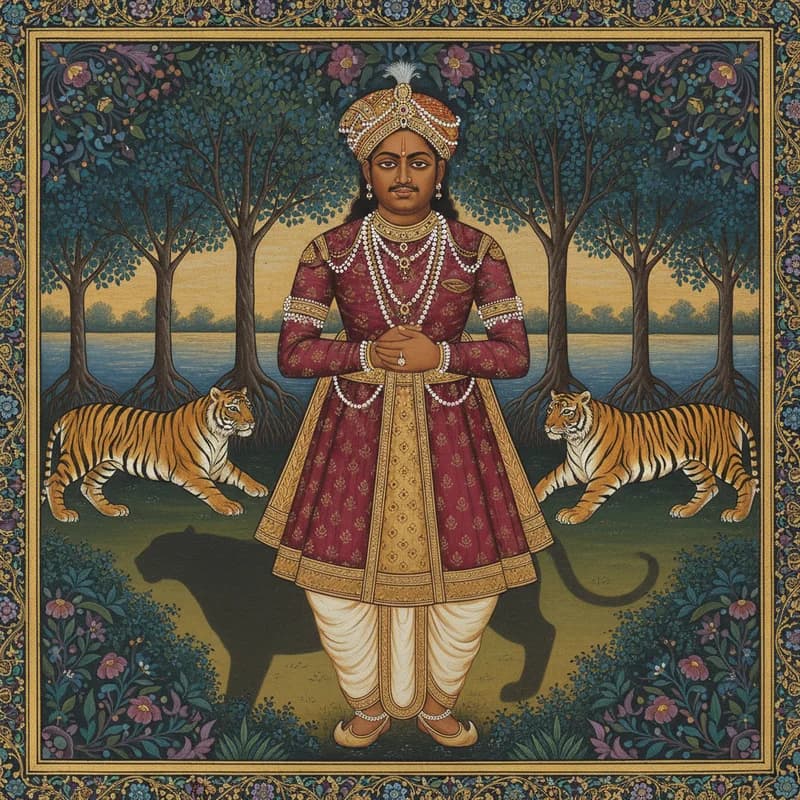
He rules the southern forest the way a tide rules the estuary — not by force alone, but by the simple fact of his prior claim. Dakshin Ray is the tiger god of the Sundarbans, that drowned labyrinth of mangrove and channel stretching from the Matla to the Raimangal, and the honey-collectors and woodcutters and crab-fishermen who push their boats into those creeks know his name before they know how to swim. He takes the shape of a tiger when he chooses to appear, though the older accounts from Gosaba and Basanti insist that the tiger is only his preferred garment — that what wears it is older and less legible than any animal.
His compact with Bon Bibi, the forest mother, defines the moral architecture of the delta. She holds the forest on behalf of the poor; he holds it on behalf of himself. Those who enter with honest need and proper prayer — the leaf-plate offering made at the forest edge, the name of Bon Bibi spoken before the name of anyone else — move under a negotiated protection. Those who enter greedy, who take more timber than they declared, who wade into restricted channels after the larger crabs, withdraw that protection entirely. What follows is documented in the accounts of Canning and Namkhana both: a boat found drifting without its crew, a sandbar with a single sandal on it, the distinctive wound pattern that the forest department records with clinical language and the villagers describe with none. Dakshin Ray does not punish randomly. He collects what was owed.
Dakshin Ray appears most often at the treeline where the mangrove gives way to open water — a man of middle years, broad-shouldered and dark-complexioned, dressed in the manner of a zamindar from an older century, his dhoti clean despite the brackish mud of the Sundarbans delta. The face is composed, almost courtly, which is precisely what makes it wrong: no human being moves through the Sundarbans with that stillness, that absence of the small flinching adjustments the body makes against insects, heat, and uneven ground. Witnesses from the char islands near Gosaba report a smell before the form — not the rot-and-salt smell of the tidal forest, but something underneath it, warm and animal, the musk of a large cat that has been lying in sun. When he turns, the shadow he casts does not match his body — it is low, four-legged, and does not turn with him.
In the deep mangrove channels of the Sundarbans, where the Matla and Gosaba rivers braid together and the tide erases footprints within minutes, Dakshin Ray is said to appear most often as an elderly Muslim fakir — white-bearded, unhurried, carrying a bamboo staff and a small cloth bundle, the kind of wandering holy man whose presence in a honey-gathering camp would raise no alarm. He speaks first, which is itself unusual; genuine fakirs in these parts wait to be addressed. The second tell is the staff: pressed into the soft delta mud at the water's edge, it leaves no indentation, as though the weight behind it belongs to something far lighter than an old man, or far heavier than anything with a human shape.
First Documented
Dakshin Ray appears in the *Bon Bibi Johuranama*, a Bengali narrative poem likely composed between the seventeenth and eighteenth centuries, though oral accounts from fishing and honey-gathering communities of the Sundarbans delta suggest his worship predates any written record by several generations.
Last Recorded
Accounts of Dakshin Ray persist unbroken into the present day — honey collectors and fishermen entering the Sundarbans still report encounters, leave offerings at forest shrines, and return with stories of a tiger-mounted figure glimpsed between the mangroves along the Matla and Gosaba rivers.
Source Language
Bengali
Origin
Dakshin Ray enters the written record through the Bon Bibi Johurnama, an eighteenth-century Bengali narrative text that circulates in both manuscript and printed chapbook form across the deltaic districts of South 24 Parganas, where the Matla and Gosaba rivers push into the mangrove interior. The textual account positions him as an antagonist held in check by Bon Bibi — a lord of tigers and forest wealth who accepts a negotiated sovereignty, ceding human devotees to Bon Bibi's protection while retaining dominion over those who enter the Sundarbans with greed in their hearts. The oral tradition of the mawali fishing and honey-gathering communities, however, refuses this subordinate framing: in accounts collected from Sajnekhali and Gosaba, Dakshin Ray predates Bon Bibi entirely, an autochthonous lord whose compact with the forest was already old when she arrived from Medina. That divergence is not incidental — it maps a historical tension between an older, animist territorial cult rooted in the Bengal delta and the later Sufi-
Frequently Asked
Dakshin Ray is the tiger deity of the Sundarbans delta, worshipped across the mangrove forests where the Ganges and Brahmaputra empty into the Bay of Bengal. He rules the deep forest as its sovereign, commanding the Royal Bengal tigers as his earthly form and his agents. Fishermen and honey collectors who enter his territory without ritual permission do so at their peril.
Dakshin Ray can possess tigers, directing them to attack those who enter the Sundarbans without offering proper tribute. Oral accounts collected from Mridha and Mondal communities along the Matla River describe him as capable of appearing in human form to test the faith of forest workers. He controls the boundary between the human world and the wild interior of the delta.
Dakshin Ray and Bon Bibi exist in a state of ancient, negotiated tension — he represents the forest's hunger and danger, she its protection of the righteous poor. According to the Bon Bibi Johuranama, the two struck a pact dividing the Sundarbans: Dakshin Ray holds dominion over the uninhabited interior, while Bon Bibi protects those who enter with honest need and humble hearts. Their rivalry is not resolved but managed, and that balance is what makes the forest survivable.
Dakshin Ray predates the clean sectarian lines that later religious history tries to impose on him. Worshipped by both Hindu and Muslim communities in the Sundarbans, he appears in the syncretic Bon Bibi narrative tradition, which blends Islamic and Hindu elements freely. His shrines — simple earthen platforms beneath old trees near the Gosaba and Basanti blocks — draw devotees regardless of faith.
Before cutting wood or collecting honey in the deep mangroves, forest workers traditionally invoke both Bon Bibi and Dakshin Ray, offering sweets and prayers at forest-edge shrines. Failing to acknowledge Dakshin Ray is considered an act of arrogance that invites tiger attack. The moule, or honey collectors, are especially careful — their work takes them furthest into his territory.
The primary source for Dakshin Ray's mythology is the Bon Bibi Johuranama, an oral and written narrative tradition in Bengali that circulates widely through the Sundarbans region. It is not a Sanskritic scripture but a vernacular religious text, sung and recited by performers during community rituals before forest expeditions. Copies are kept in many households along the tidal rivers of South 24 Parganas.
Dakshin Ray shares structural similarities with tiger guardian spirits found across tribal traditions in Jharkhand, Odisha, and the Bastar forests of Chhattisgarh, but he is distinct in his specific mythological biography and his pairing with Bon Bibi. Where many tiger spirits are unnamed ancestral forces, Dakshin Ray has a name, a narrative, and a defined territorial claim. His worship is inseparable from the ecology and economy of the Sundarbans mangrove delta.
Dakshin Ray is not malevolent by nature, but he is territorial and unforgiving of greed — those who take more from the forest than they need, or who enter without ritual acknowledgment, are said to draw his wrath in the form of tiger attacks. Accounts from forest guards stationed near Sajnekhali describe a pattern: the men taken by tigers are often those who ignored the old protocols. He demands respect, not fear, but the line between the two is thin in the Sundarbans.
संबंधित लोकगाथाएं
Related Lore
Algorithmic Inference
आपको यह भी पसंद आ सकता है
You May Also Like
Community Discussion
Comments are reviewed by AI before appearing publicly. Unsafe, unrelated, or uncertain comments go to human review.
Sign in to join the discussion.
0 comments
No public comments yet.