प्रतीक्षा करें
Decoding the Pishacha encounter logs…
प्रतीक्षा करें
Decoding the Pishacha encounter logs…
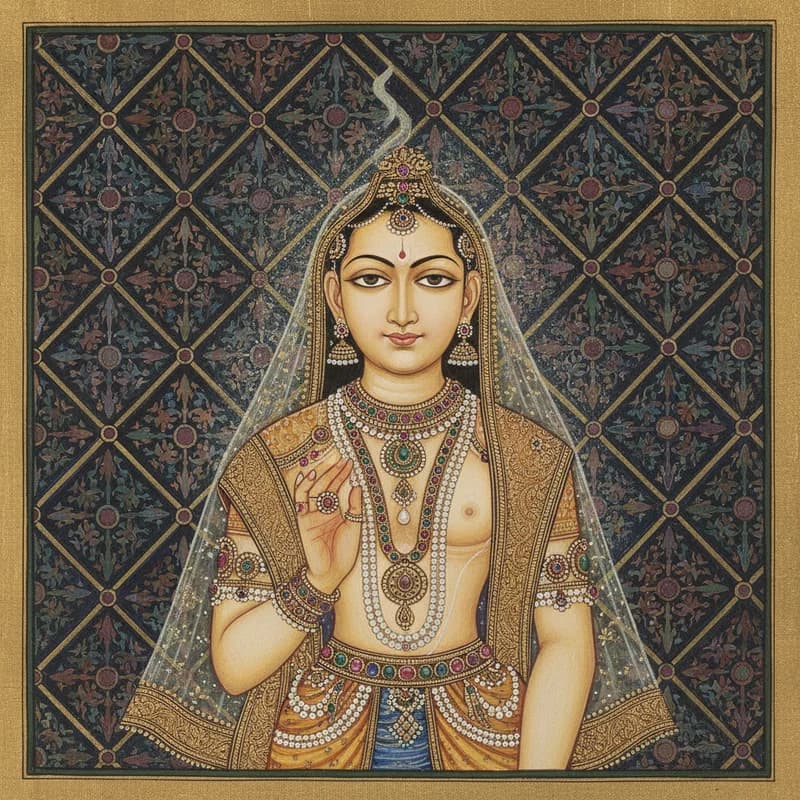

Gandhabba
In Pali Buddhist cosmology, the Gandhabba arrives before the body does. It is the being of smell — gandha, fragrance — that descends into the womb at the precise moment of conception, carrying with it the karmic residue of a previous life. Without the Gandhabba's presence, conception does not hold. The Majjhima Nikaya states this plainly: three conditions must converge — the parents' union, the mother's fertile moment, and the arrival of the Gandhabba. Remove any one of them and no new life forms.
What it brings is not merely presence but character. The Gandhabba determines the tenor of the life it enters — its inclinations, its moral weight, the direction of its unfolding. Folk accounts collected near the Bodhi temples of Bodh Gaya and among Theravada communities in the Pali-literate belt of eastern India describe a brief, hovering interval between death and rebirth during which the Gandhabba exists in a state of acute sensitivity to smell, drawn toward the conditions that match its accumulated karma. Incense burned at the moment of birth in certain Bihar households is not decorative; it is understood as a greeting, an acknowledgment that something arrived. The threat here is not violence. It is the weight of what the Gandhabba carries — because what it deposits in the womb, no ritual after birth will fully undo.
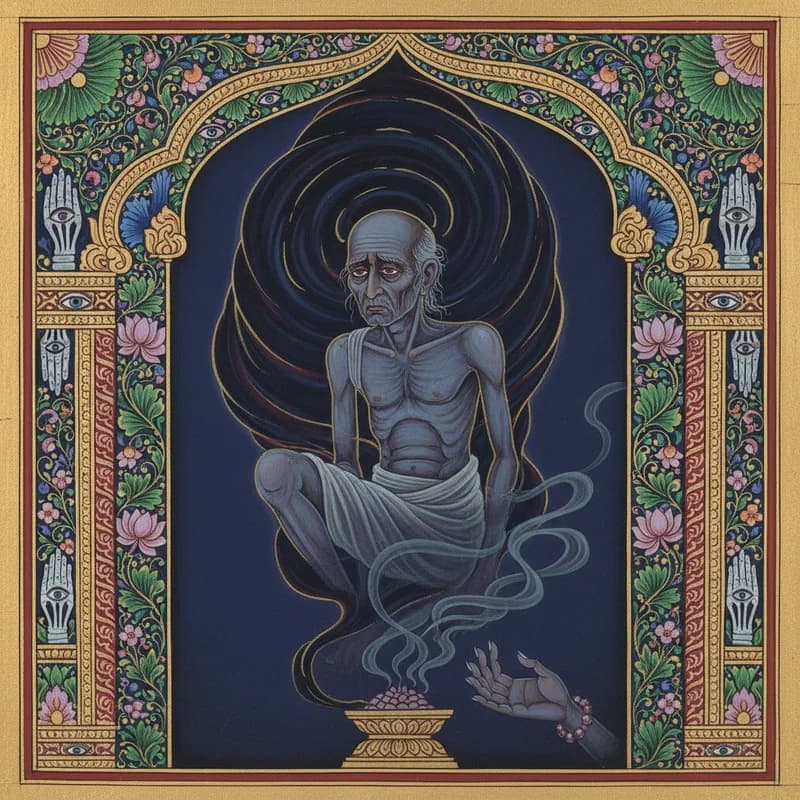
The Gandhabba does not appear so much as it arrives — witnesses across the Terai foothills and the older monastery accounts from Bodh Gaya describe a figure of uncertain gender, slight and luminous without being bright, like the air above a field of jasmine at the hour before dawn when the scent is strongest but the flowers are still closed. The skin, where it can be called that, carries the quality of old beeswax: pale, faintly warm, slightly translucent at the temples and wrists. What marks it as not-human is this: it has no shadow. Not an absent shadow but a wrong one — those who have looked carefully describe a shadow that falls in a direction unrelated to any available light. The smell precedes and outlasts the vision entirely — not one fragrance but a layered progression, as if every flower a person has ever encountered is cycling through in rapid sequence, marigold to champak to the particular dampness of wet earth outside a delivery room.
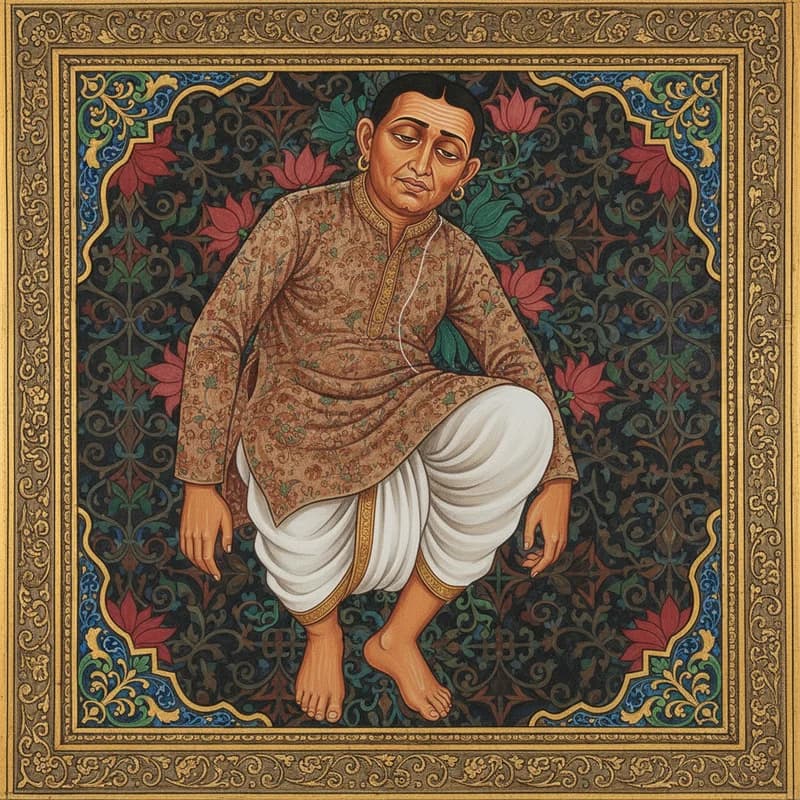
Along the Ganga's western bank near Haridwar, where cremation smoke drifts inland through the sal forests each evening, the Gandhabba is reported in the form of an itinerant perfume-seller — a man of indeterminate middle age carrying a flat wooden tray of small glass attar bottles, moving through village lanes during the hours between sunset and the lighting of household lamps. He approaches pregnant women specifically, offering a free sample, pressing nothing. Two tells mark him for those who know to watch: the bottles on his tray have no labels and no colour, yet each woman who smells them reports a different fragrance — jasmine, camphor, wet earth, something unnameable — never the same scent twice. His own smell is the deeper sign. He carries no odour whatsoever. Not sweat, not dust, not the attar he sells. Where a living man would leave a trace on the air, he leaves nothing.
First Documented
The Gandhabba appears in the Pali Canon, specifically in the Majjhima Nikāya's Mahātaṇhāsankhaya Sutta, where the Buddha describes three conditions necessary for conception — the meeting of mother and father, the mother's fertile season, and the presence of a gandhabba, a being poised at the threshold of rebirth.
Last Recorded
Accounts of the Gandhabba appear as early as the Majjhima Nikāya and persist in living Theravāda ritual speech across Myanmar and Sri Lanka; monks in the Kandyan hill monasteries still invoke the concept when counseling expectant families, suggesting the belief has never fully retreated into textual history.
Source Language
Pali
Origin
The Gandhabba enters the Buddhist textual record in the Majjhima Nikaya's Mahatanhasankhaya Sutta, where the Buddha enumerates the three conditions required for conception: the union of mother and father, the mother's fertile season, and the presence of the gandhabba — the being ready to descend. The Pali term carries the trace of the older Vedic gandharva, celestial musicians associated with scent and with the boundary between worlds, and the overlap is not accidental. What the Abhidhamma tradition then codifies as a doctrinal mechanism — the gandhabba as a being between deaths, drawn to the womb by its own karmic momentum — differs sharply from the oral accounts collected in Theravada village communities of Bengal's Rarh region and along the Irrawaddy corridor, where the gandhabba is understood not as a neutral vehicle but as something with appetite, drawn specifically by smell: the smell of cooking, of desire, of a house that wants a child. That sensory specificity — smell as karmic gravity — appears nowhere in the canonical texts, but it survives
Frequently Asked
The Gandhabba (गन्धब्ब) is a subtle spirit described in Pali Buddhist texts as the being that enters the womb at the precise moment of conception, making the third condition necessary for new life to take form. Without the Gandhabba's presence, even the union of mother and father cannot produce a child. The term itself is rooted in gandha, meaning smell or fragrance, pointing to this being's essential, invisible nature.
In the Majjhima Nikaya, the Buddha specifies that three factors must converge for conception to occur: the parents must come together, the mother must be in her fertile period, and a Gandhabba must be present and ready to descend. The Gandhabba is understood to be a being in the intermediate state between death and rebirth, drawn toward the womb by its own karmic momentum.
Many Theravada commentators, including Buddhaghosa writing in fifth-century Sri Lanka, equate the Gandhabba with the being that exists in the antarabhava, the liminal state between one life and the next. Not all Buddhist schools agree — the Theravada tradition is cautious about fully endorsing the antarabhava concept — yet the Gandhabba's function as a transitional, womb-seeking entity makes the identification difficult to dismiss.
The connection to gandha, fragrance, reflects the ancient Indian understanding that smell is the most primal and penetrating of the senses, capable of reaching where light and sound cannot. Some commentarial traditions suggest the Gandhabba is drawn to the womb through a form of olfactory attraction, perceiving the conditions of the parents and the karmic environment before any other faculty engages. This is why the being is named for smell rather than for vision or thought.
The Vedic Gandharva is a celestial musician associated with the heavens, soma, and the guardianship of women — a being of beauty and cosmic order described in the Rigveda and the Atharvaveda. The Buddhist Gandhabba, while sharing a linguistic root, is a far more intimate and biological figure, concerned not with celestial music but with the mechanics of rebirth and the entry of consciousness into a new body. The two traditions borrowed the name but shaped the being for entirely different purposes.
The Gandhabba carries no malevolent intent in canonical Buddhist sources — it is not a predatory spirit but a being in transition, following the pull of its own karma toward a new birth. Caution arises not from the Gandhabba's hostility but from the weight of what it represents: the conditions that shape a life are set at the moment of its arrival, before the child draws a single breath. In folk traditions across Bengal and parts of Odisha, however, spirits associated with conception are treated with ritual care, and the boundary between the Gandhabba and more ambiguous womb-spirits can blur.
The most direct reference appears in the Mahatanhasankhaya Sutta of the Majjhima Nikaya, where the Buddha uses the Gandhabba to explain the conditions required for conception. Buddhaghosa's fifth-century Pali commentary Visuddhimagga returns to the concept in its analysis of rebirth-consciousness, treating the Gandhabba as the stream of karmic continuity that bridges one life to the next. These two texts remain the primary sources for any serious study of the being.
Buddhist doctrine holds that the Gandhabba does not choose freely — it is drawn by the force of its accumulated karma toward a womb that matches the conditions its past actions have prepared. The Milindapanha, a dialogue between the monk Nagasena and the Greek king Menander composed around the first century BCE, uses the image of a flame passing from lamp to lamp to describe how this transfer occurs without a fixed self making a deliberate decision. The Gandhabba arrives not by will but by weight.
संबंधित लोकगाथाएं
Related Lore
Algorithmic Inference
आपको यह भी पसंद आ सकता है
You May Also Like
Community Discussion
Comments are reviewed by AI before appearing publicly. Unsafe, unrelated, or uncertain comments go to human review.
Sign in to join the discussion.
0 comments
No public comments yet.