प्रतीक्षा करें
Consulting the Shastra archives…
प्रतीक्षा करें
Consulting the Shastra archives…

Lohasur
Among the Gond and Agaria communities of Chhattisgarh, the blacksmith's furnace is never simply a furnace. It sits above a wound. The origin accounts, collected across the Bastar plateau and the forested hills near the Indravati river, agree on the essential fact: Lohasur was a demon of iron who grew so powerful that he threatened the order of the living world, and the goddess — most often named as Danteshwari in the southern accounts — came to fight him. She won. His blood soaked into the laterite earth and became the ore that smiths dig up and smelt to this day. Every piece of iron, in this understanding, carries the demon's body inside it.
That history makes Lohasur neither safely dead nor safely defeated. The Agaria blacksmiths who work the iron understand themselves to be reopening that old violence each time they heat the ore, and their ritual precautions reflect this. They do not begin a smelting without propitiation. They do not let menstruating women near the furnace, not from contempt but from a belief that the demon stirs toward blood. Accounts from the Kanker and Dhamtari districts describe tools that turn against their makers, blades that crack without cause, furnaces that collapse mid-smelt — all read as signs that Lohasur's portion was not properly acknowledged. He does not require worship exactly. He requires recognition that the iron was his before it was yours.
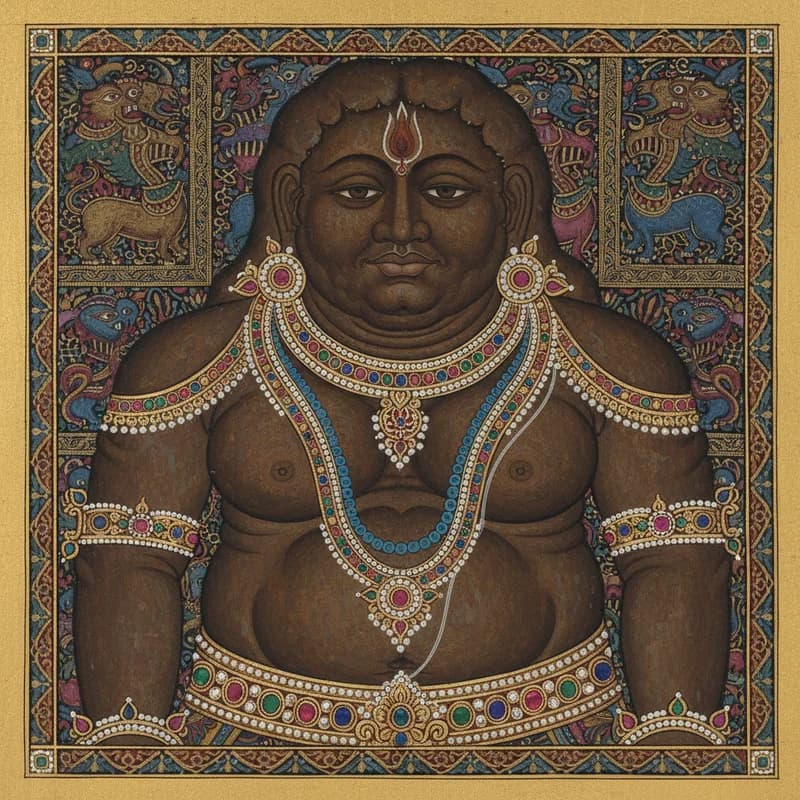
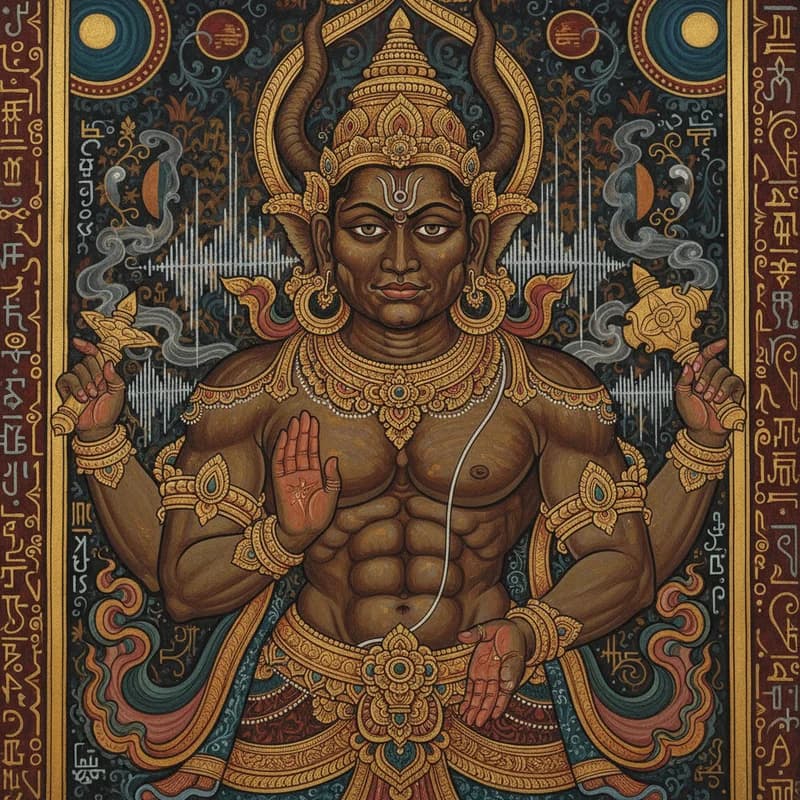
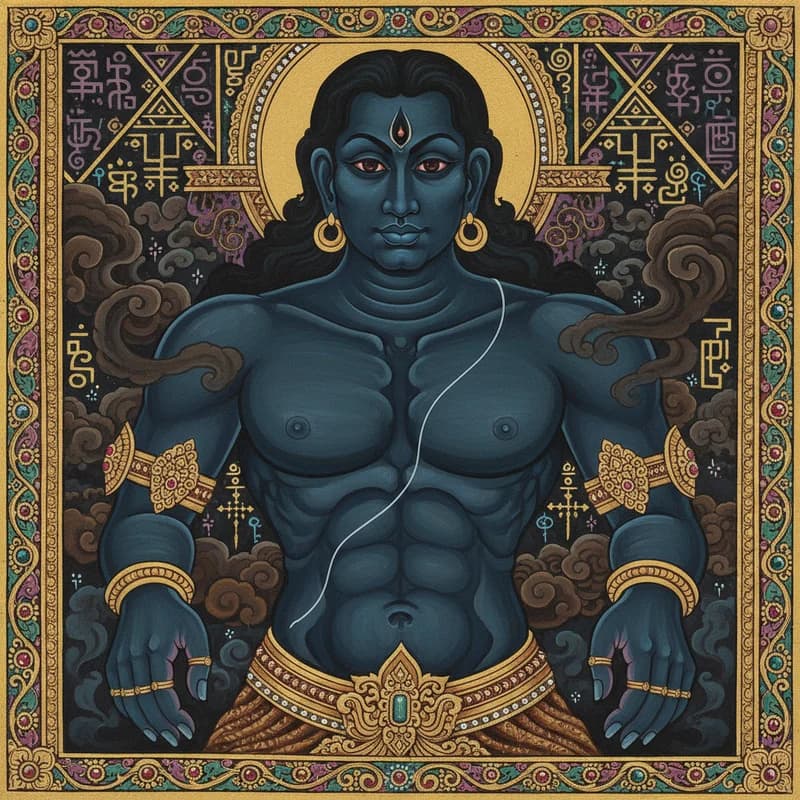
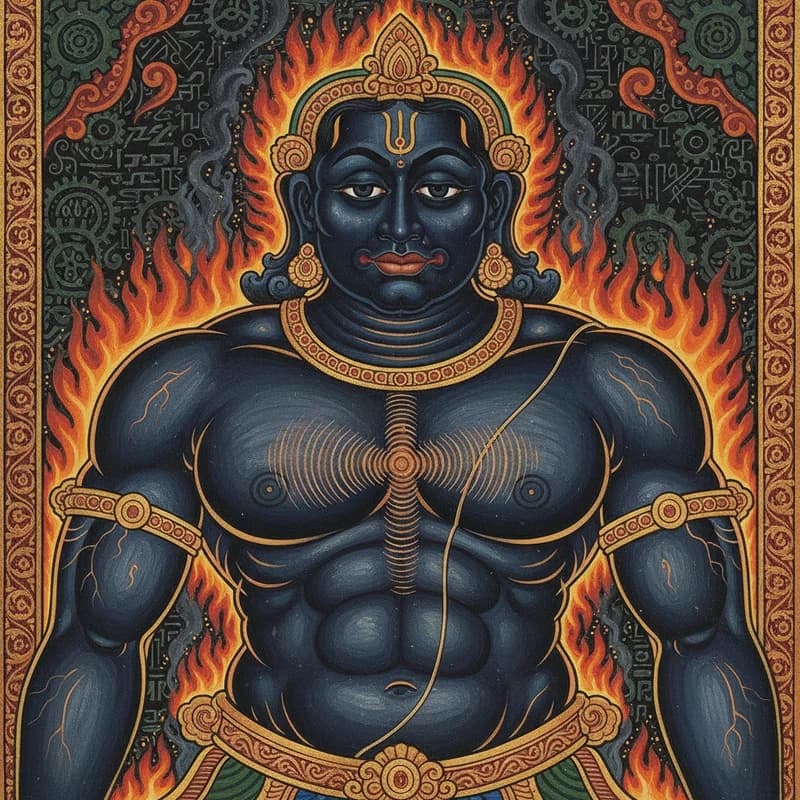
Lohasur appears as a massive figure, broad through the chest and shoulders in the way of a man who has spent lifetimes at a forge — not fat, but dense, as though the body itself has been compressed under great heat and pressure. The skin carries the blue-black sheen of pig iron fresh from the furnace, and where the joints flex, the surface shows hairline fractures that glow faint orange at the edges, like cooling metal that has not yet decided to be solid. Oral accounts from the ironworking Agaria communities of Bastar describe a sound that precedes him: not footsteps but a low, rhythmic clanging, as though something heavy swings loose inside the chest cavity. The smell is unmistakable — hot iron and sulfur, the exact smell of the Dalli-Rajhara mines in the dry months before the Sheonath floods. What marks him as something other than flesh is this: he casts no shadow, only a heat-shimmer.
Lohasur moves through the iron-belt villages of Chhattisgarh — the settlements near Bailadila and the Dalli-Rajhara mines — as an itinerant blacksmith, arriving at the edge of a settlement just before the monsoon breaks, when every farmer needs plowshares sharpened and tools mended before the soil softens. He carries a proper bundle: tongs, a small bellows, a worn leather apron. The work he produces is flawless, which is itself the first tell — the edges hold longer than any iron should, and animals refuse to be shod with his shoes, pulling back from the fitted metal as though it burns. The second tell is in the coals: the fire he works over burns without smoke, even in wet air, and the ash he leaves behind is the color of dried blood rather than grey.
First Documented
Lohasur surfaces most clearly in the oral ritual traditions of the Agaria blacksmith caste of Chhattisgarh and the Maikal Hills, recorded with ethnographic precision by Verrier Elwin in *The Agaria* (1942), where smelting songs and invocation chants preserve his defeat at the hands of the goddess as living liturgy.
Last Recorded
Accounts of Lohasur persist among the Agaria blacksmith communities of Chhattisgarh, with oral recitations recorded as recently as the 1980s by Verrier Elwin himself near the Hasdeo river basin; smelters still invoke protective rites before lighting the furnace, suggesting the tradition, if not the demon, remains alive.
Source Language
Chhattisgarhi
Origin
Lohasur appears most directly in the oral tradition of the Agaria smiths of Chhattisgarh, whose creation accounts were recorded by Verrier Elwin in *The Agaria* (1942), though the figure's roots run deeper into the Gondi cosmological stream that Elwin's informants drew from but did not fully disclose. In the textual tradition — fragmentary references in regional Shakta literature — Lohasur is simply an asura subdued by the goddess, one entry in a long catalogue of demonic defeats. The Agaria oral account refuses that reduction: here, Lohasur is not defeated so much as transformed, his blood seeping into the red laterite soil of the Chhota Nagpur plateau and the hills above the Sheonath River, becoming the iron ore the Agaria have worked for generations. That distinction carries weight. In the textual reading, the goddess destroys. In the smith's account, she converts — and the ore in the furnace is still, in some sense, alive.
Frequently Asked
Lohasur (लोहासुर) is a demon of iron and metallurgy venerated and feared in the tribal traditions of Chhattisgarh. Oral accounts collected among the Gond and Agaria communities describe him as a being of immense destructive power, his body forged from the same dark ore that runs through the Maikal hills. He was ultimately defeated by a goddess, and his spilled blood is said to have seeped into the earth, becoming the iron deposits that smiths mine to this day.
Lohasur commands dominion over iron, fire, and the forge — the three forces that define metalworking in Chhattisgarhi tradition. Accounts from villages near the Sheonath river describe him as capable of hardening flesh like tempered metal and corrupting the tools of blacksmiths who fail to propitiate him. His influence is strongest during the dry months, when the smelting fires burn longest.
In the primary Chhattisgarhi oral tradition, Lohasur is defeated by a fierce goddess — often identified with Danteshwari or a local form of Durga worshipped at shrines in the Bastar region. The battle is not merely cosmic but deeply practical: her victory explains why iron can be worked and shaped, the demon's defeat making the metal yield to human hands. Some accounts name the goddess as Kankali, whose temple traditions in the Chhattisgarh belt carry strong associations with iron and blood offerings.
When the goddess slew Lohasur, his blood poured into the red laterite earth of the Chhattisgarh plateau and hardened into the iron-rich ore that the Agaria tribe has mined for centuries. This origin myth, documented by Verrier Elwin in his fieldwork among the Agaria, transforms every act of smelting into a ritual re-enactment of that primordial defeat. The ore is not merely mineral — it carries the demon's essence, which is why Agaria smiths perform propitiatory rites before breaking new ground.
Lohasur occupies both positions simultaneously, as is common with defeated demons in Indian folk religion. The Agaria smiths of Chhattisgarh acknowledge him through ritual before working iron, treating his presence in the ore as something to be managed rather than ignored. To work iron without acknowledgment is to invite the demon's anger — cracked bellows, failed smelts, and injury at the forge are all attributed to his displeasure.
The Asuras of Sanskrit literature — the Puranas, the Mahabharata — are cosmic adversaries of the Devas, operating on a pan-Indian theological stage. Lohasur belongs to a more localized stratum of belief, rooted in the specific landscape of the Chhattisgarh plateau and the occupational world of tribal smiths. Where Puranic Asuras are defeated to restore cosmic order, Lohasur's defeat has a material consequence: it explains the iron in the ground beneath your feet.
Formal temple structures dedicated solely to Lohasur are rare, but his presence is acknowledged at the sacred spaces of Agaria smiths — small iron-post shrines set near smelting sites in the forests of Chhattisgarh and parts of Madhya Pradesh. The goddess who defeated him, however, receives elaborate worship at sites like the Danteshwari temple in Jagdalpur, where the mythology of her victory over iron-bodied demons is woven into the ritual calendar. His is a presence marked in practice rather than architecture.
The most significant documentation comes from Verrier Elwin's 1942 ethnographic study The Agaria, which recorded the cosmological beliefs of Chhattisgarh's hereditary ironsmith community in close detail. Lohasur does not appear in the classical Sanskrit Puranas; his story lives in oral tradition, passed between smiths along the Hasdeo and Sheonath river valleys. Regional folklore collections in Hindi and Chhattisgarhi also preserve fragments of the myth, though Elwin's account remains the most thorough written record.
संबंधित लोकगाथाएं
Related Lore
Algorithmic Inference
आपको यह भी पसंद आ सकता है
You May Also Like
Community Discussion
Comments are reviewed by AI before appearing publicly. Unsafe, unrelated, or uncertain comments go to human review.
Sign in to join the discussion.
0 comments
No public comments yet.