प्रतीक्षा करें
Transcribing the Sutradhaar’s field report…
प्रतीक्षा करें
Transcribing the Sutradhaar’s field report…
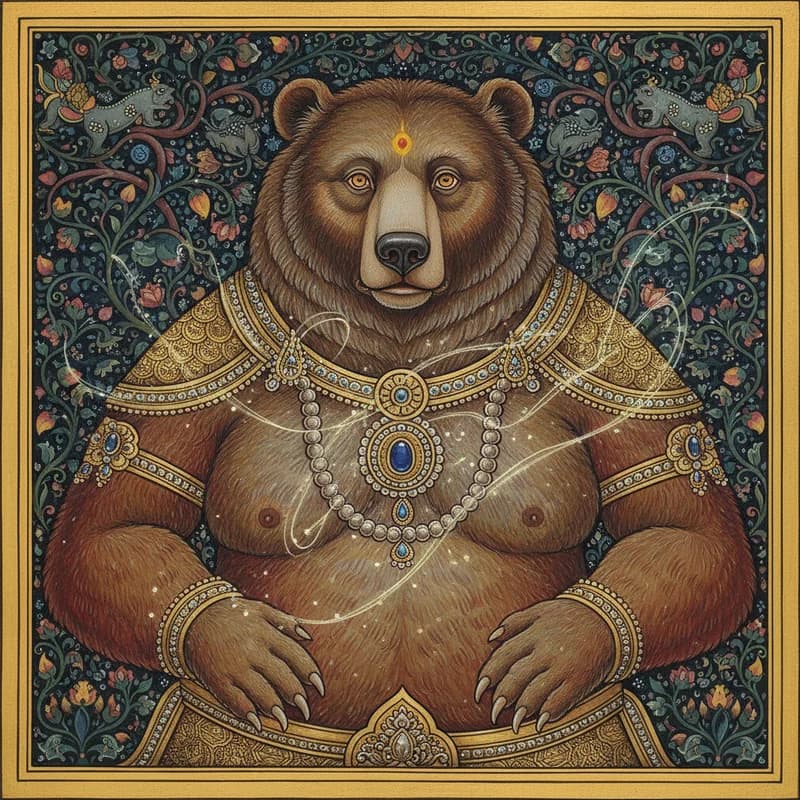

Riksha
They walked upright and spoke in councils. The Riksha were not animals wearing the shape of bears — they were something older, beings who had emerged when the world was still being arranged, before the categories of human and beast had fully hardened. The Valmiki Ramayana places them among the vanaras who crossed to Lanka on the bridge of stones, and the Kishkindha Kanda names their lineage with the same gravity it gives to kings. Jambavan, their most famous elder, carried memory the way mountains carry water — slowly, completely, in every direction at once.
What the Riksha represent in the living oral traditions of the Vindhya foothills and the forested districts of Chhattisgarh is harder to fix than any epic text suggests. Adivasi accounts collected near the Maikal range describe a class of forest-guardian who appears in the form of a great bear at dusk, near the confluence of the Narmada's upper tributaries, and does not harm unless the old agreements are broken — agreements about which trees to cut, which seasons to hunt in, which silences to keep. These accounts do not cite Rama. They predate that framing entirely. The Riksha of the Ramayana may be the Brahminical absorption of something that was already there, already watching, from the edge of the sal forest before the first verse was composed.
The Riksha stands at the height of a doorframe and broader, the body carrying a bear's mass but arranged with a deliberateness no animal possesses — the shoulders set back, the spine straight, the hands hanging open at the sides in the posture of someone who has chosen stillness over movement. The fur is the colour of iron-ore dust, dark reddish-brown at the flanks and fading to ash-grey around the muzzle, which is long and carries the particular dignity of extreme age. When one draws close, the smell is specific: wet riverbank clay mixed with something older, the crushed-leaf scent of a forest floor undisturbed for centuries — accounts from the Dandakaranya region describe it as the smell of the Godavari in monsoon, before the villages begin. The sound that accompanies a Riksha presence is not a growl but a low resonant hum, felt more in the sternum than heard with the ears, like a conch shell being blown at great distance. What marks it as something other than flesh is this: in accounts from the Bastar plateau and the Vindhya foothills
In the forested corridors between Kishkindha's old territory and the Tungabhadra's eastern bank, Riksha is reported to appear as an elderly tribal elder — a man of the Soliga or Kuruba communities, broad-shouldered, unhurried, carrying a short-handled axe and smelling of wood smoke. The disguise is entirely plausible in this landscape; no villager would look twice at such a figure on a forest path in the weeks before the monsoon. The first tell is the hands: the knuckles are too large, the fingers too short relative to the palm, and the grip on the axe handle leaves visible impressions in the wood. The second is that he knows the forest incorrectly — not poorly, but from a direction that has been wrong for centuries, naming streams by names that appear only in the Kishkindha Kanda and nowhere in living memory.
First Documented
The Rikshas appear in the Valmiki Ramayana, likely composed between 500 and 100 BCE, where they are summoned as part of Sugriva's vast animal army in the Kishkindha Kanda. Jambavan, their ancient patriarch, is described there as born from Brahma's yawn — a detail suggesting the Rikshas carried cosmogonic weight long before the epic's final redaction.
Last Recorded
Accounts of the Riksha as living cosmic presences faded from active oral tradition sometime in the early twentieth century, though the forests of the Vindhya range still carry stories of Jambavan's descendants among Gond and Baiga communities. These accounts persist quietly to the present day.
Source Language
Sanskrit
Origin
The Riksha appear in the Valmiki Ramayana's Kishkindha Kanda as a distinct class of bear-warriors, named separately from the Vanara, yet the Mahabharata's later references blur the distinction, folding them loosely into the broader category of forest allies without preserving their genealogical specificity. Jambavan — eldest of the Riksha — is given a cosmogonic birth in some Puranic passages, said to have emerged from Brahma's yawn at the beginning of the current age, making him technically older than the events he witnesses. Where the Sanskrit textual tradition treats the Riksha as a narrative category — warriors, allies, functionaries of the Rama-katha — the oral tradition of the Vindhya and Satpura hill communities, particularly among forest-dwelling groups along the upper Narmada valley, treats them as presences still moving in the deep jungle, not extinct but withdrawn. That divergence is not trivial: it marks the difference between a people the epics consumed into allegory and a people whose memory the forest kept intact.
Frequently Asked
Riksha (ऋक्ष) refers to a race of cosmic bear beings described in the Sanskrit epics, most prominently in the Valmiki Ramayana and the Mahabharata. These are not ordinary animals but spiritually potent beings of divine origin, capable of speech, warfare, and devotion. Jambavan, the ancient bear king who counseled Rama and later tested Krishna, is the most celebrated figure of the Riksha lineage.
The word ऋक्ष does carry the literal meaning of bear in Sanskrit, but the Rikshas of the epics are something far older and stranger than the animal. Born from the breath of Brahma according to some accounts, they belong to a category of primordial beings whose animal form is inseparable from their cosmic identity. Treating them as mere bears is like calling the Nagas mere snakes.
The Riksha army fought alongside Rama in the war against Ravana, crossing the sea to Lanka as part of the great vanara-riksha coalition assembled at the southern shore near Rameshwaram. Their king Jambavan served as a strategic elder, his counsel shaping key decisions during the siege. The Kishkindha Kanda of the Valmiki Ramayana records their gathering and their oath of loyalty to Rama's cause.
Jambavan is the patriarch of the Riksha beings, said in the Puranas to have been present at the churning of the cosmic ocean and to have circled Vamana's three strides so many times that his beard grew long before he finished. He appears in both the Ramayana and the Mahabharata, making him one of the few figures to span both epics. His encounter with Krishna in the Syamantaka jewel episode, recorded in the Bhagavata Purana, marks the twilight of the Riksha age.
Epic sources credit the Rikshas with enormous physical strength, the ability to uproot mountains, and a near-indestructible constitution born of divine ancestry. Jambavan alone is said to have struck Ravana's chariot with such force that the demon king was momentarily stunned, a feat recorded in the Yuddha Kanda. In oral traditions collected along the forest margins of the Vindhya range, Riksha figures are also associated with deep memory — they are beings who remember the ages before the current world.
Vanaras are the monkey beings, most famously Hanuman and Sugriva, while Rikshas are the bear beings — distinct in form, origin, and temperament within the epic's cosmology. Where Vanaras are often depicted as swift, agile, and emotionally volatile, the Rikshas carry a quality of ancient stillness, their power rooted in endurance rather than speed. Both groups are classified as forest-dwelling semi-divine beings, but the Riksha lineage is generally portrayed as older, with Jambavan predating even the events of the Treta Yuga.
Formal temple worship of Riksha beings as a class is rare, but Jambavan shrines exist in parts of Andhra Pradesh and Karnataka, often located near rocky hillsides or dense forest edges where bears were historically sighted. In the oral traditions of tribal communities in the Dandakaranya forest belt — the same forests through which Rama wandered in exile — bear ancestors are sometimes invoked in protective rituals, a practice that may carry an echo of the older Riksha reverence. The Jambavanti episode is also dramatized in regional Harikatha performances across the Deccan.
Within the epic tradition, Rikshas are unambiguously allied with dharmic order — they fought for Rama and their king Jambavan is revered as a figure of wisdom and loyalty. The caution associated with Riksha in folk memory comes not from malevolence but from their sheer antiquity and power; encountering a being who has lived through multiple cosmic ages carries its own kind of danger. Like the deep forests of the Vindhyas where their memory persists, they are not hostile, but they are not tame.
संबंधित लोकगाथाएं
Related Lore
Algorithmic Inference
आपको यह भी पसंद आ सकता है
You May Also Like
Community Discussion
Comments are reviewed by AI before appearing publicly. Unsafe, unrelated, or uncertain comments go to human review.
Sign in to join the discussion.
0 comments
No public comments yet.