प्रतीक्षा करें
Retrieving sighting coordinates from the Map…
प्रतीक्षा करें
Retrieving sighting coordinates from the Map…
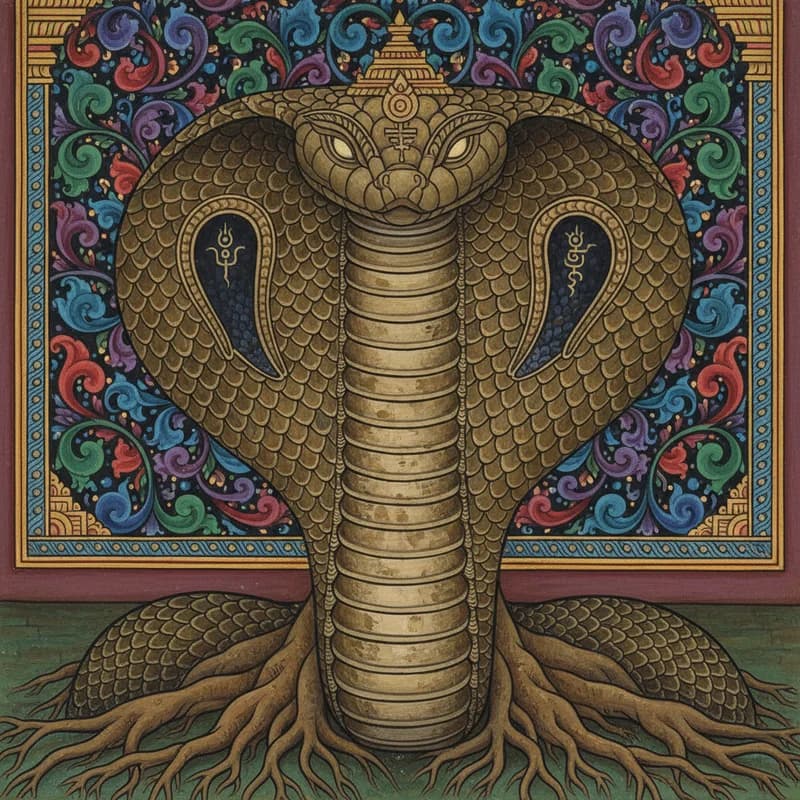

Mahoraga
Among the eight classes of supernatural beings in Buddhist cosmology — the Ashtamahayaksha and their kin — the Mahoraga occupy the lowest register, pressed into the earth itself, enormous beyond ordinary imagining. Where the Naga are river-dwelling and approachable, the Mahoraga coil at the roots of Mount Meru in a darkness that predates the current age. Texts preserved at Nalanda before its burning describe them as cobras of cosmic dimension, their bodies so vast that their breathing shifts the water table of entire river systems. The Gandavyuha Sutra names them among the assembly at Vairocana's feet, present but barely containable — devotion and menace held in the same enormous form.
What makes the Mahoraga significant to the living is not aggression but proximity. The folk accounts collected along the Narmada's upper reaches — where the river runs closest to deep limestone — speak of certain nights in Shravan when the ground itself seems to respire, when cattle refuse to enter their sheds and the air carries a mineral cold that has nothing to do with season. Older priests at the Omkareshwar ghats say the Mahoraga do not pursue. They simply are, beneath everything, and awareness of them is its own kind of danger — not because they harm but because the scale of what they represent makes ordinary human concerns briefly and terrifyingly small.
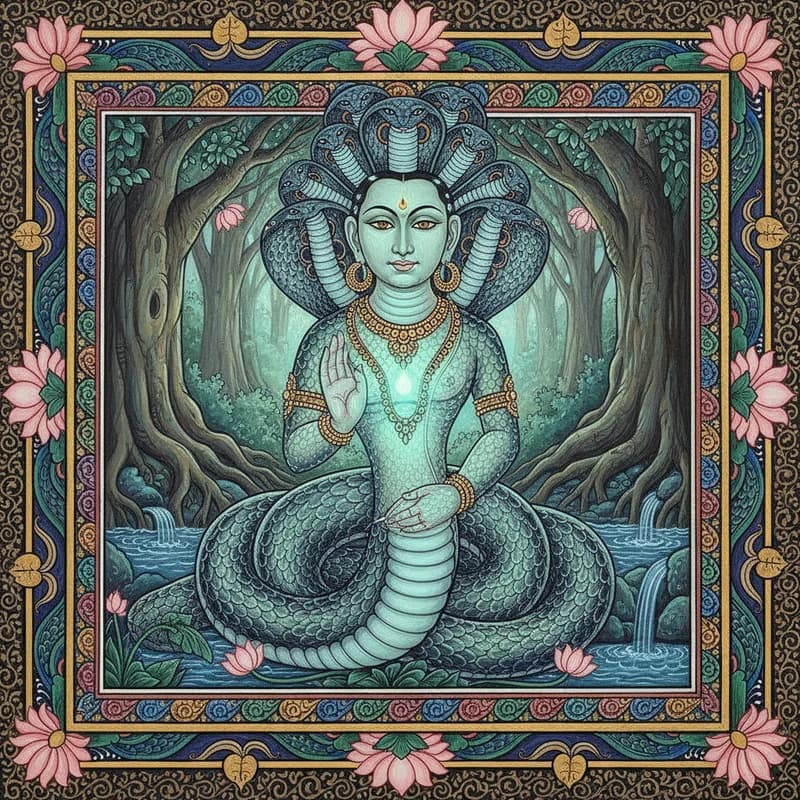
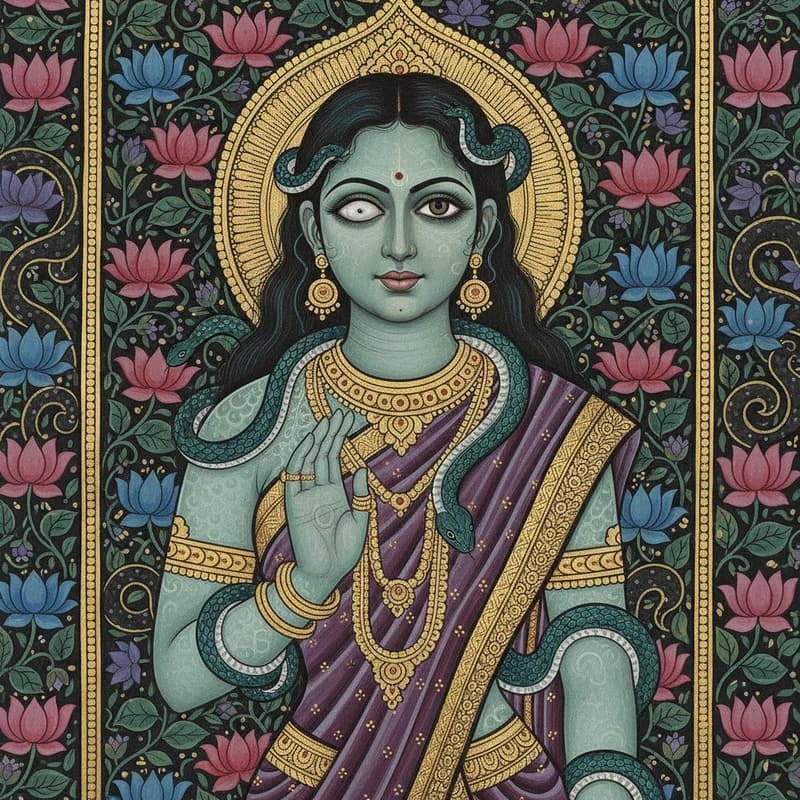
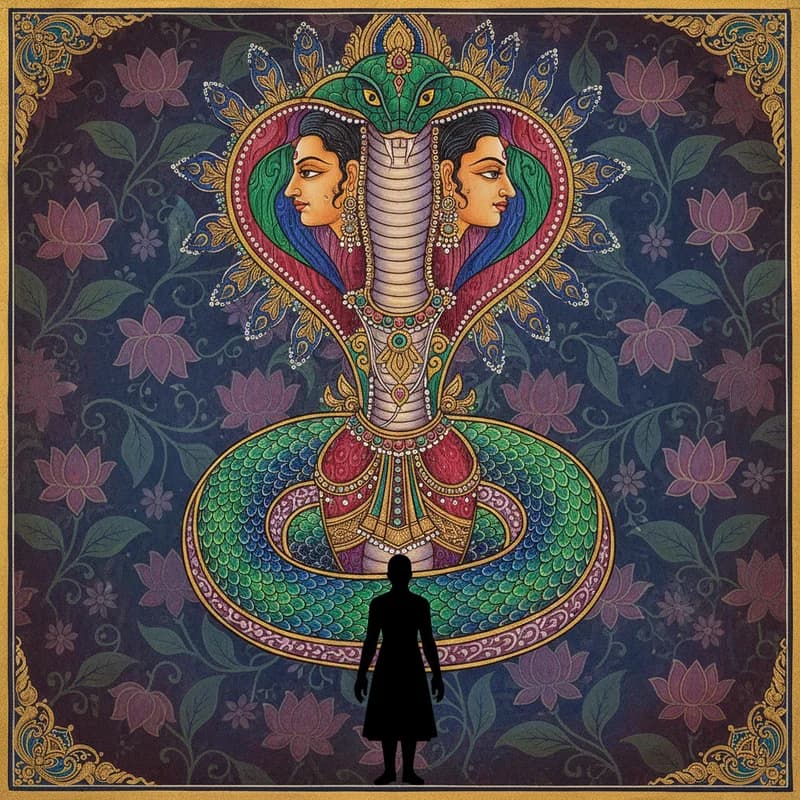
The Mahoraga manifests as a cobra of impossible proportion — not the exaggerated length of village accounts, but something structurally wrong with scale itself, as though the creature belongs to a geometry that does not accommodate human sight comfortably. Accounts collected near the Narmada's northern bank describe the hood as wide enough to occlude the horizon at dusk, its underside the pale, bruised white of river-silt exposed after the monsoon recedes. What witnesses remember first is not the size but the sound: a subsonic pressure in the sternum, felt before heard, like the lowest register of a temple bell struck inside a closed room. The scales carry a smell of deep stone and standing water from lightless places — the specific cold-mineral scent of a well that has not been opened in a generation. Where ordinary serpents move with muscular intention, the Mahoraga's coils adjust like tectonic plates shifting — deliberate, geological, indifferent to the categories of living and dead.
Mahoraga moves through the dry-season villages of the Narmada basin as an itinerant snake-charmer, the most unremarkable figure on any rural road — a man of indeterminate age carrying a cracked gourd pungi and a pair of cane baskets, dust-grey dhoti, nothing to pause the eye. He sets up at the edge of weekly haats between Jabalpur and Hoshangabad, plays his instrument, and the crowd thins slowly without anyone deciding to leave. The first tell is the snakes themselves: they do not sway to the music but instead orient toward him like compass needles, still and vertical, watching. The second is the ground beneath his seated position — even on the driest Jyestha afternoon, the packed earth around him remains faintly damp, as though something very large and very cold had rested there long before he arrived.
First Documented
Mahoraga appears among the earliest strata of Buddhist canonical literature, named explicitly in the Pali Agamas and the Sanskrit Mahāvastu as one of the eight classes of supernatural beings — the aṣṭagatyaḥ — who gathered to hear the Buddha's teachings. Their presence is recorded in the Lotus Sutra as well, where Mahoraga kings attend the assembly on Gṛdhrakūṭa
Last Recorded
Accounts of Mahoraga persist in living tradition — Theravada monks in the Pali-speaking communities of Bodh Gaya still invoke them in protective chants, and oral accounts collected along the Narmada's upper reaches as recently as the 1990s describe vast serpentine presences felt beneath the river's bedrock during the monsoon's first surge.
Source Language
Sanskrit
Origin
The Mahoraga enters Buddhist cosmological literature in the Lotus Sutra's assembly of the eight classes of beings — the ashtamaharājakāyika — where they appear alongside nāgas, garudas, and gandharvas as cosmic witnesses to the dharma, enormous serpent-bodied beings whose coils encircle the base of Mount Meru as roots encircle old earth. The Mahāvastu elaborates their nature further, placing them beneath the nāgas in cosmic hierarchy while granting them a bodily scale that exceeds ordinary serpent imagination. Where the textual tradition fixes them as attendant figures — present, vast, subordinate — the oral accounts collected in the Nāth-influenced villages of the Vindhya foothills, particularly near the Betwa River, describe the Mahoraga not as cosmic attendants but as the original architects of underground water: their movement beneath the earth is what causes rivers to find their beds. This divergence is significant. The Buddhist canonical record is interested in hierarchy and witness; the folk account is interested in causation, in agency. One places the Mahoraga at the
Frequently Asked
Mahoraga (महोरग) are great serpent beings of Buddhist cosmology — enormous, cobra-formed entities of cosmic scale who dwell at the roots of Mount Meru. The name itself compounds 'maha' (great) and 'uraga' (serpent), and they appear in canonical Pali and Sanskrit Buddhist texts among the eight classes of supernatural beings known as the Ashtamahayaksha or ashtavidha devata. Unlike the Nagas of Hindu tradition, Mahoragas are specifically associated with the subterranean foundations of the world-mountain rather than with rivers or rain.
Both Mahoragas and Nagas are serpentine supernatural beings, but their cosmological positions differ sharply. Nagas in Hindu tradition govern rivers, monsoon rains, and underworld treasuries — the Narmada and Yamuna rivers carry deep Naga associations — while Mahoragas occupy a fixed station in Buddhist cosmological hierarchy, listed among the eight classes of beings who attend the Buddha's teachings. Mahoragas are generally depicted as purely serpentine, lacking the human-torso hybrid form that Nagas frequently assume.
Mahoragas appear in the Pali Canon and in several Mahayana sutras as members of the ashtavidha devata, the eight categories of supernatural beings present at great Buddhist assemblies. The Lotus Sutra (Saddharmapundarika) explicitly names them among those gathered to hear the Dharma. Their presence in these texts is not incidental — it signals that even beings of immense, primordial power are subject to the Buddha's teaching.
Mahoragas carry the ambivalence common to serpent beings across South Asian traditions — neither purely malevolent nor reliably protective. In Buddhist cosmology they are counted among beings capable of receiving the Dharma, which implies a capacity for moral development. Still, their sheer scale and chthonic nature place them in the 'caution' category of supernatural encounter; rural oral traditions in Bihar and Bengal, regions with deep Buddhist historical roots, treat great serpent spirits with respectful distance rather than easy devotion.
Mahoragas are described as enormous cobras of cosmic proportion, their bodies coiled at the base of Mount Meru where the world-axis meets the underworld. Unlike Nagas, who frequently appear in sculpture — as at the Ajanta caves or the Nagaraja shrines of Karnataka — with human upper bodies, Mahoragas retain a fully serpentine form that emphasizes their primordial, pre-human nature. Their scale is not merely physical but cosmological; they are creatures whose length is measured in world-ages rather than cubits.
As beings rooted at the foundations of Mount Meru, Mahoragas are associated with the stabilizing and potentially destabilizing forces of the earth itself. Buddhist texts credit them with great physical power and longevity, and their presence at the Buddha's assemblies suggests they command authority among lower supernatural beings. Like Nagas, they are implicitly connected to subterranean waters and the deep energies that move through the earth before surfacing in springs and rivers.
Buddhist cosmology organizes supernatural beings into eight classes — Devas, Nagas, Yakshas, Gandharvas, Asuras, Garudas, Kinnaras, and Mahoragas — each occupying a distinct station in the layered universe. Mahoragas hold the lowest cosmological position in this hierarchy, dwelling beneath the world-mountain, yet their inclusion signals that the Dharma's reach extends to the very foundations of existence. This eightfold schema appears across Theravada and Mahayana traditions and is visually encoded in temple iconography from Bodh Gaya to the Buddhist sites of Andhra Pradesh.
Mahoraga is not identical to Shesha or Vasuki, though all three belong to the broader South Asian tradition of cosmic serpents. Shesha supports Vishnu above the primordial ocean in Vaishnava cosmology, and Vasuki served as the churning rope at the Samudra Manthan — both are named, individuated beings with specific mythological roles. Mahoragas, by contrast, are a class of beings in Buddhist cosmology rather than singular named entities, and their cosmological function — anchoring the base of Mount Meru — reflects a distinctly Buddhist spatial imagination.
Algorithmic Inference
आपको यह भी पसंद आ सकता है
You May Also Like
Community Discussion
Comments are reviewed by AI before appearing publicly. Unsafe, unrelated, or uncertain comments go to human review.
Sign in to join the discussion.
0 comments
No public comments yet.