

Kumar Saksham
31 May 2026
looks good
प्रतीक्षा करें
Transcribing the Sutradhaar’s field report…

Aghor
The man who walked the burning ghats of Manikarnika in life does not simply die. Among the Aghor tradition — rooted in the Kina Ram lineage of Varanasi and documented in accounts stretching from the Ganga's western bank into the ash-grey hills of Girnar — the practitioner accumulates powers through deliberate transgression: eating from skull-bowls, meditating among corpses through the deep cold of Makar month, consuming what ordinary life refuses to name. When such a man dies, something of that accumulated force does not dissolve. It remains. It wanders the same ground.
The spirit retains what the living body learned. Accounts from the ghats and from the forest hermitages near Ujjain describe encounters with a figure who smells of ash and camphor and something sweeter beneath, who offers things — cures, knowledge, the resolution of long-standing ruin — and whose offers are neither entirely false nor entirely safe. The Aghor spirit does not pursue. It waits near the places it knew: the dhuni fires that never fully go out, the peepal trees at the edge of the burning ground, the riverbanks where the water runs slow and dark before dawn. Those who approach with need sometimes receive what they asked for. The accounts do not always record what was paid.
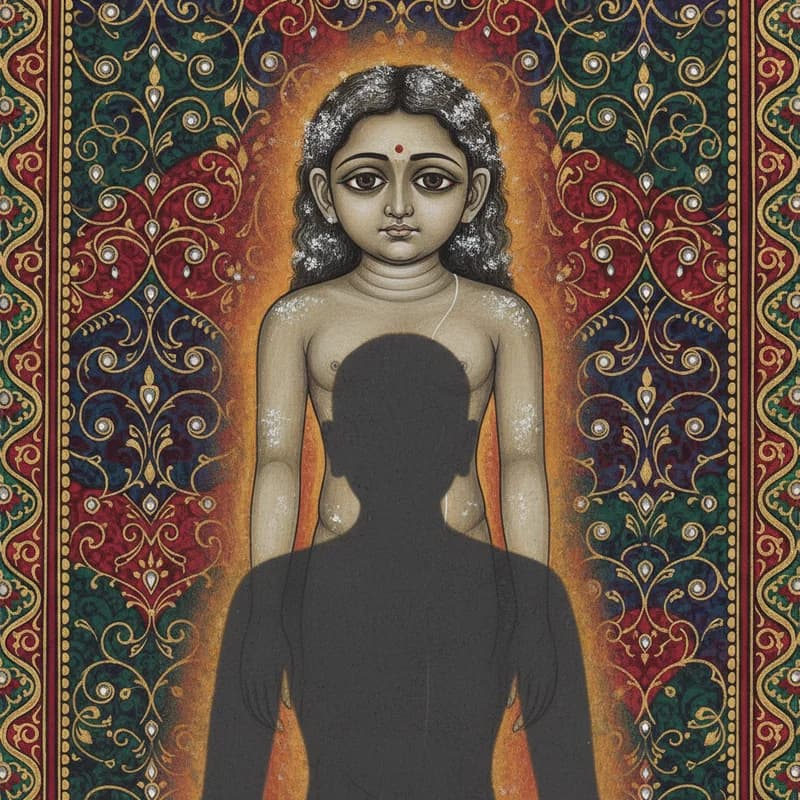
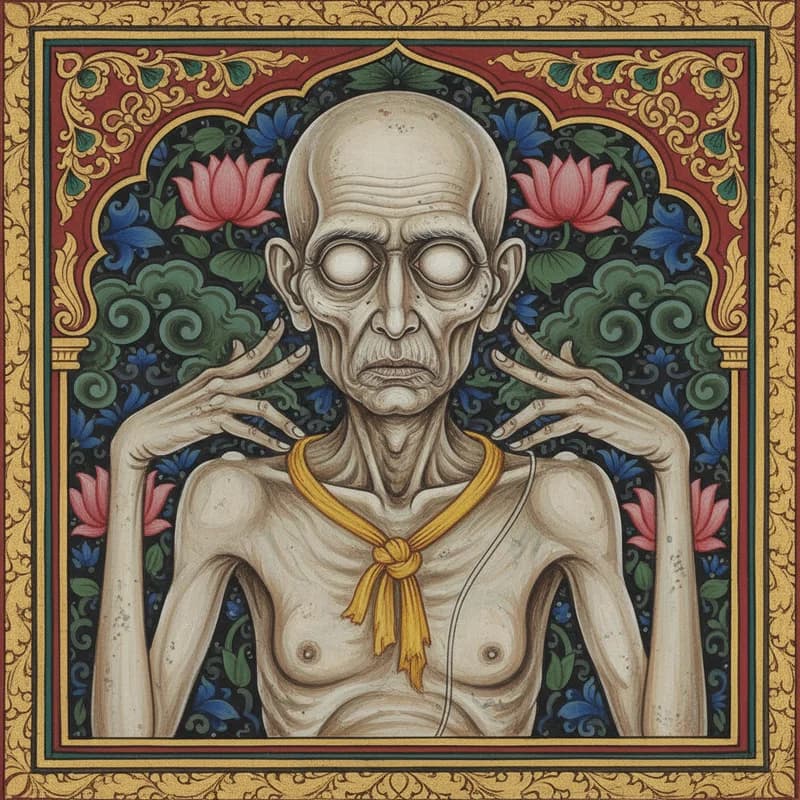
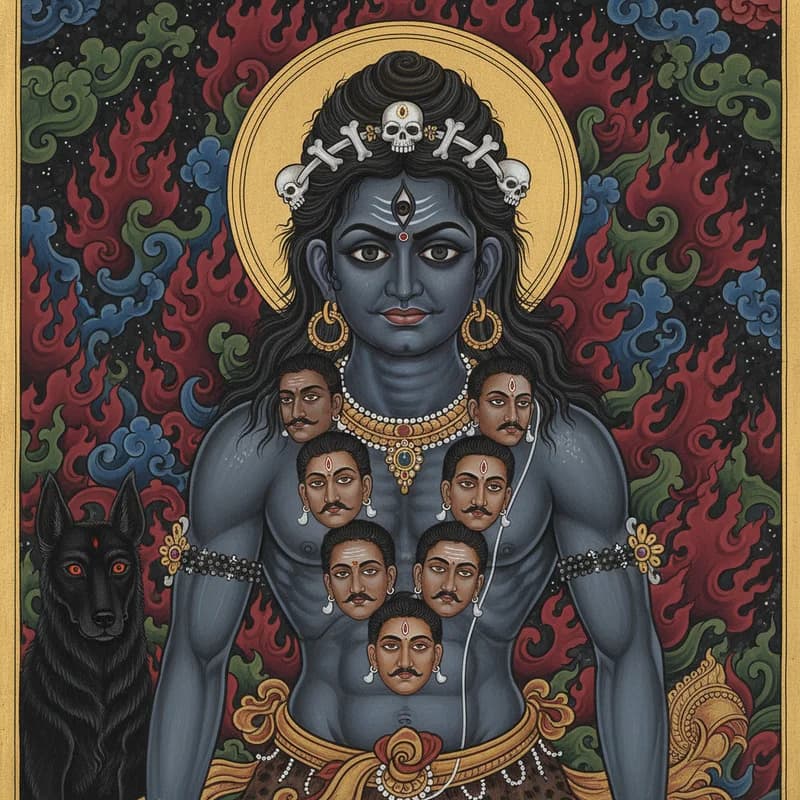
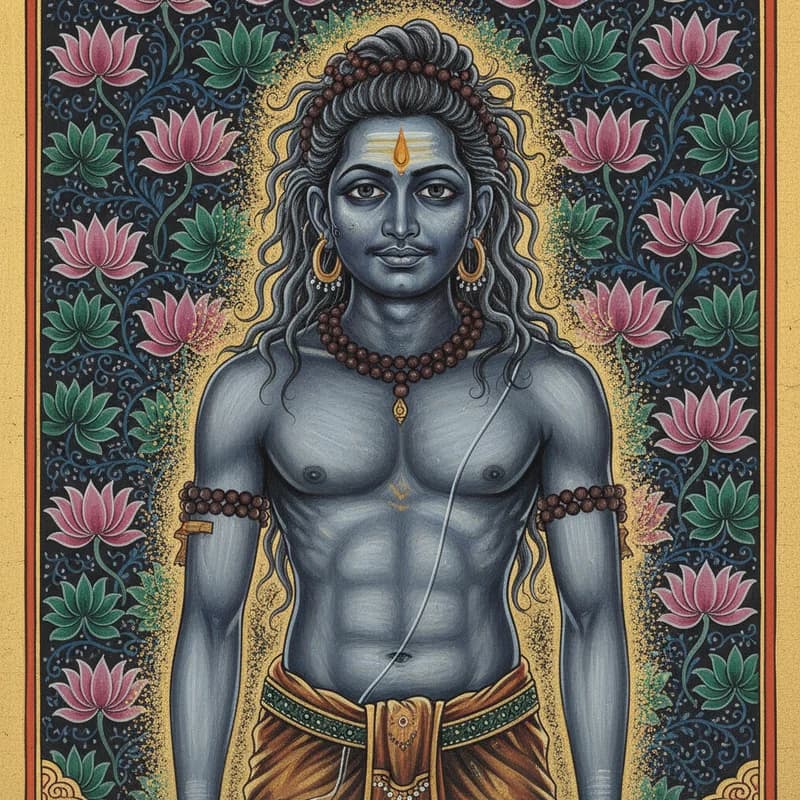
The Aghor appears as a man mid-ritual, never finished, never begun — the ash from Harishchandra Ghat pressed so deep into the skin that the flesh beneath has taken on a permanent grey-blue, the colour of a bruise that has stopped hurting. The matted hair is wound with the rudraksha of a practitioner who no longer counts them, and the eyes hold the particular vacancy of someone who has looked directly at something consuming and found it ordinary. What witnesses from the Manikarnika burning grounds consistently report is not the sight but the smell: wet ash, human hair, and beneath it something chemical and sweet, like mercury heated in an earthen pot. Reached in the cold months along the Ganga's western bank, he casts no shadow — not an absence of shadow, but the light bends around him as though it has been instructed to.
Along the burning ghats of Varanasi — particularly the Manikarnika steps between the months of Kartik and Paush, when fog sits low on the Ganga — the Aghor spirit appears as a living ascetic: ash-smeared, matted-haired, seated apart from other sadhus with a dhuni fire that burns without visible fuel. The disguise is entirely plausible; no one questions an ash-covered figure at a cremation ground at three in the morning. The first tell is the fire itself — it produces no smoke, not even in the damp river air of November, when every cook-fire and funeral pyre bleeds grey into the fog. The second is subtler: dogs, which approach every genuine sadhu eventually, will not cross within ten feet of this one, and they do not bark — they simply stop, turn, and walk away with the deliberate quiet of animals that have already made a decision.
First Documented
The Aghor tradition surfaces in the Atharva Veda's darker hymns, where cremation-ground ascetics are invoked alongside spirits of the unquiet dead, but the practitioner-turned-wandering-spirit appears most distinctly in the Kaulajnananirnaya, a tantric text attributed to Matsyendranath, likely composed between the 9th and 11th centuries.
Last Recorded
Accounts of wandering Aghor spirits persist into the present, with the most recent oral testimonies collected near the Manikarnika and Harishchandra ghats of Varanasi as recently as the early 2000s, where cremation-ground attendants described encountering ash-smeared figures who vanished before dawn.
Source Language
Hindi
Origin
The Aghor as a post-mortem wandering entity is distinct from the living ascetic tradition and appears most clearly in the oral accounts collected along the Manikarnika and Harishchandra ghats of Varanasi, where cremation attendants — the Doms who tend the pyres — speak of practitioners who achieved partial siddhi but died before the final dissolution of the self. The written tradition, primarily the Kularnava Tantra and later commentaries on the Aghora Shiva upasana, treats death as the culmination of practice, not its interruption. Folk accounts from the Dom lineages diverge sharply here: in their telling, the Aghor spirit is precisely the one who came close enough to taste the absolute but did not cross — left behind in the smoke, neither ash nor living, still conducting invisible rites at the burning grounds after midnight. The Dom accounts specify that such spirits retain alchemical knowledge — the capacity to transmute rot into medicine — but can no longer apply it to their own condition. That gap, between knowing and being unable to act, is what the textual tradition cannot accommodate and what the cremation-
Frequently Asked
Aghor refers to the spirit of a deceased Shaivite ascetic who practiced the extreme left-hand path on the cremation grounds — the shmashana — and whose soul, after death, is believed to persist as a wandering supernatural entity. These practitioners worshipped Shiva in his most terrifying aspect, Aghora, consuming flesh and ash as sacrament along the burning ghats of Varanasi and Tarapith. The spirit retains the alchemical and occult powers cultivated during its human life.
The Aghor spirit demands caution rather than outright fear — it is neither a malevolent demon nor a benign guardian, but something in between, shaped entirely by the intentions of whoever encounters it. Along the Kashi cremation grounds, oral accounts describe Aghor spirits as wrathful toward the impure or the disrespectful, yet capable of granting extraordinary boons to sincere seekers. Approach without reverence, and the encounter rarely ends well.
Aghor spirits are credited with siddhi — perfected occult abilities — including mastery over poisons, the capacity to animate the dead, and alchemical transformation of base matter into gold or medicine. Accounts collected from villages near the Manikarnika Ghat describe Aghor spirits as able to move between the living and the dead without restriction. Their power is rooted in the Shaivite belief that confronting death directly dissolves all spiritual limitation.
A Brahmarakshasa is the ghost of a Brahmin who misused sacred knowledge in life and is condemned to haunt specific locations — often old wells or pipal trees — in a state of torment and hunger. The Aghor spirit, by contrast, is not condemned but liberated in a peculiar sense: it wanders by choice or residual will, carrying the accumulated power of deliberate ascetic practice. Where the Brahmarakshasa is trapped, the Aghor spirit moves.
The Aghor tradition draws from the Rudrayamala Tantra and the Kularnava Tantra, both of which describe shmashana sadhana — ritual practice conducted among corpses and cremation fires as a means of transcending duality. The Mahanirvana Tantra also references left-hand Shaivite rites that align with Aghor methodology. These texts do not describe the post-mortem spirit directly, but the oral traditions of Varanasi and Girnar fill that gap with considerable consistency.
Varanasi's Manikarnika and Harishchandra Ghats are the primary sites associated with Aghor spirits, given their unbroken history as cremation grounds and centers of Aghori asceticism. Tarapith in West Bengal — where the Dwarka River runs past a functioning cremation ground beside the temple of Tara — is the second major concentration. Sporadic accounts also emerge from the forests around Girnar in Gujarat, where Aghori sadhus have practiced for centuries.
Witnesses in oral accounts consistently describe the Aghor spirit as smelling of ash and camphor simultaneously, appearing at the hour of the dead — the prahar between midnight and two in the morning — near active cremation fires. The figure is often naked or ash-smeared, carrying a skull bowl, and its eyes are said to reflect firelight even when no fire is present. Unlike most spirits, it does not flee at the name of Vishnu; it responds, if at all, only to invocations of Shiva in his Aghora form.
An Aghori sadhu is a living human practitioner of the Aghor path — an ascetic who has chosen the cremation ground as both home and temple in pursuit of non-dual consciousness. The Aghor spirit is what some traditions believe that practitioner becomes after death, if their accumulated power has not fully dissolved into liberation. The distinction matters: one is a person making a choice, the other is the residue of that choice persisting beyond the body.
संबंधित लोकगाथाएं
Related Lore
Algorithmic Inference
आपको यह भी पसंद आ सकता है
You May Also Like
Community Discussion
Comments are reviewed by AI before appearing publicly. Unsafe, unrelated, or uncertain comments go to human review.
Sign in to join the discussion.
1 comment
Kumar Saksham
31 May 2026
looks good