प्रतीक्षा करें
Unfolding the scroll…
प्रतीक्षा करें
Unfolding the scroll…
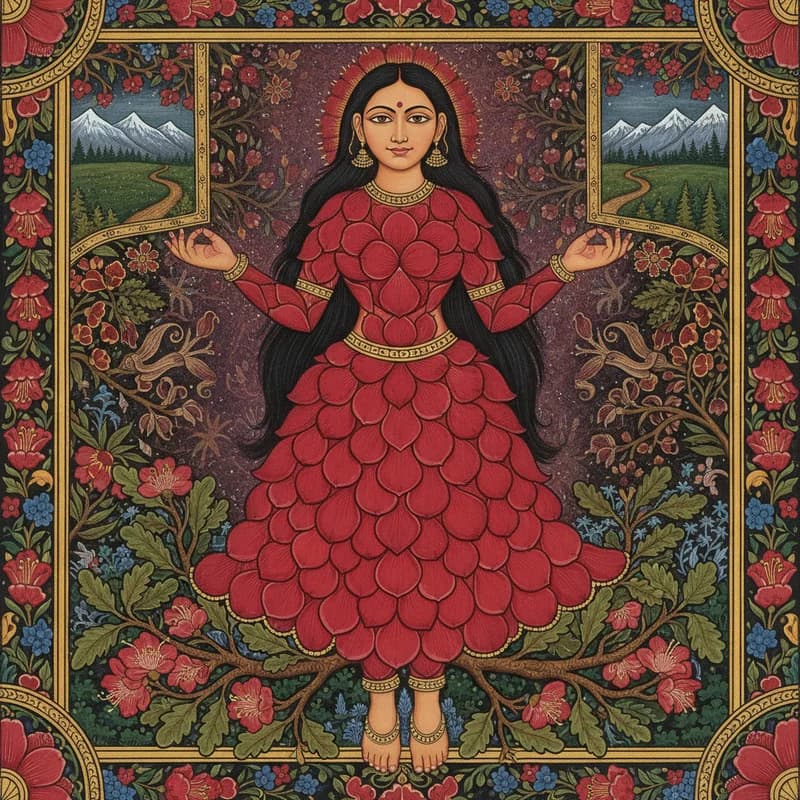

Burans
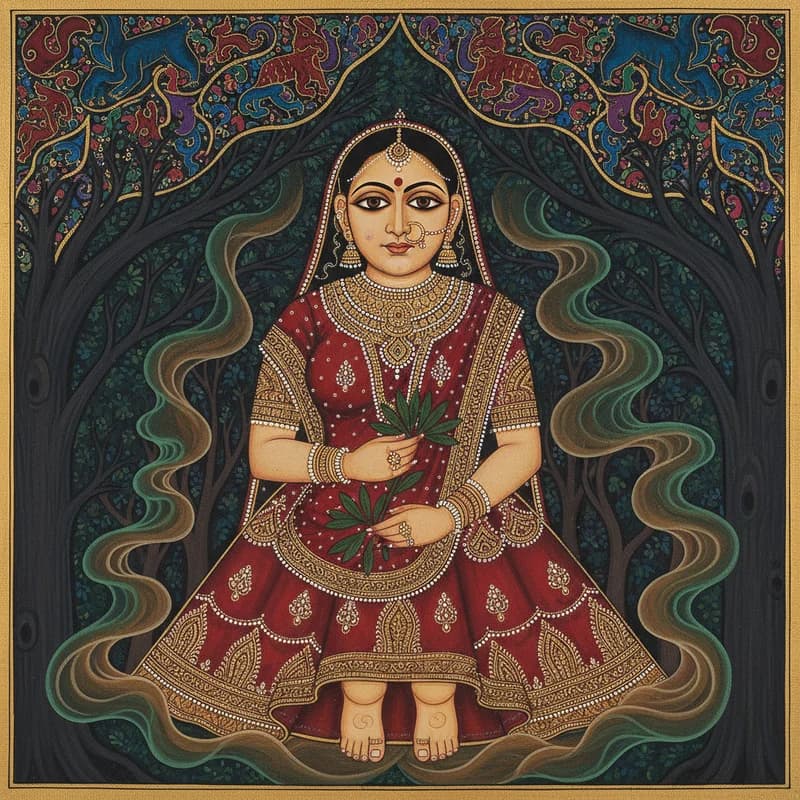
When the rhododendron forests of the Kedarnath valley flush red in March and April, the old women of Chamoli district will tell you not to walk alone among the burans trees after dusk. The spirit takes the form of a woman in red — the exact red of the flowers, they insist, not cloth-red — moving between the trunks in the slant evening light. She does not chase. She simply appears at a distance, watching, and the accounts from Garhwali hill villages agree that the unease she produces is disproportionate to anything she actually does.
She is not malevolent in the way that forest spirits often are in these hills. No one claims she kills. What the oral accounts describe instead is a kind of displacement — men who follow her through the rhododendron groves above Gopeshwar or Rudraprayag find themselves, hours later, somewhere they cannot account for, with no memory of the interval and a faint sweetness on their breath like fermented rhododendron juice. Some return quieter than they left, carrying a quality the villages call *udas* — not grief exactly, but a loosening of attachment to ordinary life. The flowering season ends in late April. She is not seen in summer. Whether she retreats with the blossoms or simply stops being visible, the Garhwali tradition does not say.
The Burans appears in the oak and rhododendron forests above Chopta and along the Kedarnath trekking routes between February and April, when the hillsides run red with bloom. She takes the form of a woman dressed entirely in that same red — not cloth, witnesses insist, but something closer to petals arranged against skin, slightly too perfect, slightly too still in the wind. Her face is consistently described as pleasant and unremarkable, which is itself the warning: the Garhwali accounts stress that she carries no distinguishing feature you could name afterward. The smell that precedes her arrival is the real rhododendron scent — faintly medicinal, sweet at distance and astringent up close — but concentrated past what any single tree produces, as though the whole ridge is exhaling. The single feature that marks her: her feet, when glimpsed, rest on the branches rather than bending them.
In the oak and rhododendron forests above Lansdowne and along the ridgelines approaching Tungnath, Burans appears during the brief March flowering season as a woman in a red ghaghra moving between the trees — unhurried, purposeful, as though returning from a market in the next village. The disguise is entirely plausible; women do move through these forests, collecting fuel, carrying doko baskets down to Pauri or Chamoli. What the Garhwali shepherds note, however, is that she carries no load and leaves no broken undergrowth behind her, moving through dense rhododendron thickets without disturbing a single branch. The second tell is more unsettling: the blossoms nearest her path drop their petals all at once, not scattered by wind but falling clean and simultaneous, the way flowers fall only when shaken hard from below.
First Documented
Burans does not appear in any datable Sanskrit text or colonial-era ethnographic record; her presence surfaces through oral tradition among Garhwali and Kumaoni hill communities, where seasonal songs sung during the rhododendron bloom — roughly February through April — carry the earliest traceable accounts of a red-clad woman moving through the oak and rhododendron forests of the Kedarnath range.
Last Recorded
Accounts of Burans persist into the present, with shepherds in the Kedarnath Wildlife Sanctuary and villagers near Chopta still reporting glimpses of a red-clad figure moving through rhododendron groves each March and April, when the hillsides above the Mandakini valley burn crimson with bloom.
Source Language
Kumaoni
Origin
The Burans enters the oral record through the garhwali and kumaoni singing traditions of Uttarakhand, particularly in the seasonal folk songs — called *jhora* and *chaufula* — performed during the rhododendron bloom between February and April, when the hillsides above Lansdowne and Munsiyari run red. No classical Puranic text catalogs her directly; her existence is carried entirely in the mouths of women who sing at the forest edge during the flowering. In these accounts she appears as a woman dressed entirely in deep red, moving through the burans groves of the Nanda Devi foothills at dusk, visible only during peak bloom and gone when the last flower drops. What distinguishes the folk account from the later literary treatments — which frame her as merely a symbol of seasonal longing — is this insistence on agency: she is not a metaphor, but a presence that chooses to appear, and women who encounter her are said to gain the ability to predict snowfall. That divergence matters, because it reveals how the literary tradition has consistently domesticated a spirit that the oral tradition understood as genuinely numin
Frequently Asked
The Burans is a forest spirit from Uttarakhand, believed to inhabit the rhododendron groves that blaze red across the Kumaon and Garhwal hills each spring. She is said to appear as a woman dressed in deep crimson, her presence tied to the blooming of the burans flower itself. Oral accounts collected from villages near Munsiyari and the Kedarnath forest corridor describe her as neither wholly benevolent nor openly hostile — a spirit of the season, not of the hearth.
The Burans is said to walk the oak and rhododendron forests of Uttarakhand only during the flowering season, roughly February through April, when the hillsides above 1,500 metres turn a deep arterial red. Her appearance is inseparable from the bloom — when the flowers fade, so does she. Villagers in the Pindar valley have long warned against wandering alone through rhododendron groves at dusk during this period.
She is consistently described across oral traditions as a woman of striking appearance wearing red — the exact shade of a freshly opened burans blossom. Some accounts from the Chamoli district add that her skin carries a faint luminescence in low forest light, and that she moves without disturbing the undergrowth. The red clothing is the single most reliable identifying detail across all regional variants.
The Burans is classified as a caution-level spirit — not a predatory entity, but one that demands respect and awareness. Accounts from the Bageshwar region suggest she may lead solitary travellers astray in the rhododendron forests, particularly those who pick the flowers carelessly or in excess. She is not recorded as causing direct harm, but encounters with her are rarely without consequence.
In Uttarakhand folk belief, the burans flower — Rhododendron arboreum, the state tree — is not merely associated with the spirit but is understood as her physical manifestation in the world. To see a grove in full bloom is, in some tellings, to be in her presence already. The flower's deep red colour, its brief season, and its prevalence in high-altitude forests along the Himalayan foothills all feed into the spirit's character as something beautiful, transient, and not entirely safe.
Unlike the Banjhakri, a forest shaman-spirit found across the central Himalayas, the Burans is not a teacher or initiator — she does not abduct or instruct. She is closer in character to the Van Devatas, the forest deities propitiated at sacred groves near Jageshwar and Binsar, but she lacks their fixed, worshipped status. The Burans is seasonal and ambulatory, a spirit of a specific flower rather than a specific place.
Older residents of villages along the Almora-Bageshwar road have described a practice of leaving a few blossoms unpicked on any rhododendron tree as a form of acknowledgment when gathering the flowers for juice or ritual use. No formal temple worship is recorded, and she does not appear in Pahari Brahminical ritual texts. Her propitiation, where it exists, belongs entirely to the oral and domestic sphere.
The Burans as a named spirit is specific to the Kumaon and Garhwal regions of Uttarakhand, where the rhododendron forests are densest and most culturally prominent. Neighbouring Himachal Pradesh has its own forest spirit traditions, but none that map directly onto the Burans figure. The spirit's identity is so thoroughly bound to a particular landscape — the mid-altitude Himalayan forests between the Alaknanda and Kali river valleys — that meaningful parallels elsewhere are difficult to establish.
संबंधित लोकगाथाएं
Related Lore
Algorithmic Inference
आपको यह भी पसंद आ सकता है
You May Also Like
Community Discussion
Comments are reviewed by AI before appearing publicly. Unsafe, unrelated, or uncertain comments go to human review.
Sign in to join the discussion.
0 comments
No public comments yet.