प्रतीक्षा करें
Illuminating the manuscript…
प्रतीक्षा करें
Illuminating the manuscript…
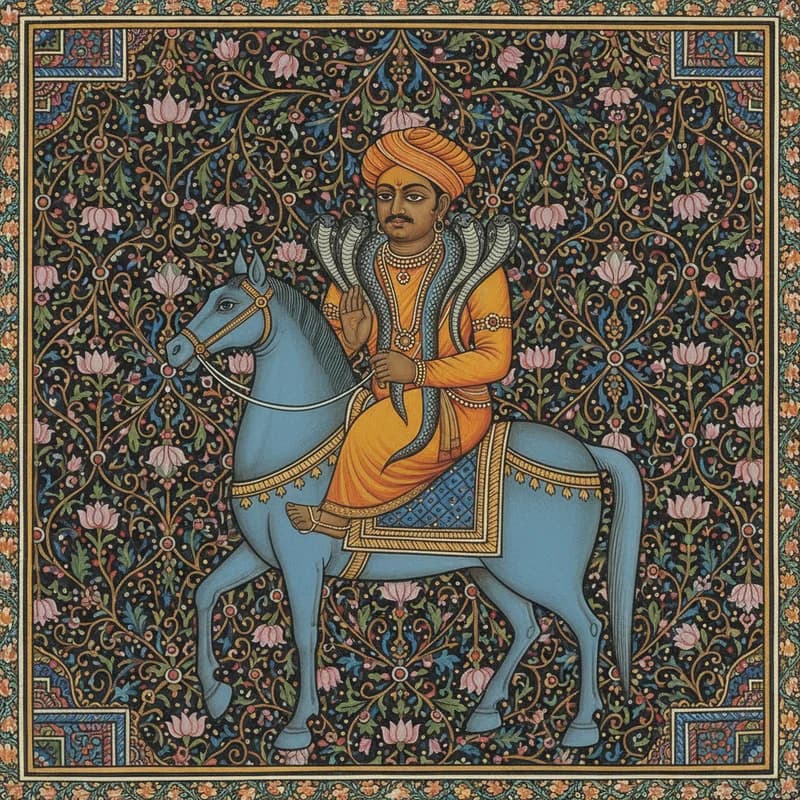

Guga Pir
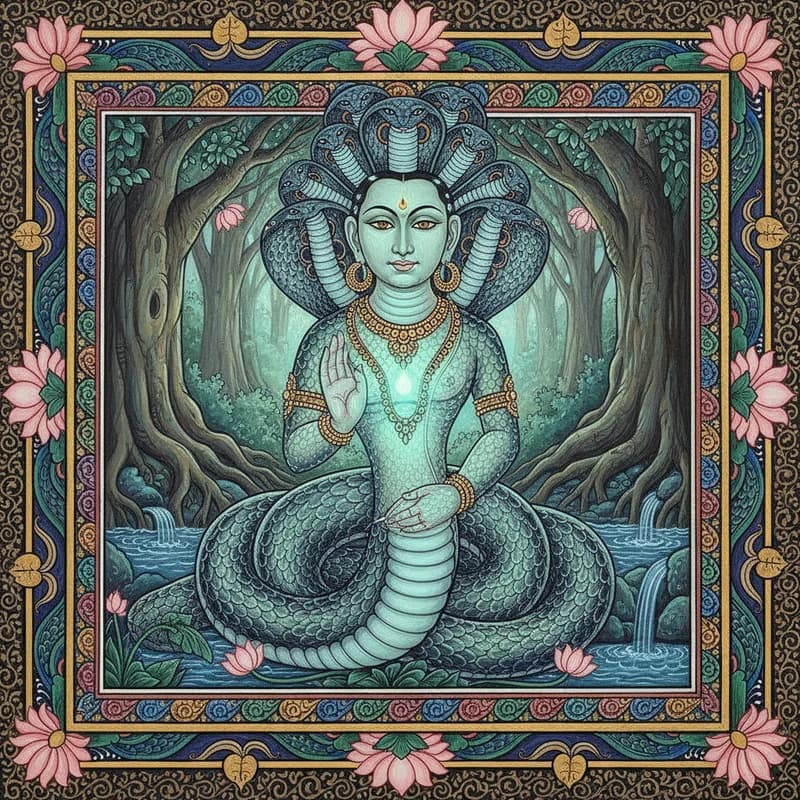
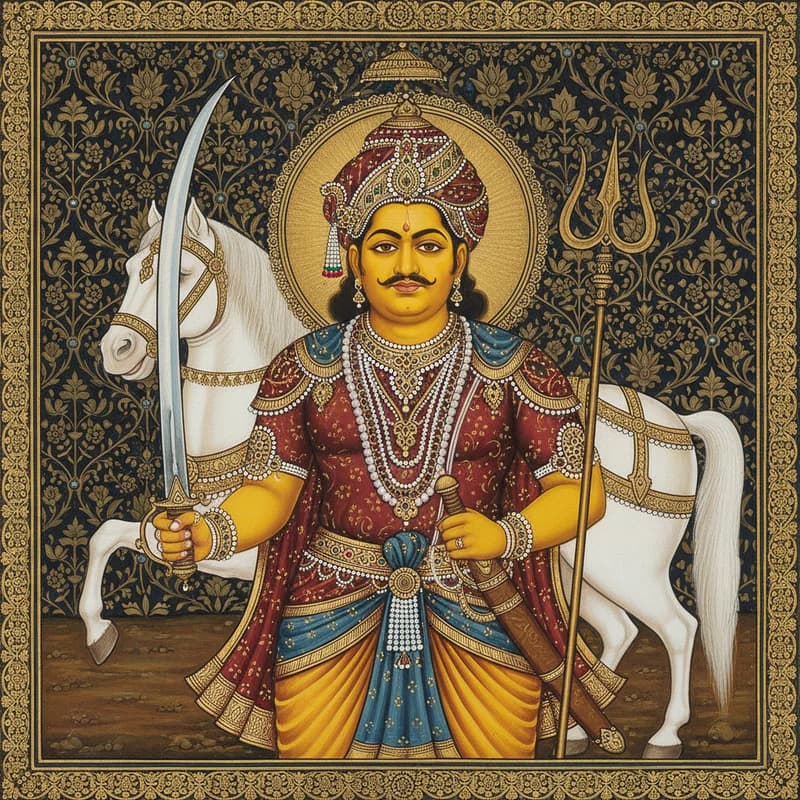
He rides a blue horse through the scrubland between Hanumangarh and Bikaner, and the shrines that mark his path are small, low things — a painted stone, a clay serpent coiled at the base of a khejri tree, a strip of saffron cloth tied where two dirt roads cross. Guga Pir was a warrior-saint, born in the village of Dadrewa in the Churu district, whose legend runs through the oral traditions of Rajasthan and Haryana like the Ghaggar river runs through sand — present even when invisible. He converted to Islam under the influence of Gorakhnath's disciples, a detail that matters because it explains the strange doubling of his shrines: Hindus and Muslims both claim him, both leave offerings, and the serpent coils equally through both traditions. Accounts collected from the Shekhawati region describe him as a master of nagas, a man who did not fear snakes because he understood something about them that ordinary men do not.
His shrines appear most thickly in the weeks before and after the harvest month of Bhadrapada, when the monsoon has softened the earth and cobras move freely through the fields. Farmers who have been bitten, or who fear they will be, come to these shrines and speak directly to the clay snake — not as supplicants exactly, but as people addressing someone who has jurisdiction over the matter. Guga Pir does not punish the snake; he negotiates. That distinction is important in the folk accounts, which consistently describe him as an intermediary rather than a destroyer. The Dadhreva dargah draws pilgrims from as far as Punjab each year, men walking barefoot across cracked alkali flats to reach it, and what they ask for is not vengeance but protection — the quiet, practical kind that lets a man walk through his own field at dusk without fear.
Guga Pir appears most often as a horseman who has not fully arrived — seated on a white or blue-grey mare, turbaned in saffron cloth wound tight enough to suggest something beneath it that should not be visible, his body carrying the particular stillness of a man who has been waiting in the same posture for several centuries. The face is dark, composed, unremarkable except for the snakes: cobras draped across the shoulders like a shawl, their hoods open but their bodies utterly motionless, not the stillness of sleeping animals but of objects that have chosen to resemble them. Witnesses near the thorn-scrub shrines between Hanumangarh and Sirsa report the smell before the sighting — dry earth, and beneath it something colder, the smell of a stone well in the Aravalli foothills at dawn. What marks him as something other than a horseman is the sound the mare does not make: no hoofbeats on packed sand, no breath, no creak of leather.
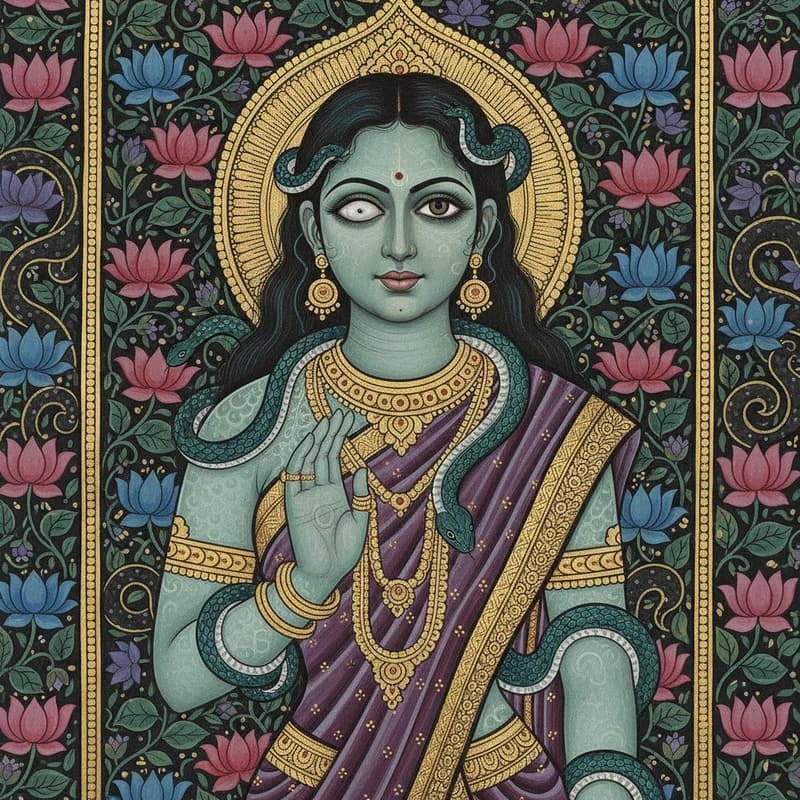
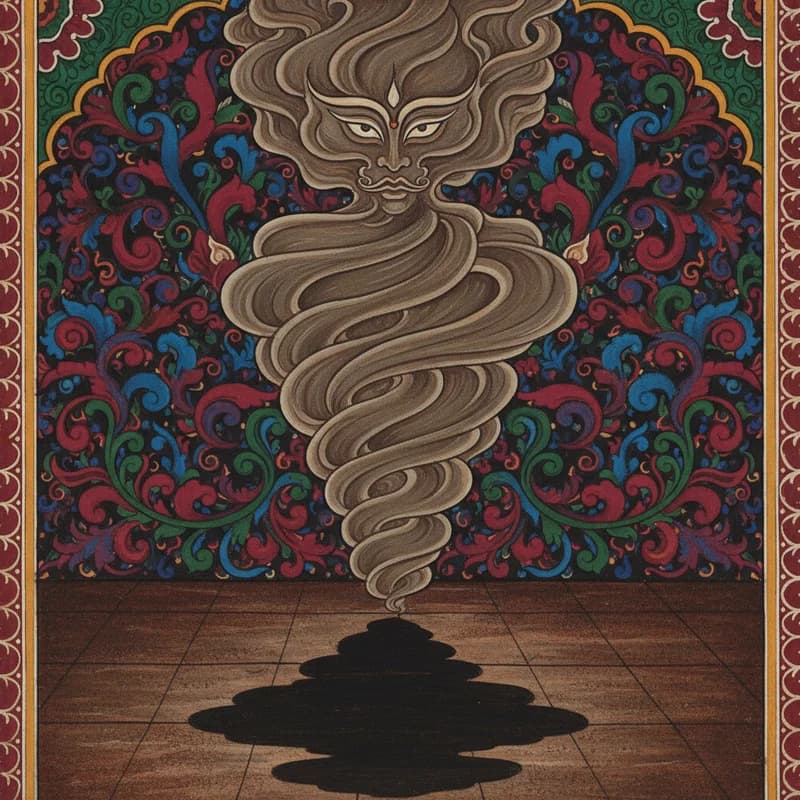
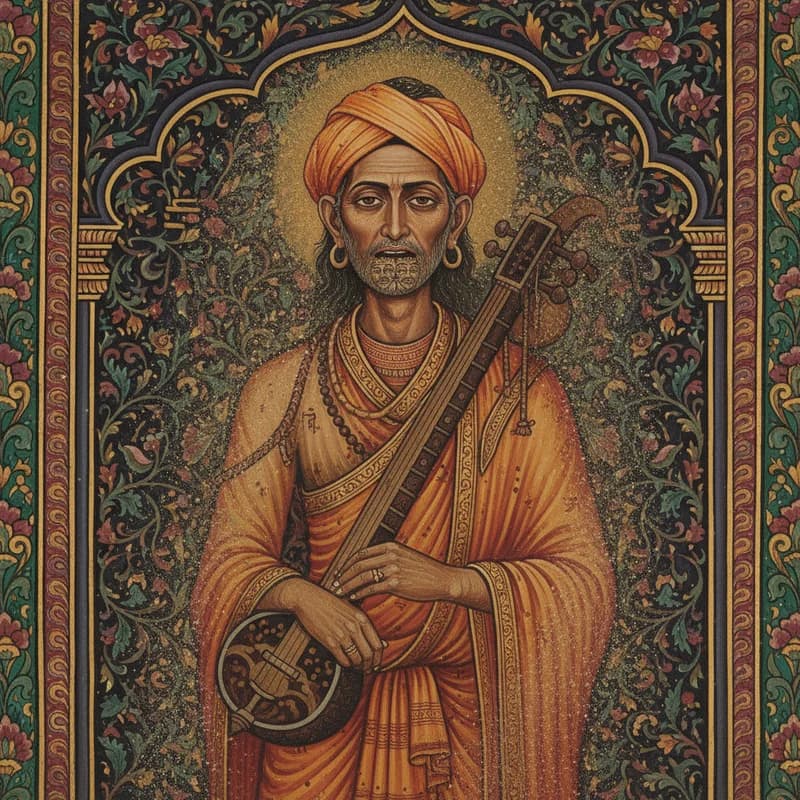
Across the sandy scrublands between Hanumangarh and Sirsa, Guga Pir is said to appear as a wandering faqir — staff in hand, saffron-patched robe, the unremarkable figure of a man moving between villages in the dry heat of Sawan when the snakes are most active and the fields most anxious. He asks for water, sometimes for a resting place, and villagers who have turned such men away without looking carefully have reported finding a cobra coiled on the threshold by morning — not a warning, elders insist, but a calling card. The first tell is his staff: however cracked the earth or deep the loose sand, it leaves no impression when he walks. The second is the sound that follows him at a slight distance — a dry, papery movement through dead grass, even when he stands still on bare stone.
First Documented
Guga Pir's earliest traceable presence surfaces in medieval bardic traditions of Rajasthan and Haryana, where wandering *dholis* and *langas* carried his legend through the Thar's scrubland villages long before any written account. The *Guga Puran*, a vernacular text composed roughly in the 11th–12th centuries, codifies his miraculous birth and his pact with the serpent world.
Last Recorded
Accounts of Guga Pir remain alive and unbroken — pilgrims still report visions and miraculous cures at his earthen shrines along the Ghaggar river basin each Bhadrapada, and village healers in Hanumangarh and Sirsa districts continue invoking his name over snakebite victims well into the present decade.
Source Language
Rajasthani
Origin
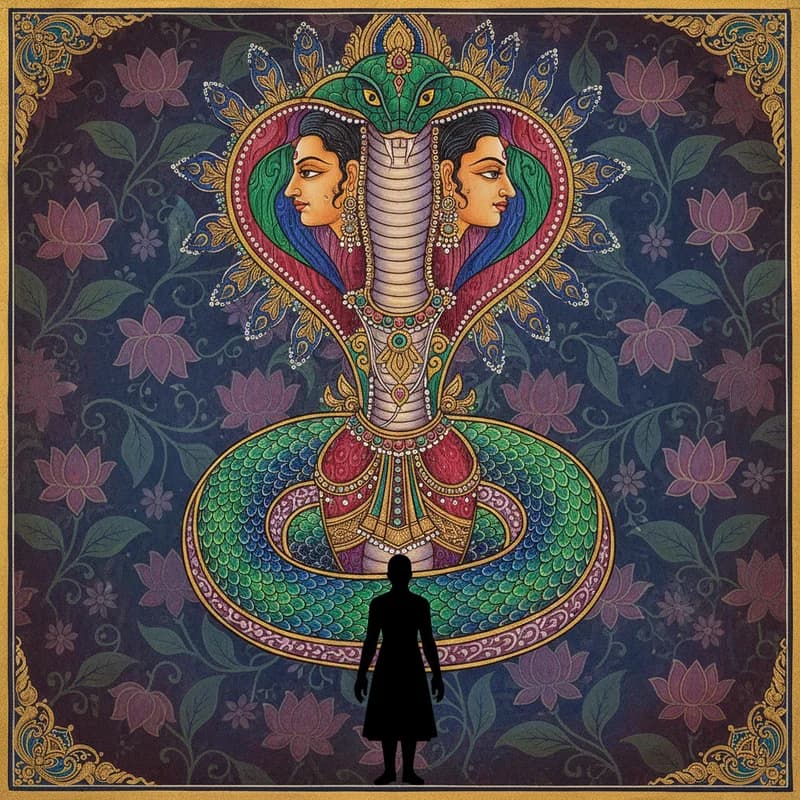
Guga Pir enters the record in two parallel streams that have never fully merged. The hagiographic tradition, preserved in the *Guga Purana* and in bardic recitations performed by Nath jogis during Bhadrapada, presents him as a Chauhan Rajput of tenth-century Dadrevra — born through divine intercession, initiated by Gorakhnath himself, and martyred after a conflict with his brothers over land and cattle. The Dalit and pastoral communities of the Ghaggar basin, however, carry a significantly older-feeling account in which Guga predates his own biography: he is not a man who became a snake-saint but a being who took human form briefly, then returned to the earth through a willing descent into a termite mound near Bahraur in present-day Hanumangarh district. That divergence is not incidental. The textual account requires his holiness to be conferred — by Gorakhnath, by lineage, by sacrifice — while the oral account locates his power as prior and intrinsic, which is precisely why the low-caste
Frequently Asked
Guga Pir is a snake-saint of Rajasthan and Haryana, venerated across the semi-arid plains of northwest India as a protector against snakebite and serpent-related harm. Born of miraculous origin in the Churu region, he is believed to command serpents and intercede on behalf of the afflicted. His cult blends Hindu and Sufi traditions, which is why he carries both the title of a Hindu hero and the honorific 'Pir' of Islamic saint-veneration.
Guga Pir is said to hold absolute authority over all serpents — nagas obey his command, and devotees believe his blessing can neutralize venom even after a bite has been struck. Oral accounts collected in villages along the Ghaggar river basin describe snake charmers and healers invoking his name before treating the bitten. His power is not merely protective but sovereign: snakes are understood to be his subjects, not his enemies.
Shrines to Guga Pir, called 'Gugga Maṛhi' or 'Gugga Thaan,' are scattered across the thorn-scrub landscape of Rajasthan, Haryana, and parts of Punjab — often at the base of old kikar trees or along field boundaries where snakes are known to move. They are typically low mud platforms bearing a serpent image or a trident, draped in blue and yellow cloth. The shrines are modest by design, rooted in the land rather than in temple architecture.
Guga Pir sits at the confluence of both traditions, and that is precisely the source of his enduring popular appeal across northwest India. He is worshipped by Hindus as a hero-deity descended from Naga lineage and by Muslims as a Sufi pir with miraculous powers, a pattern common to several folk saints of the Indus-Gangetic borderlands. The annual Guga Navami festival, observed in the month of Bhadrapada, draws devotees of both faiths to his principal shrine at Dadrewa in Churu district.
According to oral tradition preserved in the Churu and Hanumangarh districts, Guga's mother Baachhal received a divine fruit from Gorakhnath that granted her a son of extraordinary power — a child born with serpent-nature woven into his being. His birth narrative shares structural features with other Nath-influenced hero legends of Rajasthan, where ascetic blessing and miraculous conception produce a figure who transcends ordinary human limits. Some versions hold that Guga was himself a partial incarnation of the serpent-king Sheshnag.
Nag Devata worship venerates the serpent itself as a divine being — the cobra as a form of Shiva or as a guardian spirit of water and soil. Guga Pir, by contrast, is a human hero who achieved mastery over serpents through divine grace and ascetic power, making him an intercessor rather than a deity in the classical sense. The distinction matters in practice: a farmer bitten by a krait near the Luni river might pray to Guga Pir to cure the bite, while Nag Devata is propitiated to prevent the encounter altogether.
The primary observance falls on Guga Navami, the ninth day of the dark fortnight in Bhadrapada — a month when the monsoon has swelled the land and snake activity is at its peak across Rajasthan and Haryana. Devotees fast, sing ballads called 'Gugga ki Katha' accompanied by the damru and nagara drums, and carry clay serpent images in procession to local shrines. Snake charmers, known as Jogis, play a central ceremonial role and are considered hereditary custodians of the Guga tradition.
Guga Pir is protective toward those who honor him correctly, but folk accounts from the Shekhawati region are consistent in warning that disrespect toward his shrines — urinating near a Gugga Thaan, plowing over a serpent mound, or neglecting the Navami fast — can bring serpent encounters upon a household. His authority over snakes cuts both ways: he can send them as readily as he can restrain them. Reverence is not optional but obligatory, which places him in the category of spirits demanding careful, ongoing propitiation.
संबंधित लोकगाथाएं
Related Lore
Algorithmic Inference
आपको यह भी पसंद आ सकता है
You May Also Like
Community Discussion
Comments are reviewed by AI before appearing publicly. Unsafe, unrelated, or uncertain comments go to human review.
Sign in to join the discussion.
0 comments
No public comments yet.