प्रतीक्षा करें
Illuminating the manuscript…
प्रतीक्षा करें
Illuminating the manuscript…
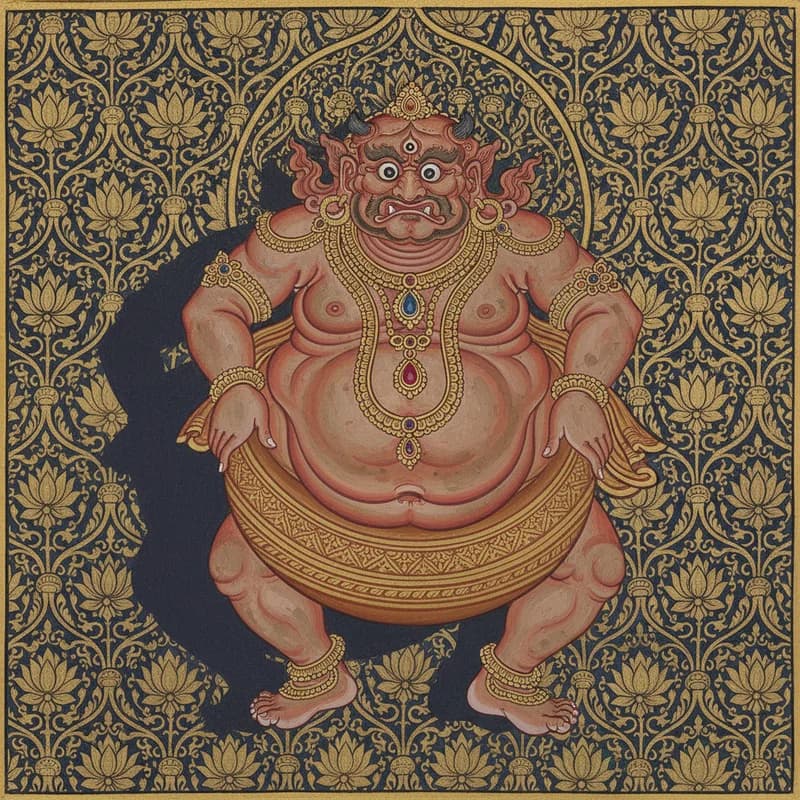

Kumbhanda
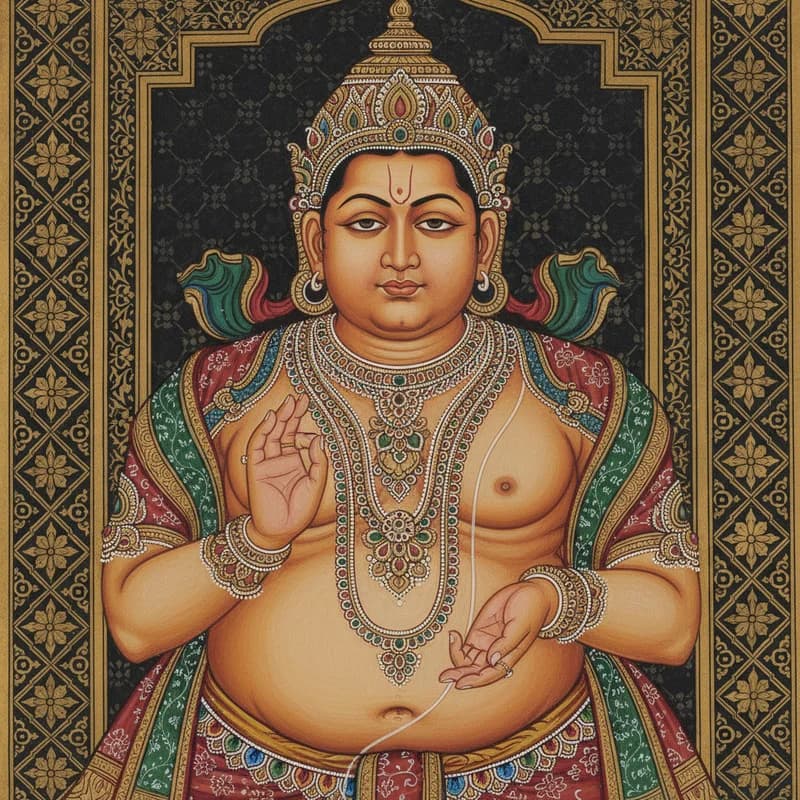
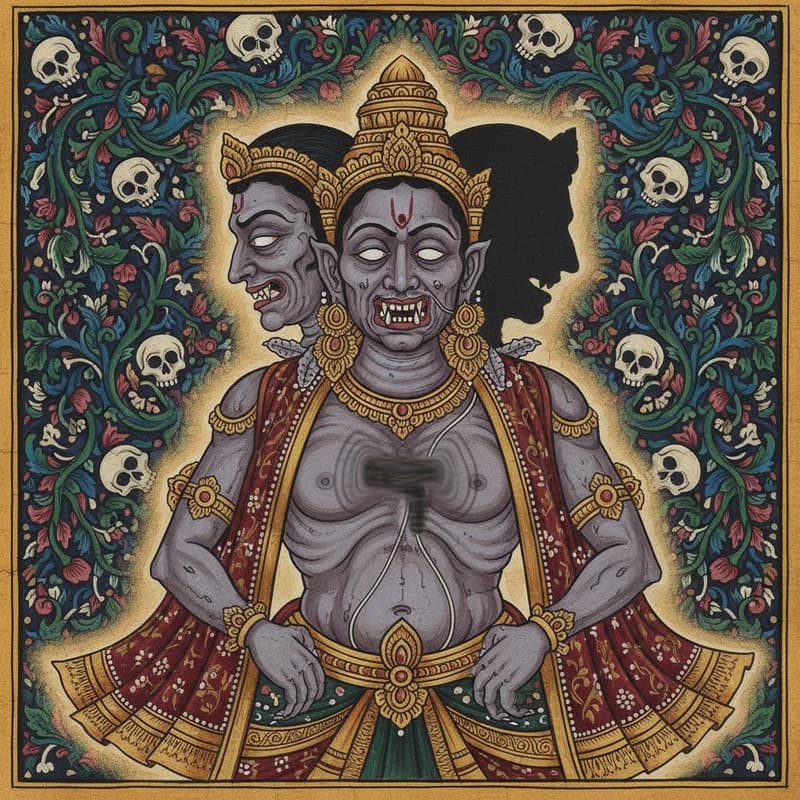
These are not subtle creatures. The Kumbhandas appear in the Pali Atanata Sutta and across the Abhidharma literature as squat, grotesque beings whose bodies bulge at the abdomen like a water-gourd left too long in the August heat — kumbha, the pot; anda, the egg. They guard the southern quarter of the world under Virudhaka, one of the four great kings of the Caturmaharajika heaven, and their presence in the cosmological scheme is military rather than spiritual. They enforce. They do not negotiate.
Accounts that filtered into the folk imagination along the old pilgrimage routes between Bodh Gaya and Sarnath, where the Ganga bends north and the air carries the particular weight of a land long accustomed to the proximity of the unseen, describe the Kumbhandas as creatures you do not encounter so much as stumble into — beings occupying the margins of sacred precincts after dusk, unseen but felt as a pressure in the chest, a sudden sourness in the mouth. The Atanata Sutta treats them as legitimate denizens of a structured cosmological order, dangerous but bounded by Virudhaka's authority. That boundary is the only reassurance the tradition offers. Outside it, the old village accounts suggest, they are considerably less restrained.
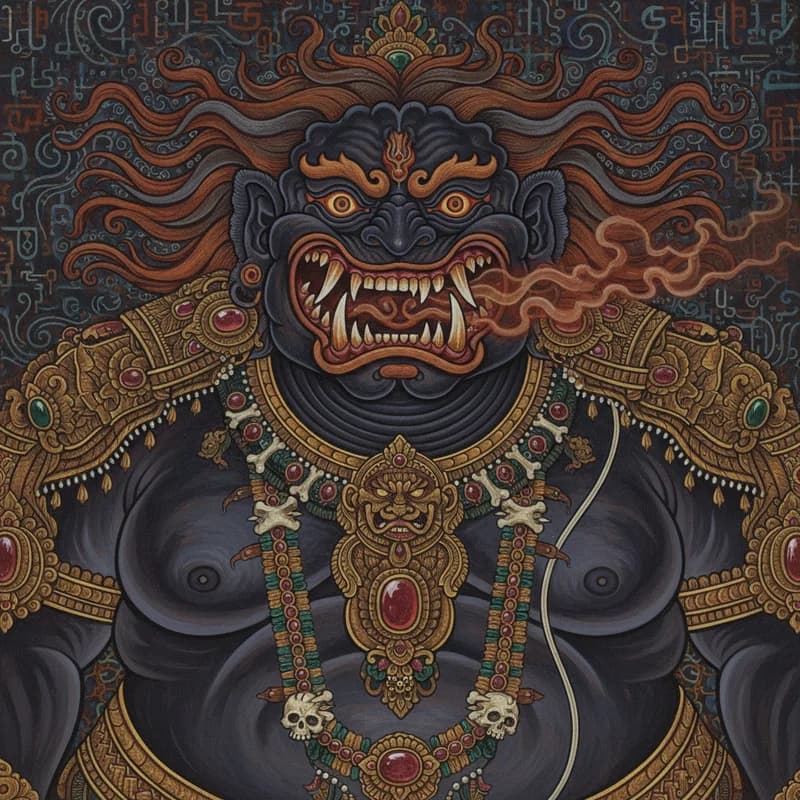
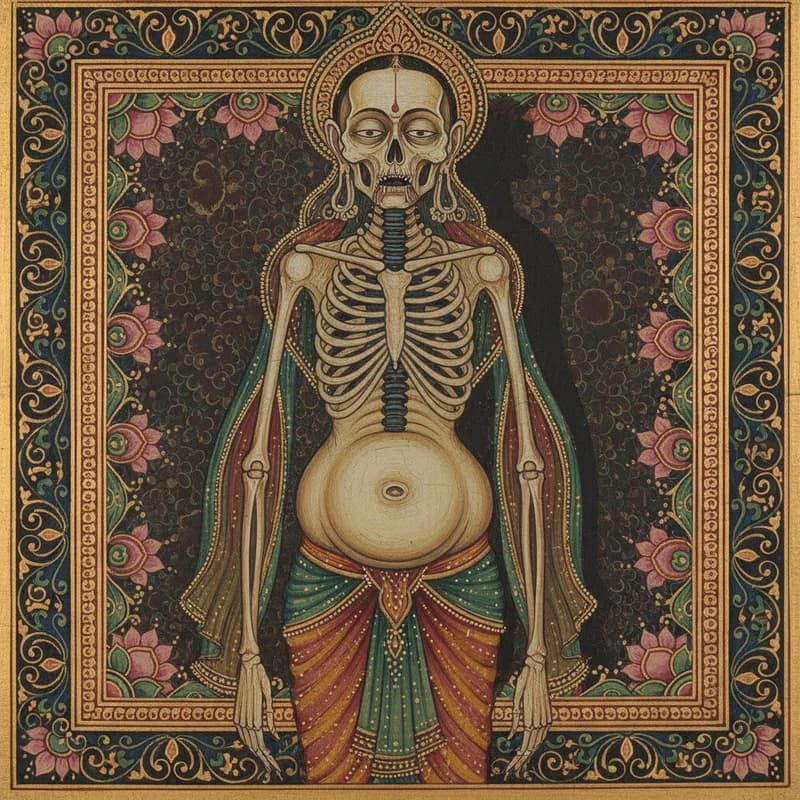
The Kumbhanda is built wrong from the waist down — the legs are normal, even unremarkable, but the scrotum swells to the size of a water-pot, a kumbha, and the creature carries this weight the way a porter carries an overloaded sack, with a forward lean that makes its gait a slow, rolling lurch. The skin is the colour of a clay pot fired unevenly, blotched between terracotta and the grey of river silt. Accounts from the foothills of the Vindhyas describe a sound that precedes its arrival — not footsteps but a low, wet drag, like something being pulled across wet stone in the dark before the monsoon breaks. The smell is of standing water in a sealed vessel, stagnant and faintly ferrous. What marks it finally as something other than flesh is the shadow it casts, which always falls in the wrong direction, regardless of where the light stands.
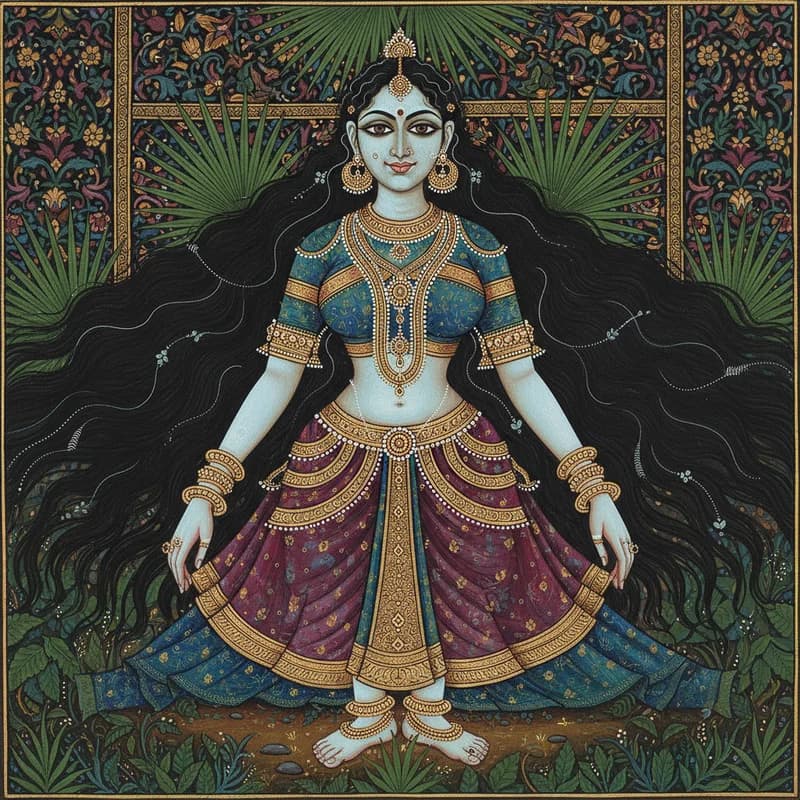
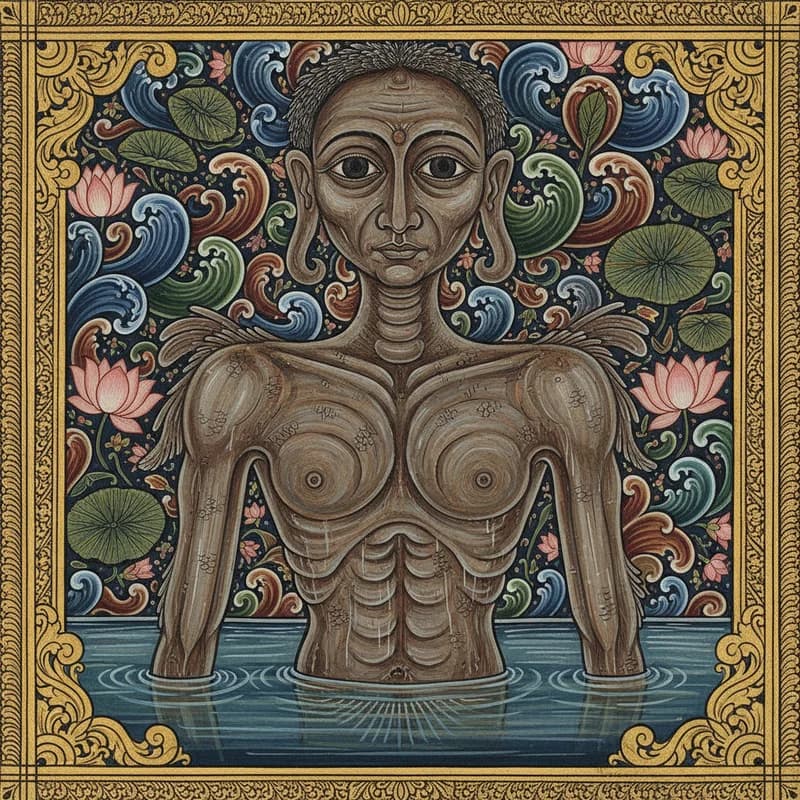
In the accounts collected from villages along the Narmada's southern bank, the Kumbhanda appears most reliably as a squatting gourd-seller — a figure entirely unremarkable at any weekly haat, wrapped in a coarse cotton dhoti, surrounded by a low mound of bottle gourds and ash gourds arranged with the casual disorder of honest commerce. The disguise holds at a distance. Closer inspection, however, reveals that the gourds do not cast shadows independent of their seller's — they share a single pooled darkness beneath them, as though they and the figure are one continuous mass. The second tell, noted by a handful of traders from the Hoshangabad stretch who have compared accounts: no flies settle on the gourds, not one, however ripe the afternoon heat.
First Documented
Kumbhandas appear among the earliest strata of Buddhist canonical literature, named explicitly in the Pali *Digha Nikaya's* Atanatiya Sutta, where they are listed among the supernatural armies marshaled under Virudhaka, guardian-king of the south — a text scholars date to at least the third century BCE, though the oral recitation traditions behind it are almost certainly older.
Last Recorded
Accounts of Kumbhanda persist in fragmentary form through Theravāda oral traditions recorded in Sri Lanka and the hill monasteries of Ladakh well into the twentieth century, with the last substantive documentation appearing in mid-century Pali manuscript studies. Sporadic references surface even now among Buddhist practitioners in Sikkim's Rumtek region.
Source Language
Sanskrit
Origin
The Kumbhanda enters the written record in the Digha Nikaya's Atanata Sutta, where they appear as a class of demonic guardians serving Virudhaka, the Great King of the South, stationed at the boundary between the human world and the lower celestial orders. The Pali texts are anatomically precise in a way that invites unease: the Kumbhanda's defining feature is a gourd-shaped scrotum — *kumbha* for pot, *anda* for egg — which it must drape over its shoulder when it walks. Buddhist scholastic tradition treats them as functionaries, beings of cosmological order rather than chaos, assigned a post and held to it. The oral tradition of the Terai belt, particularly among communities near the Lumbini forest groves, diverges sharply: there, the Kumbhanda are not guardians but failed gatekeepers, beings who once let something terrible through and now must stand watch in perpetuity as consequence. That divergence matters — the Pali canon assigns them duty, but the Terai tradition assigns them guilt, which is a
Frequently Asked
Kumbhandas are demonic beings from Buddhist cosmology, described as having bodies shaped like gourds or water pots — the name itself derives from the Sanskrit for 'pot-bellied.' They appear in Pali canonical texts and later Abhidharma literature as a class of supernatural beings occupying the lower celestial hierarchies.
Virudhaka, the Guardian King of the South, commands the Kumbhandas as his retinue. He is one of the four Lokapalas, the directional protectors described in texts like the Digha Nikaya, and the Kumbhandas serve as his soldiers and attendants in the southern quarter of the cosmos.
Kumbhandas are classified as caution-level entities — malevolent in disposition but not among the most destructive beings in Buddhist demonology. Early Pali sources suggest they could afflict humans with illness or madness, and protective chants called parittas were recited specifically to ward them off.
Canonical descriptions emphasize their grotesque, gourd-shaped bodies, with enormous pot-like bellies that give the species its name. Some commentarial traditions, including Buddhaghosa's Visuddhimagga, elaborate on their fearsome appearance as befitting beings who guard the threshold between the human world and the lower celestial planes.
Both Yakshas and Kumbhandas appear in Buddhist cosmological hierarchies as supernatural beings capable of harming humans, but they occupy distinct positions. Yakshas serve under Vaisravana, Guardian of the North, while Kumbhandas fall under Virudhaka's southern dominion — different commanders, different quarters, and broadly different temperaments in the texts.
The Kumbhandas appear in the Digha Nikaya's Atanatiya Sutta, one of the most important early texts dealing with protective cosmology, where the four Guardian Kings enumerate the beings under their command. Later Abhidharma commentaries and the Mahavastu of the Mahasanghika school expand on their nature and hierarchy.
The Kumbhanda as a distinct gourd-bodied demonic class is primarily a Buddhist cosmological category, though the broader world of gana-like demonic attendants is shared across Buddhist and Hindu traditions. Hindu texts describe their own hierarchies of demonic guardians, but the specific Kumbhanda taxonomy belongs to the Pali and Sanskrit Buddhist corpus.
The Atanatiya Sutta itself functioned as a protective recitation — monks and laypeople would chant it to invoke the four Guardian Kings and their armies as a shield against malevolent beings including Kumbhandas. This practice of paritta recitation survives today in Sri Lanka, Myanmar, and Thailand, where the sutta is still chanted at night vigils and healing ceremonies.
संबंधित लोकगाथाएं
Related Lore
Algorithmic Inference
आपको यह भी पसंद आ सकता है
You May Also Like
Community Discussion
Comments are reviewed by AI before appearing publicly. Unsafe, unrelated, or uncertain comments go to human review.
Sign in to join the discussion.
0 comments
No public comments yet.