प्रतीक्षा करें
Transcribing the Sutradhaar’s field report…
प्रतीक्षा करें
Transcribing the Sutradhaar’s field report…


Madeswara
He walks the edge between god and memory, this figure the Vokkaliga and Kuruba communities of southern Karnataka have been singing about for centuries. Madeswara belongs to the dense, tiger-haunted forests of the Malai Mahadeshwara Hills in the Chamarajanagar district — the same hills that still carry his name, where the Cauvery's tributaries run cold even in April and the teak canopy holds darkness well past sunrise. His life story is not scripture. It is performance: a ten-thousand-line oral epic sung across three consecutive nights by specialist singers called *Madesha Okkalu*, who carry the narrative in memory the way a river carries silt — invisibly, completely.
The story itself is a record of wandering. Madeswara moved through the forests of the Western Ghats performing miracles, subduing demons, and demanding nothing from the powerful while feeding the hungry from a bowl that never emptied. His transformation from itinerant holy man into presiding deity is not a clean theological event — the communities who sing him do not separate those two identities, and neither should the archivist. At the Malai Mahadeshwara temple, situated at roughly 1,500 metres in forest that still shelters leopards, devotees approach with a particular kind of wariness that sits somewhere between reverence and negotiation. He is not malevolent, but accounts collected from Kollegal and Hanur taluk describe the consequences of broken vows made in his name as swift and specific: crops failing in a single field while neighbours' flourish, illness that healers cannot locate. The threat here is not aggression. It is the precision of a witness who forgets nothing.
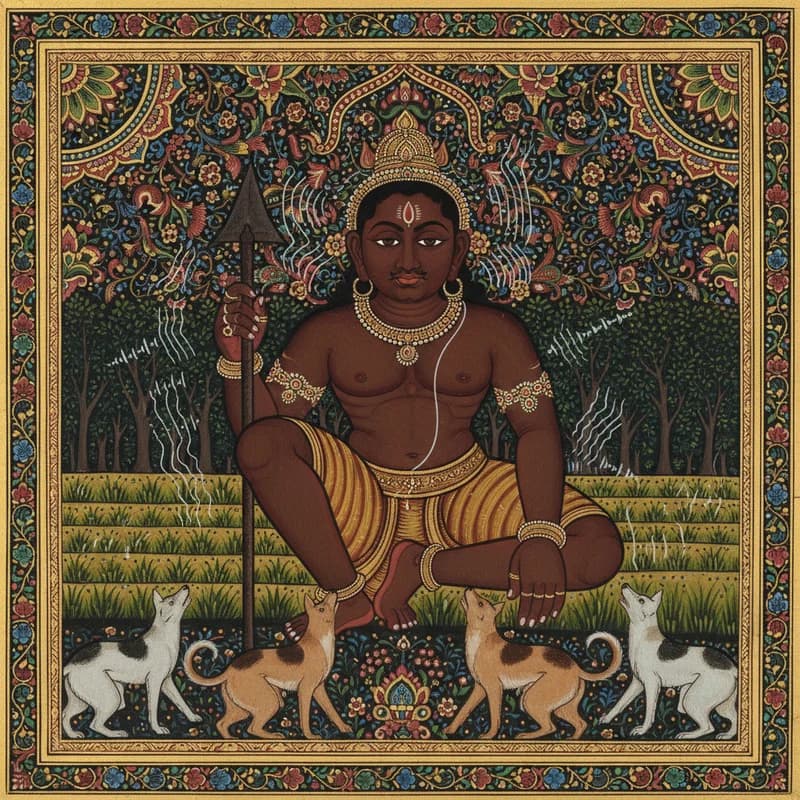
Madeswara moves through the Biligiri Rangana hills as a lean, dark-complexioned ascetic — the body of a man who has walked the forest between Chamarajanagar and the Cauvery's upper tributaries for longer than any living account can fix a date to. His matted hair is wound with forest creepers rather than cloth, and the bark of the nandi tree has left its grain pressed into the skin of his forearms like a second scripture. The single feature that separates him from a wandering sadhu is his feet: witnesses report they do not disturb dry leaves, and the forest floor beneath him stays dry even in the months when the Mysore plateau receives the full weight of the southwest monsoon. He carries the smell of wet laterite and wild turmeric root, the specific smell of the Biligiri forest floor after the first rains — clean, fungal, ancient.
In the dry months before the northeast monsoon reaches the Malai Mahadeshwara Hills, Madeswara moves through the villages of Chamarajanagar district as an aged Shaiva ascetic — ash-smeared, carrying a worn kamandalu, asking for shelter and a handful of rice. The disguise is entirely plausible; wandering sadhus pass through these forests constantly, and no household near the Kollegala road would refuse one. The first tell is the kamandalu: however much water is poured from it over the course of an evening, it never empties and never sounds hollow when tapped. The second is observed by those who watch him eat — the rice disappears, the leaf-plate is clean, but his hands, when he rises, show no trace of having touched food.
First Documented
Madeswara's earliest traceable presence lives in the oral epic *Sri Madeswara Kavya*, a Kannada folk composition of roughly ten thousand lines performed across three consecutive nights by trained singers in the forests and villages of the Malai Mahadeshwara Hills of southern Karnataka.
Last Recorded
Accounts of Madeswara's presence in the Male Mahadeshwara Hills of southern Karnataka have never truly ceased — devotees at the MM Hills temple still report encounters with a wandering ascetic along forest paths, and the three-night singing of his epic continues to generate fresh testimonies of his intervention among Soliga and Vokkaliga communities to this day.
Source Language
Kannada
Origin
Madeswara enters the historical record through the Madeswara Kavya, a Kannada folk epic of roughly ten thousand lines sung across three consecutive nights by specialist performers called Jangamas in the forests around the Male Mahadeshwara Hills of Chamarajanagar district, where his principal shrine sits at roughly 3,000 feet in the Biligiriranga forest range. The textual tradition, such as it exists in palm-leaf manuscripts preserved at the MM Hills temple complex, positions him as a form of Shiva — an orthodox absorption that grants him Puranic genealogy and smooths his edges into recognizable theology. The oral tradition sung along the Cauvery's upper tributaries tells a different story, one where Madeswara is emphatically not Shiva but a Veerashaiva wanderer, a flesh-and-blood holy man who walked between Soliga and Kuruba settlements, settled disputes, and refused Brahminic hierarchy loudly enough that his defiance became the point of the story. That divergence is the engine of his continuing power: the textual record domestic
Frequently Asked
Madeswara is a wandering ascetic from Karnataka who, after his death, was elevated to the status of a forest deity venerated across the Malai Mahadeshwara Hills of the Chamarajanagar district. His life and miracles are preserved in a Kannada folk epic of roughly 10,000 lines, sung by specialist bards over three consecutive nights. Devotees regard him as both protector of forests and a fierce spirit capable of punishing those who violate his domain.
The Madeswara epic is an oral narrative of approximately 10,000 lines in Kannada, recounting the saint's wanderings, miracles, and conflicts with rival powers across the forests of southern Karnataka. Trained bards perform it across three nights, typically at village festivals or temple consecrations in the Malai Mahadeshwara Hills region. The performance is considered a ritual act, not mere entertainment — the singing itself is believed to invoke Madeswara's presence.
Madeswara occupies the threshold between saint and deity — a human holy man whose spiritual power was so great that death transformed him into a presiding spirit of the forest rather than extinguishing him. In the religious landscape of the Chamarajanagar forests, he is worshipped with full temple rites at the Malai Mahadeshwara temple, yet folk accounts also describe him as a wandering presence who can appear suddenly on forest paths. The distinction between god and spirit collapses entirely in his case.
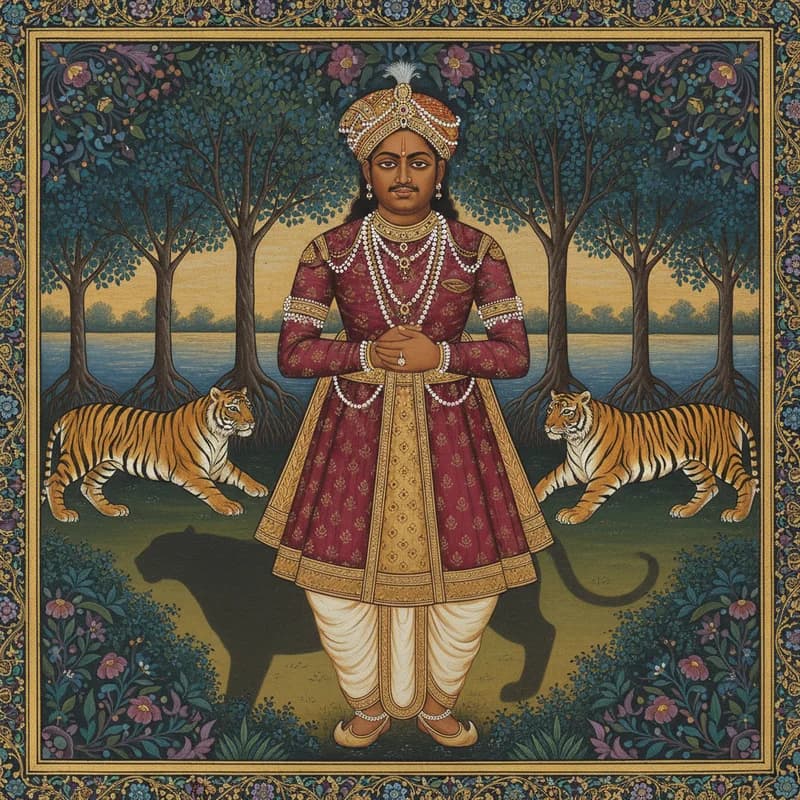
Madeswara is credited with command over wild animals, particularly tigers, which are said to have served as his companions and mounts during his earthly wanderings through the dense forests near the Kaveri basin. He is believed to grant protection to hunters, forest-dwellers, and the poor, but can also inflict illness or misfortune on those who poach, desecrate forest land, or break vows made in his name. His power is understood as inseparable from the forest itself — diminish the forest, and his protection weakens.
The primary seat of Madeswara's worship is the Malai Mahadeshwara temple in the Malai Mahadeshwara Hills of Chamarajanagar district, Karnataka, set within a wildlife sanctuary that bears his name. Pilgrims travel on foot through forest paths to reach the shrine, a practice that mirrors the wandering asceticism attributed to Madeswara himself. Smaller shrines and sacred stones dedicated to him are scattered across villages throughout the Mysuru and Chamarajanagar regions.
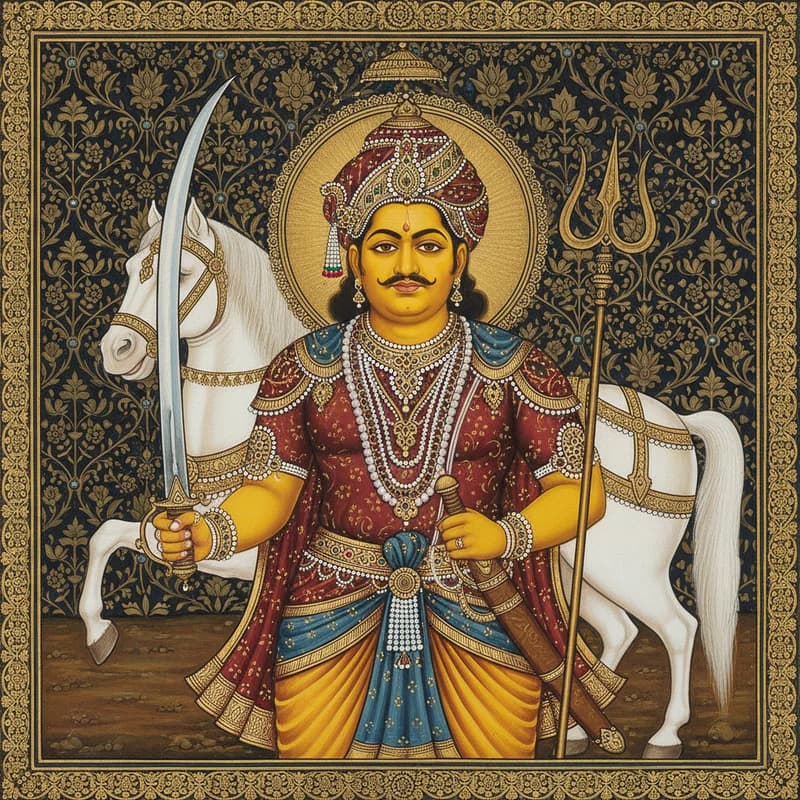
Madeswara's name fuses 'Mahadeva' with a regional suffix, and his iconography borrows the trident and ascetic's matted hair from Shaiva tradition, yet he is distinctly a local forest deity rather than a cosmic god. Where Shiva is worshipped in the abstract form of the linga in stone temples, Madeswara is encountered as a personality — a wandering figure with a specific biography, specific enemies, and specific forest territories he claims as his own. Folk practitioners in the Chamarajanagar region treat him as an intermediary being, closer to the earth and more immediately responsive than the great Shaiva deities of Sanskrit tradition.
Madeswara's benevolence is conditional — he protects those who respect the forest and honor their vows, but oral accounts collected across the Malai Mahadeshwara Hills consistently describe him punishing oath-breakers, poachers, and those who enter his forest with impure intentions. Sudden illness, disorientation in the forest, and encounters with wild animals are attributed to his displeasure. Approaching his shrines without proper ritual preparation or entering the forest during certain auspicious nights without permission is considered genuinely dangerous by local communities.
Madeswara's story exists primarily as a living oral tradition, transmitted through specialist bard communities in Karnataka who memorize and perform the 10,000-line Kannada folk epic. Scholars of Kannada folklore, including researchers affiliated with the Kannada Sahitya Parishad, have made efforts to transcribe and document versions of the epic, though regional variations between villages mean no single authoritative written text exists. The oral form is considered the authentic one — the epic's power is understood to reside in the act of singing, not in any written page.
Algorithmic Inference
आपको यह भी पसंद आ सकता है
You May Also Like
Community Discussion
Comments are reviewed by AI before appearing publicly. Unsafe, unrelated, or uncertain comments go to human review.
Sign in to join the discussion.
0 comments
No public comments yet.