प्रतीक्षा करें
Consulting the Shastra archives…
प्रतीक्षा करें
Consulting the Shastra archives…

Peta
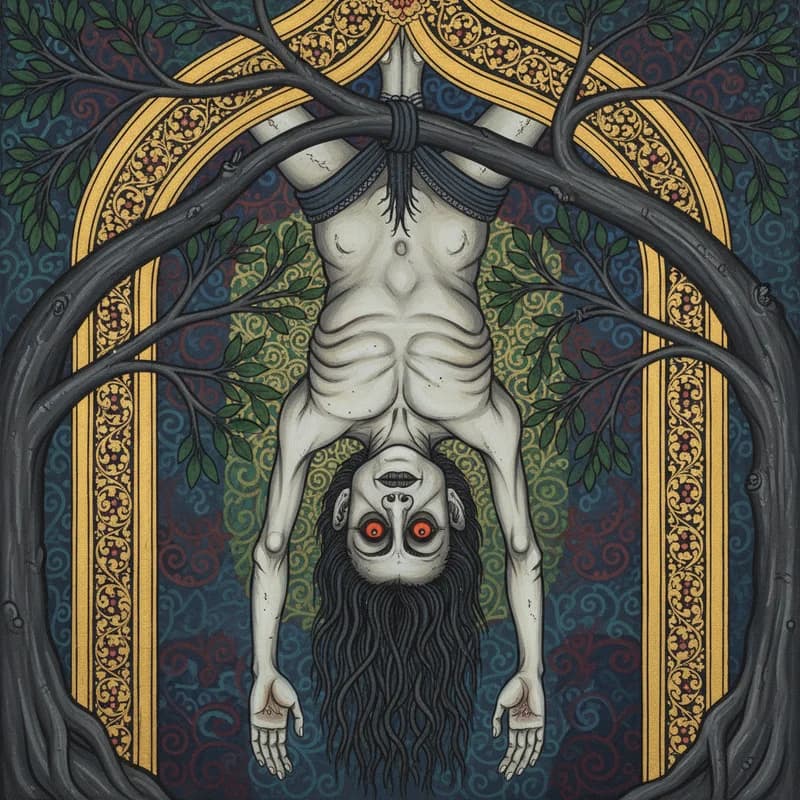
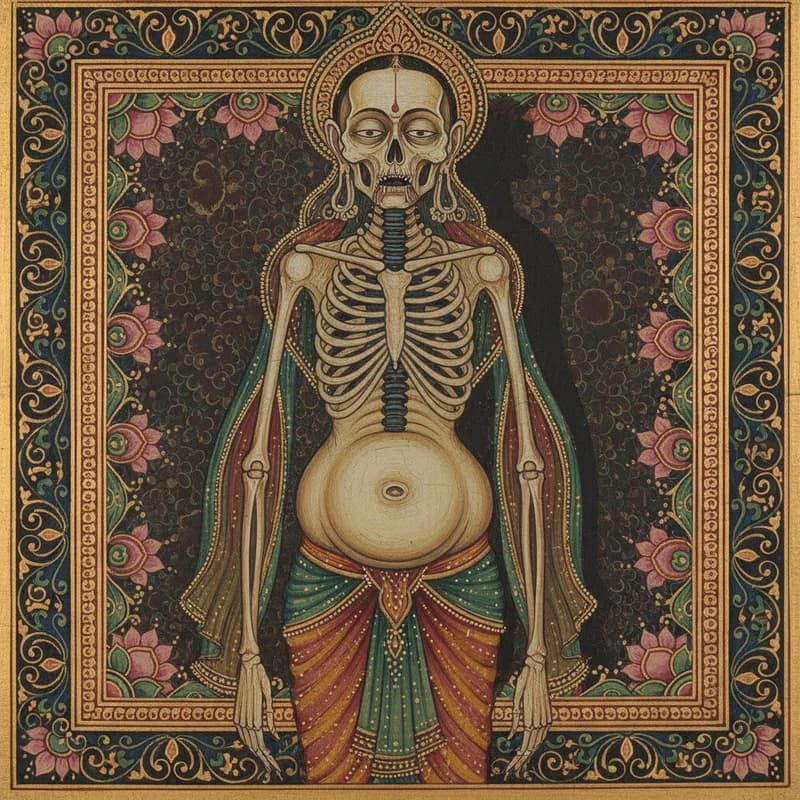
Somewhere between the living and the liberated, the Peta drifts — not demonic, not malevolent in any directed way, but suffering with a completeness that makes proximity to one deeply uncomfortable. Buddhist canonical literature, specifically the Petavatthu of the Khuddaka Nikaya, records their condition with clinical precision: these are beings who died carrying the weight of greed, attachment, or moral failure, and who now exist in a state of perpetual, unassuaged hunger. Their bodies, where accounts give them bodies at all, are described as grotesque inversions of appetite — enormous, distended stomachs, mouths the width of a needle's eye. They stand at the banks of rivers like the Ganga near Bodh Gaya, reaching toward water that evaporates before it touches them.
What distinguishes the Peta from cruder ghost-lore is the ethical architecture behind the condition. The Petavatthu stories — many collected from the Magadha region, the old heartland of early Buddhism — present these beings not as threats but as consequences. They appear to living relatives in dreams during the monsoon months, or at cremation grounds at dusk, not to harm but to petition. The tradition holds that merit transferred from the living — dana offered at a vihara, a meal given to monks — can reach the Peta and ease their condition. This is why, across the Theravada-influenced communities of eastern India and the Pali-literate monasteries of Bengal, the ritual of pattidana exists: the formal sharing of merit with the dead. Encountering a Peta demands not exorcism but generosity. The danger is not violence. It is the guilt of walking away.
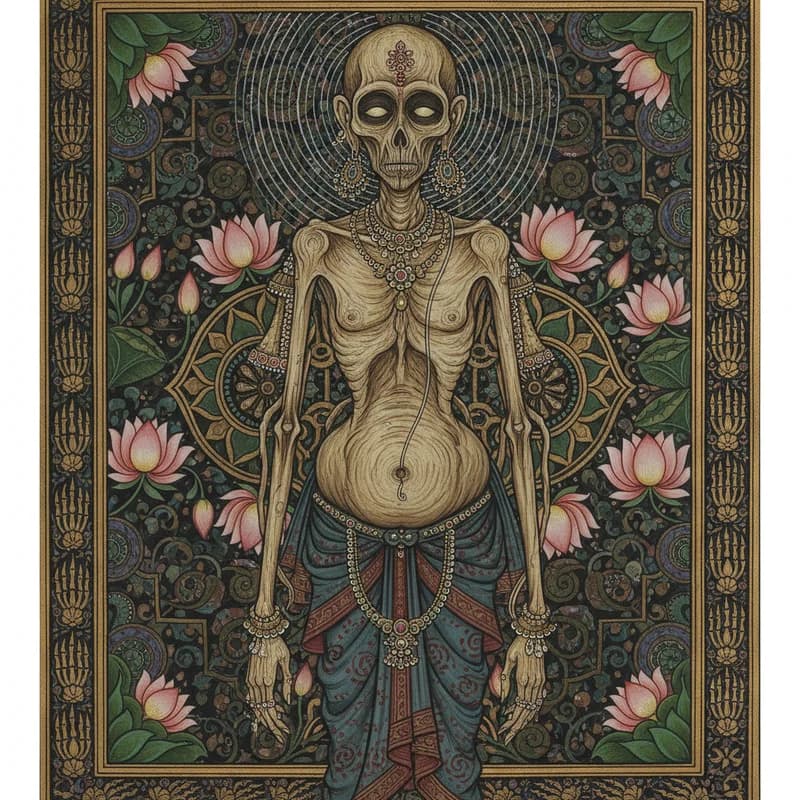
The Peta appears as a figure of extreme depletion — not thin in the way of illness, but thin in the way of something that has been consuming itself from the inside for longer than any single lifetime. The skin has the colour and texture of old jute sacking left in monsoon damp, loose over the joints, taut nowhere. Accounts from the Bodh Gaya region describe an abdomen swollen with a hunger that cannot be satisfied, set against limbs like stripped sugarcane stalks — the disproportion is the first thing witnesses register, before anything else resolves. The mouth is described consistently as too small, a sealed seam barely wide enough to admit a finger, which makes the Peta's hunger legible in the body itself: the want is total, the means of relief structurally denied. What marks it as something outside the ordinary world of suffering is the sound that precedes it — not a voice, but a dry clicking, like seed-pods in a hot wind, audible in still air, growing louder as the figure draws near.
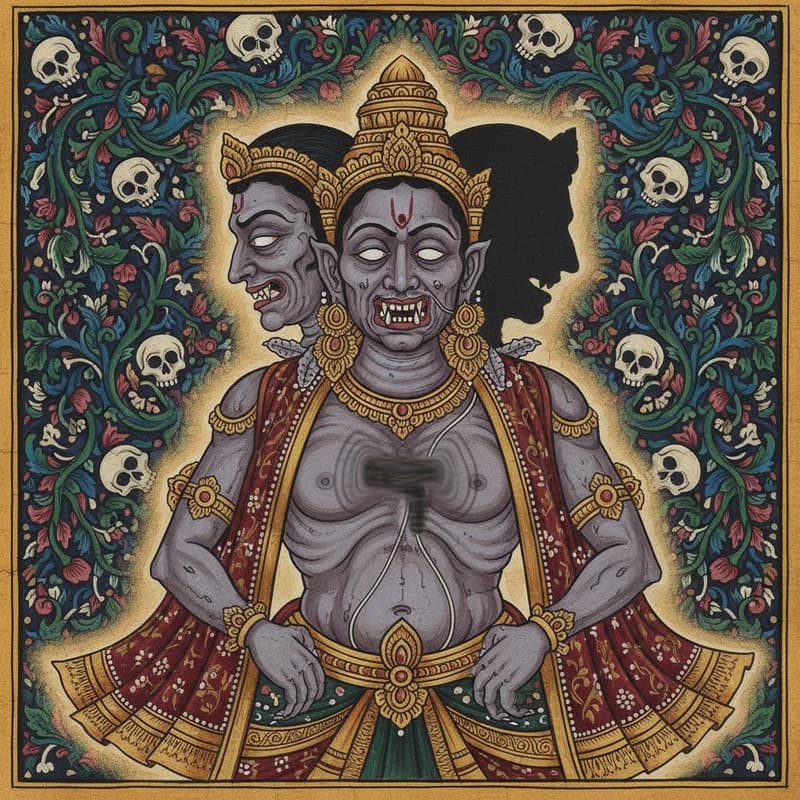
Along the cremation ghats of the Bagmati and in the shade of pipal trees that line the edges of Buddhist vihara compounds, the Peta most commonly appears as a wandering bhikkhu — robes sun-bleached to a colour just slightly wrong, a begging bowl held in the correct position, the gait of a man accustomed to walking barefoot on stone. The disguise is persuasive at dusk, when the light is poor and monks do move between settlements. Two details betray it. The bowl, when offered alms, is never full — witnesses across accounts from Bihar's Nalanda district to the Terai settlements of southern Nepal consistently report that food placed into it simply disappears, yet the figure's hunger does not diminish, its eyes fixed and hollow in a way that no amount of eating will ever correct. The second tell is the shadow: it falls in the wrong direction, away from whatever light source is present, as though cast by a sun that set in a different world entirely.
First Documented
The Peta appears in the *Petavatthu* ("Stories of the Departed"), a canonical Pali text belonging to the Khuddaka Nikaya, compiled no later than the 3rd century BCE and recited at early Buddhist councils; these fifty-one verse narratives record the testimonies of hungry ghosts, making this among the oldest systematic documentation of such beings in South Asian literature.
Last Recorded
Accounts of the Peta appear as early as the third century BCE in the Petavatthu, part of the Pali Canon's Khuddaka Nikaya, and oral traditions linking the hungry dead to riverbanks and cremation grounds — particularly along the Ganges near Bodh Gaya — persist in rural Bihar to the present day.
Source Language
Pali
Origin
The Peta enters the written record in the Petavatthu, the fifth book of the Khuddaka Nikaya, where it occupies a position unusual among supernatural entities — canonical scripture, not marginal folklore. The text is structured as a series of verse dialogues in which the living encounter the dead and learn, through their suffering, the precise moral arithmetic of their former lives: the miser who refused a monk a handful of rice now wanders the banks of the Ganga at Varanasi unable to eat, food turning to ash at his lips. What the Petavatthu insists upon is visibility — the Peta is seen, spoken to, reasoned with. The oral tradition of the Theravada villages of Arakanese Burma and the Buddhist communities of Bihar's Bodh Gaya corridor diverges sharply here: in those accounts, the Peta is not visible but audible, a sound of eating that produces no consumption. That divergence is instructive — the canonical text needs the encounter to be legible, a teachable moment; the village tradition needs it to remain unresolved, a hunger that instruction cannot close.
Frequently Asked
A Peta (पेत) is a class of hungry ghost in Pali Buddhist tradition, closely related to the Sanskrit Preta. These beings are understood as the spirits of the dead who, due to greed, moral failure, or unresolved attachment in life, are reborn into a state of perpetual deprivation and suffering.
Peta is the Pali form and Preta the Sanskrit form of essentially the same concept — a ghost condemned to hunger and thirst. The Peta belongs specifically to the Theravada Buddhist cosmological framework, while the Preta appears more broadly across Hindu texts including the Garuda Purana, where its nature and the rituals addressing it differ considerably.
The primary canonical source is the Petavatthu, a text within the Khuddaka Nikaya of the Pali Canon, which records individual ghost narratives in verse form. Each story traces a Peta's suffering back to specific moral failures committed during their human life, making the text as much an ethical guide as a supernatural record.
Accounts in the Petavatthu describe Petas as emaciated, wretched figures — some with enormous bellies and mouths too small to eat, others appearing as skeletal forms wandering cremation grounds and riverbanks. Their appearance reflects the specific nature of their transgression in life, so no single form defines them.
Yes — the Petavatthu itself describes living relatives offering merit to Petas through acts of dana, or generosity, particularly food offerings made to monks along the Ganges plain. When the Peta acknowledges the gift and rejoices, they may receive relief or even escape their condition entirely.
Petas are not predatory in the way that some other spirits in Indian folklore are understood to be, but they are not benign either. Their proximity is considered inauspicious, and in folk practice across Sri Lanka and parts of Bengal, encountering one near a cremation ground or at dusk is treated as a warning requiring ritual attention.
Unlike the broader category of bhuta — which can include spirits of violent or accidental death with no clear moral framework — the Peta exists within a precise karmic logic documented in canonical scripture. Every Peta's condition is traceable to a specific ethical failure, which gives the concept a didactic weight that ordinary ghost lore rarely carries.
Peta belief is strongest in regions with deep Theravada Buddhist histories — parts of Bengal, Odisha near the Mahanadi delta, and areas along the old pilgrimage routes connecting Bodh Gaya to Sarnath. In these places, the practice of offering rice and water at the edge of a field during Pitru Paksha carries echoes of the Petavatthu's own prescriptions for feeding the restless dead.
संबंधित लोकगाथाएं
Related Lore
Algorithmic Inference
आपको यह भी पसंद आ सकता है
You May Also Like
Community Discussion
Comments are reviewed by AI before appearing publicly. Unsafe, unrelated, or uncertain comments go to human review.
Sign in to join the discussion.
0 comments
No public comments yet.