प्रतीक्षा करें
Unfolding the scroll…
प्रतीक्षा करें
Unfolding the scroll…
Devaduta
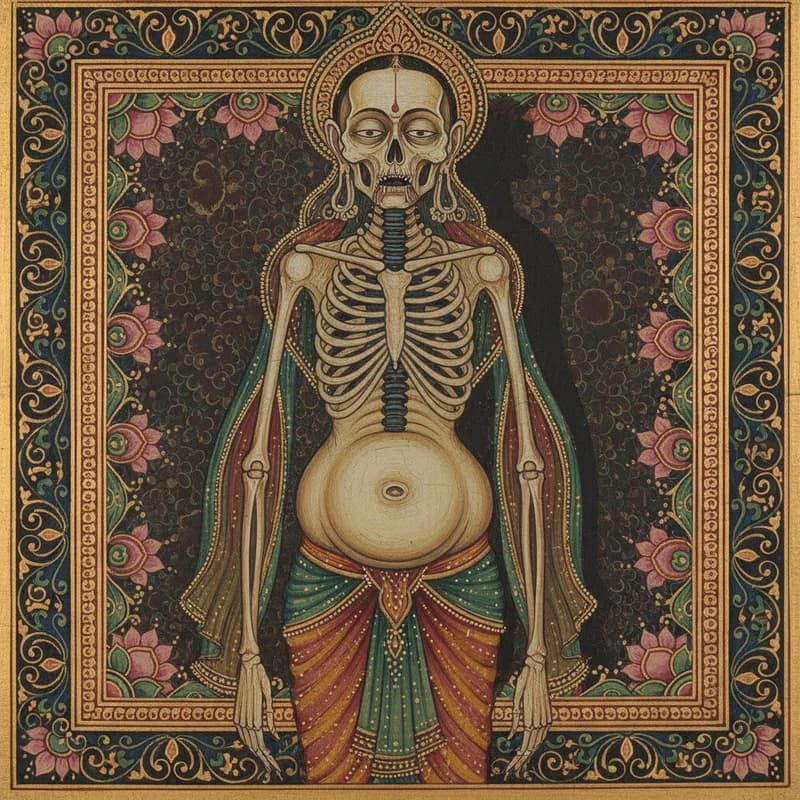
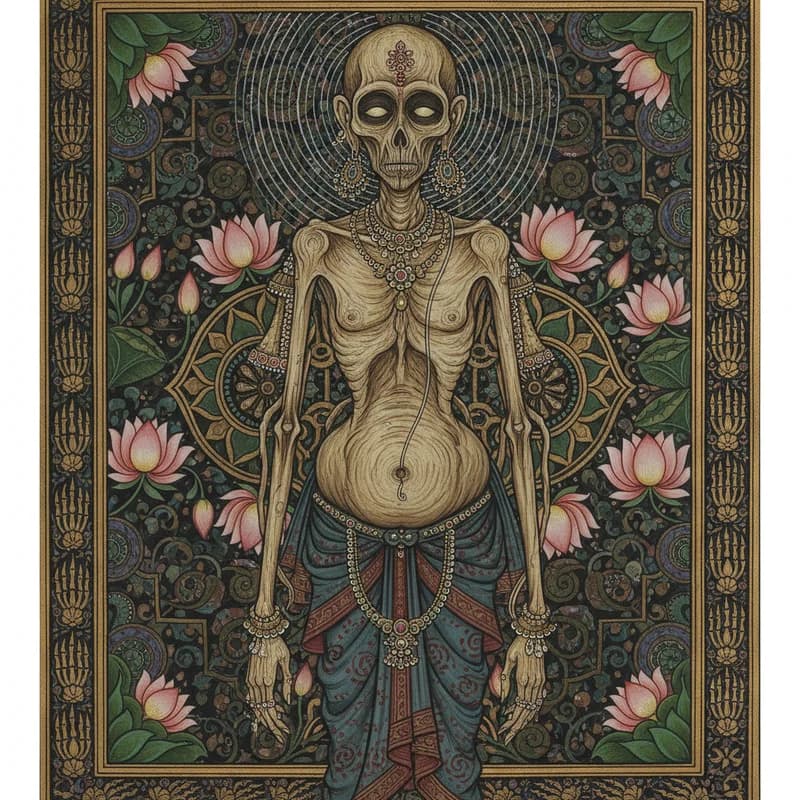
They do not arrive unannounced. The Devaduta — Yama's appointed messengers — make themselves known through the body itself, working through the slow grammar of decline: the joints that no longer obey, the fever that climbs past reason, the breath that shortens by degrees. Accounts gathered from Varanasi's hospice lanes and the cremation ghats at Manikarnika describe them not as sudden apparitions but as processes, as the body's own reckoning made visible to those with eyes trained enough to read it. The Garuda Purana is explicit on their function: they come first as old age, then as disease, then as death itself, each a messenger in sequence, each giving warning that the final escort draws near.
What the dying see at the moment of departure, the living rarely witness cleanly. Oral accounts from the Ganga-Yamuna doab and the Deccan plateau both describe a heaviness in the room, a stillness that falls differently from ordinary quiet, and occasionally the sense of figures at the threshold — patient, neither hostile nor comforting. The Devaduta do not judge; that work belongs to Yama at his court. Their task is passage alone, the escorting of the soul along the southward road that the Mahabharata calls Pitrloka's path. Families who have tended the dying in the Kashi kshetra speak of this with a certain steadiness — the messengers come to everyone, in time, and their arrival carries no malice, only the weight of an appointment that was always going to be kept.
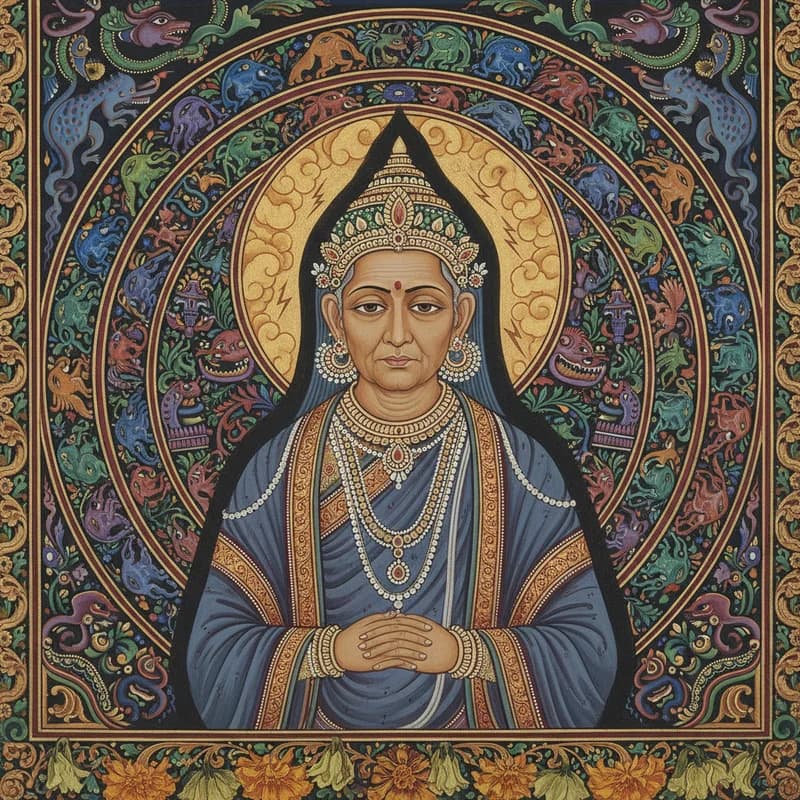
The Devaduta appears most often in the hour before death, described in accounts from the ghats of Prayagraj to the cremation grounds outside Madurai as an elderly figure of indeterminate sex, robed in cloth that is neither white nor grey but the colour of sky before monsoon breaks — a colour witnesses struggle to name after. The face is composed, almost bureaucratic in its stillness, the way a clerk looks when the paperwork is already complete. What survivors notice first — those who glimpsed one from the doorway of a sickroom — is not the figure itself but the sudden absence of sound: birds stop, the street outside goes quiet, even the laboured breathing of the dying seems to pause and reconsider. The smell that precedes it is specific: marigold garlands left three days on a stone idol, sweet and beginning to turn. The single detail that separates it from any living elder in the room is the shadow — it falls in the wrong direction, away from every available light, as though cast by a sun that exists elsewhere.
The Devaduta most commonly appears in the weeks before a death as an elderly pilgrim — gaunt, ash-smeared, carrying the staff and small brass kamandalu of a wandering sadhu — seen resting under a peepal tree near the house of the one who will die, or walking slowly along the bund between paddyfields at the edge of a village. Nothing about the figure invites suspicion; old mendicants rest where they please. The tells are these: the kamandalu, however long the pilgrim has sat in the heat of a Jyeshtha afternoon, shows no condensation and holds no water when it tips — witnesses have noticed it tilts without sound. And the figure casts no shadow at any hour, not even at noon on the flat white ground of a threshing floor, where nothing escapes the light.
First Documented
The Devaduta appear in the Majjhima Nikaya, the Pali Buddhist canon compiled around the 3rd century BCE, where the Buddha describes them to his monks as the three divine messengers — old age, sickness, and death — sent by Yama to warn the living of their fate.
Last Recorded
Accounts of Devaduta sightings persist into the present, collected as recently as the 2010s from hospice workers and cremation attendants along the Manikarnika Ghat in Varanasi, who describe luminous figures appearing at the moment of death. The tradition remains living, not archival.
Source Language
Sanskrit
Origin
The Devaduta appear earliest in the Majjhima Nikaya, where the Buddha lists them explicitly as the three divine messengers — old age, disease, and death — sent not to punish but to warn the living before Yama's final summons arrives. The Garuda Purana's account of the soul's passage after death elaborates their role into something more procedural: escorts who arrive at the moment of death, visible only to the dying, and conduct the soul along the path to Yamaloka. What the textual sources share is a theology of function — the Devaduta are instruments, not personalities. The oral tradition of the Gaya region, however, where the Falgu River carries the weight of ancestral obligation, insists on something the texts decline to record: that the messengers take the form of people the dying person loved and lost, that the face of an old grief is the last face seen. This divergence is not incidental — it suggests that the folk tradition was less interested in cosmic administration than in the specific texture of dying, in what the body and the memory do in those final moments when doctrine cannot reach.
Frequently Asked
A Devaduta (देवदूत) is a divine messenger dispatched by Yama, the god of death, to escort the souls of the dying toward his court of judgment. They appear not as sudden apparitions but as omens woven into the body itself — old age, disease, and the slow failure of the flesh. The Mahabharata and several Puranas describe them as instruments of cosmic order rather than malevolent spirits.
Devadutas are neither punishing demons nor benevolent guides in the conventional sense — they are functionaries of dharmic law, indifferent to human preference. Their arrival signals not cruelty but inevitability, the same way the Ganga at Varanasi rises regardless of who stands on its ghats. In the Bhagavata Purana, they are explicitly contrasted with the Vishnudutas, messengers of Vishnu who intervene for the righteous.
Devadutas serve Yama and carry souls to his court for judgment according to their accumulated karma, while Vishnudutas are emissaries of Vishnu who arrive specifically to escort devoted souls directly to Vaikuntha, bypassing Yama's reckoning. The confrontation between these two orders is dramatized vividly in the Ajamila episode of the Bhagavata Purana. Their opposition maps the theological tension between justice and grace in Vaishnava thought.
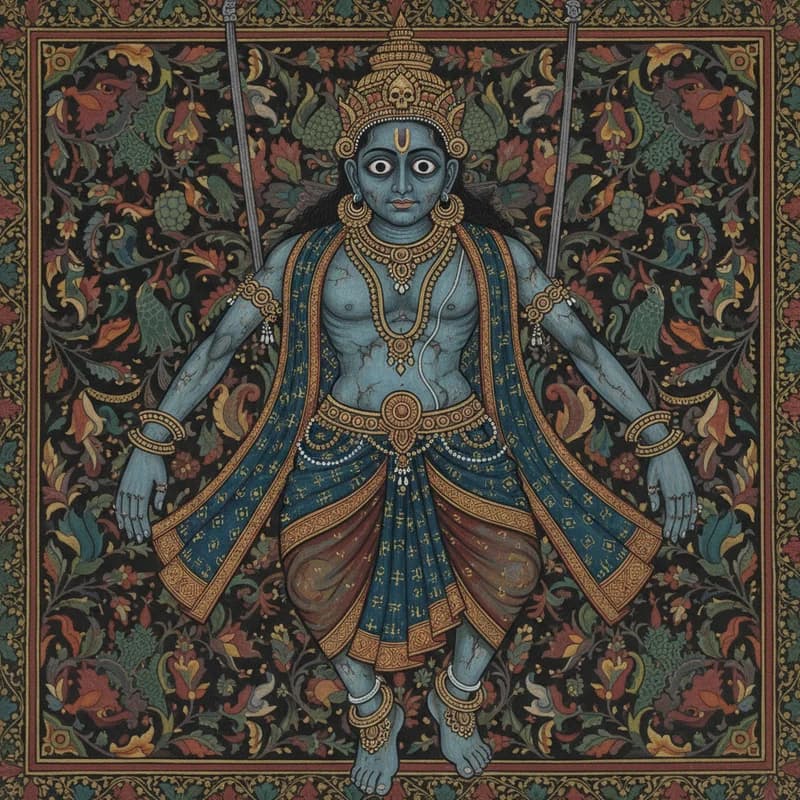
The Puranas describe Devadutas as dark-complexioned, rope-bearing figures who arrive at the moment of death to bind the subtle body and lead it southward toward Yamaloka. Before their physical arrival, they are said to have already appeared in disguised form — as the ache of aging joints, the wasting of illness, the dimming of sight. This interpretation, found in texts like the Garuda Purana, frames bodily decline itself as a prolonged divine summons.
The Garuda Purana offers the most sustained account of Devadutas, describing their appearance, the route they compel the soul to walk, and the torments of that southward road in considerable detail. The Mahabharata's Shanti Parva also references them in discussions of death and moral reckoning. Both texts treat the Devaduta not as folklore but as a precise mechanism within the architecture of cosmic justice.
The terms are often used interchangeably in popular usage, but a distinction exists in some textual traditions. Yamadutas are specifically Yama's own servants, while Devaduta carries the broader sense of 'divine messenger,' occasionally referring to any celestial emissary. In most Puranic contexts, however, the Devadutas who attend the dying are understood to be Yama's agents, making the functional difference negligible in practice.
Oral traditions across the Gangetic plain and in parts of Odisha and Rajasthan preserve figures recognizable as Devadutas — dark messengers who arrive at the deathbed, sometimes heard before they are seen, their presence announced by a sudden chill or the extinguishing of the household lamp. Village accounts collected near the Narmada river describe them as wearing black, carrying a noose, and speaking in a voice that only the dying can hear. These regional accounts align closely with Puranic descriptions, suggesting a long, continuous transmission.
Within the mythological framework, the Devaduta's arrival is not an attack but an appointment — the soul is escorted, not hunted, and the experience of that escort depends entirely on the karma accumulated in life. The Bhagavata Purana counsels that the truly devoted need not fear them, since the Vishnudutas may intercede. Caution in the LokKatha classification reflects the Devaduta's association with death and judgment, not any predatory intent toward the living.
संबंधित लोकगाथाएं
Related Lore
Algorithmic Inference
आपको यह भी पसंद आ सकता है
You May Also Like
Community Discussion
Comments are reviewed by AI before appearing publicly. Unsafe, unrelated, or uncertain comments go to human review.
Sign in to join the discussion.
0 comments
No public comments yet.