प्रतीक्षा करें
Illuminating the manuscript…
प्रतीक्षा करें
Illuminating the manuscript…

Odam
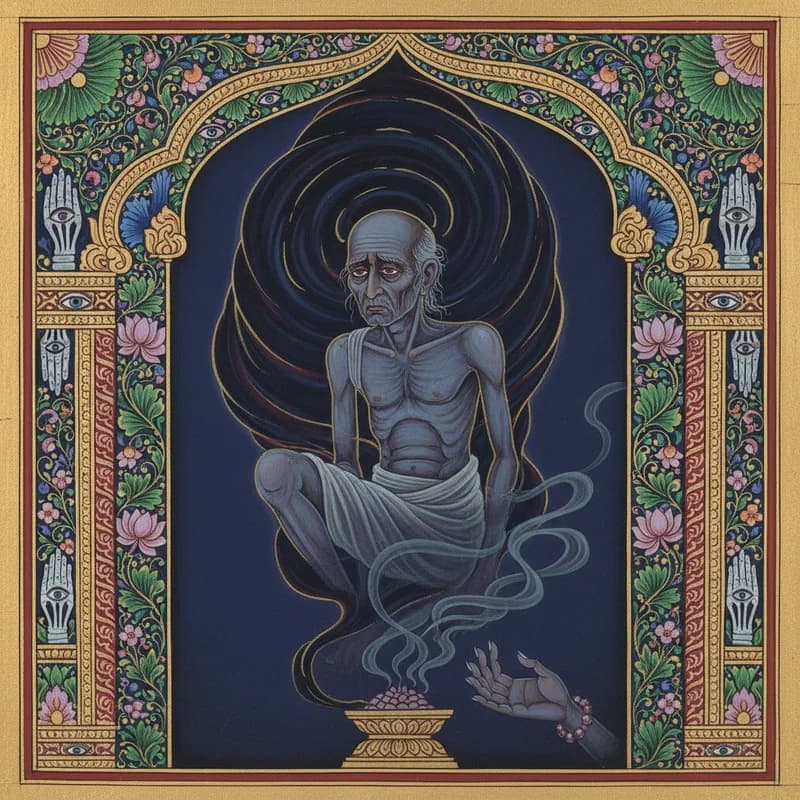
Something moves beneath the surface of the Kuttanad backwaters when the water is at its stillest. Fishermen from Alappuzha to Kumarakom have described it the same way across generations: the boat tilts without wind, without current, without any visible cause, and then the water takes it. The Odam is not seen. It is felt — a sudden wrongness in the weight of the vessel, as though something below has decided, quietly and without malice, that the boat no longer belongs on the surface.
What the Odam wants is not clear from the accounts. Unlike the river spirits of the Periyar or the Bharathapuzha, which attach themselves to transgression or broken taboo, the Odam in most oral records from the Kuttanad delta seems indifferent to the character of its victims. Old toddy-tappers and devout temple-goers have both gone down the same way. Experienced polemen read the water obsessively in the months after Onam, when the backwaters swell and the light flattens out across the surface in a way that makes depth impossible to judge — that season, they say, is when the Odam is most active. No ritual appeasement is consistently recorded. The only pattern in the survival accounts is this: those who felt the tilt and immediately moved to the centre of the boat, redistributing weight without panic, came back. Those who reached for the side came back less often.
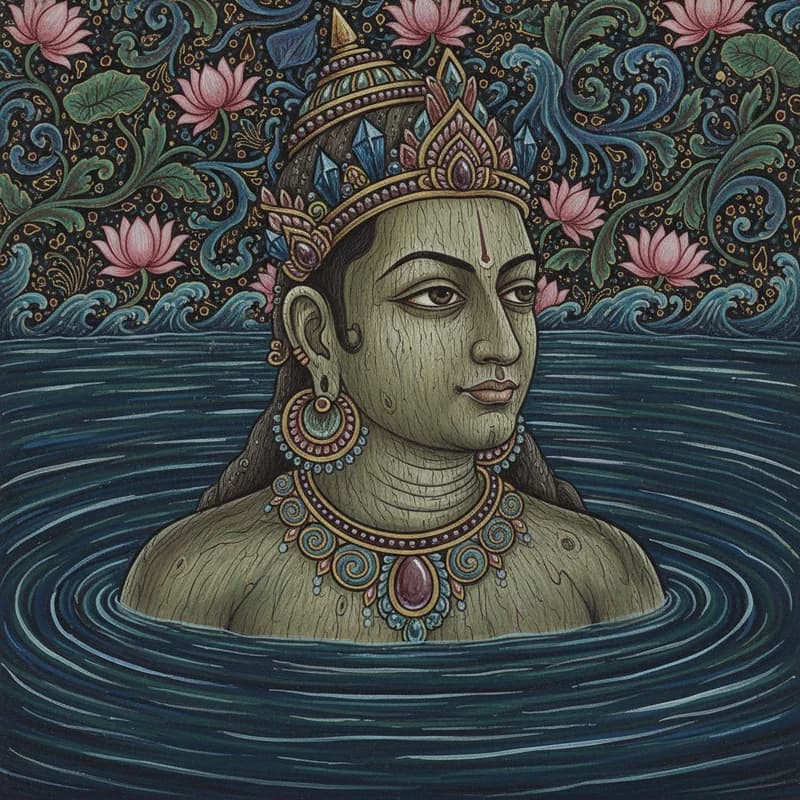
The Odam is not seen so much as sensed — a low, spreading weight beneath the hull, like a hand pressed flat against the wood from below, patient and deliberate. Fishermen on the Vembanad who have survived its attention describe a figure glimpsed at the waterline in the seconds before the capsize: the upper body of a man, the skin the grey-green of waterlogged timber left in brackish water, the face turned slightly away, as though the sinking is incidental to some other business. The smell arrives before any visible sign — not rot, but the particular mineral cold of deep backwater mud disturbed after months of stillness, the smell that comes up when a pole strikes bottom in the wrong place. What marks it finally, unmistakably, is the water around it: flat, without ripple, in a ring roughly the width of the boat, while the rest of the kuttanad surface moves normally with the wind.
Along the backwater channels between Alappuzha and Kottayam, where the kuttanad paddies press to the water's edge and the morning mist sits low enough to touch, the Odam takes the shape of a waterlogged plank or a drifting section of old teak — the kind of debris that collects after monsoon floods and means nothing to anyone. Fishermen and vallam operators have learned to watch for two things: the plank holds its position against the current when nothing else does, maintaining a fixed distance from the hull as though tethered, and the water immediately surrounding it carries no ripple, no disturbance, while the rest of the channel moves normally around it. The second tell is quieter and more unsettling — the crows that work the backwater banks will not land on it.
First Documented
Odam surfaces most clearly in the oral traditions of fishing communities along the Vembanad Lake and the Kuttanad backwaters, passed down through the cautionary accounts of *vallam* boatmen who could not explain sudden capsizings on still water; no single founding text claims it, though scattered references appear in regional Malayalam folklore collections from the early twentieth century.
Last Recorded
Accounts of the Odam persist into the present, with fishermen along the Vembanad Lake and the Kuttanad backwaters still reporting unexplained capsizings on glassy, windless afternoons; the most recent oral testimonies were gathered in the early 2000s by regional folklorists documenting vanishing water-spirit traditions across Alappuzha district.
Source Language
Malayalam
Origin
The Odam appears in the oral tradition of the Kuttanad wetlands, carried primarily by the *vallom* boatmen who work the backwaters between Alappuzha and Changanacherry, where the Pampa and Manimala rivers dissolve into a maze of shallow canals and paddy-field channels. No classical Sanskrit Puranic text names it directly; the entity belongs entirely to the living oral record, surfacing in collector's notes from the early twentieth century and in the Malayalam folk-song tradition called *vanchipattu* — the boatman's song — where certain verses warn against singing at dusk on still water. What distinguishes the folk account from later rationalized retellings is the insistence on calm: the Odam does not act during storms or monsoon surge, when a capsizing needs no explanation, but specifically on glass-flat water in the dry months of Karkidakam, when a sudden inversion becomes inexplicable. That specificity is not incidental. It places the terror precisely in the absence of cause — the Odam does not oppose the river's violence but inhabits its silence
Frequently Asked
Odam is a river spirit from Kerala folklore, known in Malayalam as ഓടം, believed to haunt the backwaters and inland waterways of the region. It causes boats to capsize suddenly on water that shows no sign of disturbance — no wind, no current, no visible cause. Fishermen and ferry workers along the Vembanad Lake and the Kuttanad backwaters have passed down accounts of the Odam for generations.
The Odam does not act out of hunger or vengeance in the way many malevolent spirits do — its capsizing of vessels appears purposeless, which is precisely what makes it unsettling to those who study Kerala's water spirits. Some oral accounts collected near Alappuzha suggest the Odam is drawn to the sound of oars on still water, interpreting the disturbance as a provocation. Whether it acts with intent or simply as a force of the water itself remains unresolved in the tradition.
Accounts of the Odam concentrate most heavily around the Kuttanad backwaters and the broad expanse of Vembanad Lake, where the water sits low and flat for much of the year. The months following the southwest monsoon — when the paddy fields of Kuttanad flood and the boundary between land and water dissolves — are considered the most dangerous time. Villages along the Pampa River's lower reaches also carry strong oral traditions about unexplained capsizings attributed to the Odam.
The Odam is distinct from pan-Indian water spirits like the Jal Devata or the Nāga, which carry clear scriptural lineages and are often associated with blessings or curses tied to human behavior. Rooted entirely in Malayalam oral tradition, the Odam belongs to a class of localized spirits that exist outside the Sanskrit textual canon. It shares some behavioral overlap with the Kuttichathan tradition of Kerala mischief-spirits, but its exclusive association with watercraft and capsizing sets it apart.
The Odam is classified as a caution-level spirit — genuinely hazardous to those on the water, but not regarded as a predatory entity that hunts or possesses. Death by drowning is the primary risk, particularly for those crossing the backwaters alone at dusk or before dawn. Experienced boatmen in the Kuttanad region traditionally avoid singing or making unnecessary noise on the water at these hours as a precaution.
Certain fishing communities along the Vembanad Lake would offer small lamps set afloat on banana-leaf boats before night crossings, a practice recorded in oral accounts from Muhamma and Thanneermukkom. Invoking the name of local Bhagavathi shrines — particularly those situated at the water's edge — was also considered protective. These customs have thinned considerably with motorized boat traffic, though older ferryman families in Kuttanad still observe them.
The Odam does not appear in classical Malayalam literary texts or in the Puranic literature that circulated through Kerala's temple traditions. Its existence is documented almost entirely through oral transmission — the accounts of fishermen, toddy tappers who crossed the backwaters at night, and the families of those lost to unexplained capsizings. This absence from written record is itself characteristic of Kerala's stratum of hyper-local water spirits, which rarely crossed into the literate tradition.
In Malayalam, ഓടം means a boat or small watercraft — the spirit takes its name directly from the object it destroys. This naming pattern, where the spirit is identified by its method of harm rather than by any personal or mythological name, is unusual even within Kerala's folk tradition. It suggests the Odam was understood less as a being with identity and more as a property of the water itself, a force that turns the vessel against its passengers.
संबंधित लोकगाथाएं
Related Lore
Algorithmic Inference
आपको यह भी पसंद आ सकता है
You May Also Like
Community Discussion
Comments are reviewed by AI before appearing publicly. Unsafe, unrelated, or uncertain comments go to human review.
Sign in to join the discussion.
0 comments
No public comments yet.