प्रतीक्षा करें
Awakening the Churel dossier…
प्रतीक्षा करें
Awakening the Churel dossier…

Yakshini
She lives at the edge of what cultivation permits — in the silk-cotton trees at the boundary of tilled fields, near the old step-wells of Rajasthan where the water has gone brackish, along the ghats of the Narmada where the current bends and the light behaves strangely at dusk. The accounts agree on her appearance: beautiful in a way that registers as wrong, the wrongness arriving a moment after the beauty. Tantric texts from the Shakta tradition — the Mantra Mahodadhi among them — classify her not as a demon but as a being capable of contract, one who can be summoned, named, and bound to a practitioner willing to observe the precise conditions of her service. Wealth follows her. So does knowledge of buried things, hidden things, things that have not yet happened.
The binding is the danger. Practitioners in the oral tradition of Rajasthan and the Deccan describe a relationship that demands absolute fidelity to its terms — a specific flower offered on a specific night, a prohibition never broken, a form of address used without variation. When the terms hold, the accounts describe extraordinary outcomes: debts settled, rivals silenced, crops saved from drought years. When the terms break, even once, through carelessness rather than malice, the same accounts stop being about prosperity. She does not leave. She inverts. The step-wells of Jodhpur district carry stories of practitioners found at the water's edge at first light, alive but unable to speak of what they saw in the hours before dawn.
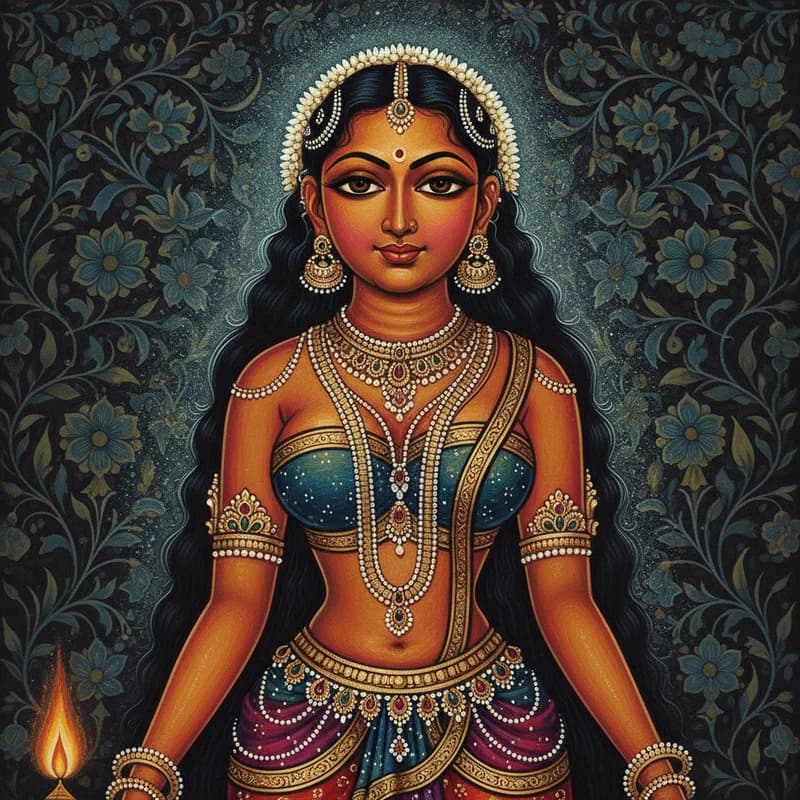
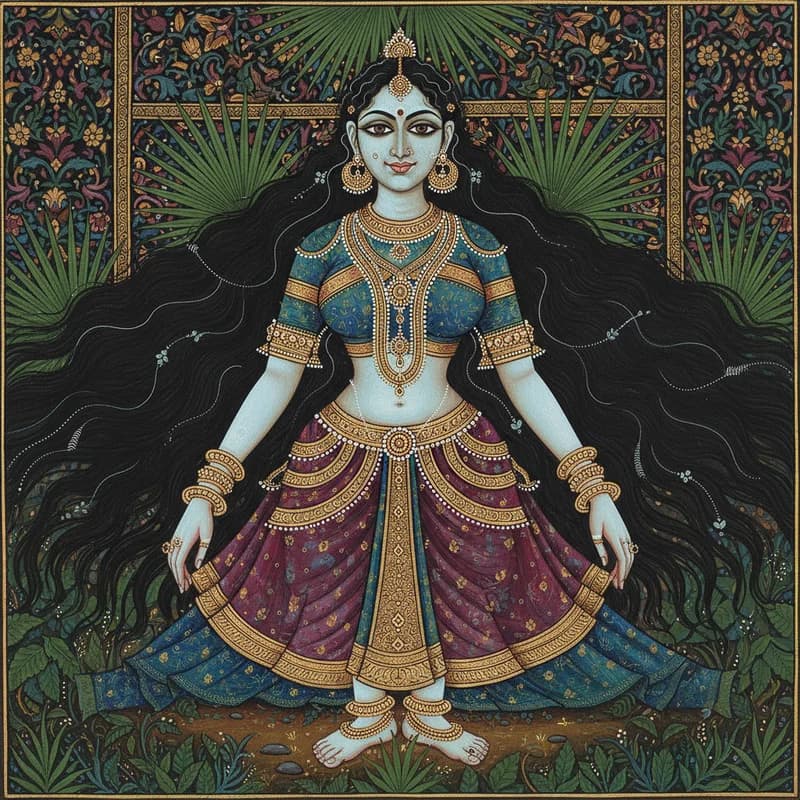
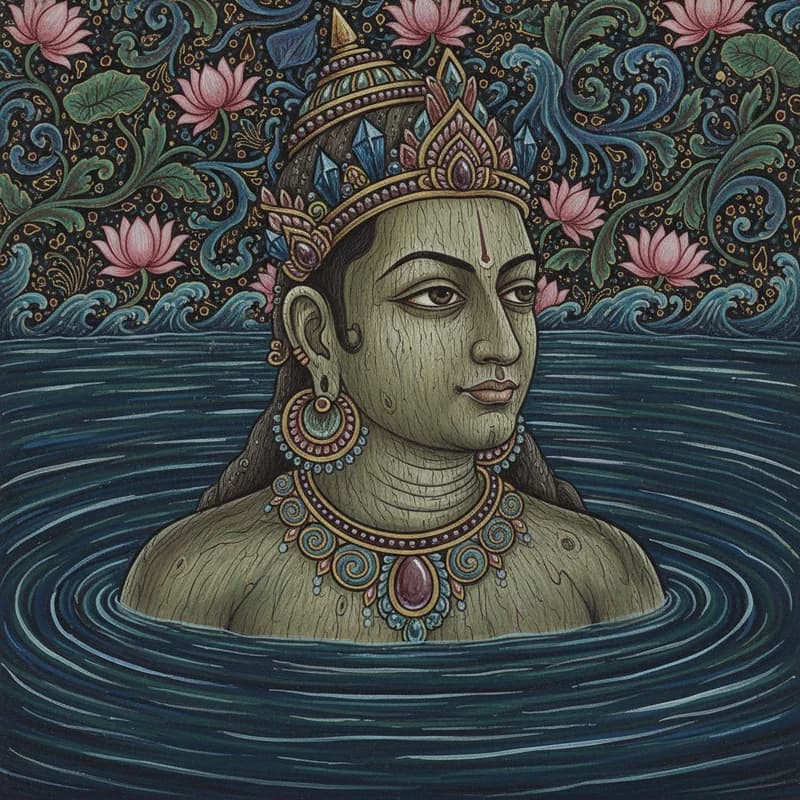
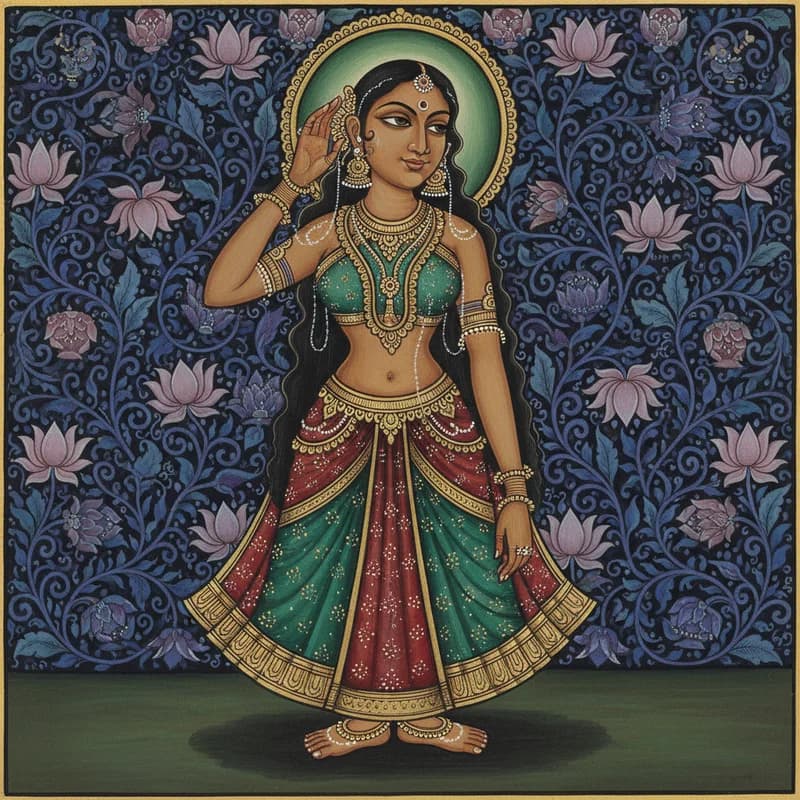
The Yakshini appears as a woman of unusual height and proportion — the limbs slightly too long, the neck carrying the head at an angle that suggests she is always listening for something just beyond the present conversation. Accounts from the forests east of Ujjain and from the ghats at Omkareshwar describe skin the colour of polished tamarind wood, cool to the touch even in the deep heat of Jyeshtha, and hair that falls without the small disorder that wind and movement impose on living women. The smell that precedes her is specific: wet earth and crushed champak flowers, the precise combination that rises from a temple courtyard after the first rains reach the Narmada valley. What marks her as something other than human is the stillness of her shadow — it does not shift with the light, but holds its position independent of the sun's movement overhead.
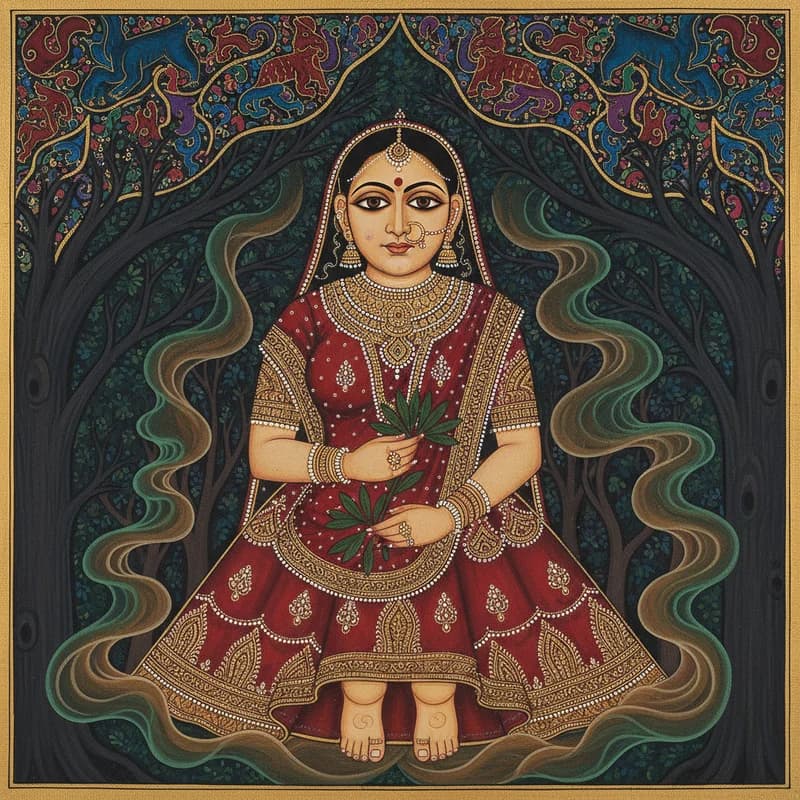
Near the banyan groves that line the tank-edges of old Malwa towns — those groves where the aerial roots have thickened into walls over centuries — the Yakshini appears as a middle-aged woman selling marigolds and loose tobacco from a cloth spread on the ground, the kind of vendor so common at temple approaches that the eye slides past her without registering. She is there at the hour when the last evening puja ends and the priests have locked the sanctum. The tells are these: the marigolds on her cloth do not wilt, not even in the dry weeks before the monsoon breaks over the Vindhyas when cut flowers last minutes in the heat, and the coins she accepts disappear into her sari folds without producing any sound of metal against metal.
First Documented
Yakshini figures appear in the Atharva Veda among catalogues of nocturnal spirits, and by the time of the Yaksha hymns in the Rigveda's later strata, the feminine form was already distinct. The Pali Petavatthu and early Jain Agamic texts solidify her as an independent supernatural category, centuries before the Tantric sadhana manuals codified her ritual binding.
Last Recorded
Accounts of Yakshini encounters persist into the present day, with practitioners in the Nath and Shakta traditions of Rajasthan and the Vindhya foothills still reporting ritual contact as recently as the early 2000s; ethnographers working along the Chambal valley have documented active sadhanas conducted to invoke or bind these spirits.
Source Language
Sanskrit
Origin
The Yakshini enters the textual record in the Atharvaveda's lists of nocturnal beings requiring appeasement, later systematized in the Yajnavalkya Smriti and the Tantric compendium Mantra Mahodadhi, which dedicates substantial space to the ritual protocols for binding individual Yakshinis by name — Padmini, Natini, Vighnantaka — each requiring specific offerings at specific tithis. The oral tradition of the Narmada valley and the forests of Bastar, however, holds a distinction the written manuals elide: the Yakshini in those accounts is not captured but negotiated with, and she retains the capacity to refuse. Where the Mantra Mahodadhi treats her as an entity whose will can be overridden through correct procedure, the adivasi tradition of Chhattisgarh insists the practitioner who approaches without genuine reciprocity receives not service but slow ruin — wealth that arrives and dissolves, knowledge that distorts in transmission. That divergence is not trivial. It marks a fault line between a textual
Frequently Asked
A Yakshini (यक्षिणी) is a female supernatural being appearing across Hindu, Buddhist, and Jain traditions — guardian spirits associated with forests, water bodies, and hidden wealth. Described in texts like the Vishnu Purana and carved into the toranas of Sanchi, they are depicted as voluptuous, tree-dwelling figures whose touch could cause trees to flower. Their nature shifts between benevolent guardian and dangerous seductress depending on the tradition and the region.
Yakshinis are credited with control over natural abundance — the fertility of the earth, the flow of rivers like the Narmada, and the growth of forest groves in regions like the Vindhya hills. In Tantric literature, particularly the Uddamareshvara Tantra, specific Yakshinis are said to grant wealth, occult knowledge, flight, and the ability to locate buried treasure. Some accounts collected in tribal communities of Chhattisgarh describe them as capable of causing illness or madness in those who disturb their trees.
Apsaras are celestial dancers bound to the courts of Indra and the heavens, their stories largely confined to the sky and the Mahabharata's divine episodes. Yakshinis, by contrast, are earth-bound spirits — rooted in specific trees, riverbanks, and crossroads, particularly in the forests of central and western India. The distinction matters: an Apsara descends from above, while a Yakshini rises from the soil beneath your feet.
The answer depends entirely on context and conduct. Yakshinis are classified under 'caution' in folk traditions because their disposition toward humans is conditional — they protect those who honor them and harm those who transgress their space, particularly lone travelers on forest roads after dusk. In the oral accounts gathered near the Betwa river in Madhya Pradesh, a Yakshini is neither demon nor deity but something closer to a landlord: indifferent until provoked.
In Tantric practice, Yakshinis occupy a unique position as spirits that can be ritually bound to a practitioner through specific sadhanas outlined in texts like the Uddamareshvara Tantra and the Mantra Maharnava. A successfully invoked Yakshini was believed to appear before the practitioner and offer services — wealth, hidden knowledge, companionship, or supernatural protection. The rituals typically required isolation, often in cremation grounds or beneath specific trees like the kadamba, and carried serious warnings about the consequences of incomplete or impure practice.
Yakshinis appear in the Vishnu Purana, the Mahabharata, and various Jain Agamas, where they are listed as attendant spirits to the Tirthankaras. The most detailed Tantric catalogues of Yakshinis — naming up to 36 distinct types with individual appearances, offerings, and powers — are found in the Uddamareshvara Tantra and the Tantrasara. Their carved forms on the eastern gateway of the Sanchi Stupa, dating to the 1st century BCE, suggest their worship predates the textual record considerably.
In rural accounts from the forests of Jharkhand and the ghats of the Narmada valley, a Yakshini is most often recognized by her association with a specific tree — the ashoka, kadamba, or banyan — and by the reversal of her feet, which point backward, a marker shared with several other Indian forest spirits. She is frequently described as extraordinarily beautiful, encountered alone at dusk or near water, and identifiable by the absence of a shadow. Villagers in the Bastar region distinguish her from ordinary spirits by the faint smell of flowers in places where no flowers grow.
Yakshinis are among the few supernatural beings shared across all three traditions with relatively consistent characteristics. In Jain cosmology, specific Yakshinis serve as Shasan Devis — protective goddesses assigned to each of the 24 Tirthankaras, with Chakreshvari attending Rishabhanatha and Padmavati attending Parshvanatha. Buddhist art at Bharhut and Sanchi depicts them as auspicious tree spirits, their imagery absorbed into the visual language of early Indian sacred architecture long before the doctrinal boundaries between these traditions hardened.
Algorithmic Inference
आपको यह भी पसंद आ सकता है
You May Also Like
Community Discussion
Comments are reviewed by AI before appearing publicly. Unsafe, unrelated, or uncertain comments go to human review.
Sign in to join the discussion.
0 comments
No public comments yet.