प्रतीक्षा करें
Parsing the Naga lineage records…
प्रतीक्षा करें
Parsing the Naga lineage records…

Olai Chuvadi
In the villages along the Kaveri delta and in the older quarters of Kumbakonam, people speak of manuscripts that appear where none should be — tucked into the rafters of a house after a monsoon, found pressed between stones at the base of a Nandi figure, surfacing in a dried-up irrigation channel after the Panguni harvest. The writing on these palm-leaf strips is in an archaic Tamil script, dense and unhurried, and it concerns the person who finds it. Not the village, not the dynasty, not the cosmos. That specific person, their debts and their deaths, the names of those they will outlive and those who will outlive them.
The Olai Chuvadi does not announce itself. It waits to be found, which is a different kind of patience entirely. Scholars of the Nadi tradition at the Vaitheeswaran Koil near Sirkazhi will tell you that palm-leaf prophecy is a science, a thing of calculation and lineage. What the rural accounts describe is something older and less orderly — a presence that attaches itself to a text and ensures the text reaches the right hands at the wrong moment. A woman in Thanjavur once described finding a manuscript in her dead husband's locked almirah, written in a hand neither of them had ever seen, detailing the precise manner of her own eventual death. She could not read it fully. She said the letters rearranged themselves when she tried. The Olai Chuvadi does not threaten; it informs, which in the folklore of the Cauvery plains is understood to be more dangerous.
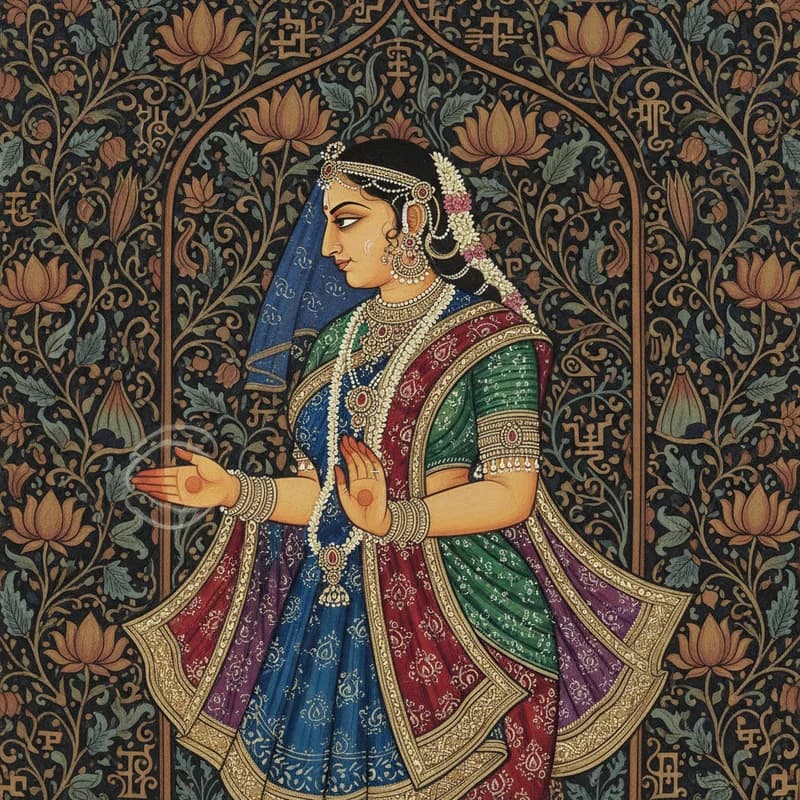
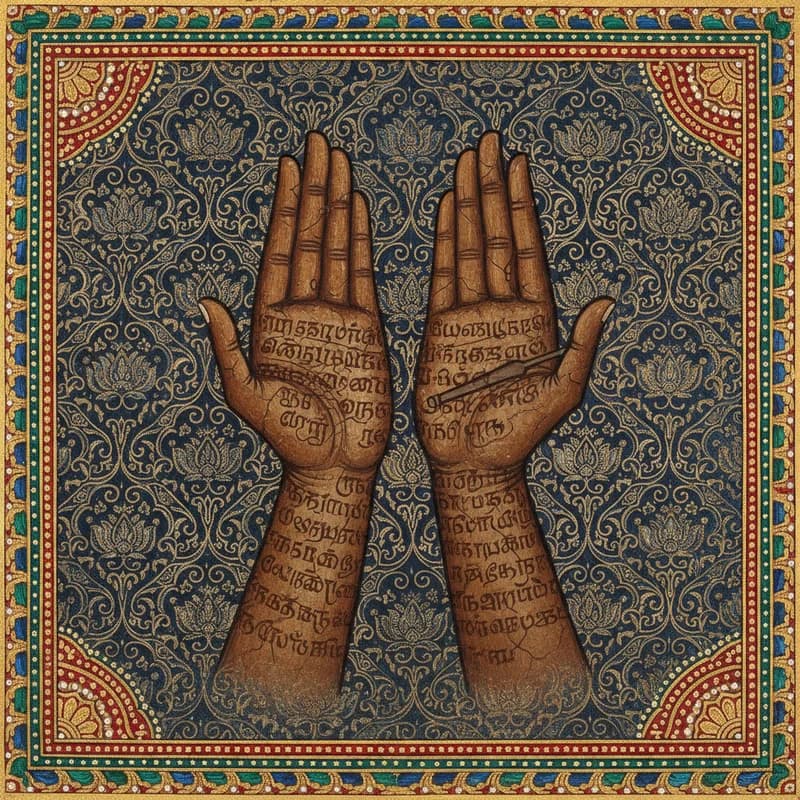
The Olai Chuvadi does not appear as a body. Witnesses across the Kaveri delta and the dry interior towns near Madurai describe only a pair of hands — dark, long-fingered, the skin the particular brown of aged palm leaf, as though the entity and its medium have been curing together for decades in the same dry heat. The hands are always in motion, the fingers moving across an unseen surface in the rhythm of someone reading aloud to themselves, lips present but not visible. What marks these accounts as consistent is the smell: old coir and the faint iron of the iron stylus, the specific dustiness of a manuscript room in a Thanjavur temple library during the summer months before the northeast monsoon arrives and the air shifts. The single feature no witness can explain away is this — the palms of those hands, when glimpsed fully, carry script. Not fixed letters, but moving ones, rearranging as the fate they record is still being decided.
The Olai Chuvadi does not take a body. What it takes, instead, is the form of a forgotten bundle of palm-leaf manuscripts — the kind left by a traveling astrologer, tied with a strip of undyed cotton and smelling of turmeric and sesame oil, exactly as the genuine nādi manuscripts kept at Vaitheeswaran Koil are stored and handled. The bundle appears in ordinary places: on the step of a house at dawn, wedged into the fork of a margosa tree, half-visible beneath the sacks in a rice merchant's godown. The first tell is the cord — it is always dry, even in the wet months before Karthigai, when everything along the Kaveri delta holds moisture. The second is the script itself: a sharp-eyed reader will notice the letters are not grantha or Tamil grantha as expected, but shift, mid-leaf, into the reader's own handwriting.
First Documented
Olai Chuvadi's earliest traceable presence lies in the Nadi astrology traditions of Tamil Nadu, where palm-leaf manuscripts attributed to sages like Agastya and Bhrigu were consulted at temple towns such as Vaitheeswaran Koil near the Kaveri delta — a practice documented in colonial-era ethnographic records and still alive in oral accounts collected across Thanjavur district.
Last Recorded
Accounts of Olai Chuvadi persist into the present, with the most recent documented sightings reported from the Vaitheeswaran Koil corridor in the Cauvery delta, where nadi astrologers continue to receive clients who claim their leaf-bundles appeared unbidden — slipped beneath doors or found among stored grain — as recently as 2019.
Source Language
Tamil
Origin
The Olai Chuvadi enters the documented record through the Nadi Shastra tradition, a corpus of predictive palm-leaf manuscripts attributed to the sage Agastya and preserved in the custody of hereditary readers concentrated around Vaitheeswaran Koil in the Nagapattinam district, with secondary collections along the Kaveri delta and in certain private holdings in Kumbakonam. The texts themselves claim absolute antiquity — Agastya writing the fate of every soul before that soul existed — but the oral tradition of the Kongu Nadu interior tells it differently. In those accounts, the Olai Chuvadi is not a stored archive but an active presence, a spirit that selects its seeker rather than the reverse, placing a leaf where it will be found: in a cracked wall, beneath a vendor's cloth, inside a borrowed book. Where the Vaitheeswaran Koil tradition frames the encounter as a retrieval — you come, you search, a reader locates your bundle — the folk account insists on unsolicited arrival, the manuscript appearing before the question is formed. That divergence is precise in its im
Frequently Asked
Olai Chuvadi (ஓலைச் சுவடி) is a Tamil oracle spirit believed to communicate human fate through palm-leaf manuscripts that appear in unexpected locations. The name itself translates literally to 'palm-leaf manuscript' in Tamil, pointing to the inseparability of the spirit from its medium. Oral accounts collected across Tamil Nadu describe these leaves as arriving unbidden — tucked beneath a threshold, found near a temple tank, or surfacing after monsoon floods recede from the Kaveri delta.
The spirit communicates exclusively through inscribed palm-leaf manuscripts rather than through possession, apparition, or auditory signs — a distinction that sets it apart from most oracular entities in South Indian folklore. Villagers near Kumbakonam and Thanjavur describe finding leaves already etched with Tamil script, sometimes in archaic Grantha-influenced letterforms that contemporary readers struggle to parse. The prophecies are understood to be personal, addressing the finder's fate rather than collective or civic destiny.
The spirit carries a designation of caution rather than outright malevolence — its threat lies not in harm but in the weight of what it reveals. Receiving an Olai Chuvadi manuscript is considered neither a blessing nor a curse; the danger is in the knowledge itself, particularly if the prophecy foretells irreversible loss. Certain oral traditions from the Chettinad region advise against reading a found palm-leaf aloud before sunrise, lest the fate described accelerate.
Nadi astrology, practiced at shrines like the Vaitheeswaran Koil near Sirkazhi, uses physical palm-leaf bundles attributed to ancient sages such as Agastya or Bhrigu — a human-mediated system of divination with traceable manuscript lineages. Olai Chuvadi as a spirit entity belongs to a separate folk tradition in which no human intermediary exists; the manuscript appears without a reader, a library, or a known author. The confusion between the two is common, but the spirit tradition predates and operates outside the institutionalized Nadi system.
Accounts cluster most densely in the Kaveri delta districts of Tamil Nadu — Thanjavur, Tiruvarur, and Nagapattinam — where palm cultivation historically made the leaf a ubiquitous material of daily life and sacred record. The spirit is also documented in oral traditions from the Nilgiris foothills, where Toda and Tamil-speaking communities share overlapping beliefs about inscribed objects carrying autonomous will. Outside Tamil Nadu, analogous spirits appear in Kerala folklore, though the specific form of the palm-leaf manuscript as oracle medium remains distinctively Tamil.
No canonical Sangam text names the spirit directly, though the Purananuru and Akananuru contain scattered references to inscribed leaves as carriers of fate and secret knowledge. The spirit's clearest textual shadows appear in later Siddha literature, particularly in verses attributed to Thirumoolar, where the palm leaf is described as a body in which time writes without being asked. Most of what is known about Olai Chuvadi as a distinct spirit entity comes from oral transmission rather than written scripture.
Traditional accounts describe several markers: the leaf appears dry even after rain, the script shows no ink residue or stylus scoring visible to the naked eye, and the text concerns only the person who finds it — never a third party. Folklore collected near the Brihadeeswarar temple in Thanjavur adds that an authentic manuscript carries a faint smell of neem oil and camphor even when no such substances are present. Attempting to copy or transcribe the text is widely said to render the prophecy void.
Tamil folk practice, as documented in accounts from villages along the Kollidam river, advises placing the found leaf before a household deity or at the nearest Amman shrine before reading it, allowing the goddess to mediate the knowledge. Reading the manuscript alone, particularly at dusk or during the Tamil month of Aadi when spirit activity is considered heightened, is strongly discouraged by elder informants. The leaf is typically not destroyed but buried at the base of a peepal tree once its message has been received and acknowledged.
संबंधित लोकगाथाएं
Related Lore
Algorithmic Inference
आपको यह भी पसंद आ सकता है
You May Also Like
Community Discussion
Comments are reviewed by AI before appearing publicly. Unsafe, unrelated, or uncertain comments go to human review.
Sign in to join the discussion.
0 comments
No public comments yet.